

Bottom Line: A 720 credit score is achievable 12–24 months after bankruptcy discharge. At Sacks & Sacks, every bankruptcy client receives our 7 Steps to a 720 Credit Score program (a $1,000 value) at no cost. Call (904) 396-5557 for a free consultation.
Melanie Sacks, Jacksonville bankruptcy attorney, FL Bar #158070, 27+ years of experience, 6,354+ cases filed. Martindale-Hubbell BV Distinguished.
Key Takeaways
- About 63% of bankruptcy filers have a credit score of 640 or higher two years after discharge (LendingTree).
- The average filer’s score rises 69 points in the first month, from 533 to 602, as bankruptcy clears the debt weighing it down (LendingTree, 2024).
- Without active rebuilding, that same score slides to 566 after five years, so a structured plan is what carries you to 720.
Can You Really Reach a 720 Credit Score After Bankruptcy?
Yes, and the data backs it up. FICO defines a “good” credit score as 670–739, and a 720 puts you squarely in that range (Experian). The average American’s FICO score is 715 as of 2025 (FICO), so a 720 after bankruptcy would put you above the national average.
Research from LendingTree shows that 63% of filers reach 640 or higher two years after discharge. With structured credit rebuilding through a program like our 7 Steps to a 720, that 720 target is realistic for most Jacksonville bankruptcy clients.
At the Law Offices of Sacks & Sacks, P.A., we have helped Jacksonville families rebuild their financial lives for decades. Our 7 Steps to a 720 Credit Score program gives every bankruptcy client a proven, step-by-step roadmap, included free with your case.
Why Jacksonville Residents Are Filing for Bankruptcy
Florida saw 40,679 bankruptcy filings in the 12-month period ending June 2025, up from 32,933 the year before, a 23.5% increase (Florida Trend).
The Middle District of Florida, which includes Jacksonville, was the nation’s third-busiest bankruptcy court for consumer filings in 2024, recording 19,915 nonbusiness cases, behind only the Central District of California and the Northern District of Illinois (Congressional Research Service).
Jacksonville’s division alone recorded 4,007 filings in 2024, a 21% increase from the prior year (FLMB statistics). Rising costs of living, medical debt, credit card delinquency rates climbing to 14.1%, and post-pandemic financial strain are driving these numbers higher across the state.
Nationally, 529,080 bankruptcy cases were filed in the 12-month period ending March 2025, a 13.1% jump over the previous year (U.S. Courts). For many of these filers, the decision to file is the first step toward rebuilding their credit and their financial future.
If you are considering bankruptcy in Jacksonville, know this: filing is not the end. It is the beginning of a financial fresh start, and rebuilding your credit is the first step.
Every Sacks & Sacks Bankruptcy Client Gets Our 720 Credit Score Program FREE
A $1,000 credit education program, included at no cost with your bankruptcy case.
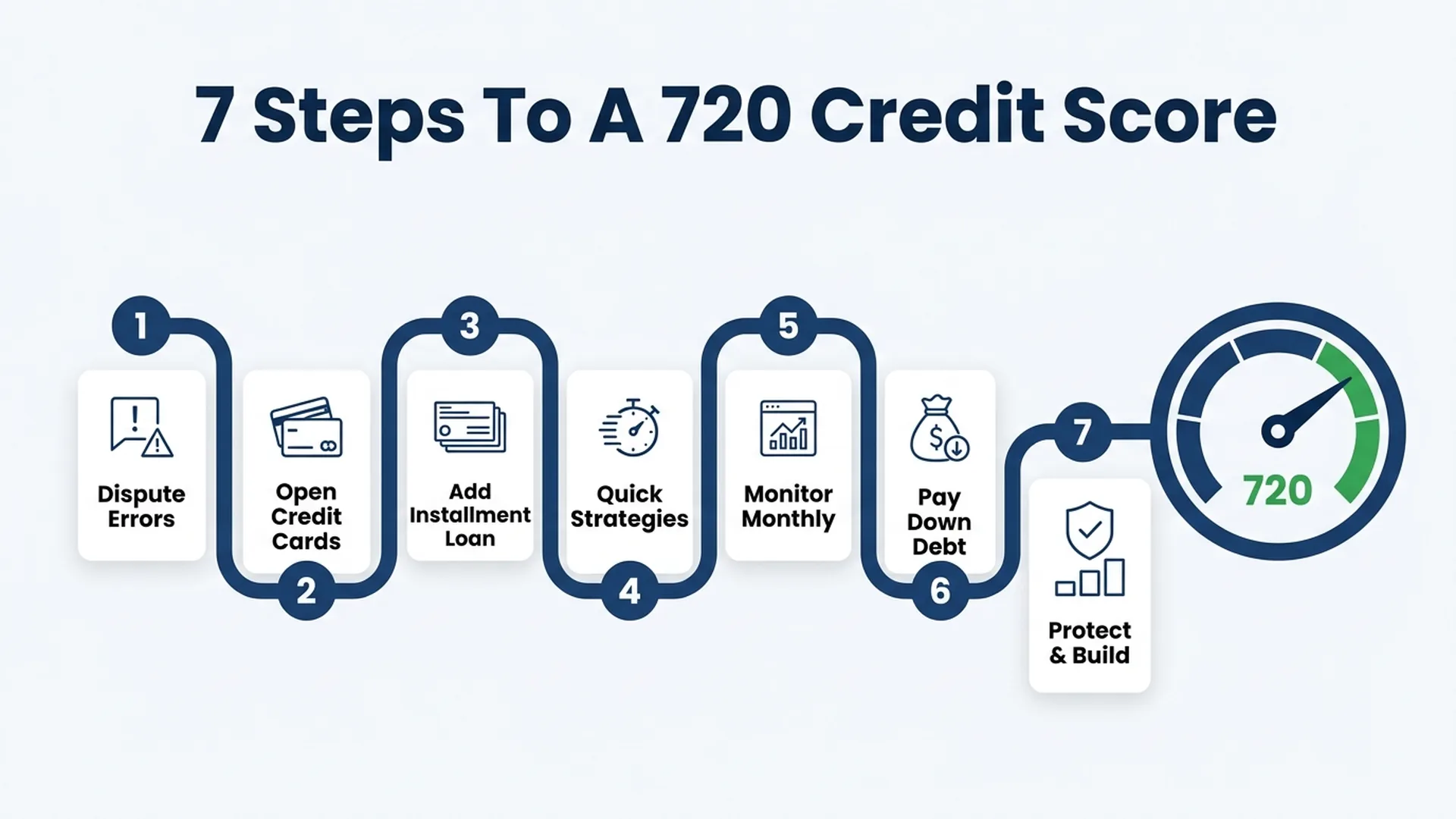
The 7 Steps to a 720 Credit Score After Bankruptcy
Each step below targets a specific piece of your FICO score, from payment history (35% of the calculation) to credit mix (10%). Followed in order, they move most clients from a post-discharge score in the low 600s to a 720 within 12–24 months.
Step 1: Dispute Credit Report Errors Immediately
Your first move after discharge is to pull your credit reports from all three bureaus, Equifax, Experian, and TransUnion, through AnnualCreditReport.com (free). Errors are common: a landmark FTC study found that one in five consumers had an error corrected on at least one of their three credit reports after disputing it.
After bankruptcy, you want to confirm that:
- All discharged debts show a $0 balance
- No discharged accounts are listed as “open” or “past due”
- The same debt is not listed twice under different creditor names
- Your bankruptcy discharge date is accurately recorded
If you find errors, dispute them in writing with each credit bureau. Under the Fair Credit Reporting Act (FCRA), bureaus must investigate within 30 days and either correct or verify the entry. Removing inaccurate negative marks can boost your score immediately.
Step 2: Open the Right Credit Cards
Amounts owed make up 30% of your FICO score, so how you handle credit cards matters (myFICO). The key is using them strategically:
- Start with a secured credit card. You deposit $200–$500 as collateral. Your spending limit equals your deposit, so the risk is low. Make small purchases (under 30% of your limit) and pay the full balance monthly.
- Graduate to an unsecured card after 6–12 months of on-time payments. Many secured card issuers upgrade you automatically.
- Keep utilization below 30%. If your limit is $500, keep your balance under $150 at all times. Lower utilization signals responsible credit use to scoring models.
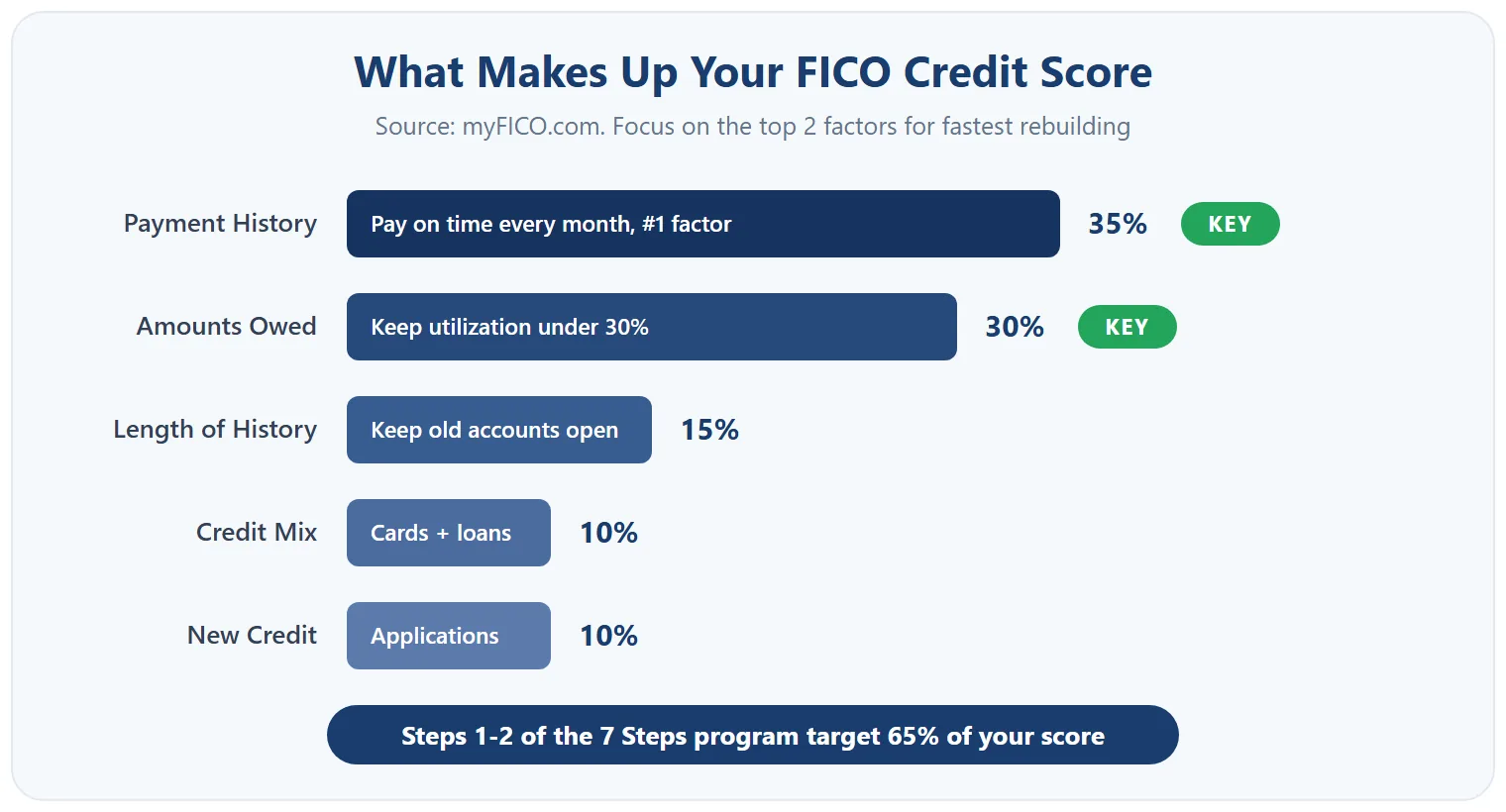
Paying your credit cards on time every month is the single most important factor. Payment history makes up 35% of your FICO score (Bankrate).
Step 3: Add an Installment Loan to Your Credit Mix
FICO rewards a healthy mix of credit types: revolving (credit cards) and installment (loans with fixed monthly payments). Credit mix accounts for 10% of your score (myFICO).
A credit-builder loan is designed for exactly this. Unlike a traditional loan, the lender holds the funds in a restricted account while you make monthly payments. Once it’s paid off, you receive the money, and you’ve built a track record of on-time installment payments.
Credit unions in Jacksonville often offer credit-builder loans with low fees. Typical amounts are $500–$1,500 with 12–24 month terms. Every on-time payment is reported to the credit bureaus, steadily raising your score.
Step 4: Use Quick Credit Strategies for an Early Boost
Several tactics can accelerate your credit rebuilding in the first few months after discharge:
- Become an authorized user. Ask a trusted family member with a long, clean credit history to add you as an authorized user on their credit card. Their positive payment history gets reported on your credit report, too. You don’t even need to use the card. Just having your name on the account helps.
- Get a co-signer for a small loan. A co-signer with good credit improves your approval odds and may qualify you for a lower interest rate. A small auto loan or personal loan with on-time payments builds your credit file.
- Report rent and utility payments. Services like Experian Boost let you add rent, utility, and streaming payments to your credit report, giving you credit for bills you already pay on time.
Step 5: Monitor Your Credit Reports and Scores Monthly
Rebuilding credit is a process, and tracking your progress keeps you on course. The LendingTree study found that without active monitoring, consumers’ average scores dropped from 602 one month after filing to 571 within one to two years, and all the way to 566 after five years (LendingTree, 2024).
That backslide is preventable. Here is what to watch:
- Credit score changes: free through your bank, credit card issuer, or Credit Karma
- New inquiries: each hard inquiry can temporarily lower your score by 5–10 points
- Utilization ratio: aim to stay under 30%, and ideally under 10%
- Payment history accuracy: make sure every on-time payment is correctly reported
A 720 credit score is classified as “good” by FICO (670–739) and “prime” by VantageScore. At this level, you qualify for competitive interest rates on mortgages, auto loans, and credit cards, saving thousands of dollars over the life of a loan.
Step 6: Pay Down Your Highest-Interest Debt First
If you have any remaining balances after bankruptcy, such as non-dischargeable debts like student loans or tax obligations, prioritize paying down the highest-interest balance first. This is known as the avalanche method, and it saves the most money over time.
For credit card balances specifically:
- Pay more than the minimum every month
- Target the card with the highest APR first while making minimum payments on others
- Once the highest-interest card is paid off, roll that payment into the next card
Reducing your overall credit utilization from high (50%+) to low (under 30%) can produce a noticeable score improvement within one to two billing cycles.
Step 7: Protect Your Credit and Keep Building
Once you reach a 720 credit score, maintaining it takes consistency. A LendingTree analysis found that more than five years after bankruptcy, the average consumer’s score dropped to 566, with average credit card balances climbing to $5,908 and utilization hitting 49.9%. The consumers who avoided this pattern were the ones who kept disciplined habits.
To protect your rebuilt credit:
- Never miss a payment. Set up autopay for at least the minimum due on every account.
- Keep old accounts open. Length of credit history accounts for 15% of your FICO score. Even if you don’t use a card, keeping it open helps.
- Limit new credit applications. Only apply for credit you need. Each application triggers a hard inquiry.
- Review your reports annually. Errors can reappear. Stay vigilant.
Major life changes can put your progress at risk, too. If you go through a divorce or separation while rebuilding, take extra care to protect your credit score during separation by keeping joint accounts current and watching for missed payments on shared debt.
What Happens to Your Credit Score During Bankruptcy?
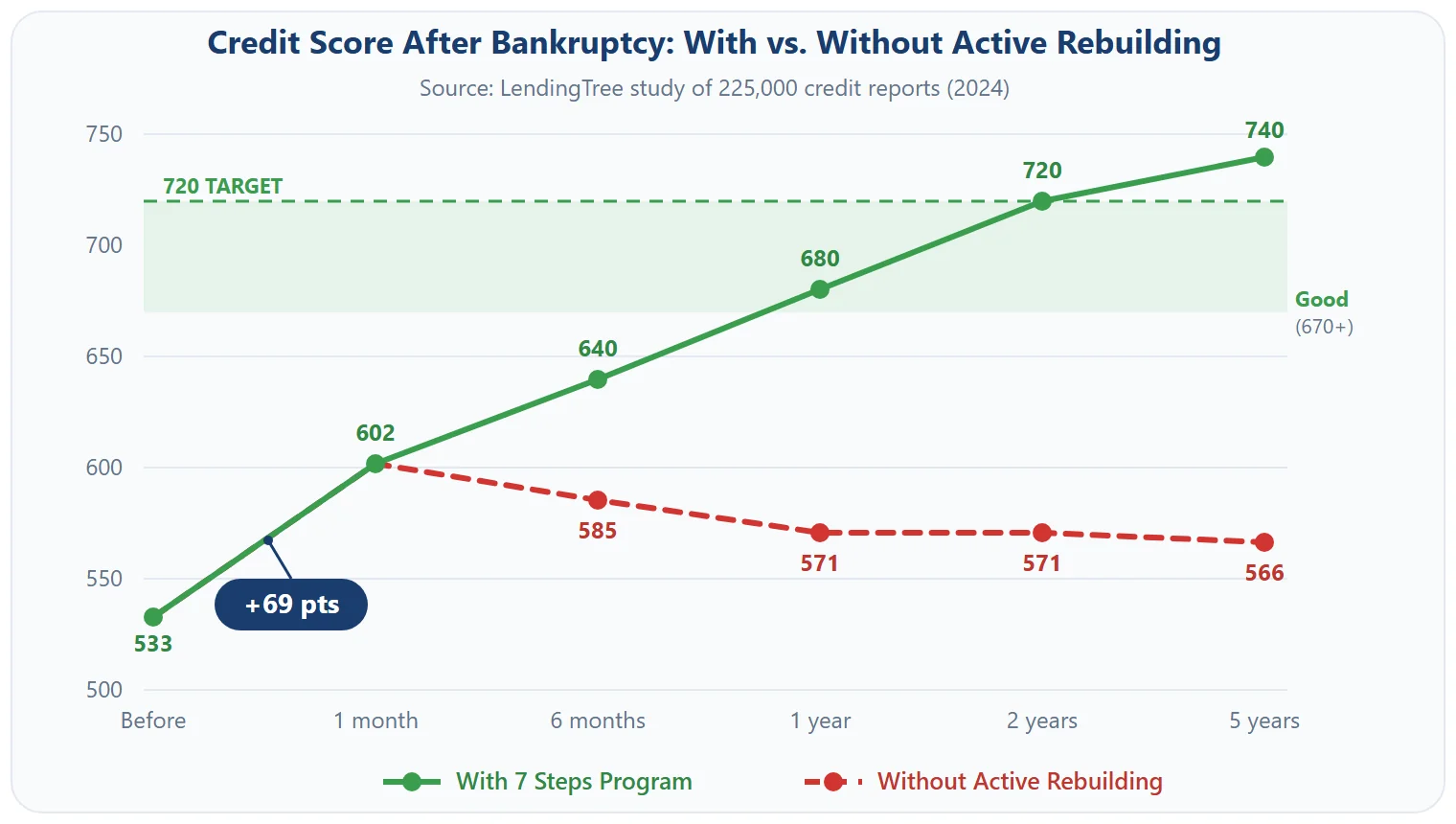
Filing for bankruptcy typically drops your credit score by up to 200 points (Experian), but that figure is misleading. Most people considering bankruptcy already have severely damaged credit from missed payments, collections, and high utilization.
The LendingTree study of 225,000 credit reports revealed a surprising pattern. The average filer’s score actually increased 69 points, from 533 to 602, within the first month after filing.
Why the jump? Bankruptcy eliminates the debt dragging your score down. Average credit card balances dropped 87.5% (from $7,571 to $950), and utilization ratios fell from 53.1% to 14.9%. The slate is wiped clean, and that clean starting point is what makes reaching 720 realistic with structured rebuilding.
The timeline depends on which chapter you file:
- Chapter 7 bankruptcy stays on your credit report for 10 years but can be discharged in as little as 3–6 months. Most of our Jacksonville clients begin seeing meaningful credit improvement within 6–12 months.
- Chapter 13 bankruptcy stays on your credit report for 7 years and involves a 3–5 year repayment plan. Credit rebuilding begins during the plan as you demonstrate consistent payment history.
Why I Include the 720 Credit Score Program Free
Most credit rebuilding programs charge around $1,000 for enrollment, and many lack the legal context that bankruptcy filers actually need.
I developed the 7 Steps to a 720 Credit Score program after 27+ years of practice (FL Bar #158070) because I saw too many clients walk out of my office with a discharge order and no plan for what comes next.
The LendingTree study found that without active rebuilding, the average filer’s score drops from 602 one month after filing to just 566 after five years. That decline is entirely preventable.
Getting out of debt is only half the journey. Rebuilding your financial life is the other half, and most attorneys ignore it entirely.
Every bankruptcy client at Sacks & Sacks receives the 7 Steps to a 720 Credit Score program at no additional cost. It includes step-by-step credit education, ongoing guidance, and a proven framework that has helped clients across Jacksonville qualify for mortgages, auto loans, and credit cards in the first year or two after discharge.
In 27 years and more than 6,354 cases, I’ve watched clients go from financial crisis to buying homes, financing cars, and opening businesses, all because they followed this program. That’s why I do this work.

Client Reviews: See What People Are Saying

Ready to Rebuild Your Credit After Bankruptcy?
Call me for a free consultation. I’ll review your situation and tell you exactly what bankruptcy can do for you, and how the 720 Credit Score program will help you rebuild. No judgment, no pressure.
Frequently Asked Questions
How long does it take to get a 720 credit score after bankruptcy?
With consistent effort and the right strategy, most people reach a 720 credit score within one to two years of their bankruptcy discharge. Research shows that 63% of bankruptcy filers reach 640 or higher two years after discharge (LendingTree). Our 7 Steps program helps clients accelerate that timeline with a structured, guided approach.
Does filing for bankruptcy destroy your credit forever?
No. While Chapter 7 bankruptcy stays on your credit report for 10 years and Chapter 13 for 7 years, the impact on your score decreases significantly over time. A LendingTree study found that the average filer’s score increased 69 points within the first month of filing (LendingTree, 2024).
Many of our clients qualify for competitive mortgage rates within a few years of discharge, once they have rebuilt their credit.
Can I get a mortgage after filing bankruptcy in Florida?
Yes, many people do. The waiting period is set by each loan program (FHA, VA, USDA, or conventional) and depends on the specifics of your case: which chapter you filed, whether the case was discharged or dismissed, your re-established credit history, whether the loan is manually underwritten, and whether you can document extenuating circumstances beyond your control.
These program guidelines are updated periodically, so confirm the current waiting period for your situation directly with a lender or your attorney. Reaching a 720 credit score before you apply positions you for the best available interest rates.
What credit score do most people have after filing bankruptcy?
According to the LendingTree study, the average credit score one month after bankruptcy is 602. Without active rebuilding, scores tend to decline, dropping to an average of 571 within one to two years and 566 after five years. A structured program reverses this pattern and pushes scores higher.
Is the 7 Steps to a 720 Credit Score program really free at Sacks & Sacks?
Yes. The program typically costs $1,000, but every bankruptcy client at the Law Offices of Sacks & Sacks, P.A. receives enrollment at no additional charge. We include it because a true fresh start means more than debt relief. It means a clear path to rebuilding your financial future.
Should I file Chapter 7 or Chapter 13 bankruptcy in Jacksonville?
It depends on your income, assets, and debts. Chapter 7 (liquidation) eliminates most unsecured debts in 3–6 months and is best for those who pass Florida’s means test.
Chapter 13 (reorganization) creates a 3–5 year repayment plan and is often better for homeowners facing foreclosure. Our Jacksonville bankruptcy attorneys can evaluate your situation during a free consultation and recommend the best option.
How many people file for bankruptcy in Florida each year?
Florida had 40,679 bankruptcy filings in the 12-month period ending June 2025, a 23.5% increase over the prior year (Florida Trend). The Middle District of Florida, which includes Jacksonville, ranked as the nation’s third-busiest bankruptcy court for consumer filings in 2024. You are not alone, and filing is often the smartest financial decision you can make.
Sources
- LendingTree. “The Real Cost of Bankruptcy Lies Within Interest Rates” March 2020. lendingtree.com
- Experian. “What Is a Good Credit Score?” 2025. experian.com
- FICO. “Average U.S. FICO Score Drops to 715.” 2025. fico.com
- LendingTree. “The Real Cost of Bankruptcy Lies Within Interest Rates.” 2024. lendingtree.com
- U.S. Courts. “Bankruptcies Rise 13.1 Percent Over Previous Year.” May 2025. uscourts.gov
- Florida Trend. “Bankruptcy Filings Jump in Florida.” August 2025. floridatrend.com
- Congressional Research Service. “United States Bankruptcy Courts: Overview and Analysis of Bankruptcy Filings in 2024.” 2025. congress.gov
- U.S. Bankruptcy Court, Middle District of Florida. “Facts & Statistics.” flmb.uscourts.gov
- Shotlaw. “How to Rebuild Your Credit After Filing for Bankruptcy.” June 2025. shotlaw.com
- Experian. “How Does Filing Bankruptcy Affect Your Credit?” experian.com
- myFICO. “What’s in Your Credit Score.” myfico.com
- Federal Trade Commission. “In FTC Study, Five Percent of Consumers Had Errors on Their Credit Reports.” February 2013. ftc.gov
Serving Jacksonville, Orange Park, St. Augustine, Fernandina Beach, and all of Northeast Florida. Virtual consultations available, no office visit required.
This article is for general informational purposes only and is not legal or financial advice. Bankruptcy and lending rules change and depend on your specific circumstances. Consult a licensed attorney about your situation.