
Bottom Line: Florida courts can issue emergency protective orders (including temporary custody, domestic violence injunctions, and asset freezes) as fast as the same day you file. [1]
Duval County saw 6,546 injunctions for violence filed in 2023 alone. [2] If you or your children are in danger, don’t wait. Led by Adam Sacks: 25+ years of family law experience, former state prosecutor, Florida Supreme Court Certified Mediator.
Emergency? Call (904) 396-5557 now. Adam Sacks handles emergency motions for Jacksonville families.
What Is an Emergency Motion in Florida Family Law?
An emergency motion is a formal request for immediate court intervention filed when a family member or child faces imminent harm that cannot wait for normal court scheduling, which may take weeks or months to reach a hearing date.
Unlike standard family law motions that follow regular docket procedures, emergency motions filed under Fla. Fam. L. R. P. 12.610 and related statutes are forwarded directly to the assigned judge’s chambers for same-day review and can result in temporary protective orders within hours of filing. [1]
In Jacksonville’s Fourth Judicial Circuit, emergency motions are used to obtain domestic violence injunctions under F.S. § 741.30, emergency temporary custody orders when a child is at risk of harm or removal from the state, asset freezes to prevent a spouse from dissipating marital property, and temporary support orders during pending divorce or custody proceedings.
Attorney Adam Sacks, a former state prosecutor with 25+ years of experience, handles same-day emergency filings for Jacksonville families in crisis.
Florida family courts recognize that some situations cannot wait weeks or months for a scheduled hearing. When a child is in danger, a spouse is dissipating marital assets, or domestic violence threatens someone’s safety, the court has the authority to act immediately through ex parte orders, meaning the judge can issue temporary relief without the other party being present.
In the Fourth Judicial Circuit (Jacksonville/Duval County), emergency motions are forwarded directly to the assigned judge’s chambers for prompt review. The judge determines whether a “genuine crisis directly affecting the welfare of a party or a child” exists and decides whether to grant temporary relief. [3]
Types of Emergency Relief Available in Jacksonville
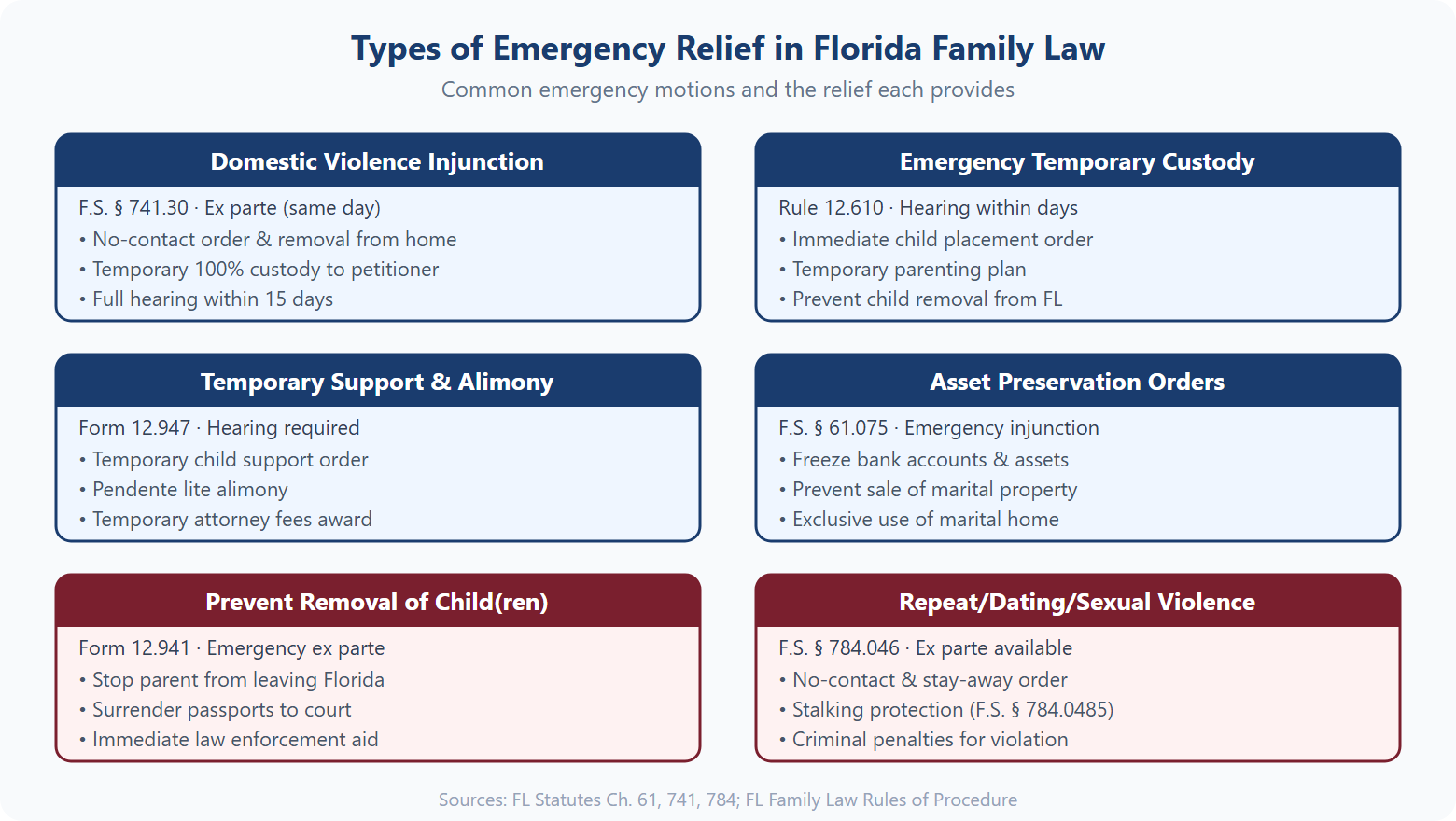
Florida family law provides several distinct categories of emergency relief, each governed by specific statutes, procedural rules, and evidentiary standards that determine how quickly the court can act and what protections are available. In Jacksonville’s Fourth Judicial Circuit, the most commonly filed emergency motions involve domestic violence injunctions under F.S. § 741.30, emergency temporary custody orders under Fla. Fam. L. R. P. 12.610, motions to prevent a child’s removal from Florida, requests for temporary financial support during pending divorce or custody cases, and asset preservation injunctions to stop a spouse from emptying bank accounts or transferring marital property. [1] [3]
Duval County alone saw 6,546 injunctions for violence filed in 2023, underscoring how frequently Jacksonville families need emergency court intervention. [2] Understanding which type of emergency relief applies to your situation is the first step toward obtaining protection. Here are the primary categories available under Florida law:
1. Domestic Violence Injunction (F.S. § 741.30)
If you face an “immediate and present danger” of domestic violence, the court can issue a temporary injunction ex parte (meaning the same day you file, without your abuser present). [1] This is the fastest form of emergency relief available. The temporary injunction can include:
- A no-contact order prohibiting the respondent from any communication
- Removal of the respondent from the shared residence
- Temporary 100% custody of minor children awarded to the petitioner
- Exclusive possession of the marital home and vehicles
- Temporary possession and protection of pets
- A directive for the respondent to surrender firearms
The temporary injunction lasts up to 15 days, during which the court schedules a full evidentiary hearing where both parties can present evidence. [1] For more details, see our restraining orders page.
2. Emergency Temporary Custody Orders
When a child faces risk of physical, mental, or emotional harm, or when a parent threatens to remove a child from Florida, the court can issue an emergency temporary custody order. This motion is governed by Florida Family Law Rule 12.610 and the court’s inherent authority to protect minors. [3]
Grounds for emergency temporary custody include:
- Physical abuse or neglect of a child
- Substance abuse by a parent that endangers the child
- Threat of parental kidnapping or removal from Florida
- Exposure to domestic violence in the household
- Mental health crisis affecting the custodial parent
- Unsafe or unstable living conditions
3. Prevention of Child Removal from Florida (Form 12.941)
If you believe your spouse or co-parent is about to flee the state with your child, you can file an emergency motion to prevent removal. The court can order the surrender of passports, prohibit travel beyond county or state lines, and direct law enforcement to enforce the order immediately. [4]
4. Temporary Support and Financial Relief (Form 12.947)
During a pending divorce or custody case, either party can request temporary financial relief including:
- Temporary child support
- Pendente lite (temporary) alimony
- Temporary exclusive use of the marital home
- Temporary responsibility for debts and liabilities
- Temporary attorney fee awards to ensure equal access to legal representation
A financial affidavit (Form 12.902) must be served with the motion. [4]
5. Asset Preservation and Dissipation Prevention
If your spouse is emptying bank accounts, hiding assets, selling marital property, or running up debt, you can seek an emergency injunction under F.S. § 61.075 to freeze accounts, prevent asset transfers, and preserve the marital estate until equitable distribution is determined. [5]
How the Emergency Motion Process Works in Jacksonville
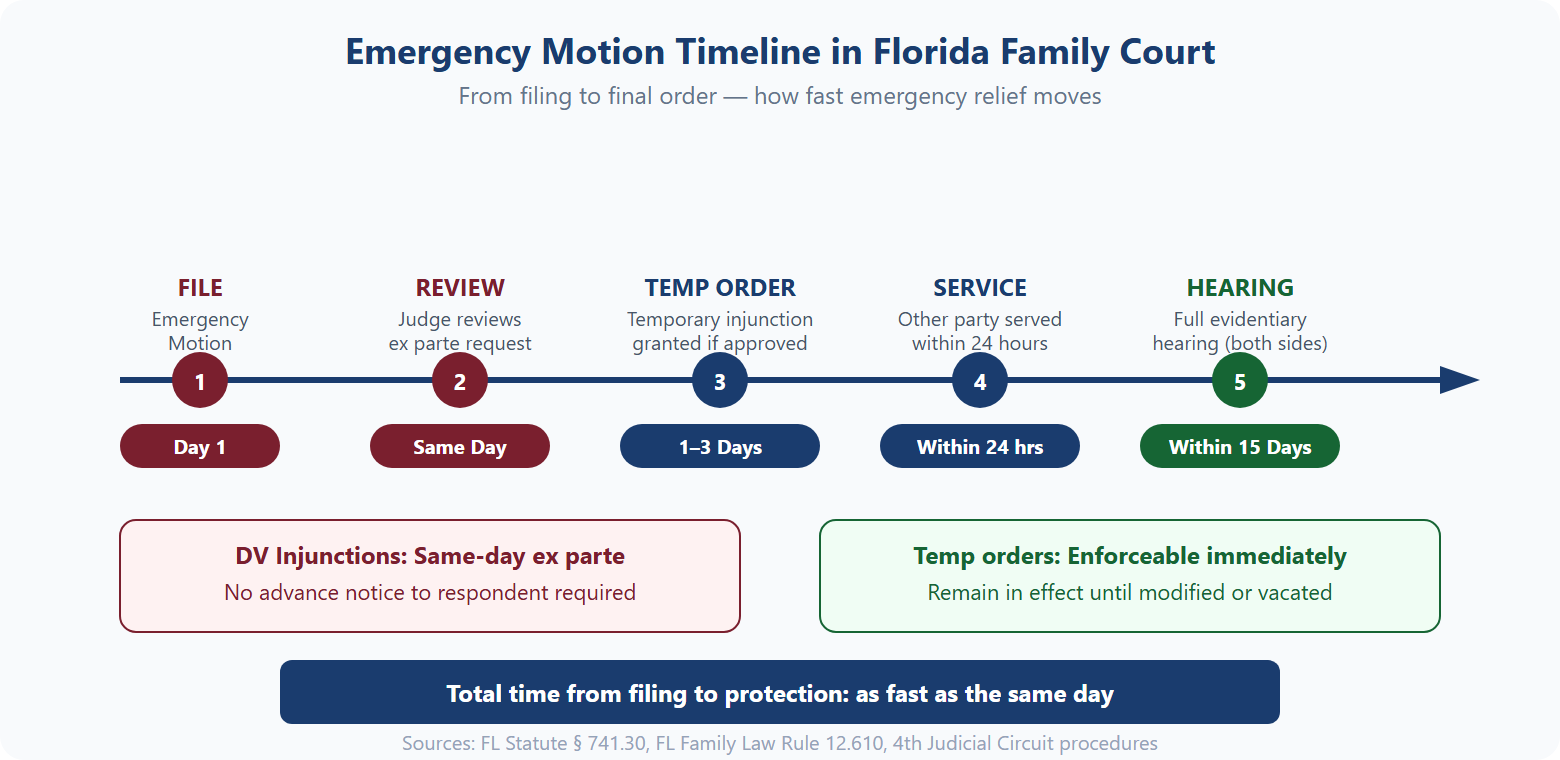
The emergency motion process in Florida moves dramatically faster than standard family court proceedings, with same-day judicial review and the possibility of ex parte temporary orders issued within hours of filing, before the other party even knows a motion has been submitted. [1]
In Jacksonville’s Fourth Judicial Circuit, emergency motions are forwarded directly from the Duval County Clerk of Courts to the assigned judge’s chambers, bypassing the normal docket scheduling process that can take weeks.
The process is governed by Fla. Fam. L. R. P. 12.610 for emergency relief in family cases and by F.S. § 741.30 for domestic violence injunctions, and it follows a structured five-step path from filing through the full evidentiary hearing where both parties present evidence and testimony. [3]
Understanding each step helps you prepare effectively and know exactly what to expect. Here is what happens:
Step 1: Filing the Emergency Motion
Your attorney prepares and files a verified emergency motion with the Duval County Clerk of Court. The motion must include specific facts demonstrating why immediate relief is necessary: not general allegations, but detailed descriptions of the imminent threat. A supporting affidavit is typically required.
Step 2: Same-Day Judicial Review
The clerk forwards the emergency motion directly to the assigned judge. In the Fourth Judicial Circuit, emergency motions are reviewed promptly, often the same day they’re filed. [3] The judge determines whether a genuine emergency exists.
Step 3: Ex Parte Temporary Order (If Granted)
If the judge finds an emergency exists, a temporary order is issued without the other party present. For domestic violence injunctions, this can happen within hours of filing. [1] The temporary order is immediately enforceable by law enforcement.
Step 4: Service on the Other Party
Within 24 hours of the court issuing an injunction, the clerk forwards a copy to the sheriff for service on the respondent. [1] Service can also be completed by a private process server.
Step 5: Full Evidentiary Hearing
A full hearing is scheduled within 15 days (for DV injunctions) or at the earliest available date for other emergency motions. At this hearing, both parties present evidence and testimony. The judge then decides whether to extend, modify, or dissolve the temporary order.
When Should You File an Emergency Motion?
Emergency motions should be filed only when there is a genuine crisis directly affecting the welfare of a party or child that cannot wait for normal court scheduling, which may take weeks or months in the Fourth Judicial Circuit.
Florida courts take the “emergency” designation seriously: filing a non-emergency matter as an emergency motion to circumvent the normal docket process damages your credibility with the judge and can result in sanctions, denial of the motion, and a negative impression that carries forward into all future proceedings in your case. [3]
The standard for emergency relief requires you to demonstrate an imminent threat of harm, not merely an inconvenience or a disagreement that could be resolved through normal motion practice.
Timing matters significantly: if you wait days or weeks after the triggering event to file, the court may question whether the situation truly constitutes an emergency. You should file an emergency motion when any of the following circumstances exist:
You should file an emergency motion when:
- A child is in immediate danger: physical abuse, sexual abuse, neglect, exposure to dangerous conditions, or a parent’s substance abuse crisis
- Domestic violence has occurred or is threatened: physical violence, threats of violence, stalking, harassment, or destruction of property
- A parent is about to flee with a child: purchasing plane tickets, packing, making statements about leaving, or failing to return a child after visitation
- Assets are being dissipated: emptying bank accounts, selling property, transferring assets to third parties, or incurring large debts
- A child needs immediate medical treatment and the other parent refuses consent
- A current court order is being violated and the child’s safety is at risk
Emergency Filings in Duval County: The Numbers
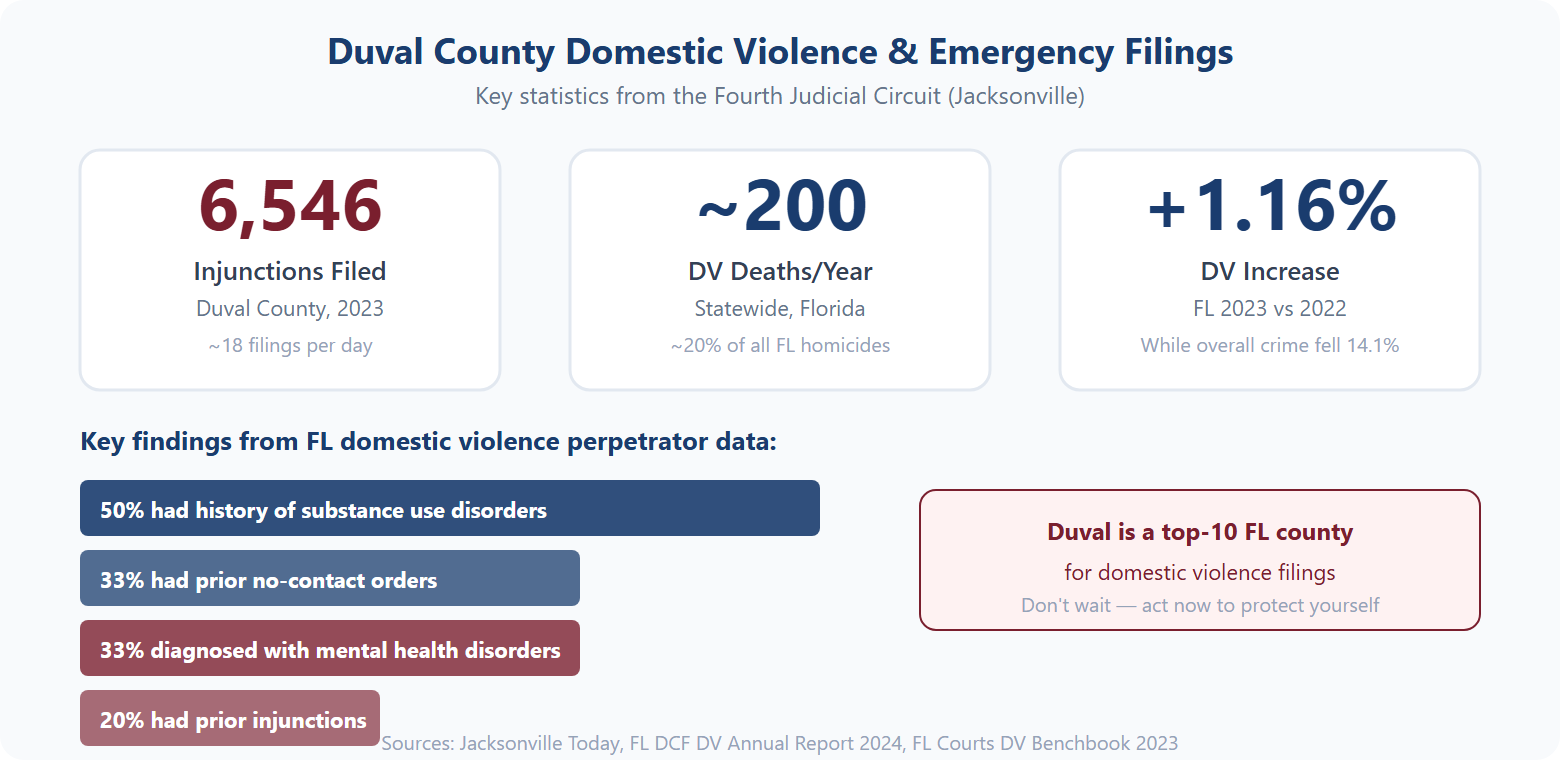
Duval County (Jacksonville) consistently ranks among Florida’s top 10 counties for domestic violence filings, reflecting the serious and ongoing nature of family violence in the greater Jacksonville metropolitan area.
In 2023, a total of 6,546 injunctions for violence were filed in Duval County alone, averaging approximately 18 filings per day across the Fourth Judicial Circuit. [2]
Statewide, domestic violence causes approximately 200 deaths per year in Florida, accounting for roughly 20% of all homicides, and while overall crime in Florida decreased by 14.1% in 2023, domestic violence incidents actually increased by 1.16% during the same period. [6]
These statistics underscore why emergency motions and protective orders are a critical tool in Florida family law and why having an experienced attorney who can file same-day emergency relief is essential for Jacksonville families facing immediate threats of harm.
Statewide, domestic violence causes approximately 200 deaths per year in Florida, accounting for roughly 20% of all homicides. [6] While overall crime in Florida decreased by 14.1% in 2023, domestic violence actually increased by 1.16%. [6]
Key findings from Florida’s domestic violence data show that among perpetrators: 50% had a history of substance use disorders, 33% had prior no-contact orders, 33% were diagnosed with mental health disorders, and 20% had prior permanent injunctions filed against them. [6]
These numbers confirm that domestic violence is a persistent crisis in Jacksonville, and that early legal intervention through emergency motions saves lives.
What You Need to File an Emergency Motion
Having the right documentation strengthens your emergency motion and significantly increases the likelihood that the judge will grant same-day ex parte relief.
Florida courts require specific factual allegations supported by a verified sworn affidavit, and supplemental evidence (photographs, text messages, police reports, medical records, and financial documentation) demonstrates the urgency and credibility of your petition. [1]
In Jacksonville’s Fourth Judicial Circuit, judges reviewing emergency motions look for concrete, dated evidence of the threat rather than general statements of fear or concern. The more organized and thorough your evidence is when you contact attorney Adam Sacks, the faster we can prepare and file your motion with the Duval County Clerk of Courts.
Even if you do not have every piece of documentation listed below, do not let that prevent you from calling. In genuine emergencies, we can file immediately and supplement the evidence before the full hearing. Gather as much of the following as possible:
- Evidence of the emergency: Photos of injuries, threatening text messages or emails, voicemails, screenshots of social media threats, police reports, hospital/ER records
- Financial documentation (for asset preservation): Bank statements showing suspicious withdrawals, evidence of property transfers, credit card statements showing unusual spending
- Child-related evidence: School records, medical records, photos of living conditions, statements from teachers or counselors, evidence of substance abuse
- Existing court orders: Any current custody orders, parenting plans, or injunctions being violated
- Witness information: Names and contact information for anyone who witnessed the emergency situation
- Your Financial Affidavit: Required for temporary support motions (Form 12.902)
Even if you don’t have perfect documentation, don’t let that stop you from calling. In genuine emergencies, we can file the motion immediately and supplement the evidence as it becomes available.
What Happens After Emergency Relief Is Granted
A temporary emergency order is not a permanent resolution. It is a legally enforceable bridge designed to protect you and your children until the court can hold a full evidentiary hearing where both parties present evidence and testimony before the judge.
Understanding what happens after emergency relief is granted is essential because the temporary order comes with specific obligations, timelines, and next steps that directly affect whether the court will extend, modify, or dissolve the protection at the full hearing. [1]
For domestic violence injunctions, the full hearing must be scheduled within 15 days of the temporary order. For other emergency orders, including temporary custody and asset preservation, the hearing is set at the earliest available date on the Fourth Judicial Circuit’s family law docket.
Violating a temporary order carries serious criminal penalties, including up to one year in jail for violation of a domestic violence injunction under F.S. § 741.31. Here is what to expect after the court grants emergency relief:
- Enforcement: Temporary orders are enforceable immediately. Violating a domestic violence injunction is a first-degree misdemeanor (F.S. § 741.31), punishable by up to 1 year in jail. [1]
- Full hearing: Both parties appear before the judge (typically within 15 days for DV injunctions). You can present witnesses, documents, and testimony. The other party can respond.
- Permanent order or modification: The judge may issue a permanent injunction (lasting up to 1 year, renewable), modify the temporary order, or dissolve it based on the evidence.
- Integration with pending cases: If a divorce or custody case is pending, orders entered in those proceedings take precedence over inconsistent provisions in the injunction. [1]
Common Mistakes in Emergency Motion Cases
Emergency motions carry high stakes (the safety of a child, protection from domestic violence, or preservation of marital assets) and mistakes during the filing or hearing process can result in denial of protection, loss of credibility with the judge, or dissolution of a temporary order that was keeping you safe.
After 25+ years of handling emergency family law matters in Jacksonville’s Fourth Judicial Circuit, including my early career as a state prosecutor handling domestic violence and child endangerment cases, I have seen the same critical errors undermine otherwise meritorious emergency petitions.
These mistakes range from waiting too long to file after the triggering event to violating your own protective order by initiating contact with the restrained party. Each error is preventable with proper legal guidance, and understanding them before you file significantly improves your chance of obtaining and maintaining emergency protection from the Duval County court.
- Waiting too long to file: If you wait days or weeks after the emergency event, the court may question whether it’s truly an emergency. File as soon as possible after the triggering event.
- Filing without sufficient facts: “I’m afraid” is not enough. You need specific facts: dates, times, descriptions of threatening behavior, evidence. The more detail, the better.
- Misusing emergency motions: Filing a non-emergency matter as “emergency” to get faster court access damages your credibility. Judges remember, and it will hurt you in future proceedings.
- Violating your own protective order: If you have an injunction against your spouse, do not initiate contact with them. Courts take mutual violations seriously and may dissolve the order.
- Not showing up to the full hearing: The temporary order expires after the full hearing date. If you don’t appear, the order is dissolved and your protection ends.
- Not documenting ongoing violations: If the other party violates the temporary order, document every incident and report it to law enforcement. Each violation strengthens your case at the full hearing.
Why Choose Adam Sacks for Your Emergency Motion
I started my career as a prosecutor for the State of Florida. I spent years in the courtroom prosecuting criminal cases, including cases involving domestic violence, child endangerment, and violations of protective orders.
That experience gave me something most family law attorneys simply don’t have: the ability to move fast under pressure and present a compelling case to a judge on the same day a crisis happens.
Emergency motions are not routine filings. They require a lawyer who can interview you, identify the legal grounds, draft the motion, prepare supporting evidence, and get it in front of a judge, often all within the same day. I’ve been doing this for over 25 years, and I know exactly what Fourth Judicial Circuit judges need to see before they’ll grant emergency relief.
I’m also a Florida Supreme Court Certified Family Mediator, which means I understand de-escalation and resolution as well as I understand litigation. Not every situation requires the nuclear option. But when it does, when a child is in danger or someone’s safety is at risk, I move immediately and aggressively.
Adam Sacks earned his J.D. from Western Michigan University Cooley Law School, where he received a Book Award for the highest grade in his class. He served as an Assistant State Attorney in Seminole County before transitioning to private practice.
He holds a bachelor’s degree in Psychology from the University of Massachusetts, directly relevant to the emotional crisis situations that drive emergency family law motions. He is a Florida Supreme Court Certified Family Mediator and a member of the Florida Bar (Bar #248370) since 2000.
What Happens When You Call Our Office
Emergency situations do not follow business hours, and neither does our response to Jacksonville families in crisis.
When you call (904) 396-5557, you will speak directly with attorney Adam Sacks, a former state prosecutor with 25+ years of family law experience and a Florida Supreme Court Certified Mediator who has handled hundreds of emergency motions in the Fourth Judicial Circuit.
I handle emergency calls personally because the first conversation determines the legal strategy, the type of emergency relief to pursue, and whether same-day ex parte filing is appropriate for your situation.
If you or your child is in immediate danger, I can prepare and file the emergency motion with the Duval County Clerk of Courts the same day you call, seeking temporary protective orders that are enforceable by law enforcement within hours. There is no charge for the initial consultation. Here is exactly what happens:
- You speak with me directly. Not a receptionist, not an intake coordinator. I handle emergency calls personally because the first conversation sets the strategy.
- Immediate threat assessment. I’ll ask specific questions to determine what type of emergency relief you need and whether ex parte (same-day) relief is appropriate.
- Same-day filing when necessary. If you’re in immediate danger or your child is at risk, we can prepare and file the emergency motion the same day you call.
- Clear explanation of next steps. I’ll tell you exactly what the court process looks like, what evidence to preserve, and what to expect at the full hearing.
- Coordination with law enforcement. If a protective order is issued, I’ll ensure it’s properly served and that you understand how to report violations.
Need emergency protection? Call Adam Sacks now at (904) 396-5557. Free consultation. Same-day filing available when your safety or your child’s safety is at risk.
Frequently Asked Questions About Emergency Motions in Jacksonville
How fast can I get an emergency protective order in Jacksonville?
Domestic violence injunctions can be issued the same day you file under F.S. § 741.30. The judge reviews the petition ex parte and can grant temporary relief within hours. [1]
Other emergency motions (temporary custody, asset preservation) typically receive judicial review within 1–3 business days. In genuine emergencies involving child safety, same-day relief is possible.
What qualifies as an emergency in Florida family court?
A genuine crisis directly affecting the welfare of a party or a child. This includes domestic violence, child abuse or neglect, threat of parental kidnapping, dissipation of marital assets, and situations where a child’s physical or emotional safety is at immediate risk. [3]
Filing a non-emergency as “emergency” damages your credibility with the court.
Can I get emergency custody of my child without a lawyer?
Technically yes: Florida allows self-representation. But I strongly advise against it in emergency situations.
Emergency motions require precise legal language, specific factual allegations, and familiarity with the judge’s requirements. An improperly drafted motion can be denied, delaying protection for your child. The stakes are too high for trial and error.
How long does a temporary emergency order last?
Domestic violence temporary injunctions last up to 15 days, at which point a full hearing is held. [1] After the full hearing, a permanent injunction can last up to 1 year and is renewable.
Other temporary custody and support orders remain in effect until modified, vacated, or superseded by a final judgment in the underlying divorce or custody case.
What happens if my spouse violates the emergency order?
Violating a domestic violence injunction is a first-degree misdemeanor under F.S. § 741.31, punishable by up to 1 year in jail and a $1,000 fine. [1]
Call 911 immediately if a violation occurs, then contact your attorney. Document every violation: photos, screenshots, witness statements. Each violation strengthens your position at the full hearing and in the underlying family law case.
Do I need evidence to file an emergency motion?
Evidence significantly strengthens your motion, but you don’t need a perfect case to file. Photos, text messages, police reports, medical records, and witness statements all help.
In immediate danger situations, your sworn affidavit describing the threat may be sufficient for a temporary ex parte order. You can supplement your evidence before the full hearing.
How much does it cost to file an emergency motion in Duval County?
There is no filing fee for domestic violence injunction petitions in Florida. They are free to file. [1]
For other emergency motions filed within a pending divorce or custody case, costs include attorney preparation time (typically 2–5 hours at $250–$500/hour) plus any process server fees. In cases of financial disparity between spouses, the court can order the other party to pay your temporary attorney fees under F.S. § 61.16. [5]
Sources:
[1] Florida Statutes, F.S. § 741.30: Domestic Violence; Injunction; Powers and Duties of Court. flsenate.gov
[2] Jacksonville Today, Duval’s Domestic Violence Homicides Hit 8-Year Low (Oct. 1, 2024). 6,546 injunctions filed in 2023. jaxtoday.org
[3] Eighth Judicial Circuit of Florida, Emergency Motions for Ex Parte Relief Procedures (applicable statewide). circuit8.org
[4] Florida Courts, Family Law Forms: Motion for Temporary Support (12.947), Prevent Removal of Child(ren) (12.941). flcourts.gov
[5] Florida Statutes, Title VI, Chapter 61: Dissolution of Marriage; Support; Custody (F.S. §§ 61.075, 61.16). flsenate.gov
[6] Florida Dept. of Children & Families, Domestic Violence Annual Report (Jan. 2024); FL Courts DV Benchbook (May 2024). flcourts.gov