
Bottom Line: Florida offers 5 types of protective injunctions (domestic violence, repeat violence, dating violence, sexual violence, and stalking), all free to file.[1] Duval County recorded 6,546 injunctions for violence filed in 2023.[2]
A temporary injunction can be issued the same day you file, and violating it is a criminal offense punishable by up to 1 year in jail.[3] Led by Adam Sacks, 25+ years of family law experience, former state prosecutor.
Need protection now? Call (904) 396-5557, Adam Sacks files restraining orders for Jacksonville families.
What Is a Restraining Order in Florida?
A restraining order in Florida is legally an injunction for protection, a court order barring contact, available in five types under F.S. § 741.30 and § 784.046. All are free to file, and 6,546 injunctions for violence were filed in Duval County in 2023.[1][2]
In Florida, what most people call a “restraining order” is legally known as an injunction for protection under F.S. § 741.30 (domestic violence) and F.S. § 784.046 (repeat, dating, and sexual violence).
It is a court order that prohibits a specific person from contacting, approaching, or harassing you, and violations carry criminal penalties including up to one year in jail for a first offense.[3]
Beyond the no-contact provision, an injunction can award you temporary custody of your children, exclusive use of your shared home even if the respondent’s name is on the lease, temporary child support and spousal support, and an order requiring the respondent to surrender all firearms to law enforcement.
Every type of injunction in Florida is free to file, and a judge can issue emergency relief the same day you submit your petition.[1] In 2023 alone, 6,546 injunctions for violence were filed in Duval County, approximately 18 per day.[2]
Florida’s injunction system is designed for speed. When you face domestic violence, stalking, or threats, you cannot wait weeks for a court date. Under F.S. § 741.30, a judge can review your petition and issue a temporary protective order the same day you file, without the other person being present (ex parte).[1]
The temporary order remains in effect for up to 15 days while the court schedules a full hearing. At the full hearing, both parties present evidence and testimony, and the judge decides whether to issue a final injunction, which remains in effect until the court modifies or dissolves it, either permanently or for a fixed period.[1]
5 Types of Injunctions for Protection in Florida
Florida provides five injunction types: domestic violence (F.S. § 741.30), plus repeat, dating, and sexual violence (F.S. § 784.046), and stalking (F.S. § 784.0485). Domestic violence injunctions are the most commonly filed in Duval County, all five are free, and each carries criminal penalties for violations.[1]
Florida law provides five distinct types of protective injunctions, each designed to address specific relationships and threat patterns. The type you file determines the evidentiary standard you must meet, the relief available, and the procedural requirements at the full hearing.
Domestic violence injunctions under F.S. § 741.30 are the most commonly filed in Duval County and offer the broadest relief, including temporary custody, support, firearms surrender, and residence exclusion. Repeat violence, dating violence, and sexual violence injunctions fall under F.S. § 784.046, while stalking injunctions are governed by F.S. § 784.0485.
All five types are free to file, and all carry criminal penalties for violations. Understanding which injunction applies to your situation is critical, because filing the wrong type can result in delays or denial of your petition.[1]
1. Domestic Violence Injunction (F.S. § 741.30)
The most commonly filed type in Duval County. Available when you face violence or threat of violence from a family or household member, including a spouse, ex-spouse, co-parent, or anyone who currently or formerly lived with you as a family.[1]
A domestic violence injunction can order:
- No contact (direct or through third parties) between you and the respondent
- Removal of the respondent from your shared residence
- Temporary 100% custody of minor children
- A temporary parenting plan and time-sharing schedule
- Temporary child support and spousal support
- Surrender of firearms by the respondent
- Protection of pets and animals in the household
- Referral to a certified domestic violence center
- Mandatory counseling or intervention programs
2. Repeat Violence Injunction (F.S. § 784.046)
Available against any person, no family or household relationship required. You must show two or more incidents of violence or stalking by the same person, with at least one incident occurring within six months of filing.[4] This covers situations involving neighbors, coworkers, acquaintances, or strangers.
3. Dating Violence Injunction (F.S. § 784.046)
Covers violence by a current or former dating partner. Florida defines “dating relationship” as a continuous and significant relationship of a romantic or intimate nature, not casual acquaintances or business relationships. The relationship must have existed within the past six months.[4] Only one incident of violence is required.
4. Sexual Violence Injunction (F.S. § 784.046)
Available to victims of sexual battery, lewd or lascivious acts, or sexual exploitation, regardless of the relationship to the perpetrator. A parent or legal guardian can file on behalf of a minor child.
The petitioner must have reported the incident to law enforcement and be cooperating in any related criminal proceeding, regardless of whether charges were filed, reduced, or dismissed, or the respondent must have been sentenced to prison for the offense and the term must have expired or be due to expire within 90 days.[4]
5. Stalking Injunction (F.S. § 784.0485)
Covers willful, malicious, and repeated following, harassing, or cyberstalking. Florida’s stalking statute includes electronic harassment, threatening emails, texts, social media messages, and GPS tracking.[5] Aggravated stalking, making a credible threat, is a third-degree felony under F.S. § 784.048 punishable by up to 5 years in prison.[5]
How to Get a Restraining Order in Jacksonville
To get a restraining order in Jacksonville, file a petition at the Duval County Clerk’s Domestic Violence Department, 501 West Adams Street, Room 2409. There is no filing fee, a judge can issue a temporary injunction the same day, and the full hearing is held within 15 days.[6][1]
Filing for an injunction for protection in Duval County is free and follows a structured process administered by the Fourth Judicial Circuit Court. There is no filing fee for any of the five injunction types, domestic violence, repeat violence, dating violence, sexual violence, or stalking, making protective orders accessible regardless of your financial situation.[1]
The process begins at the Duval County Clerk of Courts, Domestic Violence Department, located at 501 West Adams Street, Room 2409, Jacksonville, FL 32202, where trained staff can assist you with the required paperwork.[6]
In urgent situations involving immediate danger to you or your children, a judge can review your sworn petition and issue a temporary injunction the same day you file, without the respondent being present. The entire process from filing through full evidentiary hearing typically takes no more than 15 days.[1]
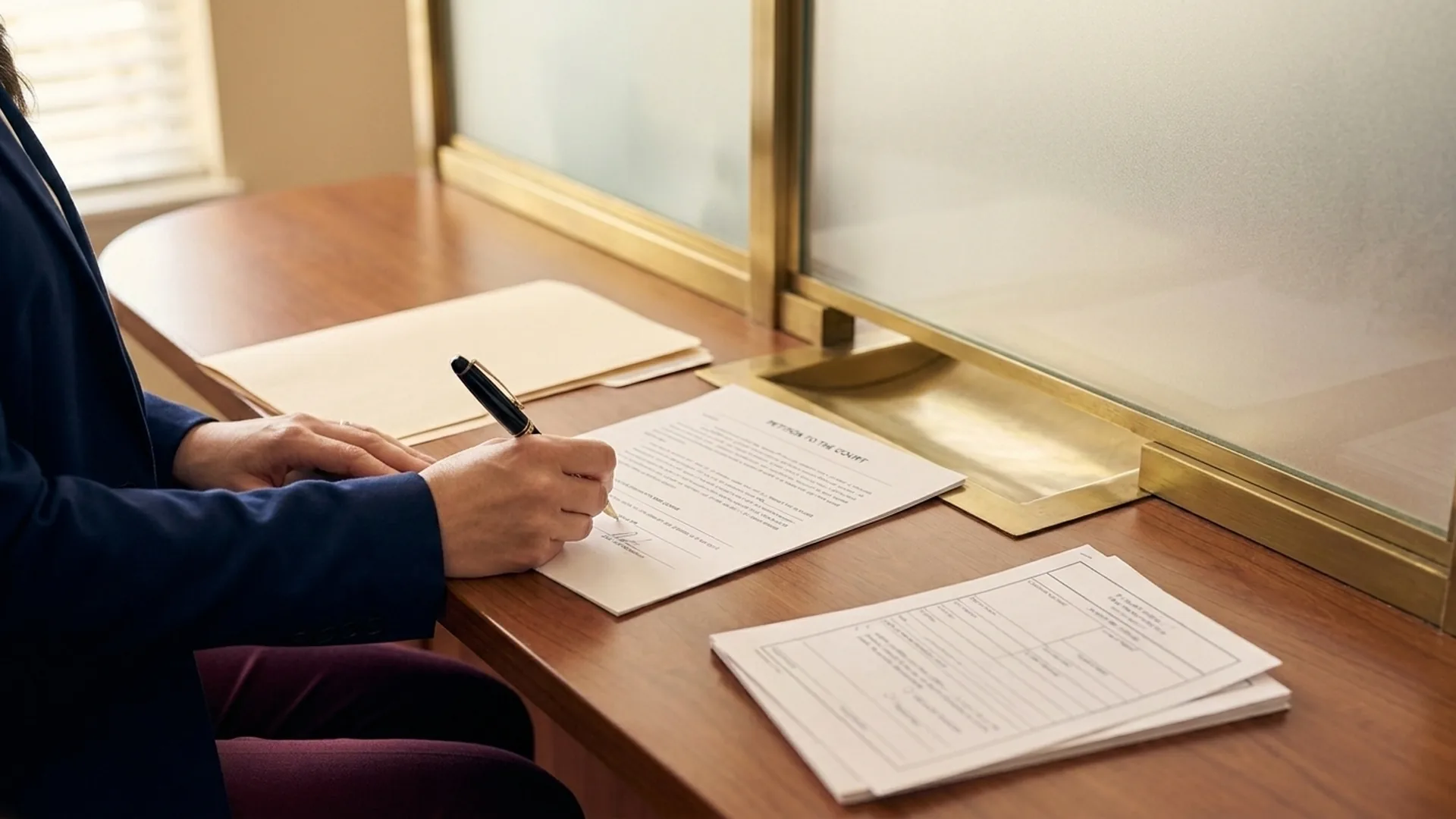
Step 1: File the Petition
Go to the Duval County Clerk of Courts, Domestic Violence Department, located at 501 West Adams Street, Room 2409, Jacksonville, FL 32202. The office is open 8 AM to 5 PM, Monday through Friday, and accepts new petitions until 4 PM. Phone: (904) 255-2210.[6] There is no filing fee for any type of injunction for protection.
You’ll need the respondent’s full name and an address where they can be served. A clerk’s office staff member can help you complete the required forms.
Step 2: Judge Reviews Your Petition (24–48 Hours)
After you file, a judge reviews your petition ex parte (without the respondent present). The judge decides whether to grant a temporary injunction based on the facts in your sworn petition. In urgent cases, review can happen the same day.[1]
Step 3: Temporary Injunction Issued
If the judge finds sufficient grounds, a temporary injunction is issued immediately. This order is enforceable by law enforcement from the moment it’s signed. The respondent does not need to be served for the order to take effect, but they must be served before the full hearing.
Step 4: Service on the Respondent
Within 24 hours of issuing the injunction, the clerk forwards a copy to the Duval County Sheriff’s Office for service on the respondent.[1] Once served, the respondent is legally bound by all terms of the order.
Step 5: Full Evidentiary Hearing (Within 15 Days)
A full hearing is scheduled within 15 days. Both parties appear before the judge. You can present witnesses, documents, photos, text messages, police reports, and other evidence. The respondent can also present their case. The judge then decides whether to issue a permanent (final) injunction.[1]
What a Restraining Order Can Do For You
A Florida injunction does far more than order no contact. Under F.S. § 741.30, a judge can award up to 100% temporary custody of minor children, exclusive use of your home, temporary child and spousal support, and surrender of all the respondent’s firearms to law enforcement.[1]
A Florida injunction for protection is one of the most powerful legal tools available to protect yourself and your children from harm, harassment, and contact by a threatening individual.
Unlike a simple no-contact order issued as part of a criminal case, an injunction provides comprehensive civil relief that addresses your immediate safety, housing, financial needs, and parental rights, all in a single court order.

Under F.S. § 741.30 and F.S. § 784.046, the judge has broad discretion to craft protective provisions tailored to your specific circumstances, and every provision is enforceable by law enforcement with criminal penalties for violations.[1]
In my experience representing Jacksonville families, the most effective injunctions combine multiple forms of relief to create a complete safety plan. The court can order:
- No-contact order: The respondent cannot contact you by any means, in person, by phone, text, email, social media, or through third parties
- Stay-away order: The respondent must stay a specified distance from your home, workplace, school, and other locations you frequent
- Removal from residence: The respondent is ordered to leave your shared home, even if their name is on the lease or deed
- Temporary custody: The court can award you up to 100% of time-sharing with minor children
- Temporary support: The court can order temporary child support and spousal support
- Firearms surrender: The respondent must surrender all firearms to law enforcement or a licensed dealer
- Pet protection: The court can award temporary care and control of household pets to the petitioner
- Treatment and counseling: The court can order the respondent to complete batterer’s intervention, substance abuse treatment, or other programs
Penalties for Violating a Restraining Order in Florida
Violating a Florida restraining order is a first-degree misdemeanor punishable by up to 1 year in jail and a $1,000 fine under F.S. § 741.31. Two or more prior convictions for violating an injunction against the same victim become a third-degree felony, carrying up to 5 years in prison.[3]
Violating an injunction for protection is a criminal offense in Florida, and law enforcement can arrest the violator on probable cause without a warrant the moment they become aware of the breach.[3]
The penalties escalate significantly with each subsequent violation, ranging from a first-degree misdemeanor carrying up to one year in county jail and a $1,000 fine for a first offense, to a third-degree felony punishable by up to five years in state prison for repeat offenders or those who make credible threats while subject to an active injunction.
Under F.S. § 741.31 and F.S. § 784.047, any knowing and intentional violation, including a single unwanted text message, showing up at the petitioner’s workplace, or contacting the petitioner through a third party, constitutes a criminal act.
Florida courts take these violations seriously, and documented violations also strengthen your position in any related custody or divorce proceedings.[3]
First violation (F.S. § 741.31 / § 784.047):
- First-degree misdemeanor
- Up to 1 year in jail
- Up to $1,000 fine
- Immediate arrest, law enforcement can arrest on probable cause without a warrant
Two or more prior convictions for violation (same victim):
- Third-degree felony
- Up to 5 years in prison
- Up to $5,000 fine
- Permanent felony criminal record
Aggravated stalking (F.S. § 784.048(4)):
- Third-degree felony
- Applies when a person follows, harasses, or cyberstalks the petitioner while an injunction for protection is in effect
- Up to 5 years in prison regardless of whether it’s a first offense
If the respondent violates your restraining order, call 911 immediately. Then contact your attorney. Document every violation with photos, screenshots, and witness statements, each documented violation strengthens your case at the full hearing and in any underlying divorce or custody proceedings.
Restraining Order vs. No-Contact Order: What’s the Difference?
A restraining order is a civil injunction you file yourself, providing custody, support, and firearms relief, while a no-contact order is issued by a criminal court after an arrest. Under F.S. § 741.30, both can be in effect at the same time for maximum protection in domestic violence cases.[1]
People often confuse restraining orders (injunctions for protection) with no-contact orders, but understanding the difference is important because they come from different courts, provide different levels of protection, and are enforced differently.
A restraining order is a civil court order that you initiate by filing a petition. It provides comprehensive relief including custody, support, firearms surrender, and residence exclusion, and it remains in effect regardless of what happens in any criminal case.
A no-contact order, by contrast, is issued by a criminal court judge as a condition of bond or probation after an arrest. It only prohibits the defendant from contacting the victim and expires when the criminal case concludes.
In many domestic violence situations in Jacksonville, both orders can and should be in place simultaneously for maximum protection.[1] Here is how they compare:
- Injunction for protection (restraining order): A civil court order that YOU file. Provides comprehensive relief including custody, support, firearms surrender, and residence exclusion. Violation is a separate criminal charge.
- No-contact order: Issued by a criminal court judge as a condition of bond or probation after an arrest. The defendant cannot contact the victim. This is part of the criminal case, not something you file for.
- Can you have both? Yes. If the respondent is arrested for domestic battery, the criminal court may issue a no-contact order, and you can simultaneously have a civil injunction for protection. Both are enforceable.
Restraining Orders in Duval County: The Numbers
Duval County recorded 6,546 injunctions for violence in 2023, roughly 18 filings per day, ranking among Florida’s top 10 counties for domestic violence. Statewide, 106,515 domestic violence offenses were reported to law enforcement in 2020, the most recent year of comparable FDLE data, resulting in 63,217 arrests.[2][7]
Duval County is one of Florida’s top 10 counties for domestic violence filings, and the volume of cases processed through the Fourth Judicial Circuit reflects the scale of the problem in the Jacksonville metropolitan area.
In 2023, 6,546 injunctions for violence were filed in Duval County, approximately 18 per day, covering domestic violence, repeat violence, dating violence, sexual violence, and stalking petitions.[2]
Statewide, 106,515 domestic violence offenses were reported to Florida law enforcement in 2020, the most recent year of comparable FDLE Uniform Crime Reports data, resulting in 63,217 arrests.[7]
These numbers underscore why early legal intervention through an injunction for protection is critical. A restraining order creates an enforceable legal barrier between you and the person threatening your safety, and it establishes a court record that strengthens your position in any related custody, divorce, or criminal proceedings.
Domestic violence offenses also cause approximately 200 deaths each year in Florida, accounting for roughly 20% of all murders statewide, which underscores how quickly threats can escalate.[8]
These statistics underscore why early legal intervention matters. A restraining order doesn’t just protect you today, it creates a legal record that strengthens your position in custody, divorce, and future proceedings.
What If a Restraining Order Is Filed Against You?
If a restraining order is filed against you, the full evidentiary hearing within 15 days is your one chance to respond. Under F.S. § 790.233, a domestic violence injunction bars you from possessing any firearm or ammunition, and a permanent order appears on background checks.[1]
If someone files an injunction for protection against you, take it seriously, even if you believe the allegations are exaggerated or unfounded.
A permanent injunction entered against you will appear on background checks conducted by employers, landlords, and licensing agencies, and it can directly affect your child custody rights, your ability to possess firearms under both Florida and federal law, and your professional standing in fields that require clean records such as law enforcement, healthcare, education, and military service.
Under F.S. § 790.233, a person subject to a domestic violence injunction is prohibited from possessing any firearm or ammunition, a violation of which is a separate first-degree misdemeanor. The full evidentiary hearing, typically scheduled within 15 days of the temporary order, is your one opportunity to present your defense.[1] You have the right to:
- Attend the full hearing and present your side of the case
- Hire an attorney to represent you and cross-examine the petitioner’s witnesses
- Present evidence including witnesses, documents, and testimony that contradicts the allegations
- Request modifications to overly broad provisions that affect your parental rights or access to your home
Whether you’re seeking protection or defending against an injunction, having an experienced attorney matters. The full hearing is your one opportunity to present your case, there’s no redo.
Common Mistakes in Restraining Order Cases
Six common mistakes derail restraining order cases: not filing, waiting too long, vague allegations, contacting the respondent, missing the hearing, and arriving without evidence. Missing the full hearing, scheduled within 15 days, automatically dissolves your temporary injunction, so documentation is critical to winning a permanent order.[1]
- Not filing because you think it’s too minor: If you feel unsafe, file. Judges understand that not every situation involves physical violence, threats, harassment, and stalking are all grounds for an injunction.
- Waiting too long: File as close to the triggering event as possible. Delays make the court question urgency.
- Vague allegations: Your petition must include specific facts, dates, times, locations, exact statements made, and descriptions of behavior. “He scares me” is insufficient. “On January 15, he texted ‘I know where you work’ after I told him not to contact me” is specific.
- Contacting the respondent after getting an injunction: If you initiate contact with someone you have an injunction against, the court may dissolve the order. Do not respond to attempts at contact, document and report them.
- Missing the full hearing: If you don’t show up, the temporary injunction is dissolved. Period. Make sure you attend, prepared with evidence and, ideally, an attorney.
- Not bringing evidence to the hearing: The judge decides based on the evidence presented. Bring photos, screenshots of texts and social media, police reports, medical records, and witnesses. The more documentation, the stronger your case.
Why Choose Adam Sacks for Your Restraining Order
Adam Sacks brings 25+ years of Florida family law experience and a background as a former state prosecutor who handled domestic violence and protective-order cases. A Florida Bar member since 2000 (Bar #248370) and Supreme Court Certified Family Mediator, he personally handles every injunction consultation.
I started my career as a prosecutor for the State of Florida. I prosecuted criminal cases involving domestic violence, assault, battery, and violations of protective orders. I know exactly what judges look for in injunction petitions because I’ve been on both sides of the courtroom, presenting evidence to get orders issued and prosecuting people who violated them.

That prosecutor experience is directly relevant to restraining order cases. When I draft your petition, I include the specific factual details and legal language that Fourth Judicial Circuit judges need to see before granting emergency relief.
When we prepare for the full hearing, I know how to present evidence effectively and how to cross-examine the respondent if they contest the injunction.
If a restraining order has been filed against you, my courtroom experience is equally valuable. I know how to challenge vague or exaggerated allegations and protect your parental rights and reputation at the full hearing.
Adam Sacks earned his J.D. from Western Michigan University Cooley Law School, where he received a Book Award for the highest grade in his class. He served as an Assistant State Attorney in Seminole County before transitioning to private practice.
He holds a bachelor’s degree in Psychology from the University of Massachusetts, directly relevant to the high-conflict dynamics in restraining order cases. He is a Florida Supreme Court Certified Family Mediator and a member of the Florida Bar (Bar #248370) since 2000.
What Happens When You Call Our Office
When you call (904) 396-5557, you speak directly with attorney Adam Sacks, not an intake service. Because the first 24 to 48 hours often decide the outcome, he personally assesses your case, files the same day when safety is at risk, and offers free consultations with no filing fee.[1]
When you call (904) 396-5557, you will speak directly with attorney Adam Sacks, not an answering service, not a paralegal, and not an intake coordinator.
Restraining order cases move fast, and the decisions made in the first 24 to 48 hours often determine the outcome. I handle every injunction consultation personally because an experienced assessment of your situation at the outset is critical to getting emergency relief from the court.
During our call, I will evaluate which of the five injunction types applies to your circumstances, determine whether same-day filing is necessary to protect your safety, and advise you on what evidence and documentation to begin preserving immediately.
If you or your children are in immediate danger, I can prepare and file your petition the same day. There is no fee to file an injunction in Florida, and I offer free initial consultations for all restraining order cases.[1] Here is exactly what happens:
- You speak with me directly. I handle injunction consultations personally, these cases move too fast to delegate.
- Immediate safety assessment. I’ll determine what type of injunction you need and whether same-day filing is appropriate.
- Same-day filing when safety is at risk. If you or your children are in immediate danger, we can prepare and file your petition the same day.
- Evidence strategy. I’ll tell you exactly what documentation to preserve, what to bring to the hearing, and how to strengthen your case.
- Full hearing preparation. I’ll represent you at the full hearing, presenting evidence, examining witnesses, and making legal arguments to the judge.
Need a restraining order? Call Adam Sacks now at (904) 396-5557. Free consultation. Same-day filing available. No filing fee for injunctions in Florida.
Client Reviews, See What People Are Saying
Sacks & Sacks Law holds a 4.6-star rating across 226 client reviews on Google, with clients highlighting clear communication and strong results in difficult family law and custody matters. Read verified reviews below, or view the firm’s full Google profile.
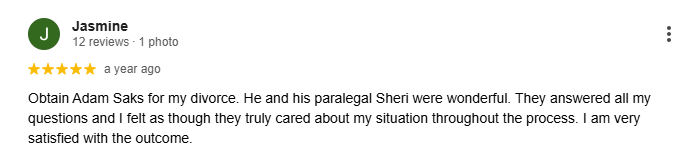
See all Google reviews for Sacks & Sacks Law
Frequently Asked Questions About Restraining Orders in Jacksonville
The most common questions about Florida restraining orders concern cost, speed, and duration. Injunctions are free to file in all five types, a temporary order can issue the same day or within 24 to 48 hours, and a final injunction stays in effect until the court modifies or dissolves it, sometimes permanently.[1][6]
How much does it cost to get a restraining order in Florida?
There is no filing fee for any type of injunction for protection in Florida, domestic violence, repeat violence, dating violence, sexual violence, and stalking injunctions are all free to file.[1]
If you hire an attorney, legal fees vary based on the complexity of the case, but many attorneys offer free initial consultations. The court can also order the respondent to pay your attorney fees.
How fast can I get a restraining order in Jacksonville?
A temporary injunction can be issued the same day you file, or within 24–48 hours.[6] The judge reviews your petition ex parte, meaning without the other party present. In urgent domestic violence situations, same-day relief is common. The full hearing where both sides present evidence is scheduled within 15 days.[1]
Can I get a restraining order without a lawyer?
Yes, you can file for an injunction without an attorney. The Duval County Clerk’s DV Department at 501 W Adams St, Room 2409 has staff who can help you complete the forms.[6]
However, having an attorney significantly strengthens your case, especially at the full hearing where the respondent may have their own lawyer. An improperly prepared case can result in the injunction being denied.
What happens if someone violates my restraining order?
Call 911 immediately. Violating an injunction is a first-degree misdemeanor punishable by up to 1 year in jail and a $1,000 fine.[3]
A person with two or more prior convictions for violating an injunction against the same victim commits a third-degree felony, up to 5 years in prison. Law enforcement can arrest the violator on probable cause without a warrant.
How long does a restraining order last in Florida?
A temporary injunction lasts up to 15 days. After the full hearing, a final injunction has no automatic expiration, it remains in effect until the court modifies or dissolves it.[1] The judge may enter it permanently or set it for a fixed period, and you can ask the court to extend or modify it as long as the threat continues.
What is the difference between a restraining order and an injunction in Florida?
They are the same thing. “Restraining order” is the common term, while “injunction for protection” is the legal term used in Florida statutes.
When you file for a “restraining order” in Florida, you are technically filing a petition for an injunction for protection under F.S. § 741.30 (domestic violence) or F.S. § 784.046 (repeat, dating, or sexual violence).[1]
Can a restraining order affect child custody in Florida?
Yes, significantly. A domestic violence injunction can include temporary custody provisions awarding the petitioner up to 100% of time-sharing.[1]
If a subsequent custody case or divorce is filed, the injunction is part of the court record and weighs heavily in the judge’s best-interest analysis under F.S. § 61.13. Domestic violence is one of the 20 statutory factors courts consider when determining custody.
Sources
[1] Florida Statutes, F.S. § 741.30, Domestic Violence; Injunction; Powers and Duties of Court. flsenate.gov
[2] Jacksonville Today, Duval’s Domestic Violence Homicides Hit 8-Year Low (Oct. 1, 2024). 6,546 injunctions filed in 2023. jaxtoday.org
[3] Florida Statutes, F.S. § 741.31, Violation of Injunction for Protection Against Domestic Violence; F.S. § 784.047, Penalties for Violating Protective Injunction. flsenate.gov
[4] Florida Statutes, F.S. § 784.046, Action by Victim of Repeat Violence, Sexual Violence, or Dating Violence for Protective Injunction. flsenate.gov
[5] Florida Statutes, F.S. § 784.0485, Stalking; Injunction; Powers and Duties of Court (florida.public.law); F.S. § 784.048, Stalking and Aggravated Stalking Penalties (flsenate.gov).
[6] Duval County Clerk of Courts, Domestic Violence Department. 501 W Adams St, Rm 2409. (904) 255-2210. duvalclerk.com
[7] Florida Dept. of Law Enforcement, Uniform Crime Reports, Domestic Violence Data (most recent published: 106,515 offenses, 63,217 arrests). fdle.state.fl.us. Florida Dept. of Children & Families, Office of Domestic Violence, Domestic Violence Statistics. myflfamilies.com
[8] StatPearls (NIH / National Center for Biotechnology Information), Florida: Domestic Violence. “Domestic violence offenses result in approximately 200 deaths each year, accounting for approximately 20% of murders annually.” ncbi.nlm.nih.gov
Local Legal Resources
- Jacksonville Bar Association, Lawyer Referral Service (Duval County)
- Jacksonville Bar Association, Attorney Directory
- Jacksonville Family Law Attorney
- Emergency Motions
- Temporary Custody Orders
- Child Custody
- Divorce
- Contested Divorce
- Child Support
- Spousal Support & Alimony
- Mediation
- Paternity
Our Office Location
The Law Offices of Sacks & Sacks are located at 1646 Emerson Street, Suite B, Jacksonville, FL 32207, serving Duval County and the Fourth Judicial Circuit. Call (904) 396-5557 for a free restraining order consultation, with same-day petition filing available when safety is at risk.
Law Offices of Sacks & Sacks, P.A.1646 Emerson St. Suite B
Jacksonville, FL 32207
Phone: (904) 396-5557