
A custody decision shapes years, not just days. What you most need right now is a clear read on how Duval County family court is likely to treat your situation.
Since 2023, Florida law starts every new case with a rebuttable presumption of equal 50/50 time-sharing. For 25 years, Adam Sacks has walked Jacksonville parents through parenting plans, time-sharing disputes, and modifications. You don't have to understand every statute before you call.
Jacksonville child custody attorney Adam Sacks is a Florida Supreme Court Certified Family Mediator with over 25 years in Duval County family court. The firm handles contested custody cases, parenting plan modifications, time-sharing enforcement, emergency motions, and relocation disputes under Florida Statute 61.13.
Free initial consultation · 50/50 time-sharing presumption since July 2023 · Serving Duval, Clay, Nassau and St. Johns
How Child Custody Works in Florida
Florida no longer uses the term “custody.” Since 2008, the state replaced custody language with parental responsibility and time-sharing under F.S. § 61.13.[2] These terms more accurately reflect how Florida courts approach parenting after divorce or separation.
Parental responsibility refers to which parent makes major decisions about the child’s education, healthcare, religion, and general welfare. Time-sharing describes the specific schedule of overnights, weekdays, weekends, and holidays the child spends with each parent.
Every custody arrangement in Florida must be documented in a court-approved parenting plan, which is required in all cases involving minor children, including divorce, paternity actions, and modifications.
Since July 1, 2023, courts must also apply a rebuttable presumption of equal (50/50) time-sharing under Ch. 2023-301 and evaluate all 20 statutory best interest factors before ordering any schedule.
Jacksonville child custody attorney Adam Sacks, a 25-year family law veteran and Florida Supreme Court Certified Family Mediator, helps parents navigate these requirements and protect their parenting rights. Call (904) 396-5557 for a free consultation.
Parental responsibility determines which parent makes major decisions about the child’s education, healthcare, religion, and welfare. Time-sharing describes the schedule specifying how many overnights and holidays the child spends with each parent.
Every custody arrangement in Florida must be documented in a court-approved parenting plan. This plan is required in all cases involving minor children, including divorce, paternity actions, and custody modifications. A parenting plan must include:
- How parents share daily tasks associated with raising the child
- A time-sharing schedule specifying overnights and holidays with each parent
- Which parent is responsible for healthcare, school decisions, and activities
- Methods and technologies for parent-child communication
- Authorized locations for child exchanges
The guiding principle behind every parenting plan is the best interests of the child. Florida law states that each child has the right to frequent and continuing contact with both parents after separation or divorce.[2]

Florida’s 50/50 Time-Sharing Presumption
Effective July 1, 2023, Florida law now includes a rebuttable presumption that equal time-sharing is in the best interests of the child.[3] This was one of the most significant changes to Florida custody law in decades, enacted through Ch. 2023-301 (SB 1416).
Under the new presumption, courts must start from the position that a 50/50 split of overnights between parents is what serves the child best.
A parent seeking unequal time-sharing must prove by a preponderance of the evidence (meaning “more likely than not”) that equal time-sharing would not serve the child’s best interests, and the court must make specific written findings of fact based on the 20 best interest factors listed in F.S. § 61.13(3).[2]
Florida is one of only five states nationwide with an explicit rebuttable presumption of equal shared parenting, and early data from Kentucky, the first state to adopt a 50/50 presumption in 2018, shows a 25% drop in divorce rates between 2016 and 2023.[4]
Adam Sacks has guided Jacksonville parents through this legal shift since its enactment, helping both custodial and non-custodial parents understand their rights under the new framework.
Under the new law, courts must start from the position that a 50/50 split of overnights between parents is what serves the child best. To overcome this presumption, a parent must prove by a preponderance of the evidence (meaning “more likely than not”) that equal time-sharing is not in the child’s best interests.[2]
Florida is one of only 5 states nationwide with an explicit rebuttable presumption of equal shared parenting, joining Kentucky, Arkansas (2021), West Virginia (2022), and Missouri (2023).[5] Approximately 20 additional states are actively working on similar legislation.[4]
Early data from Kentucky, the first state to pass a 50/50 presumption in 2018, shows its divorce rate dropped 25% between 2016 and 2023, compared with an 18% national decline over the same period.[4]
What Changed in 2023
Before July 1, 2023, Florida law stated there was no presumption for or against any specific time-sharing schedule. Judges had broad discretion to award whatever split they believed served the child. The 2023 amendment fundamentally shifted this approach:
- Before 2023: No presumption: the judge could order any time-sharing split based on the best interest factors
- After July 1, 2023: The court must presume 50/50 is in the child’s best interests unless a party proves otherwise
- Burden of proof: The parent seeking unequal time-sharing must prove by a preponderance of evidence that 50/50 is not in the child’s best interests
- Written findings required: When ordering unequal time-sharing, the court must evaluate all 20 best interest factors and make specific written findings of fact
The 2023 amendment applies to all new cases and pending cases where the court has not yet entered a final time-sharing order. According to the Florida Bar Journal, the presumption likely does not apply retroactively to existing parenting plans established before July 1, 2023.[6]
Florida’s 20 Best Interest Factors
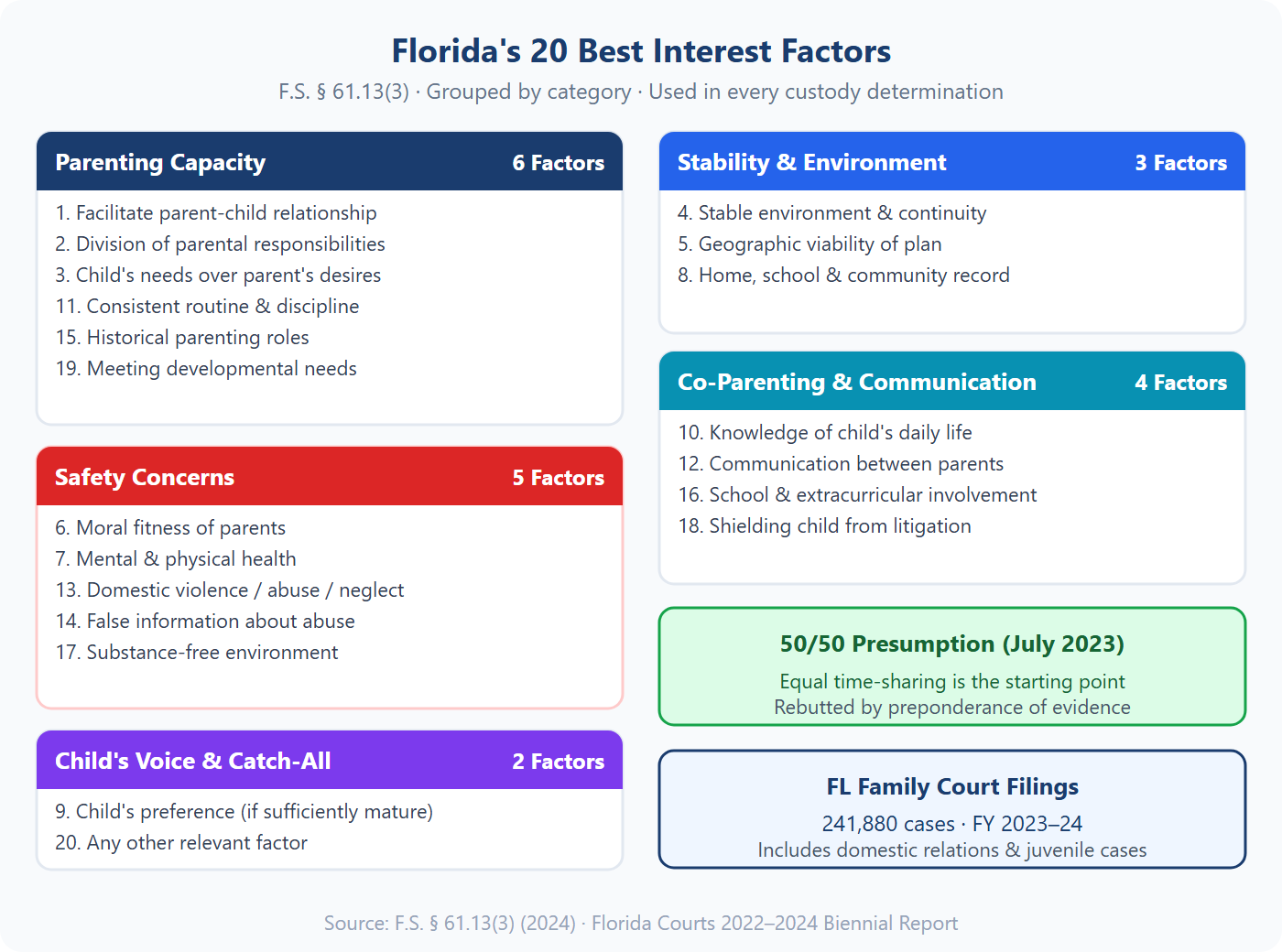
Florida Statute § 61.13(3) lists 20 specific factors that judges must evaluate when determining what arrangement serves the child’s best interests.[2] These factors are the foundation of every custody decision in Florida, whether establishing a new parenting plan or modifying an existing one.
The factors span several broad categories: parenting capacity, stability and environment, co-parenting communication, safety concerns, and the child’s own preference.
When a parent seeks to overcome the 50/50 presumption established by Ch. 2023-301, the court must evaluate all 20 factors and issue specific written findings explaining why equal time-sharing is not in the child’s best interests. No single factor is automatically decisive. Judges weigh the totality of the evidence.
However, certain factors carry particular weight in practice, especially evidence of domestic violence, substance abuse, or a demonstrated pattern of undermining the other parent’s relationship with the child. Understanding how Jacksonville judges interpret these factors is critical to building an effective custody strategy.
The 20 factors fall into several broad categories:
Parenting Capacity (Factors 1, 2, 3, 11, 15, 19)
- Willingness to facilitate the parent-child relationship: each parent’s demonstrated capacity to encourage contact with the other parent, honor the time-sharing schedule, and be reasonable about changes
- Division of parental responsibilities: how responsibilities will be shared after litigation, including whether a third party (nanny, grandparent) will handle parenting tasks
- Prioritizing the child’s needs: each parent’s ability to put the child’s needs above their own desires
- Providing a consistent routine: demonstrated ability to maintain discipline, homework schedules, meals, and bedtimes (Factor 11)
- Historical parenting roles: which parent customarily performed specific parenting tasks before and during litigation (Factor 15)
- Meeting developmental needs: capacity to address the child’s specific developmental stage and any special needs (Factor 19)
Stability and Environment (Factors 4, 5, 8)
- Stable environment and continuity: how long the child has lived in a stable, satisfactory environment and the value of maintaining that continuity (Factor 4)
- Geographic viability: whether the parenting plan is practical given where each parent lives, especially for school-age children and travel time (Factor 5)
- Child’s home, school, and community record: the child’s track record of adjustment and performance in their current environment (Factor 8)
Co-Parenting and Communication (Factors 10, 12, 16, 18)
- Knowledge of the child’s life: each parent’s demonstrated awareness of the child’s friends, teachers, medical providers, daily activities, and favorite things (Factor 10)
- Communication between parents: capacity to keep the other parent informed and present a unified front on major issues (Factor 12)
- School and extracurricular involvement: participation in the child’s school, sports, and activities (Factor 16)
- Shielding the child from litigation: not discussing the case with the child, not sharing court documents, and refraining from disparaging the other parent (Factor 18)
Safety Concerns (Factors 6, 7, 13, 14, 17)
- Moral fitness: whether a parent’s conduct has had or is likely to have an adverse impact on the child (Factor 6)
- Mental and physical health: each parent’s health status as it relates to their ability to care for the child (Factor 7)
- Domestic violence, abuse, or neglect: any evidence of domestic violence, sexual violence, child abuse, abandonment, or neglect; the court must specifically acknowledge this evidence in writing (Factor 13)
- False information about abuse: whether either parent knowingly provided false information about domestic violence or child abuse to the court (Factor 14)
- Substance-free environment: each parent’s capacity to maintain an environment free from substance abuse (Factor 17)
The Child’s Voice and Catch-All (Factors 9, 20)
- Child’s preference: the reasonable preference of the child, if the court deems the child mature enough to express a valid opinion (Factor 9). There is no set age for this: judges evaluate each child individually
- Any other relevant factor: a catch-all provision allowing the court to consider any additional circumstances relevant to the specific family (Factor 20)
Common 50/50 Time-Sharing Schedules in Florida
With the 50/50 presumption now in effect under Ch. 2023-301, equal time-sharing schedules have become the starting point in most Florida custody cases.
Courts evaluate each family’s circumstances (including the child’s age, school schedule, each parent’s work obligations, and the distance between homes) to determine which equal-time arrangement best serves the child under the 20 best interest factors of F.S. § 61.13(3).[2]
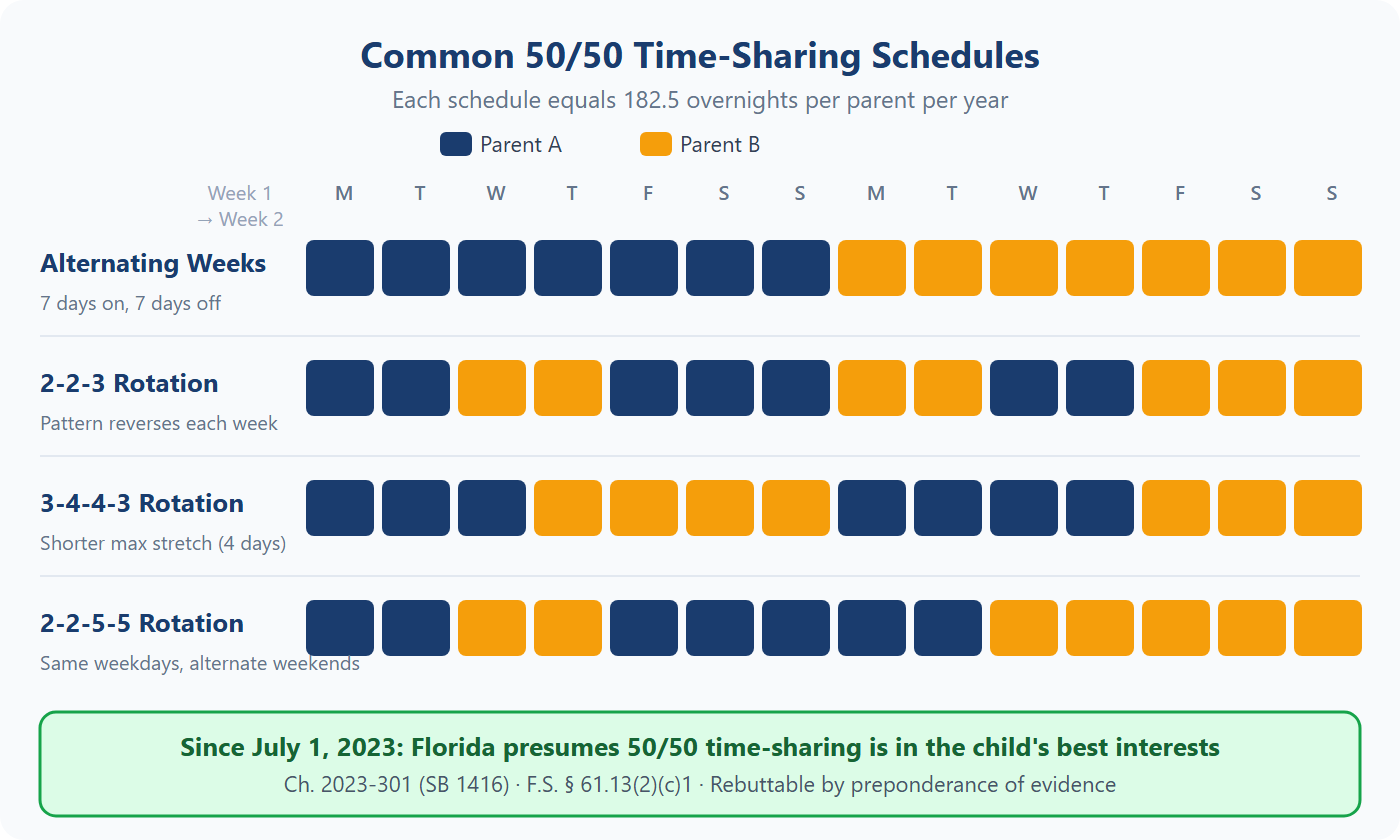
Geographic viability (Factor 5) and the child’s developmental needs (Factor 19) often play a decisive role in selecting a specific schedule. The most common 50/50 arrangements used in Duval County and throughout Northeast Florida include alternating weeks, 2-2-3 rotations, 3-4-4-3 rotations, and 2-2-5-5 rotations.
Each schedule distributes overnights equally over a two-week cycle but differs in how frequently the child transitions between homes. Parents may also agree on a hybrid schedule that combines elements of multiple formats, so long as the total overnights remain equal and the plan meets all statutory requirements. Here are the most common arrangements:
| Schedule | How It Works | Best For |
|---|---|---|
| Alternating Weeks | Child spends 7 days with one parent, then 7 days with the other | School-age children; parents who live near each other |
| 2-2-3 Rotation | 2 days with Parent A, 2 days with Parent B, 3 days with Parent A, then reverse the next week | Younger children who benefit from frequent contact with both parents |
| 3-4-4-3 Rotation | 3 days with Parent A, 4 days with Parent B, then 4 days with Parent A, 3 days with Parent B | Families wanting shorter stretches between exchanges |
| 2-2-5-5 Rotation | Each parent always has the same 2 weekdays, then alternates 5-day weekends | Parents who want a predictable weekly structure |
The right schedule depends on the child’s age, school schedule, each parent’s work schedule, and the distance between homes. Courts consider all of these factors, especially geographic viability (Factor 5) and the child’s developmental needs (Factor 19).
Types of Parental Responsibility in Florida
Florida law recognizes two primary forms of parental responsibility (shared and sole) and the default heavily favors shared responsibility.[2] Under F.S. § 61.13, courts must order shared parental responsibility unless they find that shared responsibility would be detrimental to the child.
Shared parental responsibility means both parents participate in major decisions about education, healthcare, religion, and general welfare.
Sole parental responsibility grants one parent exclusive decision-making authority and is reserved for cases involving domestic violence convictions, sexual offenses against minors, chronic substance abuse, or other circumstances where shared responsibility would harm the child.
Even under shared parental responsibility, the court may grant one parent ultimate responsibility over a specific area, such as education or medical decisions, if the parents cannot agree, preventing deadlock without removing the other parent from the process entirely.
Understanding which form of responsibility applies to your situation directly affects your rights and obligations under Florida law.
Shared Parental Responsibility (Default)
Under shared parental responsibility, both parents participate in major decisions affecting the child’s welfare, including education, healthcare, and religious upbringing. This is the presumptive standard in Florida: courts must order shared parental responsibility unless they find it would be detrimental to the child.
Even under shared parental responsibility, the court may grant one parent ultimate responsibility over specific areas (such as education or healthcare) if the parents cannot agree. This prevents deadlock without stripping the other parent of involvement.
Sole Parental Responsibility
The court may order sole parental responsibility to one parent, with or without time-sharing for the other parent, when shared responsibility would be detrimental to the child. Situations that may lead to sole parental responsibility include:
- Conviction of a first-degree misdemeanor or higher involving domestic violence
- Meeting criteria for termination of parental rights under F.S. § 39.806(1)(d)
- Conviction of or adjudication withheld for a sexual offense against a minor
- Chronic substance abuse that endangers the child
- Documented history of child abuse or neglect
In cases involving domestic violence or sexual offenses, there is a rebuttable presumption that shared parental responsibility is detrimental. The convicted parent bears the burden of overcoming this presumption.[2]
What Must Be in a Florida Parenting Plan
Under F.S. § 61.13(2)(b), every court-approved parenting plan must address several specific elements.[2] Missing even one required element can result in the court rejecting the plan. A parenting plan is required in every Florida case involving minor children, whether the case involves divorce, paternity, or a custody modification.
The plan must cover how parents share daily responsibilities, a detailed time-sharing schedule specifying overnights and holidays with each parent, decision-making authority over healthcare, education, and extracurricular activities, approved methods for parent-child communication when the child is with the other parent, and designated exchange locations.
Since July 1, 2023, parenting plans must also be consistent with the rebuttable presumption of equal time-sharing under Ch. 2023-301 unless the court makes written findings to the contrary based on the 20 best interest factors of F.S. § 61.13(3).
Parents may negotiate and submit a plan jointly, or the court may create one after a contested hearing. Either way, the approved plan becomes a binding court order enforceable through contempt proceedings.
A complete Florida parenting plan must include:
- Daily task sharing: an adequate description of how parents will share daily responsibilities for the child
- Time-sharing schedule: specific times, overnights, and holidays the child will spend with each parent
- Decision-making authority: who is responsible for healthcare (including mental health), school-related matters (including the address used for school-boundary determination), and other activities
- Communication methods: how parents will communicate with the child when the child is with the other parent (phone, video call, text, etc.)
- Exchange locations: authorized locations for transferring the child between parents, unless both parents agree otherwise in writing
Parents may agree to a parenting plan and submit it for court approval, or the court may create one after a hearing. Either way, the plan becomes a court order and is legally enforceable.
How to Modify a Parenting Plan in Florida
Life changes. Jobs relocate, children grow, circumstances shift. Florida law allows modification of parenting plans and time-sharing schedules under F.S. § 61.13, but the standard is intentionally high.[2]
To modify an existing parenting plan, the requesting parent must first demonstrate a substantial, material, and unanticipated change in circumstances since the last court order. If that threshold is met, the parent must then prove that the proposed modification serves the child’s best interests under the same 20 statutory factors that apply to initial custody determinations.
Common qualifying changes include a parent’s relocation, significant shifts in work schedules, the child’s evolving developmental needs, evidence of substance abuse or domestic violence that arose after the original order, or a parent’s repeated failure to honor the time-sharing schedule.
The modification standard is deliberately higher than the standard for initial determinations. This protects the finality of existing parenting plans and prevents constant re-litigation.[6] If you believe your circumstances justify a modification, Jacksonville family law attorney Adam Sacks can evaluate whether your situation meets the legal threshold.
To modify an existing parenting plan, the requesting parent must prove:
- A substantial and material change in circumstances: this is the threshold requirement and must be demonstrated before the court will consider any modification
- The modification is in the child’s best interests: even if circumstances have changed, the court will only approve modifications that serve the child
Examples of substantial and material changes include:
- A parent’s relocation that significantly impacts the current schedule
- A parent moving within 50 miles of the other parent (when previously more than 50 miles apart). This is specifically recognized in the statute as a potential basis for modification
- A significant change in a parent’s work schedule
- A child’s changing needs as they get older (e.g., starting school, reaching adolescence)
- Evidence of substance abuse, domestic violence, or other safety concerns that developed after the original order
- A parent’s repeated failure to honor the time-sharing schedule
The modification standard is deliberately higher than the initial determination standard. This protects the finality of existing parenting plans and prevents parents from constantly re-litigating custody.[6]
When Courts Deny or Restrict Time-Sharing
While Florida law favors both parents having meaningful time with their children, there are situations where courts will restrict or deny time-sharing entirely under F.S. § 61.13.[2]
Domestic violence creates a rebuttable presumption against shared parental responsibility: if a parent has been convicted of a first-degree misdemeanor or higher involving domestic violence, the court presumes that shared responsibility is detrimental to the child.
Sexual offenses against minors create an even stronger presumption against granting any time-sharing at all, requiring a specific written court finding that the parent poses no significant risk.
Even without a formal conviction, courts must consider any credible evidence of domestic violence, child abuse, abandonment, or neglect under Factor 13 of the 20 best interest factors.
When safety concerns are present, the court may order sole parental responsibility with supervised visitation, restricted time-sharing, or no contact. Protecting your child’s safety while preserving your parental rights requires experienced legal representation that understands how Jacksonville courts handle these sensitive matters.
Domestic violence creates a rebuttable presumption against shared parental responsibility. If a parent has been convicted of a first-degree misdemeanor or higher involving domestic violence, the court presumes that shared parental responsibility is detrimental to the child. The convicted parent must overcome this presumption to receive shared responsibility and time-sharing.
Sexual offenses against minors create a rebuttable presumption against granting any time-sharing at all. A parent convicted of or with adjudication withheld for a qualifying sexual offense must obtain a specific written court finding that they pose no significant risk of harm and that time-sharing is in the child’s best interests.
Even without a conviction, courts must consider any evidence of domestic violence, sexual violence, child abuse, abandonment, or neglect, regardless of whether formal charges were filed. If the court accepts such evidence, it must specifically acknowledge in writing that the evidence was considered.[2]
If the court determines that shared parental responsibility would be detrimental, it may order sole parental responsibility and arrange time-sharing (if any) in a manner that best protects the child and any abused parent from further harm.
How Time-Sharing Affects Child Support
The number of overnights each parent has directly impacts child support calculations under Florida’s Income Shares Model, as outlined in F.S. § 61.30.[2] Under Florida’s child support guidelines, if the non-majority parent has the child for at least 73 overnights per year (20% of nights), a different calculation formula applies that factors in the time-sharing split.
With the 50/50 presumption now in effect under Ch. 2023-301, more parents share equal overnights, but equal time-sharing does not automatically eliminate child support. When there is a significant income disparity between parents, the higher-earning parent may still owe support even with a perfectly equal schedule.
Florida law also explicitly prohibits using child support and time-sharing as leverage against each other: a parent who is owed support cannot withhold time-sharing, and a parent whose time-sharing rights are violated must continue paying ordered support.
Understanding the interplay between overnights and support calculations matters when negotiating a fair parenting plan in Jacksonville.
Key connections between time-sharing and child support:
- Equal time-sharing does not eliminate child support. The statute specifically states that an order for equal time-sharing does not preclude a child support order. If there is a significant income disparity between parents, the higher-earning parent may still owe support even with a 50/50 schedule.
- The 73-night threshold matters. Under Florida’s child support guidelines (F.S. § 61.30), if the non-majority parent has the child for at least 73 overnights per year (20% of nights), a different calculation applies that factors in the time-sharing split.
- Child support cannot be withheld as leverage. Florida law explicitly prohibits using child support and time-sharing as weapons against each other. A parent who is owed child support cannot refuse to honor the time-sharing schedule, and a parent whose time-sharing rights are violated must continue paying ordered support.
Time-sharing violations have consequences. When a parent refuses to honor the time-sharing schedule without proper cause, the court must award makeup time-sharing and may order the violating parent to pay attorney’s fees, attend a parenting course, perform community service, or face other sanctions.[2]
How Most Custody Cases Are Resolved
Despite the emotional intensity of custody disputes, the vast majority never go to trial. Nationally, 91% of custody cases settle outside of court, with only about 4% proceeding to a full trial.[7]
Approximately 51% of parents mutually agree on custody arrangements without court intervention, while many others reach agreement through mediation or collaborative law processes.[7] Florida courts strongly encourage, and in many circuits require, mediation before scheduling a custody trial.
With the 50/50 presumption now in effect under Ch. 2023-301, settlement negotiations often focus on which specific equal time-sharing schedule best fits the family’s circumstances rather than whether time-sharing will be equal at all.
When settlement fails, a judge decides based on the 20 best interest factors of F.S. § 61.13(3), and the court must issue specific written findings supporting its decision.
Jacksonville family law attorney Adam Sacks, a Florida Supreme Court Certified Family Mediator and experienced trial attorney, is prepared to resolve your case through negotiation or litigation, whichever path best protects your parenting rights. Common resolution paths include:
- Mutual agreement: Parents negotiate a parenting plan directly or with attorney guidance (51% of cases involve parents mutually agreeing on the custody arrangement) [7]
- Mediation: A neutral mediator helps parents reach agreement; Florida courts frequently require mediation before scheduling a custody trial
- Collaborative law: Both attorneys commit to resolving the case without litigation
- Trial: When settlement fails, a judge decides based on the 20 best interest factors
Research consistently supports the value of shared parenting arrangements.
Dr. Linda Nielsen of Wake Forest University reviewed 60 peer-reviewed studies and found that children in shared physical custody (35%–50% time with each parent) had better emotional, academic, and behavioral outcomes than children in sole-custody arrangements, even when parents had high conflict or one parent initially opposed the shared plan.[8]
Nationally, 79.9% of custodial parents are mothers, though this has declined from 82.5% in 2014, reflecting the growing trend toward equal parenting.[7] Florida’s 50/50 presumption is expected to accelerate this shift in the state’s courts.
What Not to Do During a Jacksonville Custody Dispute
The 20 best interest factors under F.S. § 61.13(3) tell you what courts look for, but equally important is what to avoid. Jacksonville judges evaluate parental behavior closely, and missteps during litigation can shift the outcome of your entire case.
Factor 1 assesses your willingness to facilitate the parent-child relationship with the other parent, Factor 18 evaluates whether you shield your child from the litigation process, and Factor 6 examines moral fitness as it affects the child.
Since the 50/50 presumption took effect under Ch. 2023-301, courts are especially attentive to whether each parent demonstrates the maturity and judgment required to share equal time-sharing.
A single impulsive social media post, an alienating comment made in front of the children, or a unilateral decision about schooling can become evidence that undermines your position. Adam Sacks advises every client to follow these guidelines from the moment a custody dispute begins. These common mistakes can seriously damage your custody case:
- Don’t badmouth the other parent, especially in front of the children. Factor 1 evaluates your willingness to encourage the parent-child relationship, and Factor 18 specifically looks at whether you refrain from disparaging the other parent. Parental alienation is one of the most damaging behaviors in the court’s eyes.
- Don’t introduce new partners too early: bringing a new romantic partner around the children during active custody litigation raises questions about your judgment and can increase conflict.
- Don’t disrupt the child’s routine: Factor 4 emphasizes the value of stability and continuity. Unnecessary changes to the child’s school, activities, or living situation during litigation can work against you.
- Don’t violate court orders: follow every provision of any temporary or final order. Don’t deny the other parent’s time-sharing, skip child support payments, or take the children outside the designated area without permission.
- Don’t discuss the case with your children: Factor 18 specifically evaluates each parent’s ability to shield the child from litigation. Never share court documents, discuss legal strategy, or put your child in the middle.
- Don’t make decisions unilaterally: if you have shared parental responsibility, major decisions about healthcare, education, and religion require input from both parents.
- Don’t use social media carelessly: posts showing partying, reckless behavior, or disparaging remarks about the other parent can become evidence. Assume everything you post will be seen by the judge.
Related Family Law Issues
Child custody intersects with several other areas of family law that may affect your case. Under Florida law, time-sharing determinations made pursuant to F.S. § 61.13 do not exist in isolation.
They connect directly to child support calculations under the Income Shares Model, paternity establishment for unmarried parents, divorce proceedings when minor children are involved, and domestic violence injunctions that can restrict or eliminate a parent’s time-sharing rights.
The 50/50 presumption enacted by Ch. 2023-301 has also changed how relocation disputes, temporary custody orders, and military deployment cases are handled, since courts now start from the premise of equal time-sharing rather than a blank slate.
Understanding how these related issues interact with your custody case is critical to protecting your parenting rights and avoiding unintended consequences. Jacksonville family law attorney Adam Sacks handles all of these interconnected matters and can advise you on how each one may impact your parenting plan:
- Paternity: for unmarried parents, establishing paternity is often the first step before a parenting plan can be created
- Child support: time-sharing directly impacts child support calculations under Florida’s Income Shares Model
- Divorce: custody and time-sharing are determined as part of the divorce process when minor children are involved
- Mediation: Florida courts strongly encourage (and often require) mediation before a custody trial; many parenting plans are settled through mediation
- Military divorce: deployments and relocations create unique time-sharing challenges for military families
- Restraining orders: domestic violence injunctions directly impact parental responsibility and time-sharing
- Temporary custody orders: emergency or temporary orders may be entered while the full custody case is pending
- Alimony: spousal support and child support are calculated separately but may both arise from the same divorce proceeding
Why Choose Adam Sacks for Your Custody Case
I’ve been handling custody and time-sharing cases in Jacksonville for over 25 years, guiding parents through every aspect of Florida’s custody framework, from the 20 best interest factors under F.S. § 61.13(3) to the rebuttable presumption of equal time-sharing enacted by Ch. 2023-301 on July 1, 2023.
What sets me apart from many family law attorneys is my background. I started my career as an Assistant State Attorney for the State of Florida, prosecuting criminal cases in Seminole County.
That courtroom experience gave me something most custody lawyers don’t have: the confidence and preparation to take your case to trial if the other side won’t negotiate a fair parenting plan.
I have tried contested custody matters before judges across Northeast Florida and understand how each of the 20 statutory factors is weighed in practice, not just on paper. When your child’s future is at stake, you need an attorney who has actually stood before a judge and argued for a parent’s rights, and won.
But I’m also a Florida Supreme Court Certified Family Mediator. That means I understand both sides of the process: I know how to fight effectively in court, and I know how to find common ground at the negotiation table.
In my experience, most custody disputes can be resolved through skilled negotiation or mediation. But you need an attorney who’s prepared to go to trial if the other side won’t agree to what’s fair for your child.
I also hold a degree in psychology from the University of Massachusetts. When you’re dealing with high-conflict custody, understanding human behavior matters. I use that insight to read opposing parties, anticipate their moves, and build strategies that protect your parenting rights.
Adam Sacks earned his J.D. from Western Michigan University Cooley Law School, where he received a Book Award for top academic performance. He served as an Assistant State Attorney in Seminole County before transitioning to private family law practice.
He is a Florida Supreme Court Certified Family Mediator and has been a member of the Florida Bar (Bar #248370) since 2000. Verify his credentials on Martindale-Hubbell, Justia, and Avvo. At the Law Offices of Sacks & Sacks, P.A., he provides personal, family-run legal representation.
What Happens When You Call Our Office
When you call (904) 396-5557, you will speak directly with Jacksonville child custody attorney Adam Sacks, not a paralegal, not an answering service, and not a junior associate.
During your free initial consultation, Adam will listen to your specific situation, explain how Florida’s 50/50 time-sharing presumption under Ch. 2023-301 and the 20 best interest factors of F.S. § 61.13(3) apply to your circumstances, and give you a candid assessment of your options.
With 25 years of family law experience, a background as a former state prosecutor, and certification as a Florida Supreme Court Family Mediator, Adam brings the preparation and courtroom confidence needed to protect your parenting rights whether your case resolves through negotiation, mediation, or trial.
Every custody situation is unique, and the strategy starts with that first conversation. Here’s exactly what to expect:
- You talk to me, not a paralegal, not a junior associate, not an answering service. I personally handle initial consultations because your case deserves that level of attention from day one.
- I listen to your situation: custody cases are personal. I need to understand the full picture before I can give you useful advice.
- I give you a straight assessment: I’ll tell you where you stand under Florida’s 50/50 presumption, how the 20 best interest factors apply to your situation, and what a realistic outcome looks like. No sugarcoating.
- We build a strategy together: whether that’s negotiation, mediation, or preparing for trial, we’ll map out the approach that gives you the strongest position to protect your parenting rights.
Protect your parenting rights. Call Adam Sacks at (904) 396-5557 for a free child custody consultation. Available Monday–Friday.
Client Reviews: See What People Are Saying
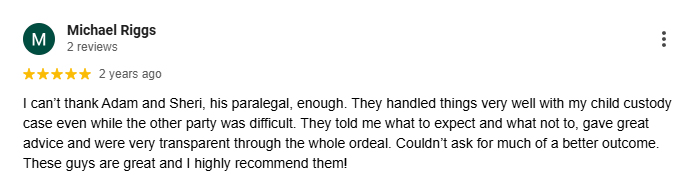
See all Google reviews for Sacks & Sacks Law
Frequently Asked Questions About Child Custody in Florida
Is 50/50 custody automatic in Florida?
Not automatic, but it is the legal starting point. Since July 1, 2023, Florida law creates a rebuttable presumption that equal time-sharing is in the child’s best interests.[3] However, either parent can overcome this presumption by proving, by a preponderance of the evidence, that 50/50 is not in the child’s best interests.
Courts still evaluate all 20 statutory best interest factors before ordering any time-sharing schedule, and many cases result in schedules other than an exact 50/50 split based on the specific family’s circumstances.
At what age can a child choose which parent to live with in Florida?
Florida law does not set a specific age at which a child can choose. Under Factor 9 of F.S. § 61.13(3), the court may consider “the reasonable preference of the child, if the court deems the child to be of sufficient intelligence, understanding, and experience to express a preference.” [2]
In practice, judges generally give more weight to the preferences of teenagers, but the child’s preference is only one of 20 factors. It is never the sole deciding factor. In my experience, courts typically begin giving meaningful weight to a child’s expressed preference around ages 12-14, depending on the child’s maturity.
Can I modify my custody arrangement if circumstances change?
Yes, but you must first demonstrate a substantial and material change in circumstances since the last order was entered. This is intentionally a high bar: it prevents parents from constantly re-litigating custody.
Common qualifying changes include a parent’s relocation, a significant change in work schedule, the child’s evolving needs, evidence of substance abuse or domestic violence, or repeated time-sharing violations. Even after showing a substantial change, the court must also find that the modification serves the child’s best interests.[2]
What happens if the other parent violates the time-sharing schedule?
Florida law takes time-sharing violations seriously. When a parent refuses to honor the schedule without proper cause, the court must award makeup time-sharing to the parent who was denied time.
The court may also order the violating parent to pay attorney’s fees, attend a parenting course, perform community service, or face contempt of court.[2] Documenting each violation with dates, times, and any written communication is critical to building an enforcement case.
Do I need a lawyer for a custody case in Florida?
You are not legally required to have a lawyer, but custody cases involve significant legal complexity: 20 statutory factors, the 50/50 presumption, parenting plan requirements, and strict procedural rules.
In my 25 years handling custody cases in Jacksonville, I’ve seen many parents who represented themselves end up with parenting plans that don’t protect their rights or that create problems years later.
An experienced family law attorney ensures your parenting plan is complete, enforceable, and structured to serve your child’s best interests and your parental rights.
How long does a custody case take in Jacksonville?
Timelines vary significantly. If both parents agree on a parenting plan, the case can be resolved in a few weeks to a couple of months.
Contested cases (where parents disagree on time-sharing or parental responsibility) typically take 6 to 12 months, and complex cases involving domestic violence, substance abuse, or relocation can take longer.
Florida courts often require mediation before trial, which can help resolve disputes more quickly. The 4th Judicial Circuit (Duval County) has its own scheduling practices that an experienced local attorney can navigate efficiently.
What is the difference between parental responsibility and time-sharing?
Parental responsibility determines who makes major decisions about the child: education, healthcare, religion, and welfare. Under shared parental responsibility, both parents participate in these decisions. Under sole parental responsibility, only one parent has decision-making authority.
Time-sharing is the physical schedule: how many overnights and holidays the child spends with each parent.
You can have shared parental responsibility with unequal time-sharing, or sole parental responsibility where the non-custodial parent still has some time-sharing. The two concepts are separate and addressed individually in the parenting plan.[2]
Sources:
[1] Florida Courts, Court Filings and Statistics, 2022-2024 Biennial Report. flcourts.gov
[2] Florida Statutes § 61.13, Support of children; parenting and time-sharing; powers of court (2024). flsenate.gov
[3] Ch. 2023-301, Laws of Florida (SB 1416), Parenting and Time-sharing of Minor Children. flsenate.gov
[4] Bowling Green State University, National Center for Family & Marriage Research, via Wall Street Journal / Law Society Gazette (Sep 2025). lawsociety.ie
[5] Complex Family Law, USA Advances Equal Shared Parenting (Jul 2025). complexfamilylaw.com
[6] Bailey Howard, Retroactivity (or Not) of the Equal Timesharing Presumption, The Florida Bar Journal, Vol. 100, No. 1 (Jan/Feb 2026). floridabar.org
[7] LegalJobs, Child Custody Statistics (2024), citing U.S. Census Bureau data. legaljobs.io
[8] Nielsen, L., Joint vs. Sole Physical Custody: Children’s Outcomes Independent of Parent-Child Relationship Quality, Income, and Conflict in 60 Studies, Journal of Divorce & Remarriage (2018). nielsen.sites.wfu.edu
- Jacksonville Family Law Attorney
- Child Support
- Divorce
- Paternity
- Mediation
- Military Divorce
- Spousal Support & Alimony
- Adoption
- Restraining Orders
- Temporary Custody Orders
Ready to Talk to a Jacksonville Child Custody Attorney?
Free initial consultation with Adam Sacks. Call or request a consultation below.