
Your spouse is on the birth certificate. You raised the kids together. But you never adopted them. That gap can decide whether you still have the right to see your children after the marriage ends, and most Florida divorce lawyers have never had to answer it. For 25 years, Adam Sacks has handled Jacksonville same-sex divorce and custody cases, going back to the Florida adoption ban falling in 2010.
Jacksonville same-sex divorce attorney Adam Sacks is a Florida Supreme Court Certified Family Mediator with 25 years in Duval County family court.
The firm handles parental rights for non-biological parents, pre-marriage property disputes, alimony under Florida’s 2023 reform, surrogacy and donor agreements, and the dissolution of prior civil unions in Duval, Clay, Nassau, and St. Johns counties.
Key Facts: Florida has no separate same-sex divorce statute. Same-sex divorce uses the same statutes as any Florida divorce (F.S. §§ 61.052, 61.075, and 61.13), but same-sex couples face three unique issues not written into Florida’s family law statutes.
Parental rights for non-biological parents can be lost without a completed adoption. Pre-marriage property acquired before legal marriage became possible in 2015 is generally non-marital under F.S. § 61.075. The 2023 alimony reform (Ch. 2023-301) ties alimony duration to legal marriage length, not relationship length.
If you are facing a same-sex divorce in Jacksonville, Adam Sacks can review your situation in a free consultation: (904) 396-5557.
Adam Sacks, Jacksonville same-sex divorce attorney, FL Bar #248370, Florida Supreme Court Certified Family Mediator, 25 years in Duval County family court.
Free initial consultation · Florida Bar #248370, member since 2000 · Florida Supreme Court Certified Family Mediator · Serving Duval, Clay, Nassau and St. Johns
What Makes Same-Sex Divorce Different in Florida
Since Obergefell v. Hodges (2015), same-sex married couples have the same constitutional right to divorce as opposite-sex couples under Florida law: the process uses the same statutes, the same courts, and the same judges in the Fourth Judicial Circuit. But the legal reality is much more complicated than equal access to the courthouse suggests.
Same-sex couples who built lives together for years or decades before marriage became legal in Florida on January 6, 2015, face a set of issues that Florida’s family law statutes were never designed to address.
A non-biological parent can lose all custody rights without a completed adoption. A 20-year partnership can be treated as a 10-year marriage for alimony under the 2023 reform. Jointly purchased property can be classified as non-marital because it was acquired before the legal marriage existed.
These cases demand an attorney who understands the intersection of LGBTQ+ family law with Florida’s evolving statutory framework. [1] [2]
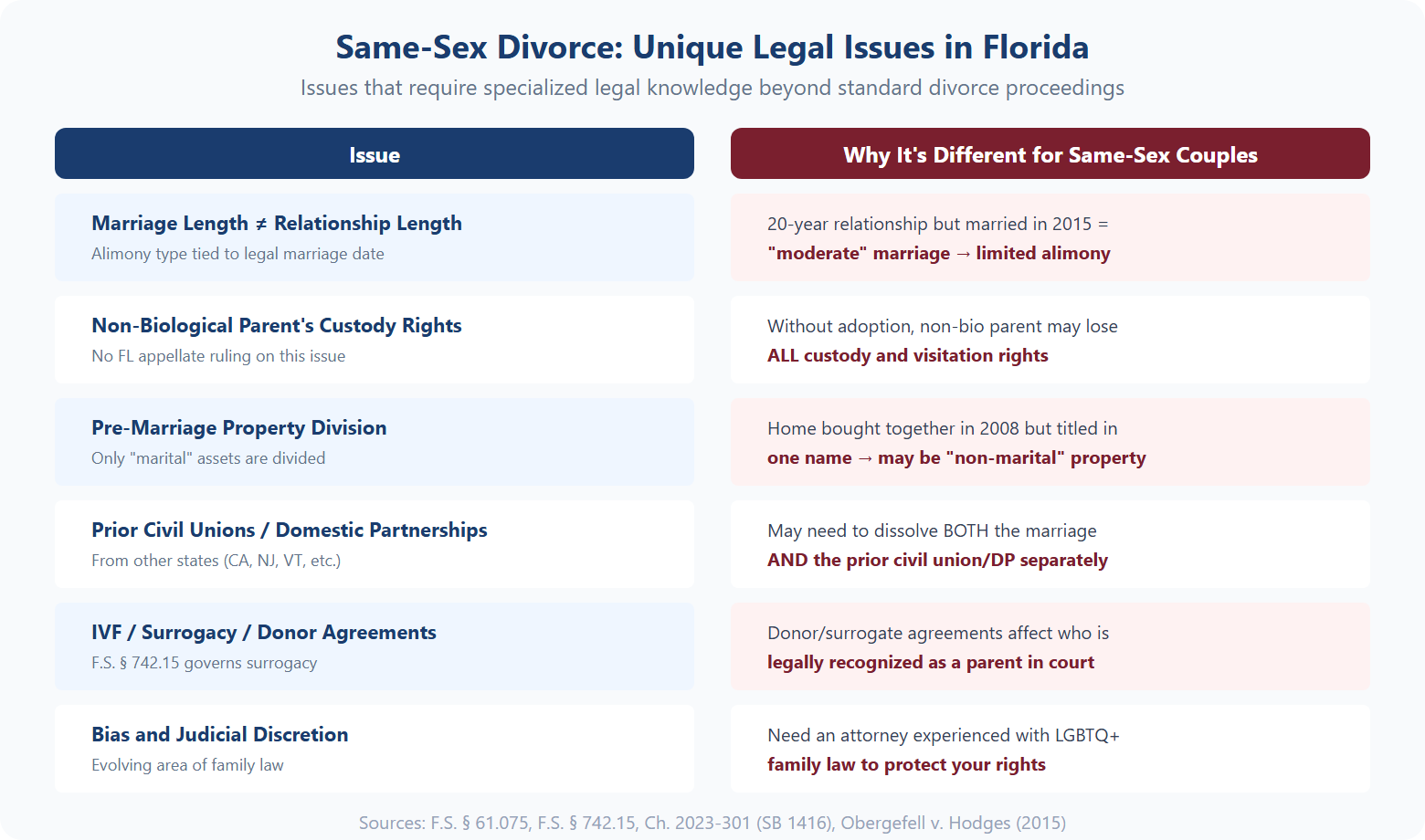
Same-sex couples face a set of issues that simply do not exist in most opposite-sex divorces:
- Parental rights for non-biological parents: The non-biological parent in a same-sex marriage may have no legal custody rights unless they completed a formal adoption. No Florida appellate court has fully resolved this issue. [3]
- Marriage length vs. relationship length: Florida’s 2023 alimony reform (Ch. 2023-301) ties alimony type and duration directly to marriage length. A couple together since 2005 but married in 2015 has a 10-year marriage, not a 20-year one, which dramatically limits alimony eligibility. [2]
- Pre-marriage property division: Under F.S. § 61.075, only assets acquired during the marriage are “marital property” subject to equitable distribution. Property purchased together before 2015 but titled in one name may be classified as non-marital. [1]
- Prior civil unions or domestic partnerships: Some states did not automatically dissolve these when marriage equality passed. You may need to dissolve both the marriage and a prior legal relationship.
- IVF, surrogacy, and donor agreements: These documents affect who is legally recognized as a parent, and their absence can be devastating in a custody dispute.
These are not theoretical concerns. They are issues I see in my practice, and they require an attorney who understands how Florida family law intersects with the unique circumstances of LGBTQ+ families.
Florida’s Same-Sex Marriage Timeline
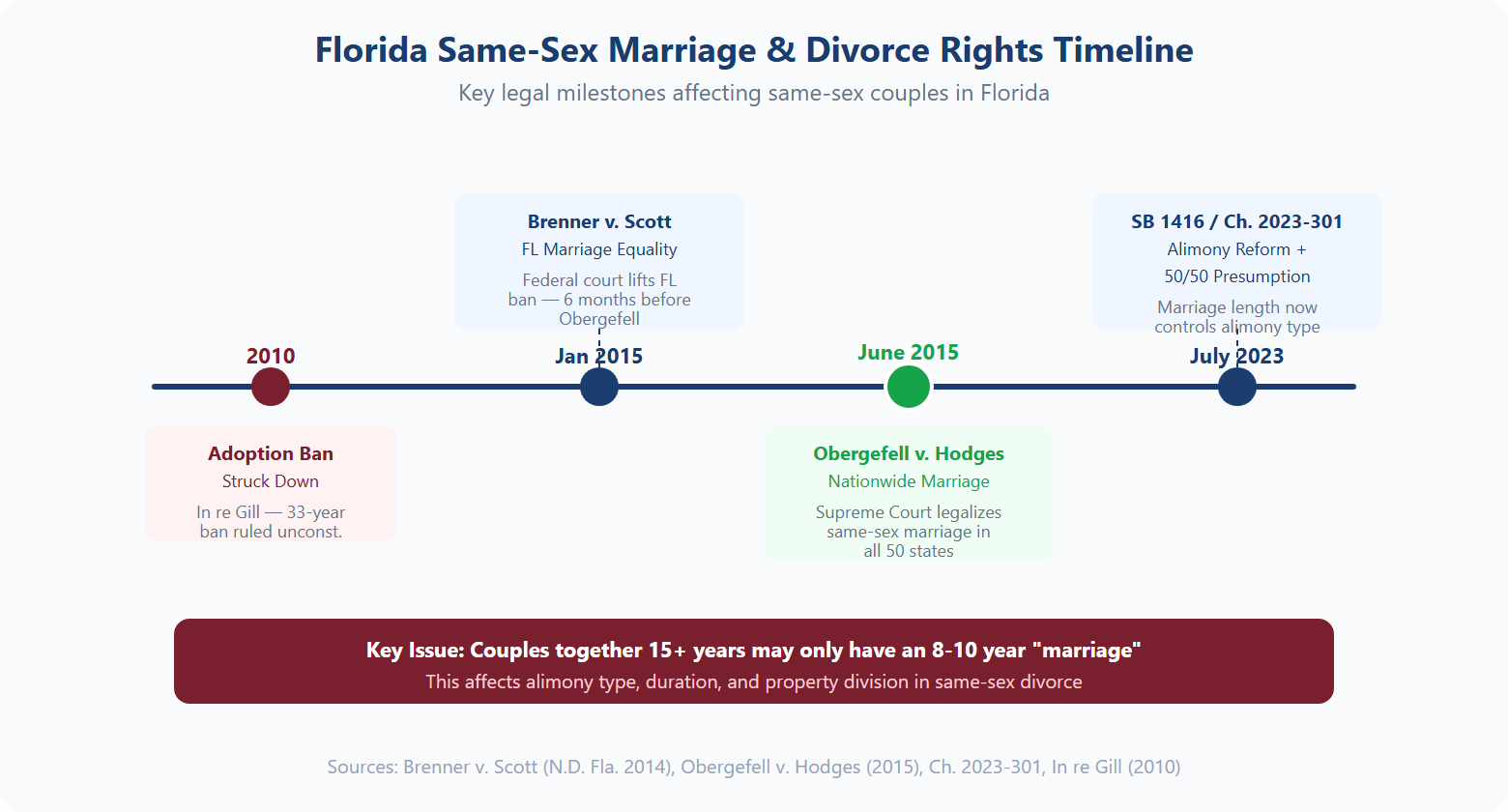
Understanding the timeline of same-sex marriage rights in Florida matters because it directly and materially affects your divorce, especially property division under F.S. § 61.075 and alimony calculations under the 2023 reform (Ch. 2023-301). Florida courts measure marriage length from the date the legal marriage began, not from the date the committed relationship started. [2]
This means a couple who began living together in 2002 but could not legally marry until January 2015 has only an 11-year marriage for alimony purposes, placing them in the “moderate-term” category with a maximum durational alimony award of 60% of the marriage length, rather than the “long-term” category that a 23-year opposite-sex marriage would qualify for.
Similarly, property acquired together before the marriage date may be classified as non-marital, even if both partners contributed equally. [1] These key dates set the legal boundaries for your case:
2010, Adoption Ban Struck Down: In In re Gill, a Florida appellate court ruled the state’s 33-year ban on adoptions by gay and lesbian individuals unconstitutional. [4] The Attorney General declined to appeal, ending the ban permanently. This opened the door for same-sex couples to adopt children and later pursue second-parent adoptions to protect parental rights.
January 6, 2015, Brenner v. Scott: A federal court ruling took effect, striking down Florida’s ban on same-sex marriage, six months before the Supreme Court’s nationwide ruling. [5] Florida became one of the first Southern states to recognize same-sex marriage.
Couples who married between January and June 2015 in Florida have a legally recognized marriage date that predates Obergefell.
June 26, 2015, Obergefell v. Hodges: The U.S. Supreme Court ruled that same-sex couples have a constitutional right to marry in all 50 states. This is the date most same-sex couples in Florida (and nationwide) use as their earliest possible marriage date.
July 1, 2023, SB 1416 (Ch. 2023-301): Florida’s alimony reform eliminated permanent alimony and tied alimony type and duration to marriage length categories. [2] This has a disproportionate impact on same-sex couples whose relationships predated marriage equality: a 25-year relationship that became a legal marriage in 2015 is only an 8-year marriage for alimony purposes.
Parental Rights in Same-Sex Divorce: the Critical Issue
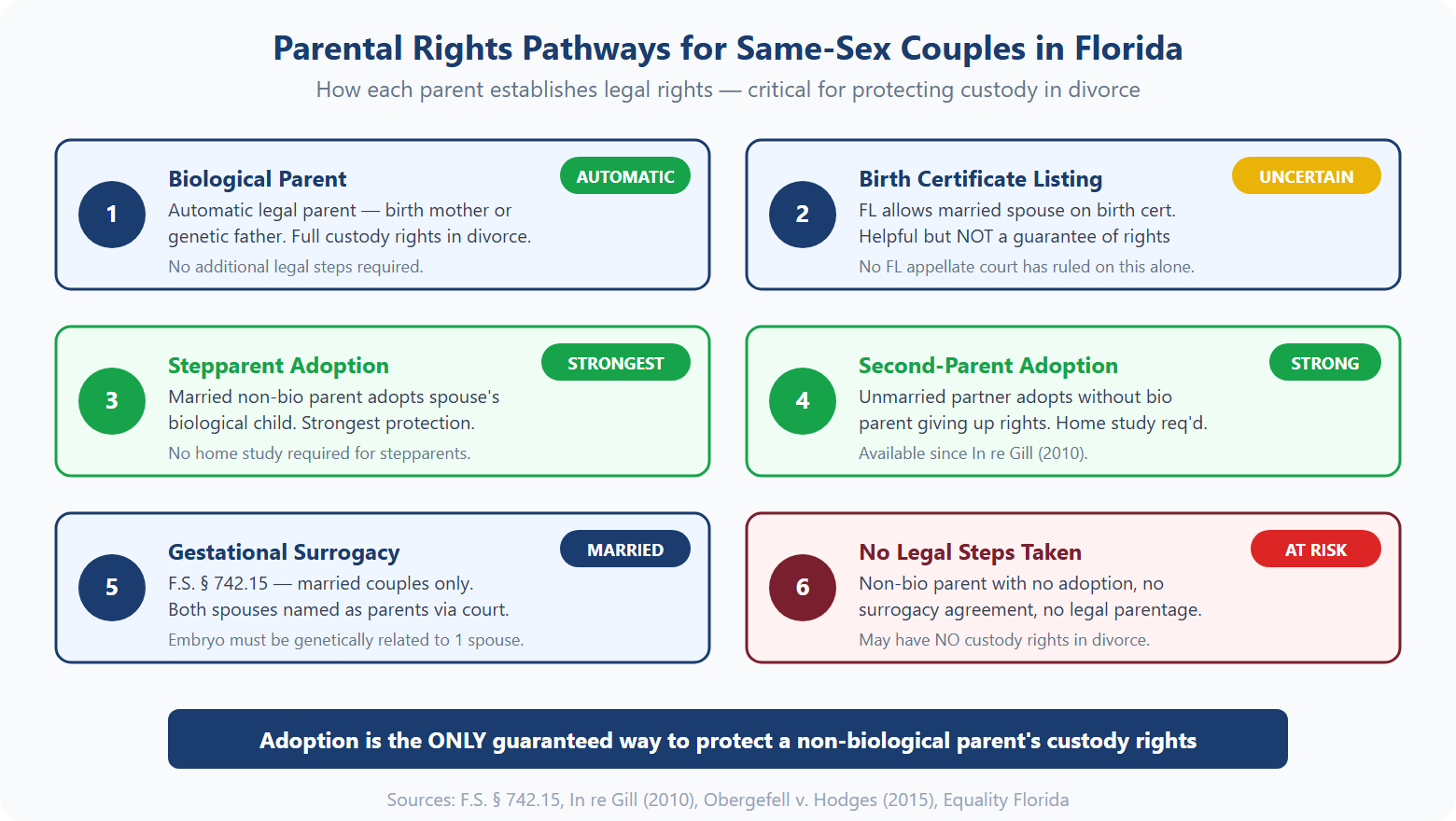
The single most important issue in same-sex divorce involving children is whether the non-biological parent has established legal parentage, and the answer to this question can determine whether that parent retains any custody rights at all after the marriage ends.
In Florida, being married to the biological parent, being listed on the child’s birth certificate, and raising the child together for years does not automatically guarantee enforceable custody or time-sharing rights in a divorce proceeding. [4]
No Florida appellate court has conclusively ruled that a birth certificate alone establishes full parental rights for a non-biological same-sex parent, which means the biological parent in a contested divorce could argue that the non-biological parent has no legal standing to seek custody.
The U.S. Supreme Court’s decision in Pavan v. Smith (2017) held that states must treat same-sex spouses the same as opposite-sex spouses on birth certificates, but Florida courts have not extended this to a definitive ruling on parental rights in divorce. [3]
Here is the reality: Florida law views only the birth parent or adoptive parent as the child’s legal parent. While a married spouse can be listed on the birth certificate, no Florida appellate court has ruled that a birth certificate alone establishes full parental rights for a non-biological same-sex parent. [3]
This means that in a contested divorce, the biological parent could argue that the non-biological parent has no legal standing to seek custody or time-sharing. Without a completed adoption, the non-biological parent may be left with no enforceable custody rights, regardless of how many years they raised the child.
Stepparent and Second-Parent Adoption
The only guaranteed way to protect a non-biological parent’s custody rights in Florida is through adoption:
- Stepparent adoption: Available to married couples. The non-biological spouse adopts the biological parent’s child. No home study is required for stepparent adoptions in Florida. This is the simplest and strongest path.
- Second-parent adoption: Available to unmarried partners. The non-biological parent adopts the child without the biological parent giving up their rights. A home study is required. This has been available in Florida since In re Gill (2010). [4]
If you are a same-sex parent who has not completed an adoption, this is an urgent legal matter, whether or not you are considering divorce. I strongly recommend consulting with an attorney to understand your options before a crisis arises.
Surrogacy, IVF, and Donor Agreements
For same-sex couples who used assisted reproduction, the legal documents governing the process play a critical role in divorce:
- Gestational surrogacy agreements (F.S. § 742.15): Available to married same-sex couples. The embryo must be genetically related to at least one spouse. Both spouses are named as legal parents through a court proceeding. [6]
- Preplanned adoption agreements: Available to unmarried same-sex couples pursuing surrogacy. The process follows adoption procedures rather than the gestational surrogacy statute.
- Known donor agreements: If a known sperm or egg donor was used, a written donor agreement can help establish that the donor has no parental rights, or conversely, that the donor retained certain rights.
- IVF without formal agreements: If IVF was performed without a written surrogacy or donor agreement, parentage disputes become harder to resolve. The court must determine legal parentage on a case-by-case basis.
Child Custody and the 50/50 Presumption
When both parents have established legal parentage (either biologically or through a completed stepparent or second-parent adoption), child custody in a same-sex divorce follows the same rules as any other Florida custody case under F.S. § 61.13.
Sexual orientation is not one of the 20 statutory best-interest factors, and a judge cannot award more or less time-sharing based on a parent being gay, lesbian, or bisexual. [7]
Since July 1, 2023, Florida law establishes a rebuttable presumption that equal 50/50 time-sharing is in the child’s best interest, placing the burden on the parent seeking a different arrangement to demonstrate why equal time is not appropriate. [3]
This presumption applies equally to same-sex parents who have established legal parentage, and the court evaluates all 20 best-interest factors (including each parent’s demonstrated caregiving capacity, the child’s adjustment to home and school, and any history of domestic violence) when determining the final time-sharing schedule.
Since July 1, 2023, Florida law establishes a rebuttable presumption that equal (50/50) time-sharing is in the child’s best interest (Ch. 2023-301, F.S. § 61.13(2)(c)). [3]
The court evaluates all 20 best-interest factors under F.S. § 61.13(3), including each parent’s capacity to facilitate a close relationship with the other parent, the child’s adjustment to home, school, and community, and any history of domestic violence. [7]
Sexual orientation is not one of the 20 statutory factors. A judge cannot award more or less time-sharing based on a parent being gay, lesbian, or bisexual. The analysis focuses entirely on the child’s best interests and each parent’s demonstrated caregiving capacity.
Common time-sharing schedules include:
- Alternating weeks: One week with each parent, rotating
- 2-2-3 rotation: Two days with Parent A, two days with Parent B, three days alternating
- 3-4-4-3 pattern: Three/four day blocks alternating each week
- Every other weekend + midweek: For situations where equal time is not practical
Property Division: the Pre-Marriage Problem
Florida is an equitable distribution state, meaning the court divides marital assets and liabilities fairly, though not necessarily equally, between the spouses.
Under F.S. § 61.075, only assets and debts acquired during the legal marriage are classified as “marital property” subject to division, while assets acquired before the marriage belong to the spouse who acquired them as non-marital property. [1]
For same-sex couples, this classification creates a uniquely unfair result that does not exist in most opposite-sex divorces: property accumulated together during years or even decades of committed cohabitation before January 2015 may be classified as non-marital because it was acquired before a legal marriage existed in Florida.
A home purchased jointly in 2008 but titled in one partner’s name, retirement account growth before 2015, and business interests started during the relationship are all potentially at risk of being excluded from equitable distribution, regardless of both partners’ contributions. [1]
For same-sex couples, this creates a unique and often unfair result: assets accumulated together during years or decades of cohabitation before 2015 may be classified as non-marital property because they were acquired before the legal marriage existed.
Common scenarios include:
- A home purchased together in 2008 but titled in only one partner’s name: may be classified as that partner’s non-marital asset, even though both contributed to the down payment and mortgage payments
- Retirement accounts: Only the appreciation during the marriage (post-2015) is marital property; pre-marriage growth belongs to the account holder
- Business interests: A business started during the relationship but before the marriage may be non-marital, though the marital portion of its growth could be divisible
- Joint bank accounts: May be subject to commingling arguments, but the burden is on the non-titled spouse to prove contributions
Some judges may consider the equitable distribution factors in F.S. § 61.075(1) (including each spouse’s economic circumstances, contributions to the marriage, and duration of the marriage) to achieve a fairer result. But there is no guarantee, and the legal starting point favors the titled spouse. [1]
This is an area where aggressive advocacy and creative legal arguments matter most.
If you built a life together before marriage was legal, your attorney needs to fight to make sure the court considers the full picture, not just the narrow window of the legal marriage.
Alimony After the 2023 Reform: the Marriage Length Trap
Florida’s 2023 alimony reform (SB 1416, Ch. 2023-301) eliminated permanent alimony entirely and tied the type and duration of all spousal support directly to the length of the legal marriage, a change that disproportionately impacts same-sex couples whose committed relationships predated marriage equality. [2]
Under the new law, durational alimony is capped at 50% of the marriage length for short-term marriages (under 10 years), 60% for moderate-term marriages (10–20 years), and 75% for long-term marriages (20+ years), with no alimony available at all for marriages lasting fewer than three years.
The maximum award cannot exceed 35% of the difference between the spouses’ net incomes or the recipient’s reasonable need, whichever is less.
Florida measures marriage length from the date of the legal marriage, not the start of the relationship.
A same-sex couple together since 2000 but married in 2015 has only a 10-year marriage, severely limiting the support available to the lower-earning spouse: [2]
- Under 3 years: No durational alimony available
- Short-term (3–9 years): Durational alimony up to 50% of marriage length
- Moderate-term (10–20 years): Durational alimony up to 60% of marriage length
- Long-term (20+ years): Durational alimony up to 75% of marriage length
The alimony cap is the lower of 35% of the income difference or the recipient’s reasonable need.
Here is where this disproportionately affects same-sex couples: A couple that began their committed relationship in 2000 but could not legally marry until 2015 has only a 10-year marriage as of 2025. Under the new law, that is a “moderate-term” marriage, capping alimony at 60% of 10 years (6 years maximum).
In an opposite-sex marriage of the same relationship duration (25 years), the marriage would be “long-term”, qualifying for up to 75% of 25 years (nearly 19 years of alimony).
Florida law counts the marriage from the date of the legal marriage, not the date the relationship began. [2]
However, an experienced attorney can present evidence of the full relationship duration.
Equitable factors (including each spouse’s sacrifice of career opportunities, financial contributions, and caregiving roles during the pre-marriage period) should be considered.
Prior Civil Unions and Domestic Partnerships
Some same-sex couples entered into civil unions or domestic partnerships in states such as California, New Jersey, Vermont, Connecticut, or Hawaii before marriage equality became the law nationwide in 2015.
These legal relationships carried specific rights and obligations under the laws of the states that created them, and when couples later married in Florida, the prior civil union or domestic partnership may not have been automatically dissolved or converted into the marriage.
This creates a practical problem in divorce: your Florida dissolution proceeding may need to address both the termination of the marriage and the separate dissolution of the earlier legal relationship.
Complicating matters further, the state that originally created the civil union may impose its own residency requirements for dissolution, meaning you might need to file proceedings in two states, or your Florida attorney must develop a legal strategy to address both relationships within the Florida court system.
This means that in some cases, your divorce may need to address both the dissolution of the marriage and the termination of the prior civil union or domestic partnership. The state that created the civil union may have specific requirements for its dissolution, including residency requirements that could complicate the process if you no longer live there.
An attorney experienced in same-sex family law can determine whether your prior civil union or domestic partnership has been properly dissolved and make sure every legal relationship is addressed in your Florida divorce proceeding.
Common Mistakes in Same-Sex Divorce Cases
- Assuming the non-bio parent automatically has custody rights: Being married and on the birth certificate is not enough. Without a completed adoption, the non-biological parent’s rights are legally uncertain in Florida. [3]
- Not addressing pre-marriage property proactively: If you acquired significant assets together before 2015, your attorney needs to develop a strategy for arguing that those assets should be considered in the equitable distribution. Don’t wait for the other side to classify them as non-marital.
- Hiring a divorce attorney without LGBTQ+ family law experience: Standard divorce knowledge is not sufficient. Same-sex divorce involves parental rights, assisted reproduction law, pre-marriage cohabitation issues, and civil union dissolution that most family law attorneys have never handled.
- Ignoring the alimony marriage-length issue: If you were together long before marriage was legal, your attorney must present the full relationship history to the court and argue for equitable consideration of the entire partnership.
- Not completing a stepparent adoption before divorce: If divorce is a possibility and the non-biological parent has not adopted, completing the adoption should be the first priority, before filing for divorce, if possible.
- Failing to preserve donor/surrogacy documents: IVF consent forms, donor agreements, and surrogacy contracts are critical evidence in custody disputes. Preserve all originals and copies.
Why Choose Adam Sacks for Your Same-Sex Divorce
I’ve handled same-sex divorce and custody cases in the Fourth Judicial Circuit since Obergefell made them possible in 2015, and I’ve worked with LGBTQ+ families on adoption and parental rights issues since the adoption ban was struck down in 2010. These cases require a different set of skills than a standard divorce, and I’ve spent years developing that expertise.
What I bring to same-sex divorce cases is perspective. My background as a former prosecutor for the State of Florida means I know how to build a case, present evidence, and argue persuasively in front of judges who may have limited experience with LGBTQ+ family law issues.
My psychology degree from the University of Massachusetts gives me insight into the emotional dynamics that same-sex couples face during divorce, dynamics that are often different from those in opposite-sex divorces.
I’m also a Florida Supreme Court Certified Family Mediator. Not every same-sex divorce needs to be a courtroom battle.
When both parties are reasonable and the children’s interests are clear, I can help negotiate a settlement that protects your rights without the cost and stress of litigation. But when the other side is unreasonable, or when parental rights are at stake, I’m prepared to fight.
Adam Sacks earned his J.D. from Western Michigan University Cooley Law School, where he received a Book Award for the highest grade in his class. He served as an Assistant State Attorney in Seminole County before transitioning to private practice.
He holds a bachelor’s degree in Psychology from the University of Massachusetts. He is a Florida Supreme Court Certified Family Mediator and a member of the Florida Bar (Bar #248370) since 2000.
What Happens When You Call Our Office
When you call (904) 396-5557, you will speak directly with attorney Adam Sacks about your same-sex divorce or LGBTQ+ family law matter.
These cases involve sensitive and legally complex issues (parental rights for non-biological parents, the marriage-length trap under Florida’s 2023 alimony reform, pre-marriage property classification, IVF and surrogacy agreements, and the potential need to dissolve prior civil unions) that require personal attention from an attorney with specific experience in this area.
I have handled same-sex divorce and custody cases in the Fourth Judicial Circuit since Obergefell made them possible, and I have worked with LGBTQ+ families on adoption and parental rights issues since 2010.
My initial consultations are free, and I will give you a candid, honest assessment of your situation so you can make informed decisions about how to proceed. Here is exactly what happens:
- You speak with me directly. Same-sex divorce cases involve sensitive issues that require personal attention from the start.
- Parental rights assessment. I’ll immediately evaluate whether the non-biological parent has established legal parentage, and if not, what steps need to be taken urgently.
- Property and alimony strategy. I’ll analyze your marriage date, relationship history, asset structure, and income to develop a strategy that accounts for the unique challenges same-sex couples face under Florida’s current laws.
- Honest assessment. I’ll tell you exactly where you stand (the strengths and vulnerabilities of your case) so you can make informed decisions about how to proceed.
- Representation from consultation through final judgment. I handle every phase of your case personally: filing, discovery, mediation, hearings, and trial if necessary.
Ready to talk?
Call (904) 396-5557 or request a free consultation. Adam Sacks personally handles every same-sex divorce case from first call to final judgment.
Client Reviews: See What People Are Saying
See all Google reviews for Sacks & Sacks Law
Frequently Asked Questions About Same-Sex Divorce in Jacksonville
Is Same-Sex Divorce the Same as Any Other Divorce in Florida?
Legally, same-sex divorce uses the same statutes and court procedures as any other divorce in Florida: equitable distribution under F.S. § 61.075, child custody under F.S. § 61.13, and alimony under F.S. § 61.08. [1] [7]
However, same-sex couples face unique issues including non-biological parent custody rights, pre-marriage property disputes, and the marriage-length trap for alimony. An attorney experienced in LGBTQ+ family law matters here.
What Happens to Custody if the Non-Biological Parent Never Adopted?
This is the most critical risk in same-sex divorce. Without a completed adoption, the non-biological parent may have no enforceable custody rights, even if they raised the child from birth and are listed on the birth certificate. [3]
No Florida appellate court has ruled that marriage plus a birth certificate alone establishes full parental rights for a non-biological same-sex parent. If you are in this situation, consult an attorney immediately.
How Does the 2023 Alimony Reform Affect Same-Sex Divorce?
Disproportionately. The 2023 reform (Ch. 2023-301) ties alimony duration to marriage length. [2]
Same-sex couples who were together for decades but could not legally marry until 2015 have “short” or “moderate” marriages on paper, severely limiting their alimony eligibility. A skilled attorney can argue for the court to consider the full relationship duration when evaluating equitable factors.
Can the Court Consider Assets We Acquired Before Marriage?
Under F.S. § 61.075, only assets acquired during the legal marriage are “marital property.” [1]
Pre-marriage assets are generally non-marital.
However, if pre-marriage assets were commingled with marital assets (for example, a pre-marriage home refinanced during the marriage), there may be arguments for partial inclusion. Your attorney needs to analyze each asset individually.
Do We Need to Dissolve a Prior Civil Union or Domestic Partnership?
Possibly. Some states did not automatically convert or dissolve civil unions and domestic partnerships when marriage equality passed.
If you entered into a civil union in New Jersey, Vermont, or another state, it may still exist as a separate legal relationship.
Your Florida divorce attorney should verify whether any prior legal relationships need to be dissolved.
Does Sexual Orientation Affect Custody Decisions in Florida?
No. Sexual orientation is not one of the 20 best-interest factors under F.S. § 61.13(3). [7] A judge cannot award more or less time-sharing based on a parent being gay, lesbian, or bisexual. Florida’s 50/50 time-sharing presumption (Ch. 2023-301) applies equally to all parents who have established legal parentage. [2]
Should We Complete a Stepparent Adoption Before Filing for Divorce?
In my experience, yes, if the non-biological parent has not already adopted, completing the adoption before filing for divorce is the strongest strategy.
Once the adoption is finalized, the non-biological parent has the same legal rights as the biological parent, and custody is determined based on best-interest factors, not biology. This takes a potential weapon off the table.
Sources:
[1] Florida Statutes, F.S. § 61.075: Equitable Distribution of Marital Assets and Liabilities (2025). Classification, valuation, and distribution of marital property. leg.state.fl.us
[2] Florida Legislature, Ch. 2023-301 (SB 1416/HB 1301): Dissolution of Marriage; Parenting and Time-Sharing. Effective July 1, 2023. 50/50 presumption, alimony reform, marriage length categories. flsenate.gov
[3] Equality Florida, LGBT Family FAQ: Parental Rights and Custody. Non-biological parent rights, birth certificate limitations, adoption recommendations. eqfl.org
[4] Florida Third District Court of Appeal, In re Gill (2010). Struck down Florida’s 33-year ban on adoption by gay and lesbian individuals. aclu.org
[5] U.S. District Court, N.D. Florida, Brenner v. Scott, Case No. 4:14-cv-00107 (2014–2015). Struck down Florida’s ban on same-sex marriage, effective January 6, 2015. clearinghouse.net
[6] Florida Statutes, F.S. § 742.15: Gestational Surrogacy Contract (2025). Requirements for surrogacy agreements, parental rights for commissioning couples. leg.state.fl.us
[7] Florida Statutes, F.S. § 61.13: Support of Children; Parenting and Time-Sharing; Powers of Court (2025). 20 best-interest factors, parental responsibility, time-sharing presumption. leg.state.fl.us