
Jacksonville Personal Bankruptcy Lawyers
More than 517,000 Americans filed for personal bankruptcy in 2024, a 14.2% increase over the prior year (U.S. Courts), and filings continued climbing in 2025 with 574,314 total cases nationwide. The Middle District of Florida, which includes the Jacksonville Division where our office files cases, is the 3rd busiest bankruptcy court of 90 federal districts in the nation. In Florida alone, 37,156 cases were filed — behind only California — and filings in the Middle District of Florida, which includes Jacksonville, rose 26.9% year over year (Kelley Law Office). Whether you are overwhelmed by medical bills, credit card debt, wage garnishment, or the threat of foreclosure on your home, personal bankruptcy under federal law provides a powerful legal mechanism to eliminate or restructure that debt while protecting your essential assets under Florida’s generous exemption system.
At The Law Offices of Sacks & Sacks, P.A., our Jacksonville personal bankruptcy attorneys have spent more than 50 years of combined practice helping individuals and families overcome debt. We handle every step of the process — from determining which chapter fits your situation through your final discharge — and we include a proven credit score recovery program so bankruptcy is the beginning of your fresh start, not just the end of your debt.
Schedule a free consultation today — call (904) 396-5557.
What Is Personal Bankruptcy?
Personal bankruptcy is a federal legal process under U.S. Code Title 11 that allows individuals to either eliminate qualifying debts entirely through Chapter 7 liquidation or repay them at reduced amounts through a court-supervised Chapter 13 repayment plan lasting three to five years. In 2025, 574,314 Americans used this legal protection to regain control of their finances (U.S. Courts). The moment your petition is filed with the U.S. Bankruptcy Court for the Middle District of Florida, the automatic stay takes effect — immediately halting foreclosure, wage garnishment, repossession, creditor lawsuits, and collection calls. Florida’s bankruptcy exemptions are among the most protective in the nation, shielding unlimited equity in your homestead, up to $5,000 in vehicle equity, and 100% of ERISA-qualified retirement accounts. At Sacks & Sacks, bankruptcy attorney Melanie Sacks — FL Bar #158070, 27+ years of experience, 6,354+ cases filed — evaluates your complete financial picture and recommends the chapter that provides the most relief.
Most personal bankruptcy cases in Jacksonville fall under one of two chapters:
- Chapter 7 — Eliminates most unsecured debt in 3 to 6 months.
- Chapter 13 — Restructures debt into a 3-to-5-year repayment plan while you keep your property.
Which chapter is right for you depends on your income, your assets, and the types of debt you owe. Our attorneys analyze your complete financial picture to recommend the path that provides the most relief.
Chapter 7 Bankruptcy — Quick Debt Relief
Chapter 7, sometimes called “liquidation bankruptcy” or “straight bankruptcy,” erases most unsecured debts — credit cards, medical bills, personal loans, and utility balances — typically within 3 to 6 months of filing. In 2024, over 310,000 Chapter 7 cases were filed nationwide, accounting for 60% of all bankruptcy filings (Debt.org). The vast majority of Chapter 7 cases in Florida are “no-asset” cases, meaning filers keep everything they own because all of their property falls within the state’s generous exemption limits. For most Jacksonville residents, Chapter 7 provides a complete fresh start: eligible debts are permanently discharged, creditors can never attempt to collect on them again, and the entire process is typically completed within three to six months of filing. Florida’s strong exemption system means you can protect your home, car, retirement accounts, and essential personal property throughout the process.
Who qualifies: To file Chapter 7 in Florida you must pass the means test, which compares your household income to the state median. For filings between November 2025 and May 2026, the income limits are (Nolo):
- 1-person household: $68,085
- 2-person household: $84,305
- 3-person household: $95,039
- 4-person household: $111,819
- Each additional person: add $11,100
If your income falls below these thresholds, you qualify. If it exceeds them, a more detailed calculation of your disposable income may still allow you to file. Our Jacksonville office can walk you through the means test during your free consultation.
Key considerations: Non-exempt assets may be sold to repay creditors, but Florida’s generous exemptions protect most property (see exemptions below). Chapter 7 does not stop foreclosure long-term or allow you to catch up on missed mortgage payments.
Learn more about Chapter 7 bankruptcy in Jacksonville →
Chapter 13 Bankruptcy — Keep Your Home and Assets
Chapter 13 reorganizes your debts into a single monthly payment you can afford, paid to a court-appointed trustee over a 3-to-5-year plan supervised by the U.S. Bankruptcy Court. Nearly 200,000 Americans filed Chapter 13 in 2024, representing 38% of all bankruptcy cases (Debt.org). Chapter 13 is the preferred option for Jacksonville homeowners who are behind on their mortgage, because it stops foreclosure immediately through the automatic stay and allows you to cure past-due payments over the life of your repayment plan. It is also the primary path for higher-income individuals who do not pass the Chapter 7 means test but still need debt relief. Unlike Chapter 7, there is no income cap for Chapter 13 — you qualify as long as you have regular income and your total debts fall within current federal limits.
Who qualifies: You need regular income (wages, salary, self-employment, pension, or Social Security) and your total debts must fall within current limits: $526,700 in unsecured debt and $1,580,125 in secured debt (Nolo). There is no income cap — Chapter 13 is available regardless of how much you earn.
Best for: Homeowners behind on mortgage payments, higher earners who do not pass the Chapter 7 means test, and anyone who wants to keep non-exempt property while repaying creditors over time. Chapter 13 can cure mortgage arrears through the plan, stopping foreclosure permanently.
Learn more about Chapter 13 bankruptcy in Jacksonville →
Which Chapter Is Right for You?
Choosing between Chapter 7 and Chapter 13 is one of the most important decisions in the bankruptcy process, and the right answer depends on your income, the types and amounts of debt you owe, and what assets you need to protect. Chapter 7 works best for lower-income filers who pass the means test and want to eliminate unsecured debt quickly within three to six months. Chapter 13 is typically the stronger option for homeowners facing foreclosure, individuals with income above the Florida median, and anyone who wants to keep non-exempt property while repaying creditors over a three-to-five-year court-supervised plan. At Sacks & Sacks, attorney Melanie Sacks evaluates both options during your free consultation and recommends the chapter that provides the strongest outcome for your specific financial situation. The comparison below highlights the key differences.
| Factor | Chapter 7 | Chapter 13 |
|---|---|---|
| Timeline | 3–6 months | 3–5 years |
| Your property | Non-exempt assets may be sold | Keep all assets |
| Foreclosure | Temporary delay only | Stops and cures arrears over plan |
| Income requirement | Must pass means test | Regular income, any level |
| Credit report | Stays 10 years | Stays 7 years |
| Filing fee | $338 | $313 |
| Best for | Low-income filers with few assets | Homeowners, higher earners |
Not sure which chapter fits? Our Jacksonville attorneys will evaluate your finances and recommend the strongest option during your free consultation.
What Property Can You Keep? Florida Exemptions
Florida offers some of the most protective bankruptcy exemptions in the country, and these exemptions are what make it possible for the vast majority of filers in Jacksonville to keep their home, car, retirement savings, and other essential property throughout the bankruptcy process. Under Florida Statutes Chapter 222, the state has opted out of the federal bankruptcy exemption system and established its own protections, which are significantly more generous than the federal defaults. Florida’s unlimited homestead exemption is among the strongest in the nation, protecting all equity in your primary residence regardless of its total market value, as long as you meet residency and property size requirements. These exemptions apply in both Chapter 7 and Chapter 13 cases and are among the most generous in any state in the country, determining what you keep regardless of which chapter you file (Nolo):
- Homestead: Unlimited equity in your primary residence (up to ½ acre in a city or 160 acres in a rural area). If you have owned the home for less than 1,215 days, the exemption is capped at $214,000.
- Motor vehicle: Up to $5,000 in equity per vehicle.
- Personal property: $1,000 general exemption ($4,000 if you do not claim the homestead exemption).
- Wages: Head-of-household wages are protected — generally up to $750/week or 75% of disposable earnings.
- Retirement accounts: Tax-qualified plans are fully exempt.
- Life insurance: Cash value and proceeds are exempt.
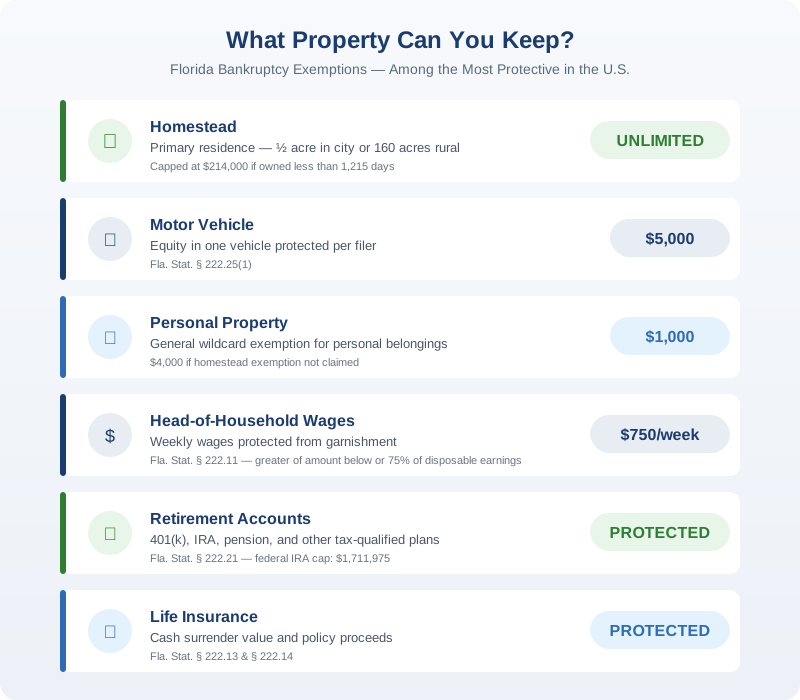
Because Florida’s homestead exemption is unlimited in value, many Jacksonville homeowners are able to file Chapter 7 without losing their home — as long as mortgage payments stay current.
How Much Does Personal Bankruptcy Cost in Florida?
Filing fees are set by the federal court: $338 for Chapter 7 and $313 for Chapter 13 (Nolo). Total costs including attorney fees and the two required financial education courses typically range from $1,800–$3,500 for Chapter 7 and $3,500–$5,000 for Chapter 13. Chapter 7 attorney fees must generally be paid before filing, while Chapter 13 fees can be included in your repayment plan, meaning you do not have to save up the full amount before getting started. Fee waivers and installment payment plans for court filing fees are also available for qualifying filers. For many Jacksonville residents, the cost of filing bankruptcy is a fraction of the total debt that will be eliminated — making it one of the most cost-effective legal remedies available for overwhelming financial obligations. At Sacks & Sacks, we also offer a Fast File option starting at just $250 upfront in attorney fees to get your case filed quickly when time-sensitive relief is needed.
At Sacks & Sacks, we offer transparent pricing and flexible arrangements. Call (904) 396-5557 to discuss costs during your free, no-obligation consultation, where we explain every fee involved and help you determine the most affordable path forward for your unique financial situation and goals.
What Debts Can Bankruptcy Discharge?
Understanding which debts bankruptcy can and cannot eliminate is essential before filing, because it directly determines how much financial relief you will receive. Under federal bankruptcy law, most types of unsecured debt — obligations not backed by collateral — are eligible for discharge in both Chapter 7 and Chapter 13 proceedings. This includes credit card balances, medical bills, personal loans, payday loans, utility arrears, past-due rent, deficiency balances after foreclosure or repossession, and most civil judgments. However, certain debts are designated as non-dischargeable under 11 U.S.C. § 523 and will survive the bankruptcy process. During your free consultation at our Jacksonville office, attorney Melanie Sacks reviews every debt you owe and explains exactly what will be eliminated, what will remain, and whether filing makes strategic sense for your specific financial circumstances. In most cases, the debts causing the greatest hardship are fully dischargeable.
Debts typically eliminated or reduced:
- Credit card balances
- Medical bills
- Personal loans and payday loans
- Utility arrears
- Past-due rent
- Some older tax debts
- Deficiency balances after repossession or foreclosure
Debts that generally survive bankruptcy:
- Child support and alimony
- Most student loans (absent a showing of undue hardship)
- Recent tax obligations
- Criminal fines and restitution
- Debts arising from fraud
Our attorneys can review your specific debts and explain which obligations will be discharged and which will remain after your case.
How Does Bankruptcy Affect Your Credit?
A Chapter 7 filing remains on your credit report for 10 years from the filing date, while Chapter 13 stays for 7 years — three years shorter, which is one reason some filers prefer Chapter 13 when both options are available. However, the impact on your credit score diminishes significantly over time, and many filers see meaningful improvement within one to two years of discharge (Nolo). It is important to understand that by the time most people file for bankruptcy, their credit has already been damaged by missed payments, collections, and high utilization ratios. Bankruptcy often provides the reset needed to begin rebuilding on a clean foundation. At Sacks & Sacks, every bankruptcy client receives complimentary enrollment in our 7 Steps to a 720 Credit Score program, a structured post-discharge roadmap designed to accelerate your credit recovery and help you reach a good credit score within two to three years of your discharge.
Typical credit recovery timeline:
- 6 months after discharge: Credit scores begin stabilizing. Secured credit card offers arrive.
- 1–2 years: Renting an apartment and opening bank accounts becomes easier.
- 2–4 years: Interest rates improve. Mortgage eligibility returns.
- 7–10 years: Bankruptcy falls off your credit report.
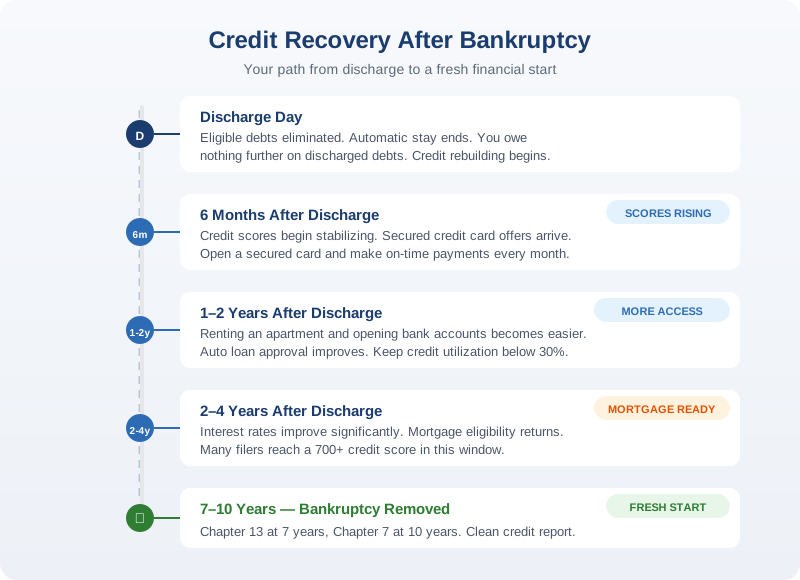
At Sacks & Sacks, we do not stop at discharge. Our credit score recovery program gives every client a concrete roadmap to rebuild their credit — because eliminating debt is only half the solution. Learn about our 7 Steps to a 720 Credit Score →
Client Reviews — See What People Are Saying
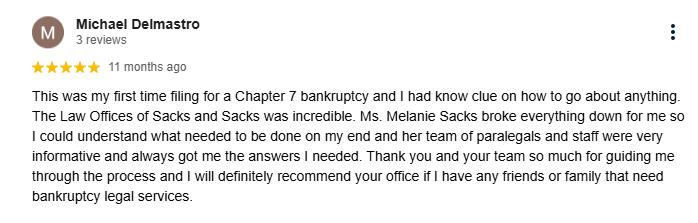
See more reviews on Google Maps
Frequently Asked Questions About Personal Bankruptcy in Jacksonville
How do I know if I should file Chapter 7 or Chapter 13?
The right chapter depends on your income, property, and goals. If your household income is below the Florida median and you have few non-exempt assets, Chapter 7 may be the fastest path to relief. If you own a home and need to catch up on mortgage payments — or if your income exceeds the means test limits — Chapter 13 allows you to repay debt over time while keeping your property. Our attorneys evaluate your complete financial situation during a free consultation and recommend the strongest option.
Will I lose my home if I file for bankruptcy in Florida?
Florida’s homestead exemption protects unlimited equity in your primary residence, as long as you meet residency requirements. In Chapter 7, you keep your home if you stay current on mortgage payments. In Chapter 13, you can cure past-due payments through your repayment plan. Most Jacksonville homeowners do not lose their home in either chapter.
Can bankruptcy stop a foreclosure or wage garnishment?
Yes. The automatic stay takes effect the moment your petition is filed, immediately stopping foreclosure proceedings, wage garnishment, bank levies, repossession, and creditor lawsuits. Chapter 13 provides long-term relief by allowing you to cure mortgage arrears through the repayment plan.
How much does it cost to file for bankruptcy in Jacksonville?
Court filing fees are $338 for Chapter 7 and $313 for Chapter 13. Including attorney fees and required counseling courses, total costs typically range from $1,800–$3,500 for Chapter 7 and $3,500–$5,000 for Chapter 13. Chapter 13 attorney fees can often be folded into your repayment plan. We discuss all costs transparently during your free consultation.
What debts cannot be discharged in bankruptcy?
Child support, alimony, most student loans, recent tax debts, criminal fines, and debts arising from fraud generally cannot be discharged. Most other unsecured debts — including credit cards, medical bills, and personal loans — are eligible for discharge in both Chapter 7 and Chapter 13.
How long does bankruptcy stay on my credit report?
Chapter 7 stays on your credit report for up to 10 years from the filing date. Chapter 13 stays for 7 years. However, many filers begin rebuilding credit within months of discharge. Our credit score recovery program helps clients develop a plan to reach a 720 credit score after bankruptcy.
How long does the bankruptcy process take?
A typical Chapter 7 case takes 3 to 6 months from filing to discharge. Chapter 13 involves a repayment plan lasting 3 to 5 years, with the discharge occurring after successful completion. In both cases, the automatic stay provides immediate relief from creditor actions as soon as the petition is filed.
Take the First Step Toward Financial Freedom
If mounting debts, creditor calls, wage garnishment, or the threat of foreclosure keep you up at night, you do not have to face it alone. The Law Offices of Sacks & Sacks, P.A. has helped thousands of Jacksonville families eliminate overwhelming debt, protect their homes and essential property under Florida’s generous exemption system, and rebuild their financial futures through our proven credit score recovery program. Attorney Melanie Sacks brings 27 years of experience and more than 6,354 bankruptcy cases filed in the Middle District of Florida, Jacksonville Division. Whether you need the quick debt elimination of Chapter 7 or the structured repayment protection of Chapter 13, we evaluate your complete financial picture during a free, no-obligation consultation and recommend the strongest path forward. You do not have to leave your house — we handle everything virtually, from the initial consultation to filing your petition with the court.
Call (904) 396-5557 or contact us online to schedule your free personal bankruptcy consultation.
Related: Jacksonville Bankruptcy Lawyer | Chapter 7 Bankruptcy | Chapter 13 Bankruptcy | Business Bankruptcy | Bankruptcy Fast File | Debt Consolidation | 7 Steps to a 720 Credit Score
