
When Should a Jacksonville Business Consider Bankruptcy?
Business bankruptcy is not an admission of failure — it is a federal legal tool designed to give struggling companies a path forward. The U.S. Bankruptcy Code (Title 11) provides structured relief that can halt creditor lawsuits, prevent asset seizure, and give you time to either reorganize or wind down operations in an orderly manner. Commercial bankruptcy filings reached 31,810 nationally in 2025, a 5% increase over the prior year (Epiq AACER, 2026), and the Middle District of Florida — which includes Jacksonville — consistently ranks as one of the busiest bankruptcy courts in the nation. As a Jacksonville bankruptcy attorney with 27+ years of experience and more than 6,354 cases filed, I help business owners understand every available option under Chapter 7 liquidation, Chapter 11 reorganization, Subchapter V streamlined reorganization, and Chapter 13 for sole proprietors. Call (904) 396-5557 for a free consultation.
You should consider speaking with a Jacksonville business bankruptcy attorney if your company is experiencing any of the following:
- Cash flow shortfalls — You cannot cover payroll, rent, or essential vendor payments for two or more consecutive months
- Creditor lawsuits or judgments — One or more creditors have filed suits or obtained judgments against your business
- Tax delinquencies — You are behind on federal payroll taxes (IRS Form 941), Florida sales tax, or corporate income taxes
- Lease or loan defaults — Your landlord has issued a notice to vacate, or your lender has sent a default notice on a commercial loan
- Unsustainable debt load — Total business debts exceed the value of your assets, and the gap is growing
Acting early matters. Business owners who consult a bankruptcy attorney before a crisis escalates generally have more options — including reorganization plans that allow the company to continue operating.
Concerned About Your Business Debt?
Attorney Melanie Sacks offers free business bankruptcy consultations for Jacksonville business owners.
(904) 396-5557 | Schedule Online
Types of Business Bankruptcy in Florida
Under the U.S. Bankruptcy Code (Title 11), there are four chapters most relevant to businesses: Chapter 7 (liquidation), Chapter 11 (full reorganization), Subchapter V (streamlined small business reorganization under 11 U.S.C. § 1181-1195), and Chapter 13 (available only to sole proprietors). The right chapter depends on your business structure, total debt level, whether you want to continue operating or shut down, and how many creditors you need to address. For Jacksonville businesses, the choice also depends on Florida-specific exemptions — including the state’s unlimited homestead exemption — and the debt limits that determine Subchapter V eligibility (currently $3,424,000 as of April 2025). During your free consultation, I review your financials and recommend the chapter that provides the strongest protection for your specific situation.
Chapter 7 — Business Liquidation
Chapter 7 bankruptcy is a liquidation — the business ceases operations, a court-appointed trustee sells the assets, and the proceeds are distributed to creditors. The remaining qualifying debts are discharged.
Chapter 7 makes sense for Jacksonville businesses when:
- The business has no realistic path to profitability
- You want to close the business and eliminate its debts
- The cost of reorganization would exceed the value of keeping the business running
- The business is a sole proprietorship and the owner wants personal debt relief at the same time
Who can file: Sole proprietorships, partnerships, LLCs, and corporations. For sole proprietors, personal and business debts are combined in the same filing. For entities like LLCs and corporations, the business files separately — but note that business entities don’t receive a discharge in Chapter 7. The debts are eliminated by dissolving the entity, but any personal guarantees remain.
Important for sole proprietors: Florida offers one of the most generous homestead exemptions in the country, protecting unlimited equity in your primary residence.
In my practice, I often advise sole proprietors to explore Chapter 7 when the business debts significantly exceed the value of the assets and continuing operations would only deepen the losses. It is not the end — it is a clean slate.
Chapter 11 — Business Reorganization
Traditional Chapter 11 allows a business to continue operating while restructuring its debts under a court-approved reorganization plan. Leases and contracts can be renegotiated, rejected, or assumed. The business proposes a plan to pay creditors over time while maintaining operations.
Chapter 11 is powerful but expensive. It typically involves:
- A creditors’ committee with its own attorneys (paid by the debtor)
- Detailed disclosure statements and plan confirmation hearings
- Quarterly U.S. Trustee fees throughout the case
- Legal fees that often run $15,000 to $75,000+ for small businesses
Who can file: Any business entity — LLCs, corporations, partnerships. This is the only option (besides Subchapter V) for non-sole-proprietor businesses that want to continue operating through bankruptcy.
In 2025, business filings rose 7.1% to 24,737 cases nationally, with Chapter 11 filings totaling 9,201 (U.S. Courts, 2026). The Middle District of Florida — which includes Jacksonville — consistently ranks among the busiest bankruptcy courts in the nation.
Subchapter V — Small Business Reorganization
Created by the Small Business Reorganization Act of 2019, Subchapter V is a streamlined version of Chapter 11 specifically designed for small businesses. It is faster, less expensive, and allows business owners to retain control of their company throughout the process.
Current eligibility (effective April 1, 2025): Your total business debts (secured and unsecured combined) must not exceed $3,424,000, and at least 50% of those debts must arise from business activities (11 U.S.C. § 1182).
Key advantages of Subchapter V over traditional Chapter 11:
- No creditors’ committee — eliminates one of the costliest parts of traditional Chapter 11
- The owner stays in control — no outside trustee takes over operations (though a Subchapter V trustee is appointed to facilitate the plan)
- Faster timeline — the plan must be filed within 90 days of filing
- No disclosure statement required — reduces paperwork and legal costs
- Cramdown without an accepting class — the court can confirm a plan over creditor objections as long as it’s fair and the debtor commits projected disposable income for 3-5 years
Subchapter V elections rose 11% in 2025 to 2,446 cases nationally (Epiq AACER, 2026). In my practice, I have seen Subchapter V become a genuine game-changer for Jacksonville small businesses. Before it existed, many small business owners couldn’t afford a traditional Chapter 11 and had no option to reorganize. Subchapter V fills that gap.
Chapter 13 — Restructuring for Sole Proprietors
Chapter 13 bankruptcy is available only to individuals, which includes sole proprietors whose business and personal finances are intertwined. It allows you to keep your assets while repaying debts over a 3- to 5-year plan.
Current debt limits (effective April 1, 2025 through March 31, 2028):
- Unsecured debt: $526,700
- Secured debt: $1,580,125
Who can file: Sole proprietors only. Partnerships, LLCs, and corporations are not eligible for Chapter 13. If your debts exceed these limits, Subchapter V or traditional Chapter 11 may be the better path.
Which Chapter Is Right for Your Jacksonville Business?
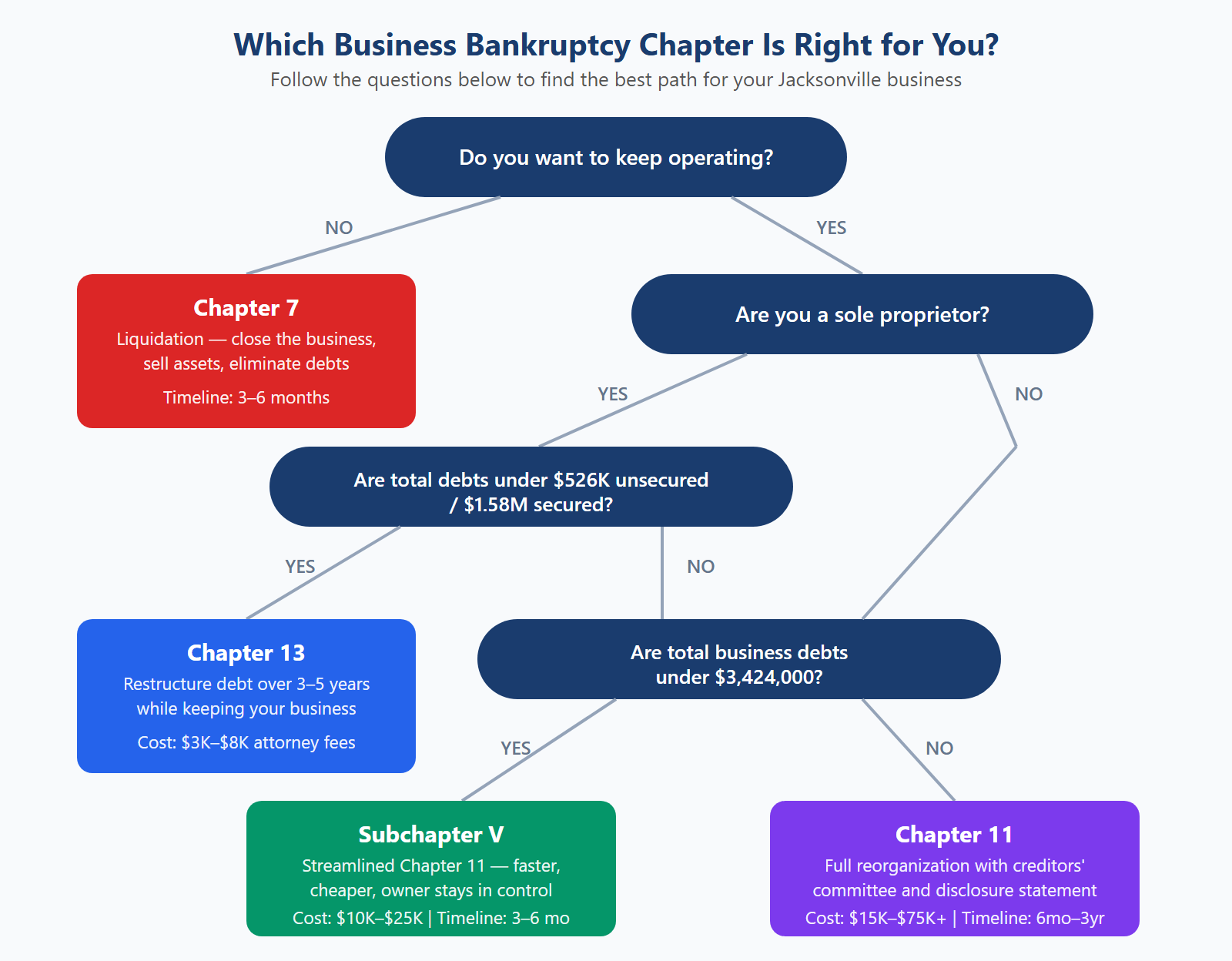
Choosing the right bankruptcy chapter is the single most consequential decision a struggling Jacksonville business owner will make. The right choice depends on your business structure — sole proprietorship, LLC, partnership, or corporation — your total secured and unsecured debt levels, whether you want to continue operating or close down, and the cost you can absorb in legal and administrative fees. A sole proprietor with debts under $526,700 in unsecured obligations may benefit from Chapter 13’s asset protection, while an LLC owner with $2 million in debt may find Subchapter V’s streamlined process far more cost-effective than traditional Chapter 11. In my experience handling over 6,354 cases across Jacksonville’s Middle District of Florida, no two business bankruptcies are alike — which is why I evaluate every factor before recommending a path. The comparison table below breaks down the key differences:
| Factor | Ch. 7 | Ch. 11 | Subchapter V | Ch. 13 |
|---|---|---|---|---|
| Goal | Close & liquidate | Reorganize | Reorganize (streamlined) | Restructure debt |
| Who can file | Any entity | Any entity | Debts ≤ $3.42M | Sole proprietors only |
| Keep operating? | No | Yes | Yes | Yes |
| Typical attorney cost | $2K-$5K | $15K-$75K+ | $10K-$25K | $3K-$8K |
| Timeline | 3-6 months | 6 mo-3+ years | 3-6 months | 3-5 years |
How Much Does Business Bankruptcy Cost in Jacksonville?
Cost is one of the first questions Jacksonville business owners ask, and the answer varies significantly depending on which chapter you file. A straightforward Chapter 7 business liquidation typically runs $2,000 to $5,000 in attorney fees plus a $338 court filing fee, making it the most affordable option for companies that need to close. Subchapter V — the streamlined small business reorganization — generally costs $10,000 to $25,000 in legal fees with a $1,738 filing fee, but eliminates the expensive creditors’ committee required by traditional Chapter 11. Traditional Chapter 11 reorganization is the most costly, with attorney fees frequently ranging from $15,000 to $75,000+ depending on case complexity, plus quarterly U.S. Trustee fees that can reach $30,000 per quarter for larger cases. Here is a realistic breakdown of what each option costs:
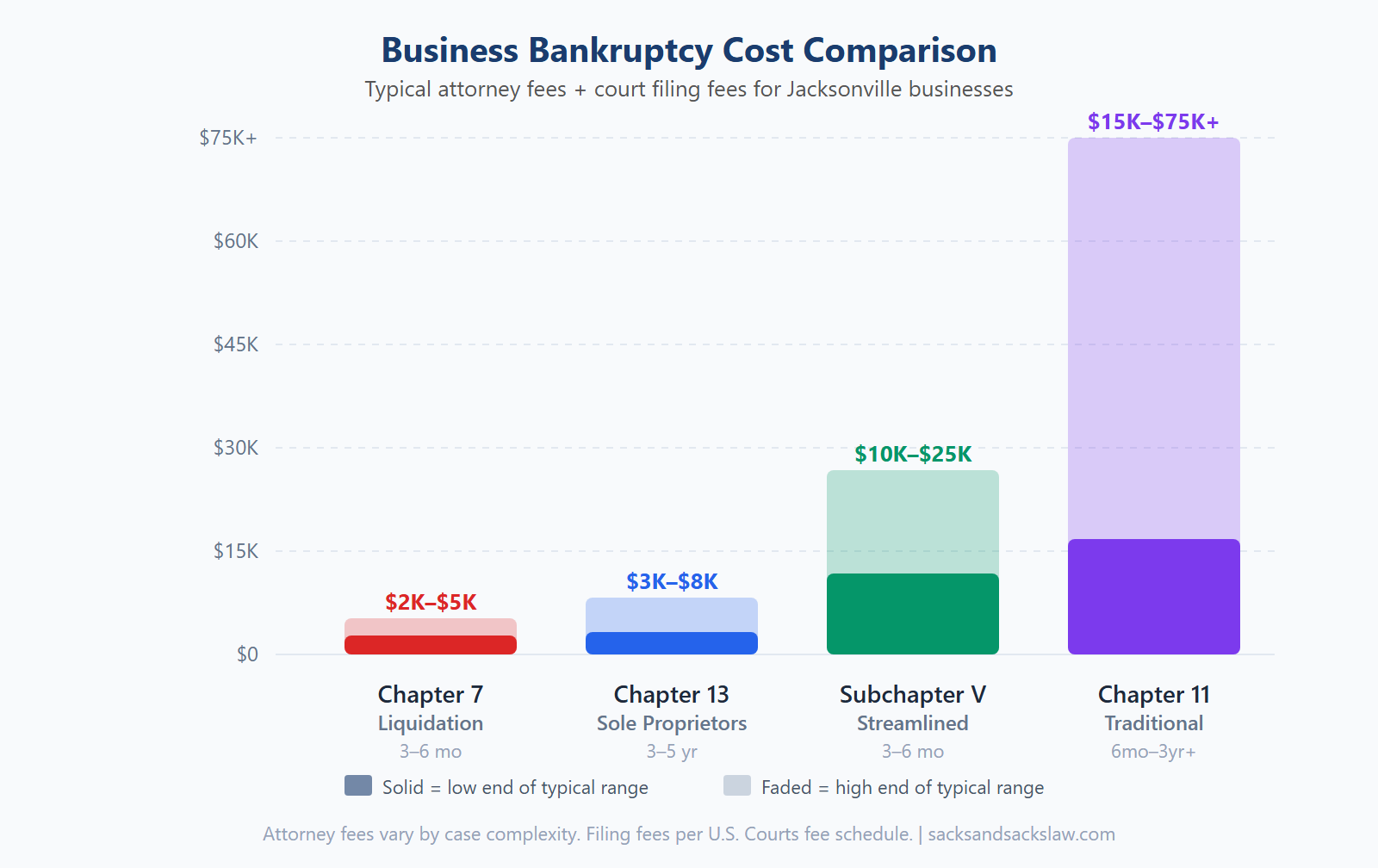
| Cost Component | Chapter 7 | Chapter 11 | Subchapter V |
|---|---|---|---|
| Court filing fee | $338 | $1,738 | $1,738 |
| Attorney fees (typical) | $2,000 – $5,000 | $15,000 – $75,000+ | $10,000 – $25,000 |
| U.S. Trustee quarterly fees | N/A | $325 – $30,000/qtr | Reduced |
| Typical timeline | 3 – 6 months | 6 mo – 3+ years | 3 – 6 months |
Filing fees per the U.S. Courts fee schedule. Attorney fees vary by case complexity.
Subchapter V is often the most cost-effective reorganization option for qualifying small businesses because it eliminates the creditors’ committee expense and shortens the overall timeline. During your free consultation, I will review your situation and provide a fee estimate specific to your case.
The Chapter 11 Process: What to Expect
If your Jacksonville business files for Chapter 11 reorganization, the process involves multiple stages that unfold over several months — and in complex cases, several years. Chapter 11 is the most powerful tool available to businesses that want to continue operating while restructuring their debts, but it also demands the most from business owners in terms of compliance, reporting, and court participation. The U.S. Bankruptcy Court for the Middle District of Florida (Jacksonville Division) has specific local rules and procedures that govern how Chapter 11 cases proceed in our district, and familiarity with these requirements matters. In 2025, Chapter 11 filings totaled 9,201 cases nationally (U.S. Courts, 2026). Here is what the process looks like step by step:
- Free consultation & case evaluation — I review your debts, assets, revenue, and business structure to determine whether Chapter 11, Subchapter V, or another option is appropriate.
- Petition filing — We file the bankruptcy petition with the U.S. Bankruptcy Court, Middle District of Florida (Jacksonville Division). The automatic stay takes effect immediately, halting all creditor collection activity.
- First-day motions — We file motions to continue paying employees, maintain essential vendor relationships, and use cash collateral to keep the business operating.
- Operating as debtor-in-possession — Your business continues to operate under court supervision. You manage day-to-day operations while we handle compliance reporting.
- Reorganization plan — We develop and file a plan detailing how the business will restructure its debts, which may include renegotiating leases, reducing unsecured debt, and extending payment terms.
- Creditor vote & court confirmation — Creditors vote on the plan. If the required majorities accept — or the court approves a cramdown — the plan is confirmed.
- Plan execution & discharge — You execute the plan terms. Once obligations are met, remaining qualifying debts are discharged.
For Subchapter V cases, this process is compressed: there is no creditors’ committee, the plan must be filed within 90 days, and the debtor retains exclusive plan-filing rights throughout.
Explore Your Business Restructuring Options
I will review your business financials and recommend the best chapter for your situation — at no cost.
(904) 396-5557 | Schedule Online
Alternatives to Business Bankruptcy
Bankruptcy is not the only option, and in some situations a non-bankruptcy strategy may achieve the same result with less cost and disruption. Florida law provides several alternatives to federal bankruptcy, including assignments for the benefit of creditors under Chapter 727 of the Florida Statutes, out-of-court workouts, debt consolidation, and court-appointed receiverships. The right alternative depends on how many creditors you have, whether any are actively suing you, and whether you need the immediate protection of the automatic stay. In my 27+ years of practice, I have guided hundreds of Jacksonville business owners toward non-bankruptcy resolutions when those paths made financial sense — and I am honest when they do not. During your free consultation, I evaluate every option before recommending any course of action:
- Out-of-court workout — Negotiate directly with creditors to restructure payment terms, reduce principal, or settle debts for less than the full amount owed. This works best when you have a small number of cooperative creditors.
- Assignment for benefit of creditors (ABC) — A state-law alternative to Chapter 7 under Florida Statutes Chapter 727. You transfer business assets to an assignee who liquidates them and distributes proceeds to creditors. ABCs are faster and less expensive than federal bankruptcy but do not provide an automatic stay.
- Debt consolidation — Combine multiple business debts into a single payment with a lower interest rate. This works for businesses with steady revenue struggling with high-interest debt.
- Receivership — A Florida court appoints a receiver to manage and liquidate business assets. Common when creditors petition the court directly.
During your consultation, I will assess whether a bankruptcy filing or an alternative approach makes more sense for your business goals.
Why Jacksonville Business Owners Choose Sacks & Sacks
In my 27 years of practice as a Jacksonville bankruptcy attorney (FL Bar #158070), I have filed more than 6,354 bankruptcy cases — including Chapter 7 liquidations, Chapter 11 reorganizations, Subchapter V filings, and Chapter 13 restructurings for sole proprietors. I have helped business owners across Duval County wind down operations they could not save, and I have helped others restructure their debts and keep their doors open through court-approved reorganization plans. The Middle District of Florida is the third-busiest bankruptcy court in the nation, and I have practiced in this district for my entire career. Whatever brought you here — creditor lawsuits, tax delinquencies, lease defaults, or an unsustainable debt load — I have likely helped a Jacksonville business owner in a very similar situation.
What sets our firm apart is that we treat business bankruptcy as more than a legal transaction. Every business owner who walks through our doors gets my direct attention — not a paralegal, not an associate. I handle your case personally because the stakes are too high for anything less.
Every client who files with us also receives complimentary enrollment in my 7 Steps to a 720 Credit Score program, because getting out of debt is only half the journey.
Melanie Sacks earned her J.D. from Thomas M. Cooley Law School and her undergraduate degree from the University of Florida. She holds a Martindale-Hubbell “BV Distinguished” rating for exceptional legal ability and high ethical standards, and has been recognized as one of the Top 3 Bankruptcy Lawyers in Jacksonville by Three Best Rated. She is a member of the American Bankruptcy Institute and the National Association of Consumer Bankruptcy Attorneys.
Frequently Asked Questions
Can my LLC file for bankruptcy in Florida?
Yes. An LLC can file for Chapter 7 (liquidation), traditional Chapter 11 (reorganization), or Subchapter V (streamlined reorganization for debts under $3,424,000). LLCs cannot file Chapter 13 — that option is available only to individuals. If you are the sole member of an LLC, you can file a personal Chapter 13 that addresses your personal liability, but the LLC itself would need a separate filing.
What is Subchapter V bankruptcy and who qualifies?
Subchapter V is a streamlined version of Chapter 11 created in 2019 specifically for small businesses. To qualify, your total business debts must not exceed $3,424,000 (as of April 1, 2025) and at least 50% must come from business activity. It is faster and less expensive than traditional Chapter 11 because there is no creditors’ committee, no disclosure statement requirement, and the plan must be filed within 90 days.
What is the automatic stay, and how does it protect my business?
The automatic stay is a federal court order that takes effect immediately when you file a bankruptcy petition (11 U.S.C. § 362). It prohibits creditors from continuing collection efforts, filing or proceeding with lawsuits, repossessing equipment, foreclosing on business property, or disconnecting utilities. For a struggling Jacksonville business, the automatic stay provides immediate breathing room.
Will I lose my business if I file for bankruptcy?
Not necessarily. Under Chapter 11, Subchapter V, and Chapter 13, you can continue operating your business while restructuring debts. Only Chapter 7 results in liquidation and closure. In my experience, most Jacksonville business owners who file have viable businesses — they just need the right legal framework to address the debt. The chapter you choose determines whether you keep operating.
How much does a business bankruptcy attorney cost in Jacksonville?
Attorney fees vary by chapter and complexity. A Chapter 7 business liquidation typically costs $2,000-$5,000 in legal fees. Subchapter V costs $10,000-$25,000 depending on complexity. Traditional Chapter 11 can run $15,000-$75,000 or more. Court filing fees are separate ($338 for Chapter 7, $1,738 for Chapter 11/Subchapter V). During your free consultation, I will provide a specific estimate for your situation.
Will filing business bankruptcy affect my personal credit?
It depends on your business structure. If your business is a corporation or LLC, the bankruptcy filing appears on the business credit report, not your personal one — unless you have personally guaranteed business debts. Sole proprietors will see the filing on their personal credit reports because there is no legal separation between the owner and the business. Every client at Sacks & Sacks receives enrollment in our 7 Steps to a 720 Credit Score program to help rebuild.
Can I discharge business tax debt in bankruptcy?
Some business tax debts can be discharged, but the rules are strict. Income tax debts may be dischargeable if the returns were filed on time, the taxes are at least three years old, the assessment is at least 240 days old, and there was no fraud or willful evasion. Payroll taxes (trust fund taxes withheld from employee wages) are never dischargeable. I can evaluate your specific tax situation during your consultation.
Protect Your Business. Explore Your Options.
Call me at (904) 396-5557 for a free consultation. I will review your situation and tell you exactly what bankruptcy can do for your business. No judgment, no pressure — just honest answers from someone who has done this over 6,000 times.
Related: Jacksonville Bankruptcy Lawyer | Chapter 7 Bankruptcy | Chapter 13 Bankruptcy | Personal Bankruptcy | Fast File Bankruptcy | Debt Consolidation | 7 Steps to a 720 Credit Score
Sources
[1] Epiq AACER. (January 2026). Total Bankruptcy Filings Increase 11% in Calendar Year 2025. https://www.epiqglobal.com/en-us/resource-center/news/total-bankruptcy-filings-increase-11-in-calendar-year-2025
[2] U.S. Courts. (February 2026). Bankruptcy Filings Rise 11 Percent. https://www.uscourts.gov/data-news/judiciary-news/2026/02/04/bankruptcy-filings-rise-11-percent
[3] Law Offices of Michael Jay Berger. (May 2025). Major Changes to Chapter 11 Dollar Amounts Effective in 2025. https://www.bankruptcypower.com/blog/major-changes-to-chapter-11-dollar-amounts-effective-in-2025/
[4] Nolo. (2025). What Are the Chapter 13 Bankruptcy Debt Limitations? https://www.nolo.com/legal-encyclopedia/what-are-chapter-13-bankruptcy-debt-limitations.html
[5] Florida Legislature. Chapter 222 — Exemptions. http://www.leg.state.fl.us/statutes/
[6] Florida Legislature. Chapter 727 — Assignment for Benefit of Creditors. http://www.leg.state.fl.us/statutes/
[7] U.S. Courts. Bankruptcy Court Miscellaneous Fee Schedule. https://www.uscourts.gov/services-forms/fees/