
This page answers the 35 most common family law questions for Jacksonville residents, organized by topic, with current Florida statute citations. Led by Adam Sacks: 25+ years of family law experience, former state prosecutor, Florida Supreme Court Certified Mediator. Call (904) 396-5557 for a free consultation.
Call (904) 396-5557. Free consultation. Answers you can trust.
Divorce in Florida
Florida is a no-fault divorce state, meaning you only need to state the marriage is “irretrievably broken” to file, no proof of adultery, abuse, or abandonment required (F.S. § 61.052).[2] Below are the most frequently asked questions about divorce in Jacksonville.
How do I file for divorce in Florida?
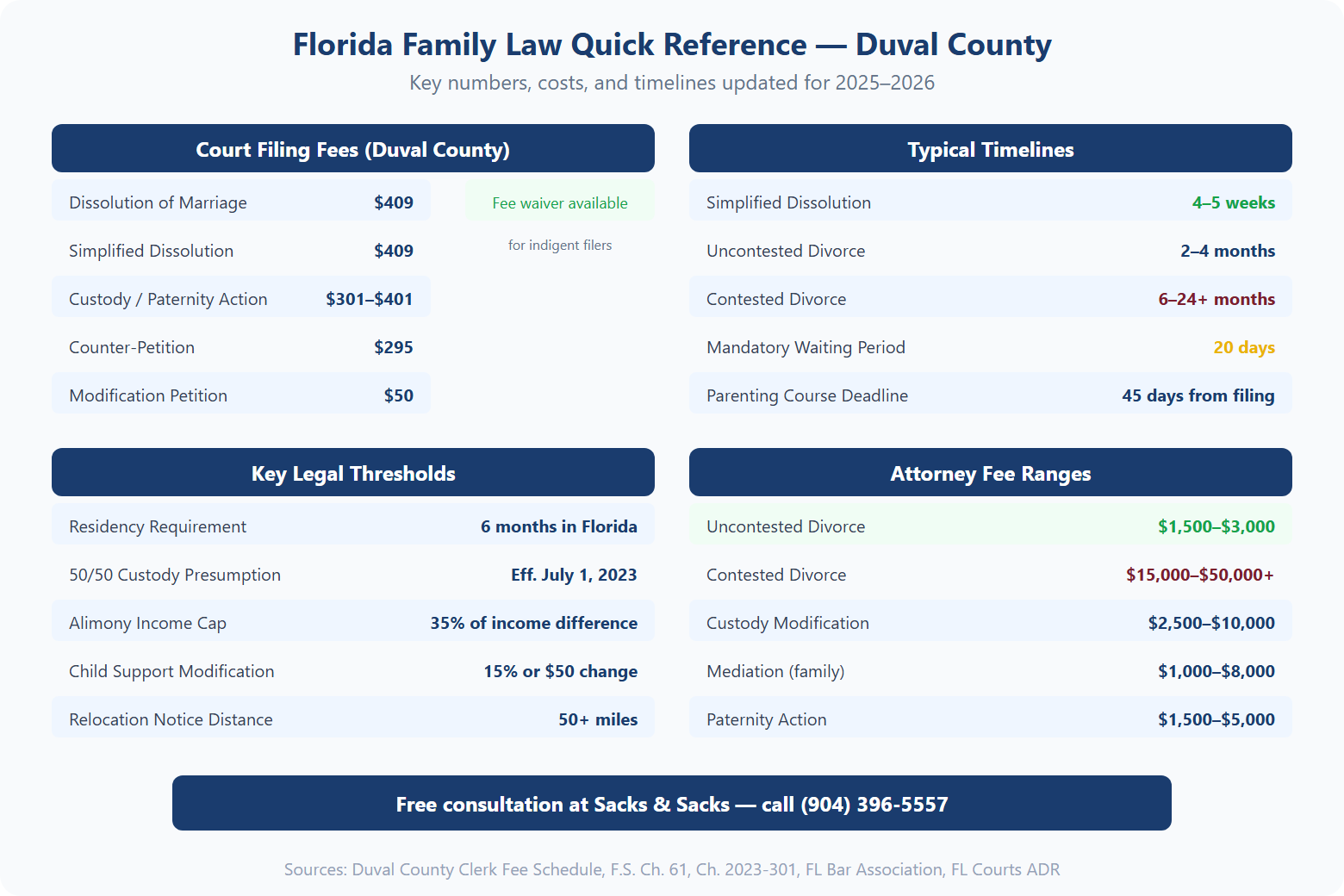
At least one spouse must have lived in Florida for 6 months before filing (F.S. § 61.021). You file a Petition for Dissolution of Marriage with the Duval County Clerk of Courts at 501 W. Adams St., Jacksonville.
The filing fee is $409.[3] You’ll also need a financial affidavit (Form 12.902) and, if you have children, a parenting plan. After filing, your spouse must be served and has 20 days to respond.
How long does a divorce take in Jacksonville?
An uncontested divorce takes 2–4 months; a simplified dissolution can be done in 4–5 weeks.[3] Contested divorces with disputes over custody, property, or alimony typically take 6–24 months or longer.
Florida requires a minimum 20-day waiting period from filing before any final judgment can be entered (F.S. § 61.19). The biggest factor in speed is whether both spouses agree on all terms.
How much does a divorce cost in Jacksonville?
A fast, uncontested divorce costs approximately $1,900–$3,500 total, including the $409 filing fee and attorney fees.
A contested divorce with trial costs $15,000–$50,000+ due to discovery, depositions, expert witnesses, and multiple hearings.[3] At Sacks & Sacks, we offer flat-fee pricing for uncontested and fast divorce cases, no hourly billing surprises.
What is the difference between contested and uncontested divorce?
In an uncontested divorce, both spouses agree on all terms: property division, custody, support, and alimony. In a contested divorce, one or more issues are disputed and must be resolved through negotiation, mediation, or trial. An uncontested divorce saves 70–90% in cost and time compared to a contested case.[2]
What is a simplified dissolution of marriage?
Simplified dissolution is Florida’s fastest divorce option, typically finalized in 4–5 weeks (Form 12.901(a)).[4]
Requirements: no minor children, wife not pregnant, neither spouse seeks alimony, both agree on all property/debt division, and both attend the final hearing. The tradeoff: you waive your right to trial and appeal. See our fast divorce page for details.
Child Custody & Time-Sharing
Florida eliminated the terms “custody” and “visitation” in 2008 and replaced them with parental responsibility and time-sharing. As of July 1, 2023, Florida law presumes that equal (50/50) time-sharing is in the best interests of the child (Ch. 2023-301).[1] Learn more on our child custody page.
What does the 50/50 custody presumption mean in Florida?
Since July 1, 2023, Florida courts begin every custody case with a presumption of equal time-sharing between both parents (Ch. 2023-301).[1]
This means a judge must start from a 50/50 split and can only deviate if one parent proves by a preponderance of the evidence that equal time-sharing is not in the child’s best interest. This was a major shift: prior to 2023, there was no presumption, and judges had more discretion.
How do courts decide custody in Florida?
Florida courts evaluate 20 “best interest of the child” factors listed in F.S. § 61.13(3).[5]
These include each parent’s willingness to encourage a relationship with the other parent, the child’s home/school/community ties, each parent’s mental and physical health, evidence of domestic violence, and the child’s reasonable preference (if mature enough). No single factor is determinative. The judge weighs them all together.
What is shared parental responsibility vs. sole parental responsibility?
Shared parental responsibility means both parents make major decisions together: education, healthcare, religion, and extracurricular activities. This is the default in Florida.
Sole parental responsibility is rare and requires a court finding that shared responsibility would be detrimental to the child, typically due to domestic violence, substance abuse, or neglect (F.S. § 61.13(2)(c)).[5]
Can I modify a custody order?
Yes, but you must prove a substantial, material, and unanticipated change in circumstances that was not known at the time of the original order, and that the modification is in the child’s best interest (F.S. § 61.13(3)).[5]
Common grounds include relocation, a parent’s substance abuse, a child’s changing needs, or a significant change in work schedule. The standard is intentionally high to provide stability for children.
Can I relocate with my child after divorce?
If you’re moving more than 50 miles from your current residence for more than 60 consecutive days, you must either get the other parent’s written consent or file a petition to relocate (F.S. § 61.13001).[5]
The distance is measured as a straight line, not driving distance. If the other parent objects, the court evaluates factors including the child’s relationship with both parents, the economic benefit of the move, and the feasibility of preserving the time-sharing schedule.
Child Support
Florida uses the Income Shares Model to calculate child support: both parents’ net incomes are combined to determine the total support obligation, then divided based on each parent’s share of that income (F.S. § 61.30).[6] Read more on our child support page.
How is child support calculated in Florida?
Child support is calculated using the Florida Child Support Guidelines (F.S. § 61.30), which combine both parents’ net monthly incomes and apply the guidelines schedule.[6] The obligation is then split proportionally based on each parent’s income share.
Adjustments are made for health insurance premiums, daycare costs, and the number of overnight stays. If one parent has fewer than 73 overnights per year, the standard guidelines apply; above 73 overnights, a time-sharing credit reduces the obligation.
Can child support be modified?
Yes, either parent can petition to modify child support if there is a substantial change in circumstances, such as job loss, a significant raise, or a change in the child’s needs (F.S. § 61.30(1)(a)).[6]
The standard threshold is a 15% or $50 change (whichever is greater) from the current support amount when recalculated under the guidelines. You cannot unilaterally reduce payments. You must get a court order.
What happens if a parent doesn’t pay child support?
Florida has aggressive enforcement tools for unpaid child support, including income deduction orders (wage garnishment), driver’s license suspension, passport denial, bank account levies, tax refund interception, and contempt of court, which can result in jail time.[6]
The Florida Department of Revenue (DOR) handles administrative enforcement, or you can file a motion for contempt directly with the court. Child support is a legal obligation, not optional.
How long does child support last in Florida?
Child support generally continues until the child turns 18, or until age 19 if the child is still in high school and expected to graduate before turning 19 (F.S. § 743.07).[6] Support for a child with special needs may continue indefinitely. Florida does not require parents to pay for college unless they agree to it in a settlement.
Alimony & Spousal Support
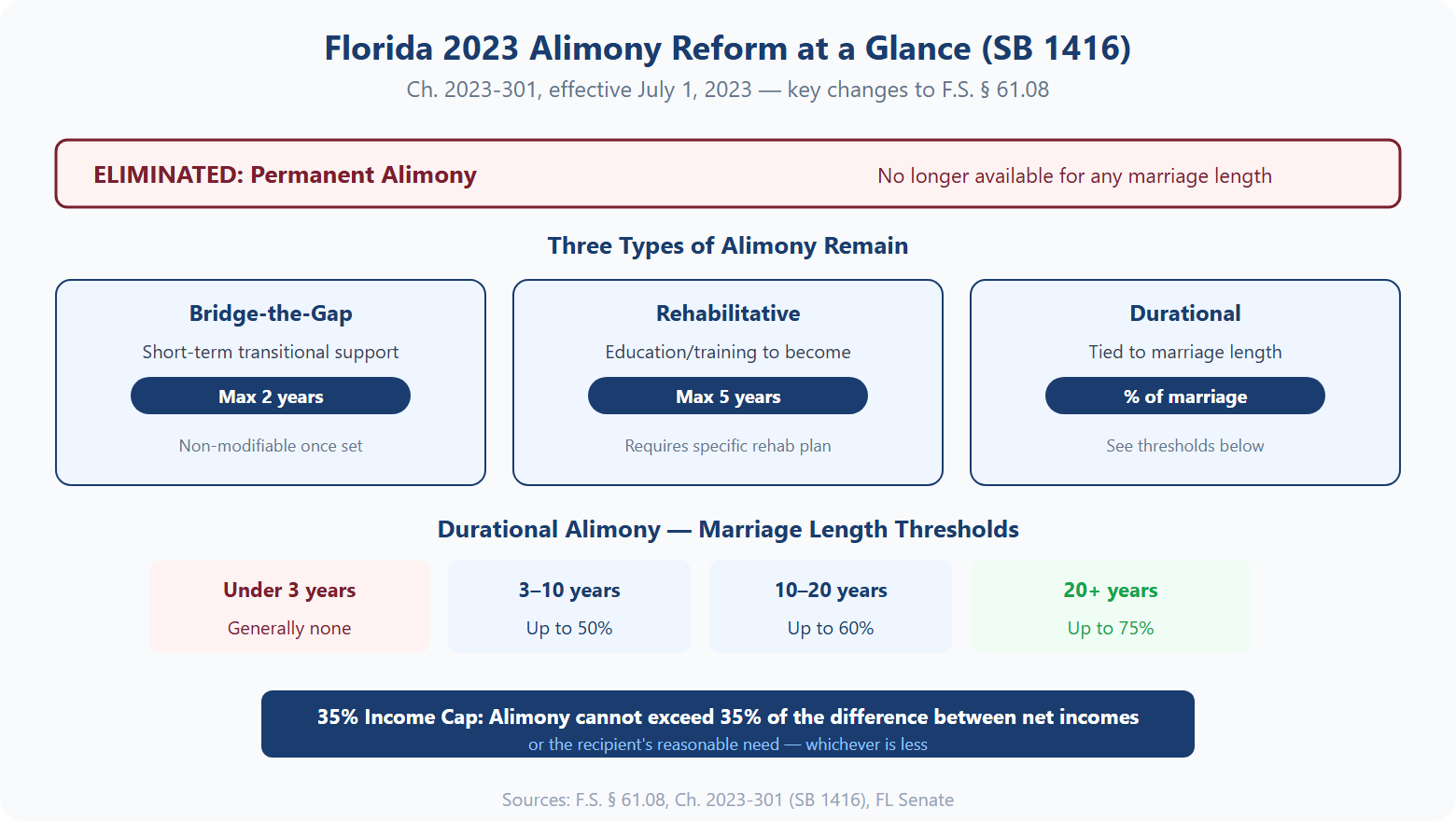
Florida’s alimony law changed dramatically on July 1, 2023 when Governor DeSantis signed SB 1416 (Ch. 2023-301), eliminating permanent alimony and capping awards at 35% of the income difference.[1] See our alimony & spousal support page for the full breakdown.
What types of alimony are available in Florida after the 2023 reform?
Three types of alimony remain after SB 1416 eliminated permanent alimony:[1] (1) Bridge-the-gap: up to 2 years, non-modifiable, for short-term transitional needs; (2) Rehabilitative: up to 5 years, requires a specific plan for education or training; (3) Durational: tied to marriage length (under 3 years = generally none; 3–10 years = up to 50%; 10–20 years = up to 60%; 20+ years = up to 75% of marriage duration).
What is the 35% alimony cap in Florida?
Alimony cannot exceed the lesser of 35% of the difference between the spouses’ net incomes or the recipient’s demonstrated reasonable need (F.S. § 61.08).[7] For example, if one spouse earns $8,000/month net and the other earns $3,000/month net, the maximum alimony is 35% of $5,000 = $1,750/month.
The court also considers 8 statutory factors including the standard of living during the marriage, each spouse’s financial resources, and contributions to the marriage.
Can men receive alimony in Florida?
Yes, Florida’s alimony statute is gender-neutral. Either spouse can request alimony regardless of gender. The court evaluates need and ability to pay based on income, earning capacity, and the factors in F.S. § 61.08(2).[7]
In practice, as more households have dual incomes, courts increasingly award alimony to husbands when the financial circumstances warrant it.
Is alimony taxable in Florida?
For divorces finalized after December 31, 2018, alimony is no longer tax-deductible for the payer or taxable income for the recipient under the Tax Cuts and Jobs Act (TCJA).[8] This is federal law: it applies in Florida and all other states.
For divorces finalized before January 1, 2019, the old rules still apply (deductible to payer, income to recipient) unless the agreement is modified and specifically opts into the new treatment.
Can alimony be modified or terminated?
Yes, durational and rehabilitative alimony can be modified upon a showing of substantial change in circumstances (F.S. § 61.14).[7] Alimony terminates automatically upon the death of either party or the remarriage of the recipient.
It may also be reduced or ended if the recipient enters a “supportive relationship” (cohabitation) under F.S. § 61.14(1)(b). Bridge-the-gap alimony cannot be modified once set.
Property Division
Florida follows equitable distribution: marital property is divided fairly, but not necessarily 50/50 (F.S. § 61.075).[2] Understanding the difference between marital and non-marital property is critical to protecting your assets in a divorce.
How is property divided in a Florida divorce?
Florida courts divide marital property using equitable distribution, considering 10 factors listed in F.S. § 61.075(1).[2]
These include the contribution of each spouse to the marriage, the economic circumstances of each party, the duration of the marriage, career sacrifices made by either spouse, and any intentional dissipation of marital assets. “Equitable” means fair, which can be 50/50, 60/40, or another split depending on the facts.
What is marital property vs. non-marital property?
Marital property includes assets and debts acquired during the marriage, regardless of whose name is on the title (F.S. § 61.075(6)).[2] Non-marital (separate) property includes assets owned before the marriage, inheritances, and gifts to one spouse, as long as they were not commingled with marital assets.
If you deposit an inheritance into a joint bank account, it may lose its non-marital character. Proper documentation and tracing are essential.
Can I keep the house in a divorce?
Possibly, but the marital home is typically the largest marital asset and subject to equitable distribution. Options include: one spouse buys out the other’s equity share, the home is sold and proceeds split, or one spouse keeps the home in exchange for other assets of equivalent value.
If children are involved, courts may allow the custodial parent to remain in the home temporarily. Mortgage qualification is a practical consideration: the spouse keeping the home must refinance into their name alone.
Are retirement accounts divided in a divorce?
Yes, the portion of retirement accounts (401(k)s, IRAs, pensions) accumulated during the marriage is marital property subject to equitable distribution.[2]
Dividing a 401(k) or pension typically requires a Qualified Domestic Relations Order (QDRO), which is a separate court order directing the plan administrator to transfer a portion to the non-employee spouse. IRAs can be divided via a transfer incident to divorce without a QDRO.
Paternity
Florida’s paternity laws are governed by F.S. Chapter 742 (Determination of Parentage). Establishing paternity is the legal prerequisite for custody, time-sharing, and child support rights for unmarried parents.[9] See our paternity page.
How is paternity established in Florida?
Paternity can be established five ways in Florida: (1) signing an acknowledgment at the hospital (DH-511); (2) signing a voluntary acknowledgment after birth (DH-432); (3) filing a legitimation affidavit (DH-743A); (4) Department of Revenue administrative order; or (5) court petition under F.S. Chapter 742.[9]
DNA testing (99.99% accuracy) is often ordered when paternity is disputed. For married couples, the husband is presumed the legal father.
What rights does an unmarried father have in Florida?
An unmarried father has no legal rights to custody or time-sharing until paternity is legally established.[9]
Once paternity is established, either voluntarily or by court order, the father has the same rights as a married father, including the 50/50 time-sharing presumption (Ch. 2023-301). He can petition for a parenting plan, seek equal time-sharing, and is also obligated to pay child support.
Can paternity be disestablished in Florida?
Yes, Florida allows paternity disestablishment under F.S. § 742.18 if DNA testing proves the man is not the biological father.[9] The petition must include DNA test results within 90 days.
However, disestablishment can be blocked if the man adopted the child, knew he was not the biological father when paternity was established, or married the mother knowing she was pregnant. The 2023 Good Dad Act (HB 775) expanded fathers’ rights in paternity cases.
Mediation
Florida requires mediation for all contested family law issues before trial (F.S. § 61.183). Mediation settles approximately 70–80% of family law disputes, saving significant time and money compared to litigation.[10]
What is family law mediation?
Mediation is a confidential, court-ordered process where a neutral third-party mediator helps divorcing spouses negotiate and reach agreement on contested issues: custody, property division, alimony, and child support (F.S. § 44.102).[10]
Unlike a judge, the mediator does not make decisions. Both parties must agree voluntarily to any terms. Mediation is typically completed in 1–3 sessions and costs $1,000–$8,000, far less than the $15,000–$50,000+ for trial.
Is mediation required before trial in Florida?
Yes, Florida courts require mediation for all contested family law matters before scheduling trial (F.S. § 61.183).[10] The only exceptions are cases involving domestic violence where mediation would be inappropriate.
If mediation fails to resolve all issues, the remaining disputed matters proceed to trial. About 65% of family cases reach full settlement in mediation; another 10% reach partial agreement.
Is what I say in mediation confidential?
Yes, mediation communications are confidential and inadmissible in court under F.S. § 44.405.[10] Nothing said during mediation can be used as evidence at trial if mediation fails. This confidentiality encourages honest negotiation. The only exceptions are threats of violence, evidence of child abuse, or an executed written agreement.
Domestic Violence & Injunctions
Florida provides several types of protective orders (injunctions) under F.S. § 741.30 for victims of domestic violence, stalking, sexual violence, and repeat violence.[11] Learn more on our restraining orders page.
What types of injunctions are available in Florida?
Florida offers five types of injunctions: (1) Domestic violence (F.S. § 741.30): for family/household members; (2) Repeat violence (F.S. § 784.046): two incidents of violence, no relationship required; (3) Dating violence (F.S. § 784.046): within a dating relationship; (4) Sexual violence (F.S. § 784.046): after a sexual offense; (5) Stalking (F.S. § 784.0485): pattern of harassment causing substantial emotional distress.[11]
How do I get an emergency restraining order in Jacksonville?
File a Petition for Injunction at the Duval County Courthouse. The court can issue a temporary injunction the same day without the other party present (ex parte).[11] A full hearing is then scheduled within 15 days where both parties can present evidence.
To file, you describe the specific acts of violence or threats in a sworn petition. There is no filing fee for domestic violence injunctions in Florida. See our emergency motions page.
Does a restraining order affect custody?
Yes, a domestic violence injunction can significantly impact custody and time-sharing decisions. Florida law requires judges to consider evidence of domestic violence when determining the best interests of the child (F.S. § 61.13(3)(c)).[5]
A parent subject to an injunction may receive supervised visitation, restricted time-sharing, or in severe cases, no time-sharing at all. An injunction also creates a rebuttable presumption against shared parental responsibility.
General Family Law Questions
Do I need a lawyer for a family law case in Florida?
You’re not legally required to have an attorney, but family law cases involve complex statutes, strict deadlines, and consequences that affect your children, finances, and future.
In my 25 years of practice, I’ve seen countless cases where people lost custody, accepted unfair settlements, or had filings rejected because they didn’t have legal guidance.
The cost of fixing mistakes almost always exceeds the cost of getting it right the first time. At Sacks & Sacks, we offer free consultations so you can understand your options before making any decisions.
Can I change my name during a divorce?
Yes, you can request restoration of your former name as part of the divorce petition, and the judge includes it in the Final Judgment of Dissolution. There is no additional filing fee for a name change requested within a divorce proceeding.
You’ll then need to update your name with the Social Security Administration, DMV, banks, and other institutions using the certified copy of your final judgment.
What is a parenting course and is it required?
Yes, Florida requires all parties in a divorce or paternity case with minor children to complete a 4-hour court-approved parenting course (F.S. § 61.21).[12]
The petitioner must complete the course within 45 days of filing; the respondent within 45 days of service. Online courses are available ($25–$40). The judge will not schedule your final hearing without certificates of completion from both parents.
Have a question not answered here? Call (904) 396-5557 for a free consultation with attorney Adam Sacks. 25+ years of Jacksonville family law experience.
What Our Clients Say

Hackie G.: “Adam is a wonderful attorney, he is always on top of things and is very dedicated. He worked hard for us, and we are blessed to have had him represent us.” Google Review
Robert: “Adam Sacks’ work ethic and dedication stood out since day one. He was not only understanding of my situation but provided expert guidance every step of the way.” Google Review
Linda J.: “Adam Sacks is the best family law attorney I have ever known. He treated me like a person, never just another case.” Google Review
Sources:
[1] Ch. 2023-301 (SB 1416), Florida Alimony Reform & 50/50 Custody Presumption. flsenate.gov
[2] F.S. § 61.052, Dissolution of Marriage; F.S. § 61.075, Equitable Distribution. leg.state.fl.us
[3] Duval County Clerk of Courts, Fee Schedules: Family Law. duvalclerk.com
[4] Florida Supreme Court, Form 12.901(a): Petition for Simplified Dissolution. flcourts.gov
[5] F.S. § 61.13, Parental Responsibility and Time-Sharing; F.S. § 61.13001, Relocation. leg.state.fl.us
[6] F.S. § 61.30, Child Support Guidelines; F.S. § 743.07, Age of Majority. leg.state.fl.us
[7] F.S. § 61.08, Alimony; F.S. § 61.14, Modification of Alimony. leg.state.fl.us
[8] IRS, Tax Cuts and Jobs Act: Alimony Tax Treatment. irs.gov
[9] F.S. Chapter 742, Determination of Parentage; F.S. § 742.18, Disestablishment of Paternity. leg.state.fl.us
[10] F.S. § 61.183, Mediation of Contested Issues; F.S. § 44.405, Mediation Confidentiality; FL Courts ADR Annual Report FY 2024-2025. flcourts.gov
[11] F.S. § 741.30, Domestic Violence Injunctions; F.S. § 784.046, Repeat/Dating/Sexual Violence. leg.state.fl.us
[12] F.S. § 61.21, Parenting Course Authorized; Fees. leg.state.fl.us
- Family Law Services in Jacksonville
- Divorce Attorney in Jacksonville
- Uncontested Divorce
- Fast Divorce: Same-Day Documents
- Child Custody & Time-Sharing
- Child Support
- Alimony & Spousal Support
- Paternity
- Family Law Mediation
- Military Divorce
- Same-Sex Divorce
- Restraining Orders
- Emergency Motions
- Adoption