
Your paycheck is being garnished, the collection calls start before you have finished your coffee, and the balance never drops no matter how much you send. If that is your life right now, you are not failing at money. You are carrying debt that the math cannot beat.
Bankruptcy exists for exactly this situation. The moment you file, federal law forces the garnishment, the lawsuits, and the phone calls to stop, and it clears a legal path back to a fresh start. The question is not whether you can recover. It is which chapter gets you there fastest.
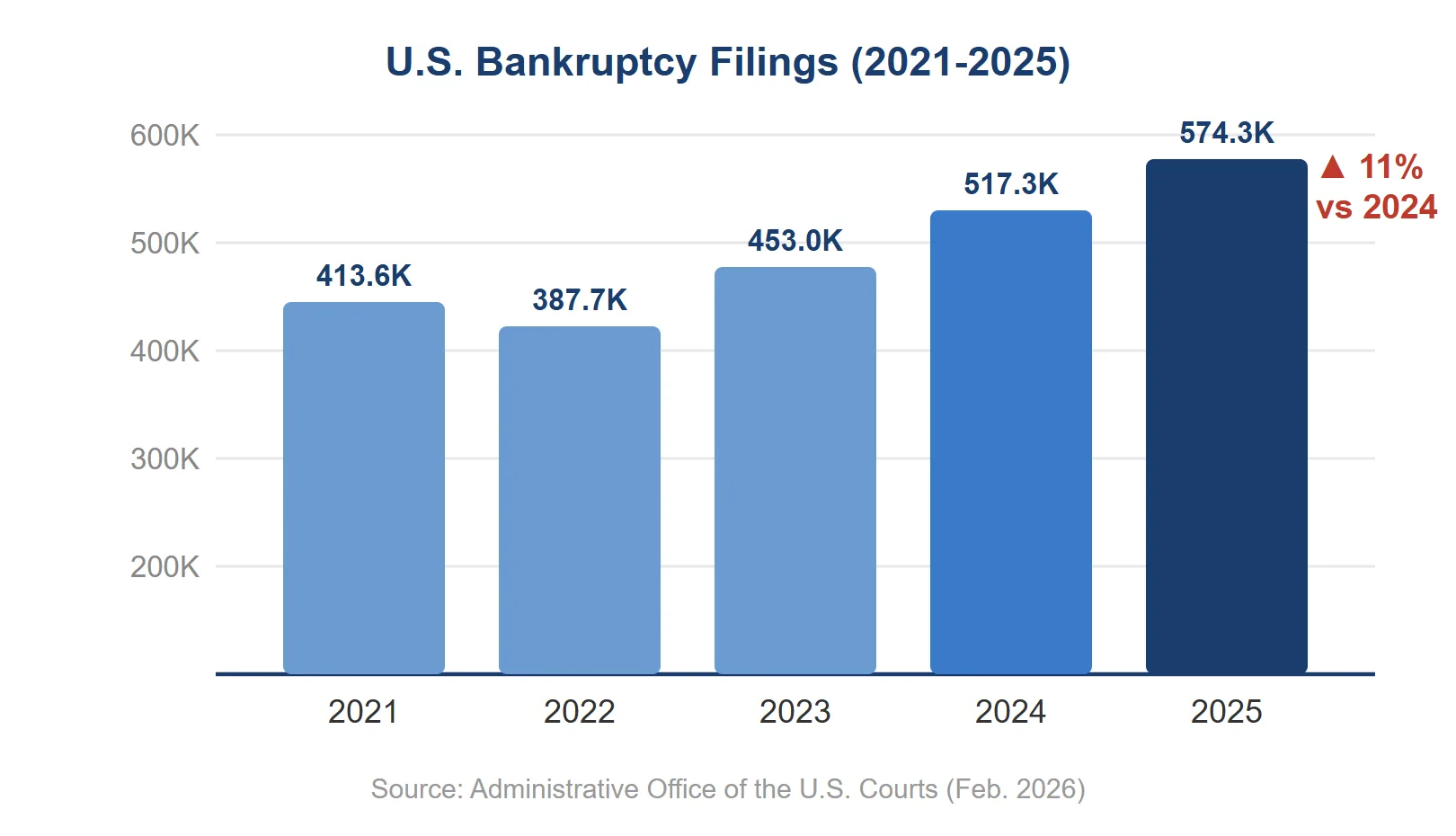
Key Facts: 574,314 Americans filed for bankruptcy in 2025, an 11% increase from the prior year (U.S. Courts, 2026). The Middle District of Florida, which includes Jacksonville, is the 3rd busiest bankruptcy court of 90 federal districts in the nation.
Florida offers one of the most generous homestead exemptions in the country, protecting unlimited equity in your primary residence. If you’re considering bankruptcy in Jacksonville, attorney Melanie Sacks can evaluate your situation in a free consultation: (904) 396-5557.
Melanie Sacks, Jacksonville bankruptcy attorney, FL Bar #158070, 27+ years of experience, 6,354+ cases filed. Martindale-Hubbell BV Distinguished.
Do You Qualify for Bankruptcy in Jacksonville?
More than 549,000 non-business bankruptcy cases were filed nationwide in 2025, up 11.2% from the prior year (U.S. Courts). In the Middle District of Florida alone, which includes the Jacksonville Division where our office files cases, filings increased 24.6% compared to 2024, from 21,094 to 26,279 cases.
If you’re struggling with debt, you’re not alone. Bankruptcy may be the right path to a fresh start. Whether you qualify depends on a few things: your household income, the types of debt you owe, and whether you file under Chapter 7 or Chapter 13.
As an experienced Jacksonville bankruptcy attorney, I can evaluate your specific situation during a free consultation and tell you exactly which options are available. Call (904) 396-5557 today to schedule your free, no-obligation case evaluation.
Eligibility depends on which chapter you file under. For Chapter 7 bankruptcy, you must pass the means test, which compares your household income to Florida’s median.
As of 2026, the median income thresholds for Florida are:
| Household Size | Annual Income Limit |
|---|---|
| 1 person | $69,876 |
| 2 people | $86,523 |
| 3 people | $97,540 |
| 4 people | $114,761 |
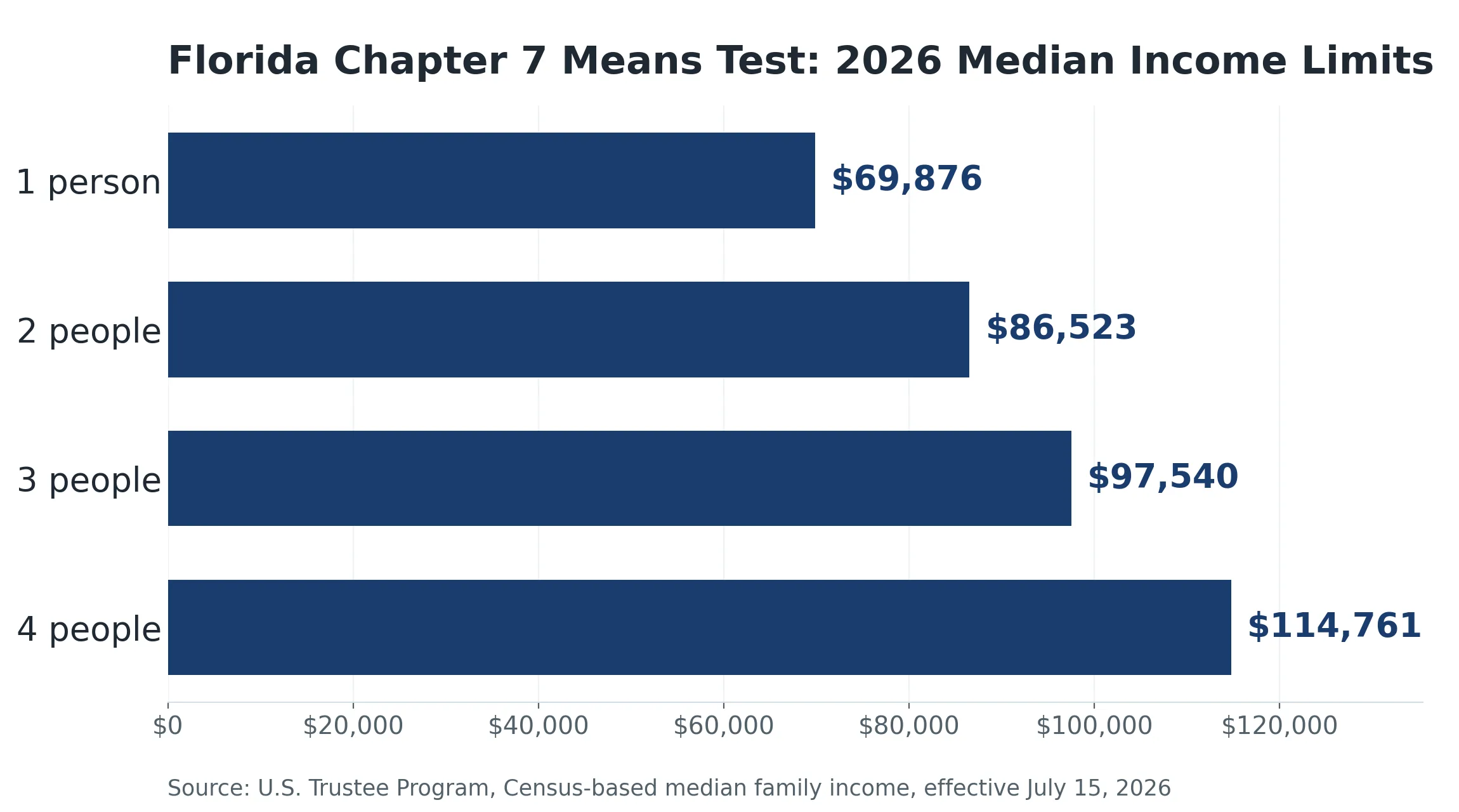
If your income falls below these thresholds, you likely qualify for Chapter 7. If it’s above, Chapter 13 bankruptcy may be the better option. It allows you to restructure debt through a court-supervised repayment plan while keeping your property. I evaluate your means test results during a free initial consultation, so you know exactly where you stand before committing to anything.
What Is the Difference Between Chapter 7 and Chapter 13 Bankruptcy?
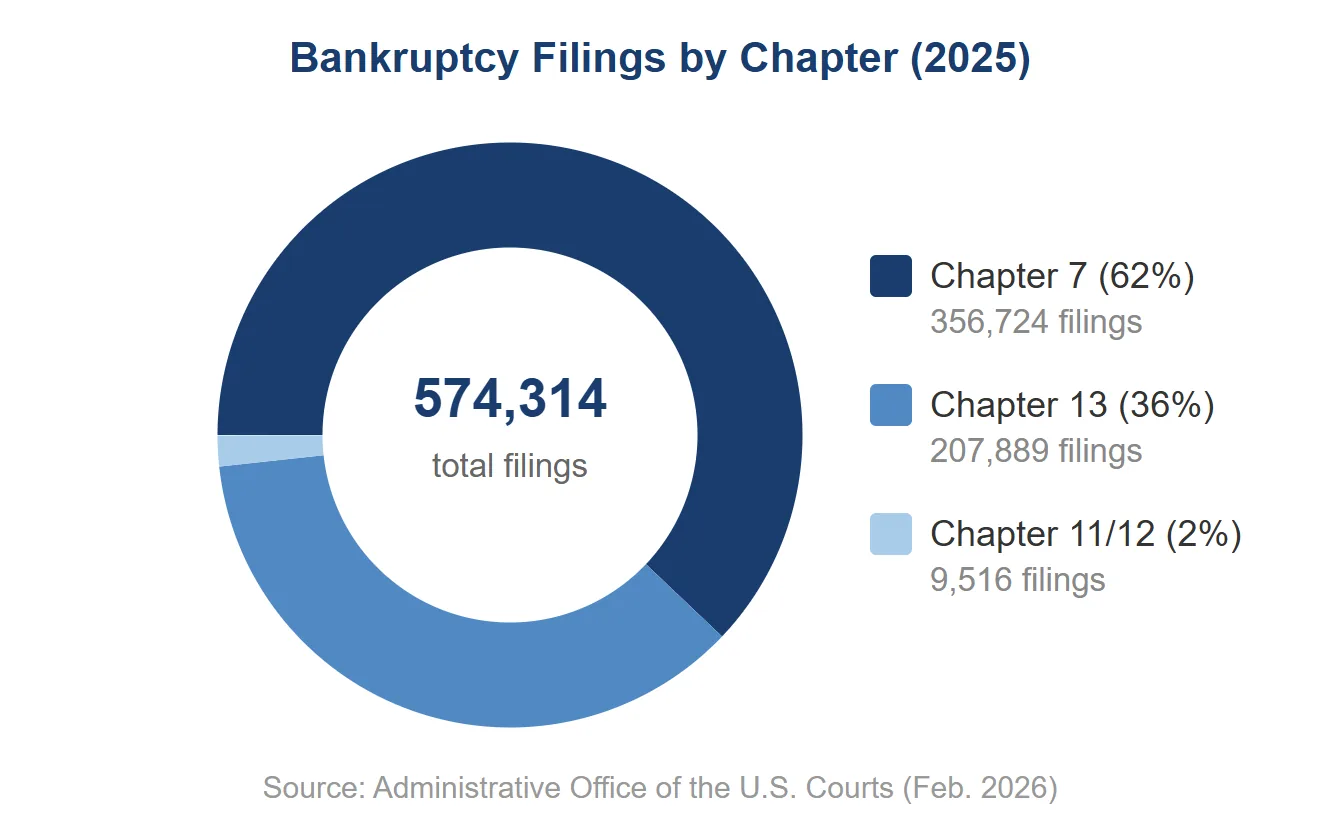
The two most common types of consumer bankruptcy do very different jobs. Choose the wrong one, and it can cost you time, money, and property you could have kept. In 2025, 356,724 Chapter 7 cases and 207,889 Chapter 13 cases were filed nationally (U.S. Courts).
Chapter 7 wipes out most unsecured debt in three to six months. It can involve selling assets that are not protected, but Florida’s exemptions are generous enough that most filers keep everything they own. Chapter 13 works differently. It reworks your debts into a court-supervised repayment plan that lasts three to five years. That plan lets you catch up on missed mortgage payments and keep property that might otherwise be at risk.
These differences matter when you choose a path. The table below lays out the key factors I review with every client during a free consultation at our Jacksonville office.
| Factor | Chapter 7 | Chapter 13 |
|---|---|---|
| Also Called | Liquidation bankruptcy | Wage earner’s plan |
| Who Qualifies | Income below FL median (means test) | Regular income; debt under limits |
| Timeline | 3–6 months | 3–5 year repayment plan |
| What Happens to Debt | Most unsecured debt discharged | Debt restructured; some discharged |
| Your Property | Non-exempt assets may be sold | You keep your property |
| Court Filing Fee | $338 | $313 |
| Credit Report | Remains for 10 years | Remains for 7 years |
For business owners, Chapter 11 bankruptcy lets you reorganize while you keep operating. The 2019 Small Business Reorganization Act added Subchapter V, a faster, cheaper path for smaller businesses. Its debt limit changes from time to time, so I confirm your business qualifies before we file.
What Property Can You Keep in a Florida Bankruptcy?
One of the biggest fears I hear from clients is losing their home or car. After years of filing bankruptcy cases in the Jacksonville Division, I understand exactly why that fear keeps people up at night.
The good news is that Florida law shields far more of what you own than you might expect, and few of my clients lose anything they truly need.
Under the Florida Constitution and Statute Chapter 222, you can protect a lot, including your home, your car, and your retirement savings in many cases. Florida has opted out of the federal exemption system, so you use the state exemptions instead. These protections apply in both Chapter 7 and Chapter 13 cases.
Florida Homestead Exemption
Florida’s homestead exemption protects unlimited equity in your primary home. The property just has to be no larger than half an acre in a municipality or 160 acres in a rural area (Fla. Const. Art. X, § 4). You must have owned it for at least 1,215 days before filing. If you have not, a federal cap of $214,000 applies. In practical terms, a paid-off or high-equity home is often fully protected in a Florida bankruptcy.

Other Key Florida Exemptions
- Motor vehicle: Up to $5,000 in equity in one vehicle (Fla. Stat. § 222.25(1))
- Personal property: Up to $1,000 in personal property, or $4,000 if you don’t claim the homestead exemption (Fla. Stat. § 222.25(4))
- Retirement accounts: 100% protected if ERISA-qualified (401(k), IRA, pension)
- Wages: Head of household wages are fully exempt from garnishment by creditors
- Life insurance: The cash surrender value of life insurance policies is exempt
In my experience handling bankruptcy cases across Jacksonville, most clients keep everything they own that matters to daily life. The goal of Chapter 7 isn’t to take what you have. It’s to eliminate the debt that’s preventing you from moving forward.
What Does the Bankruptcy Process Look Like in Jacksonville?
Filing for bankruptcy in Jacksonville follows a clear, predictable process. I have guided thousands of local clients through it. All Jacksonville cases are filed in the Middle District of Florida, Jacksonville Division, the 3rd busiest bankruptcy court of 90 federal districts in the nation.
From your first free consultation through the final discharge order, each stage has clear timelines set by federal law. The process usually starts with a credit counseling course. Next, you file the petition. That filing immediately triggers the automatic stay, which halts all creditor collection activity.
Within 21 to 40 days, you attend a brief 341 Meeting of Creditors, and in a Chapter 7 case, discharge follows approximately 60 to 90 days after that meeting. I walk every client through each step so there are no surprises along the way.
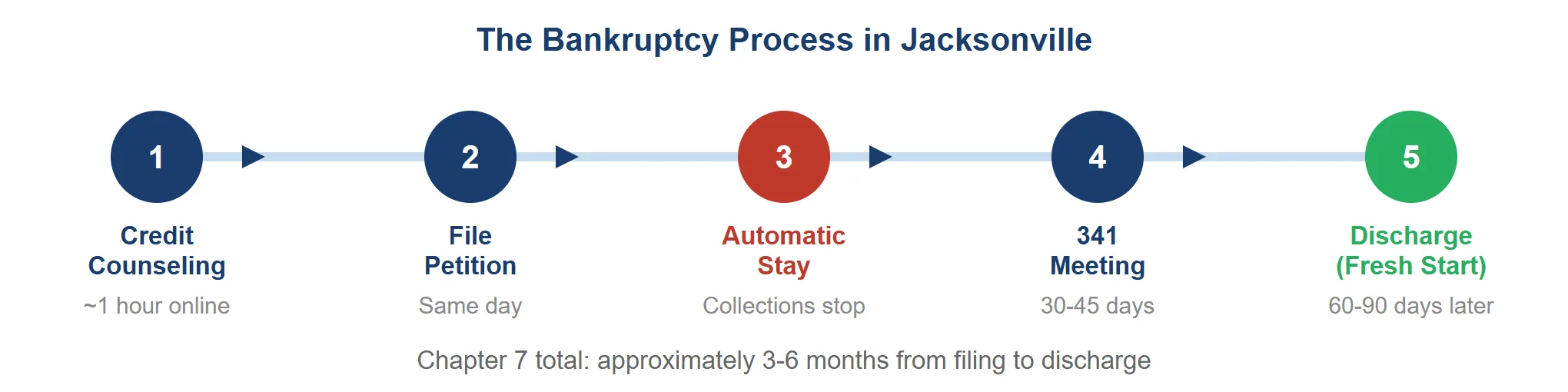
- Credit counseling: You must complete an approved credit counseling course within 180 days before filing. Most courses are available online and take about an hour.
- Filing the petition: I prepare and file your bankruptcy petition, schedules of assets and liabilities, income and expense statements, and the means test (if Chapter 7) with the court.
- Automatic stay takes effect: The moment your case is filed, an automatic stay halts all collection activity. Wage garnishment stops, foreclosure proceedings pause, repossession is blocked, and creditor calls must cease.
- 341 Meeting of Creditors: Approximately 21–40 days after filing, you attend a brief meeting where the bankruptcy trustee asks questions about your finances. In Jacksonville, these meetings typically last 5–10 minutes. I prepare you thoroughly so there are no surprises.
- Debtor education course: After the 341 meeting, you must complete a second financial education course. Like credit counseling, this is done online and costs $15–$50.
- Discharge: In Chapter 7, your eligible debts are discharged approximately 60–90 days after the 341 meeting. In Chapter 13, discharge occurs after you complete the 3-to-5-year repayment plan.
From start to finish, a Chapter 7 case in Jacksonville typically takes 3 to 6 months. Chapter 13 runs the length of the repayment plan, 3 to 5 years, but provides relief from the moment the petition is filed.
How Much Does Bankruptcy Cost in Jacksonville, FL?
Cost should never keep someone from the debt relief they need. That is why our Jacksonville office offers flexible payment options, including a Fast File program that lets you start for just $250 upfront. According to Nolo (2026), a Chapter 7 case in Florida averages $1,500 to $2,500. That figure covers attorney fees, the federal court filing fee, and two required financial education courses.
Chapter 13 costs are typically higher, ranging from $3,000 to $5,000 in attorney fees, but those fees can be folded into your court-supervised repayment plan so you do not have to pay the full amount before filing.
During your free consultation at our Jacksonville office, I explain every cost up front. There are no surprises, and you can decide whether filing is the right financial move. Here’s how it breaks down:
- Court filing fee: $338 for Chapter 7, $313 for Chapter 13 (U.S. Courts). Fee waivers and installment plans are available for qualifying filers.
- Attorney fees: $1,500–$2,500 for a standard Chapter 7 in Jacksonville. Chapter 13 attorney fees are often higher, but can be paid through the repayment plan.
- Credit counseling and debtor education: Two required courses, typically $15–$50 each.
At Sacks & Sacks, I also offer a Fast File bankruptcy option: just $250 upfront in attorney fees with the balance paid in monthly installments after filing. This lets you get the automatic stay protection immediately without paying the full attorney fee first.

When Should You File for Bankruptcy?
There is no single right time to file for bankruptcy, and many Jacksonville residents wait longer than they should because they hope the situation will improve on its own.
In my experience, early consultation with a bankruptcy attorney often leads to better outcomes. You preserve more assets, avoid unnecessary garnishment losses, and stop the cycle of minimum payments on high-interest debt that never reduces the principal balance.
The automatic stay takes effect the moment you file. It immediately stops wage garnishment, foreclosure, repossession, and creditor harassment. The sooner you file, the sooner that relief begins. A free consultation costs nothing and carries no obligation, and it gives you the information you need to decide.
After many years of practice in the Jacksonville Division, I’ve seen clear signs that it may be time to talk to a bankruptcy attorney:
- You are using credit cards to pay for basic necessities like groceries and utilities
- You are only making minimum payments, and the balances are not going down
- Creditors are calling daily or threatening legal action
- Your wages are being garnished
- You are facing foreclosure or vehicle repossession
- Medical bills have become unmanageable
- You are considering raiding your retirement savings to pay debts
One thing I always tell people: do not drain your retirement accounts to pay unsecured debt. Retirement accounts are fully protected in bankruptcy. Credit card debt can be eliminated; your retirement savings cannot be replaced.
Debts That Bankruptcy Cannot Eliminate
Bankruptcy can discharge most types of unsecured debt, including credit cards, medical bills, personal loans, utility arrears, and deficiency balances after foreclosure or repossession. Certain obligations, however, survive the discharge by federal law.
Understanding which debts can and cannot be eliminated matters before filing, because it directly affects whether bankruptcy is the right strategy for your situation.
Under 11 U.S.C. § 523, the following categories of debt are generally non-dischargeable in both Chapter 7 and Chapter 13 bankruptcy.
During your free consultation at our Jacksonville office, I review every debt you owe. I explain what will be eliminated, what will remain, and whether filing still makes sense for your situation. In most cases, the debts causing the greatest hardship can be wiped out. The debts that survive, listed below, are usually a small part of the total:
- Child support and alimony: these are non-dischargeable
- Most student loans: unless you can prove “undue hardship” (a high bar in Florida)
- Recent tax debts: income taxes from the last 3 years are generally non-dischargeable
- Criminal fines and restitution
- Debts from fraud or willful injury
- Government-backed loans obtained through fraud
If a significant portion of your debt falls into these categories, we can discuss whether bankruptcy still makes strategic sense or whether other options like debt consolidation may serve you better.
Rebuilding Credit After Bankruptcy: The 7 Steps to a 720 Program
Filing for bankruptcy does not mean your financial life is over. It means a new chapter is beginning. With the right strategy, rebuilding your credit score is entirely doable. Many of my clients are surprised to learn that credit improvement can begin within months of their discharge.
According to Nolo, filers who take proactive steps after discharge often qualify for secured credit cards within six months, auto loans within 12 to 18 months, and FHA mortgage loans within two to four years.
Many people assume bankruptcy permanently destroys their credit. In reality, most filers have already taken heavy credit damage before they file, from missed payments, collections, and maxed-out cards. Bankruptcy gives you the clean slate you need to start rebuilding.
That is why every bankruptcy client at our Jacksonville office receives complimentary enrollment in my 7 Steps to a 720 Credit Score program.
- Within 6 months: Many clients qualify for a secured credit card
- Within 12–18 months: Credit scores often reach the mid-600s, high enough for many auto loans
- Within 2–3 years: FHA mortgage qualification becomes possible (Chapter 7 requires a 2-year waiting period; Chapter 13 requires 1 year of on-time plan payments)
I developed this program because I believe getting out of debt is only half the journey. Rebuilding is the other half, and most attorneys ignore it entirely.
Why Jacksonville Families Trust Sacks & Sacks
I have practiced bankruptcy law in Jacksonville since 1998. In 27 years, I have helped over 10,000 individuals and families in the Jacksonville Division regain control of their finances.

I have seen every situation that brings people to a bankruptcy attorney’s door: crushing medical debt after an unexpected illness, credit card balances that spiraled after a job loss or a sudden drop in income, wage garnishment that leaves families unable to cover basic expenses, and small business failure that puts personal assets at risk.
My approach is straightforward. I listen to your situation, analyze your finances, explain every option available under Florida and federal law, and recommend the strongest path forward. Whatever brought you here, I have helped someone in your exact position before, and I am ready to help you too.
- 6,354+ bankruptcy cases filed in the Jacksonville Division
- 27+ years licensed in Florida (Florida Bar #158070, since 1998)
- Martindale-Hubbell “BV Distinguished” Rating for exceptional legal ability and high ethical standards
- 4.8-star Avvo review score (49 client reviews) • 4.6-star average across 265+ verified reviews
- Three Best Rated®: Top 3 Bankruptcy Lawyers in Jacksonville, FL
- Member: American Bankruptcy Institute, National Association of Consumer Bankruptcy Attorneys, Jacksonville Bankruptcy Bar Association
- J.D., Thomas M. Cooley Law School (1998) • B.A., University of Florida (1992)
- Profiled on Martindale-Hubbell • Justia • LinkedIn
“I enthusiastically endorse Melanie Sacks as one of the best Consumer Bankruptcy attorneys that I know! Melanie is superbly skilled and knowledgeable in both Chapter 7 and Chapter 13 practice.”
Peer Attorney Endorsement
When you call my office, you work directly with my experienced bankruptcy team or me, not a call center, not a paralegal reading from a script. Every case gets individual attention because your financial situation is unique. You don’t even need to leave your house. I can handle everything virtually, from the initial consultation to filing your petition.
What Our Jacksonville Bankruptcy Clients Say
“I was very nervous about declaring bankruptcy, but Melanie and her staff were so helpful and considerate that I was immediately put at ease. Everyone there was extremely accessible, and we spoke with Melanie several times during the process, and she always assured us everything was going to be alright, and it was! Very professional and helpful. I can’t say enough about them all.”
Carol • 5-star review on Avvo
“Someone I worked with recommended Sacks & Sacks. One of the best decisions of my life. Liz & Sherry went above & beyond in helping me with the bankruptcy. I will be forever grateful. I would highly recommend Sacks & Sacks to anyone.”
Allen • 5-star review on Avvo
“They were great, very communicative and kept me up to date on everything going on. Would highly recommend.”
Michele • 5-star review on Avvo
Read all 49 reviews on Avvo (4.8-star score) → • Google Reviews →
Frequently Asked Questions About Bankruptcy in Jacksonville
Will I Lose My House if I File Bankruptcy in Florida?
In most cases, no. Florida’s homestead exemption protects unlimited equity in your primary residence (up to half an acre in a municipality or 160 acres in a rural area), as long as you’ve owned the home for at least 1,215 days. If you’re current on your mortgage payments, you can typically keep your home in both Chapter 7 and Chapter 13 bankruptcy.
How Long Does Chapter 7 Bankruptcy Take in Jacksonville?
A Chapter 7 case in the Middle District of Florida, Jacksonville Division, typically takes 3 to 6 months from filing to discharge. The 341 Meeting of Creditors is usually scheduled about 21–40 days after filing, and the discharge order follows approximately 60–90 days after that meeting.
Can Bankruptcy Stop Wage Garnishment?
Yes. The moment a bankruptcy petition is filed, the automatic stay under 11 U.S.C. § 362 halts all collection activity, including wage garnishment, foreclosure, repossession, lawsuits, and creditor phone calls.
In a Chapter 7 case, the underlying debt may be discharged entirely. In Chapter 13, the debt is restructured into the repayment plan. If you’re facing active garnishment, I can often file within 24 to 48 hours.
What Debts Can’t Be Discharged in Bankruptcy?
Certain debts survive bankruptcy and cannot be eliminated, including: child support and alimony, most student loans (absent proof of undue hardship), recent tax debts (generally within the past 3 years), criminal fines and restitution, and debts resulting from fraud or willful injury. Most credit card debt, medical bills, and personal loans can be discharged.
How Long Does Bankruptcy Stay on My Credit Report?
A Chapter 7 bankruptcy remains on your credit report for 10 years from the filing date. Chapter 13 stays for 7 years. However, many clients begin receiving credit offers within months of discharge and can rebuild to a good credit score within 2–3 years. Every client at Sacks & Sacks receives my 7 Steps to a 720 Credit Score program to accelerate recovery.
Do I Need a Lawyer to File Bankruptcy in Jacksonville?
Legally, you can file without an attorney. However, bankruptcy involves complex federal and state law, including Florida’s unique exemptions, the means test, and procedural requirements in the Middle District.
Mistakes can result in losing protected property, case dismissal, or loss of your discharge. In my experience filing thousands of cases, an experienced bankruptcy attorney makes sure your exemptions are properly claimed and your case proceeds smoothly.
How Much Does It Cost to File Bankruptcy in Jacksonville?
The court filing fee for Chapter 7 is $338, and for Chapter 13 it is $313. Attorney fees in Jacksonville typically range from $1,500 to $2,500 for Chapter 7. At Sacks & Sacks, I also offer a Fast File option starting at just $250 upfront with the balance paid in monthly installments after filing. Two required credit counseling courses cost $15–$50 each.
You deserve a fresh start, and the law says you’re entitled to one.
Call me for a free consultation. I’ll review your situation and tell you exactly what bankruptcy can do for you. No judgment, no pressure, just honest answers from someone who’s done this over 6,000 times.
Serving Jacksonville and the immediately surrounding areas, including Orange Park, Fleming Island, Ponte Vedra, Atlantic Beach, Neptune Beach, and Jacksonville Beach, throughout Duval County and the neighboring communities. Virtual consultations available. No office visit required.
Related: Chapter 7 Bankruptcy | Chapter 13 Bankruptcy | Personal Bankruptcy | Business Bankruptcy | Fast File Bankruptcy | Debt Consolidation | 7 Steps to a 720 Credit Score
Sources
[1] U.S. Courts. (February 2026). Bankruptcy Filings Rise 11 Percent. https://www.uscourts.gov/data-news/judiciary-news/2026/02/04/bankruptcy-filings-rise-11-percent Retrieved 2026-09-01.
[2] U.S. Bankruptcy Court, Middle District of Florida. Filing Statistics. https://www.flmb.uscourts.gov/statistics/ Retrieved 2026-09-01.
[3] Florida Legislature. Chapter 222: Exemptions. https://www.leg.state.fl.us/statutes/ Retrieved 2026-09-01.
[4] Nolo. (2026). Florida Bankruptcy Exemptions. https://www.nolo.com/legal-encyclopedia/ Retrieved 2026-09-01.
[5] U.S. Department of Justice, U.S. Trustee Program. Means Testing. https://www.justice.gov/ust/means-testing Retrieved 2026-09-01.
This article is for general informational purposes only and is not legal advice, and reading it does not create an attorney-client relationship. Bankruptcy laws, exemption amounts, and court fees change over time. For guidance on your specific situation, consult a licensed Florida bankruptcy attorney. Last updated: September 1, 2026.
