
Bottom line: Florida’s Child Support Program disbursed $1.52 billion in FFY 2023–24 across 891,000 cases involving more than 900,000 children. [1] Child support in Florida is calculated using the Income Shares Model: both parents’ net incomes are combined and applied to a statutory schedule under F.S. § 61.30. [2]
Jacksonville family law attorney Adam Sacks has spent 25+ years helping parents establish, modify, and enforce child support orders in Duval County and across northeast Florida.
Get a straight answer about your child support case. Call (904) 396-5557 for a free consultation.
How Florida Child Support Works
Florida uses the Income Shares Model under F.S. § 61.30 to calculate child support, the same model used by 41 states nationwide. [3]
Rather than basing support on a flat percentage of one parent’s income, Florida combines both parents’ net monthly incomes and applies a statutory guidelines schedule that estimates the total cost of raising a child at that combined income level.
Each parent’s share is then determined by their percentage of the combined income. The guidelines cover combined monthly net incomes from $800 up to $10,000, with a separate formula for incomes above that threshold.
Additional costs for childcare, health insurance premiums for the child, and uninsured medical expenses are added on top and split proportionally between both parents.
As a Jacksonville family law attorney who has calculated thousands of child support obligations over 25 years, I can tell you that understanding exactly how this formula works is the single most important step in any child support case in Duval County or northeast Florida.
Here’s how the calculation works step by step:
- Calculate each parent’s gross monthly income: wages, bonuses, self-employment, disability benefits, rental income, dividends, and all other income sources listed in F.S. § 61.30(2). [2]
- Subtract allowable deductions: federal and state taxes, Social Security (FICA), mandatory retirement, health insurance premiums (excluding the child’s coverage), and court-ordered support for other children.
- Add both parents’ net incomes to get the combined monthly net income.
- Look up the minimum child support need on the statutory guidelines schedule in F.S. § 61.30(6). The amount varies by combined income and the number of children.
- Divide proportionally: each parent’s share equals their percentage of the combined income multiplied by the minimum support need.
- Add child-specific expenses: childcare costs, health insurance premiums for the child, and uninsured medical expenses are added and split proportionally.
- Adjust for time-sharing: if either parent has the child overnight at least 20% of the year (73+ nights), a different formula applies that can substantially reduce the paying parent’s obligation.
Florida Child Support Amounts by Income Level
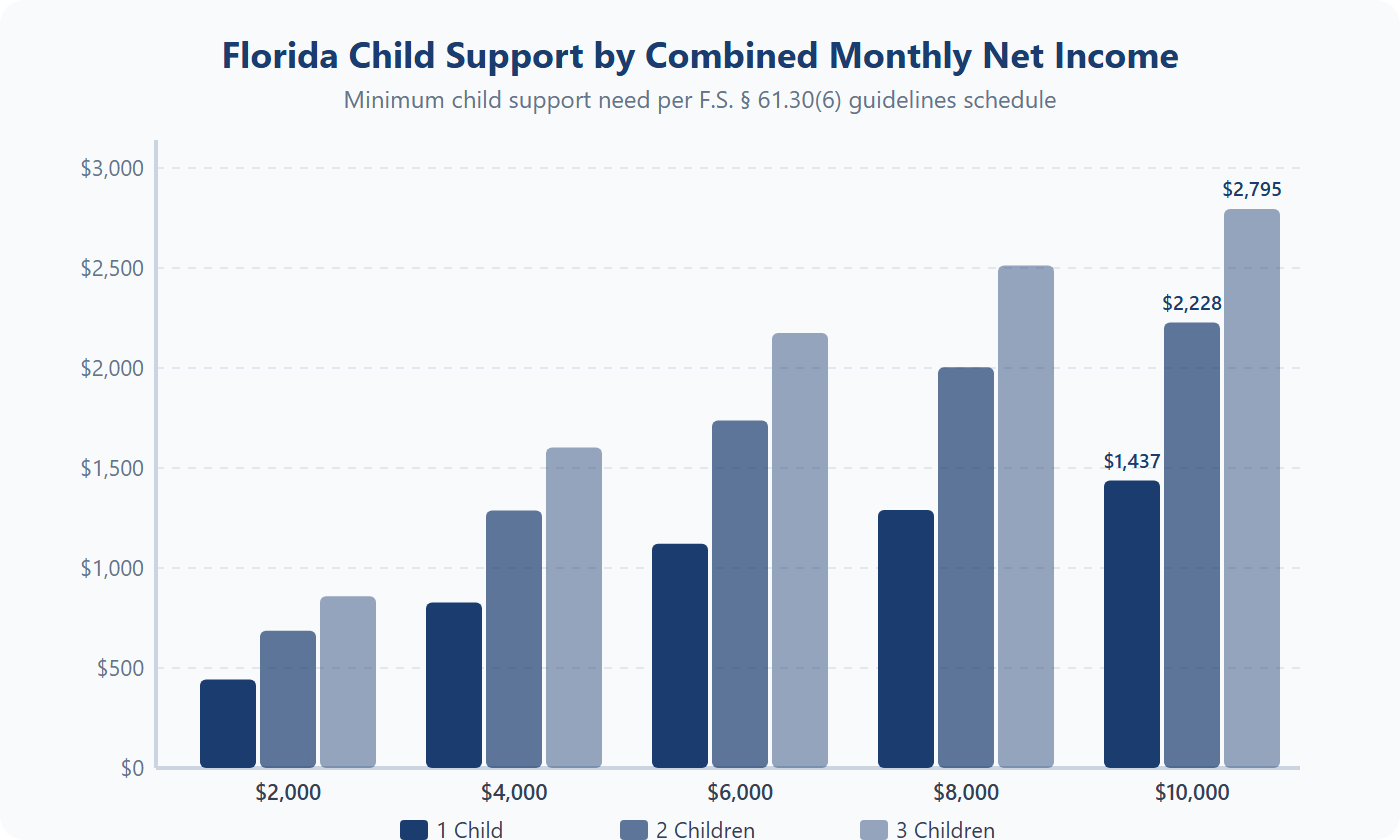
The statutory guidelines schedule in F.S. § 61.30(6) sets the minimum child support need based on both parents’ combined monthly net income and the number of children requiring support. [2] These amounts represent the total minimum need, not the amount one parent pays.
Each parent’s share is determined by their percentage of the combined income, and additional expenses such as childcare, health insurance, and uninsured medical costs are added on top. The schedule covers combined incomes from $800 to $10,000 per month, with a percentage-based formula for incomes exceeding that range.
Jacksonville parents frequently ask me what they should expect to pay or receive, so here are examples at key income levels that illustrate how the statutory schedule works in practice across a range of typical household incomes in Duval County:
| Combined Monthly Net Income | 1 Child | 2 Children | 3 Children |
|---|---|---|---|
| $2,000 | $442 | $686 | $859 |
| $4,000 | $828 | $1,288 | $1,603 |
| $6,000 | $1,121 | $1,737 | $2,175 |
| $8,000 | $1,290 | $2,004 | $2,513 |
| $10,000 | $1,437 | $2,228 | $2,795 |
For combined monthly net income above $10,000, the obligation equals the amount at $10,000 plus a percentage of income over $10,000: 5% for one child, 7.5% for two, 9.5% for three, 11% for four, 12% for five, and 12.5% for six. [2]
Important: These are the total minimum child support needs, not the amount one parent pays. Each parent’s share is determined by their percentage of the combined income. If Parent A earns 60% of the combined income and Parent B earns 40%, Parent A’s share of a $1,000 total need is $600.
How Time-Sharing Affects Child Support
Florida replaced traditional “custody” labels with time-sharing in 2008, and the number of overnight stays each parent has with the child directly impacts the child support calculation. The critical threshold under the statute is 73 overnights per year (20%). [2]
When the paying parent reaches or exceeds this threshold, the court applies a substantial time-sharing formula that adjusts each parent’s obligation based on the actual overnight split. A father or mother who increases their overnight time from every-other-weekend to a 50/50 schedule can see a meaningful reduction in their monthly child support payment.
In my experience handling hundreds of child support cases in Jacksonville, the time-sharing percentage is one of the most significant variables affecting the final support amount, and one that many parents overlook during negotiations.
If the paying parent has fewer than 73 overnights, the standard formula applies. If they have 73 or more overnights, Florida uses a substantial time-sharing formula that can significantly reduce the paying parent’s obligation:
- Each parent’s standard support obligation is multiplied by 1.5
- Each parent’s adjusted obligation is multiplied by the other parent’s percentage of overnights
- The difference between the two amounts is the net support payment
- Childcare and health insurance costs are added back proportionally
What this means in practice: A parent paying $800/month under a standard arrangement might pay $400–$500/month under 50/50 time-sharing, depending on income levels. I always analyze whether pursuing more overnight time could benefit my clients both relationally and financially.
Key Factors That Affect Your Child Support Amount
Income Determination
Florida’s definition of “income” for child support purposes under F.S. § 61.30(2) is intentionally broad and encompasses far more than just a paycheck.
It includes wages, salary, bonuses, commissions, overtime pay, self-employment income, disability benefits, workers’ compensation, unemployment compensation, pension and retirement distributions, rental income, dividends, interest, royalties, trust income, and even reimbursed expenses or in-kind benefits that reduce a parent’s personal living costs. [2]
In my Jacksonville practice, income disputes are one of the most contested aspects of child support cases, particularly when a parent is self-employed, earns irregular income, or receives compensation through a business entity.
Accurately identifying and documenting every source of income is critical because even a small difference in the income figure can change the monthly support obligation by hundreds of dollars.
If a parent is voluntarily unemployed or underemployed, the court can impute income, meaning the judge assigns an income amount based on the parent’s education, work history, and earning capacity. If no information is available, the court may impute income at the median income for full-time workers based on U.S. Census data.
Childcare, Health Insurance, and Medical Expenses
Beyond the base child support amount, parents must proportionally share:
- Childcare costs: daycare, after-school programs, and summer care required for a parent to work or attend job training
- Health insurance premiums for the child: the court orders one parent to provide coverage
- Uninsured medical, dental, and prescription costs: split by income percentage
These add-on expenses frequently increase the total support obligation by $100–$400+ per month, depending on the child’s age and needs.
When Courts Deviate from Guidelines
Judges can deviate up to 5% from the guideline amount without written justification. Deviations greater than 5% require a written finding explaining why the guideline amount would be unjust. [2] Common reasons for deviation include:
- Extraordinary medical, psychological, or educational expenses
- The child has independent income
- Seasonal income variations
- Special needs of a child with a disability
- The support obligation would exceed 55% of the paying parent’s gross income
How to Establish Child Support in Jacksonville
There are two primary pathways to establish a child support order in Jacksonville, and each has distinct advantages depending on your circumstances.
The first option is through the Florida Department of Revenue, which provides free administrative services for locating parents, establishing paternity, and setting support amounts.
The second option is filing through Duval County Family Court, which gives you more control over the outcome and allows a judge to address child support alongside time-sharing, custody, and other family law matters simultaneously.
In my 25 years of practice, I have guided Jacksonville parents through both pathways and can help you determine which approach best fits your situation based on the complexity of your income, the cooperation level of the other parent, and whether related issues like custody need to be resolved at the same time.
Option 1: Florida Department of Revenue (DOR)
The DOR provides free child support services, including locating parents, establishing paternity, and setting support orders through administrative proceedings. This is available to any parent, but it’s most commonly used by parents without an attorney. The DOR handles over 891,000 cases statewide. [1]
The DOR process typically takes 2–6 months and involves:
- Submitting an application online or in person
- Income verification using state wage records
- Scheduling an administrative hearing or consent conference
- Issuing an administrative child support order
Option 2: Duval County Family Court
Filing through family court gives you more control and allows a judge to address child custody, time-sharing, and child support simultaneously. I recommend this approach when:
- You want to establish or modify time-sharing at the same time
- Either parent has self-employment or complex income
- There are disputes over childcare, health insurance, or extraordinary expenses
- You need a judge’s oversight rather than an administrative hearing
Filing through family court typically takes 3–6 months from petition to final order, depending on the court calendar and the other parent’s cooperation.
Required Documents
To establish child support, you’ll need:
- Birth certificates for each child
- Pay stubs from the past 2–3 months
- Most recent 2–3 years of tax returns
- A completed Financial Affidavit: Form 12.902(e) for income under $50,000/year or Form 12.902(f) for income over $50,000 [3]
- Documentation of childcare, health insurance, and uninsured medical expenses
- Any existing custody, divorce, or child support orders
Modifying Child Support in Jacksonville
Child support orders are not permanent. They can and should be updated when life circumstances change significantly.
Florida law allows modifications when there is a “substantial change in circumstances” that is material, involuntary, and permanent in nature. The statutory threshold is defined as a change that would result in at least a 15% difference or $50 difference (whichever is greater) in the monthly support amount. [2]
Common triggers include job loss, a significant pay raise for either parent, a change in the overnight time-sharing schedule, or a child aging out of the order.
In my Jacksonville practice, I regularly file modification petitions when clients experience genuine changes in income or custody arrangements, and I also defend against modification attempts that lack the required legal threshold. The key is acting promptly, because your existing order remains fully enforceable until a judge signs a new one.
When Can You Request a Modification?
- Job loss or significant income reduction: involuntary unemployment, disability, or layoff
- Substantial income increase: the receiving parent may request an upward modification
- Changes in time-sharing: if the actual overnight schedule has shifted significantly from the original order
- A child turning 18 or graduating high school: the support obligation for that child ends
- Changes in childcare or healthcare costs: new medical conditions, childcare no longer needed, or insurance changes
- Remarriage or new household income: while a new spouse’s income isn’t directly included, it can affect the court’s analysis
Important: Do not stop paying child support while waiting for a modification. The existing order remains in effect until the court issues a new one, and unpaid amounts become enforceable arrears.
The Modification Process
If your order was established through the DOR, you can request an administrative review. If your order came from family court, I file a Supplemental Petition to Modify Child Support in Duval County. The process typically involves:
- Filing the petition with updated financial affidavits
- Serving the other parent
- Attending mediation or a case management conference
- If no agreement, presenting evidence at a hearing before a judge
Enforcing Unpaid Child Support in Jacksonville
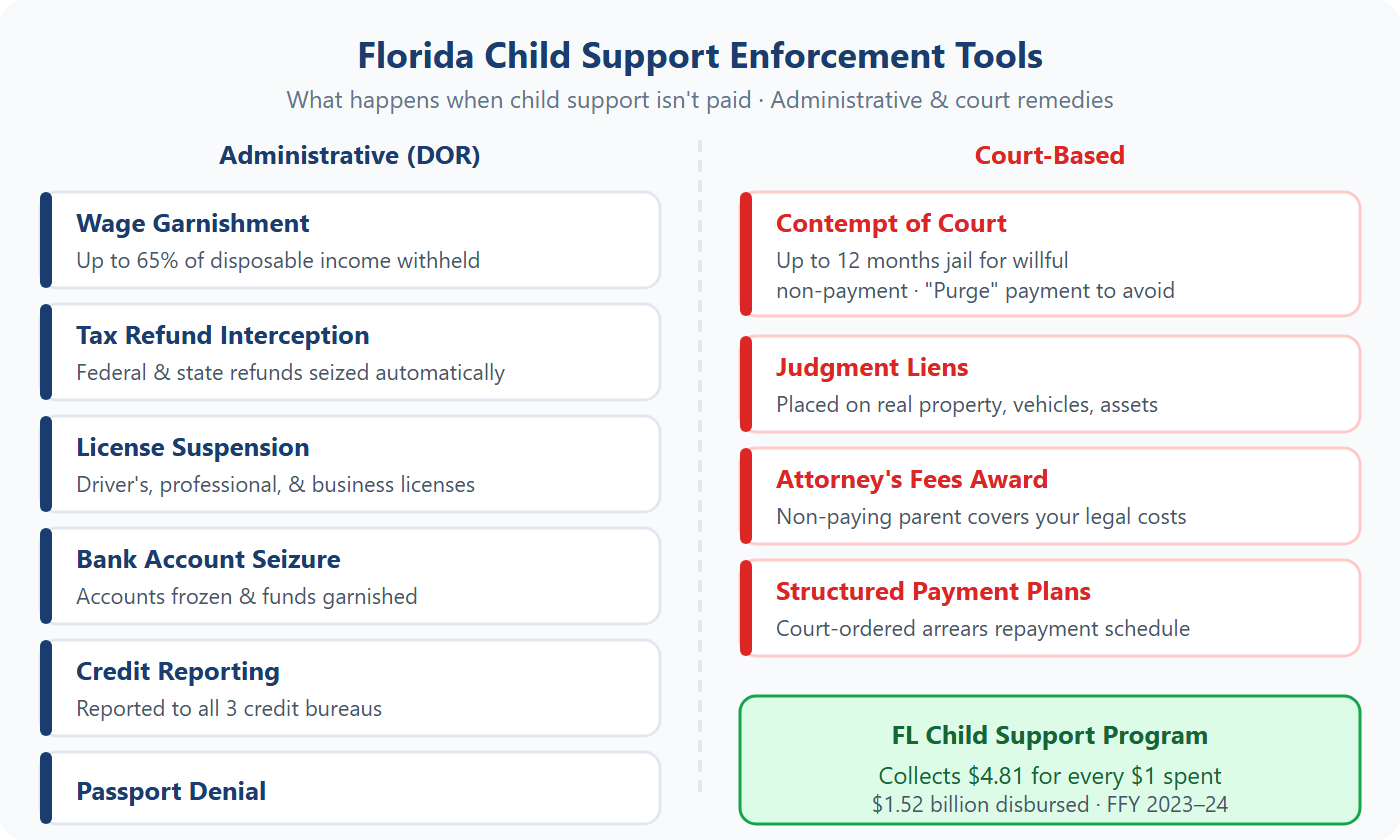
Florida takes child support enforcement seriously, and the state has some of the most aggressive collection tools in the country. The Florida Department of Revenue collected $1.025 billion through income withholding alone in FFY 2023–24, and for every $1 spent on the child support program, $4.81 was collected in support payments. [1]
If the other parent is not paying what they owe, you have powerful enforcement options available through both administrative and court-based channels.
Administrative enforcement through the Department of Revenue can happen automatically without a court hearing, while court-based enforcement through a Motion for Contempt allows a judge to impose penalties including jail time.
In my 25 years of practice in Jacksonville, I have helped custodial parents recover substantial arrears and get delinquent parents back into compliance using every tool the law provides.
DOR Administrative Enforcement
The Florida Department of Revenue can take automatic action without going to court:
- Income withholding (wage garnishment): up to 65% of disposable income can be withheld for current support plus arrears
- Tax refund interception: federal and state refunds are automatically seized for past-due support
- License suspension: driver’s license, professional licenses, business licenses, and hunting/fishing licenses
- Bank account garnishment: accounts can be frozen and seized
- Credit reporting: unpaid child support is reported to all three credit bureaus
- Passport denial: federal law denies or revokes passports when arrears exceed $2,500
Court-Based Enforcement
For more complex enforcement, I file a Motion for Contempt in Duval County Family Court. If the judge finds the non-paying parent in willful contempt, consequences can include:
- Jail time: up to 12 months for civil contempt (with a “purge” payment to avoid incarceration)
- Judgment liens: placed on real property, vehicles, and other assets
- Attorney’s fees: the non-paying parent may be ordered to pay your legal costs
- Structured payment plans for arrears with compliance monitoring
When Does Child Support End in Florida?
Under Florida law, child support does not continue indefinitely. It terminates when specific conditions are met, though the exact ending point depends on the child’s age, educational status, and whether any disabilities are involved.
Many Jacksonville parents assume that support automatically ends on the child’s 18th birthday, but that is not always the case. If the child is still enrolled in high school when they turn 18, support continues until graduation or age 19, whichever comes first.
Parents can also agree in writing to extend support beyond the statutory termination point for purposes such as college expenses.
For families with multiple children, the monthly payment does not automatically decrease when one child ages out. The paying parent must file a formal modification to recalculate the obligation. Here are the specific conditions under which child support terminates in Florida:
- Turns 18 years old, or
- Graduates from high school: if the child turns 18 before graduation, support continues until graduation or age 19, whichever comes first
- Is legally emancipated (through marriage, military service, or court order)
Exceptions: Child support may continue indefinitely if the child has a mental or physical disability that began before age 18 and requires continued parental support. Parents can also agree in writing to extend support for college or other purposes.
Multiple children: When one child ages out, the support amount does not automatically reduce. The paying parent must file a Motion to Modify Child Support to recalculate the obligation based on the remaining children. I always advise clients to file this motion promptly. Otherwise, you continue paying the full amount.
Child Support and Related Family Law Issues
Child support does not exist in isolation. It intersects with nearly every other area of family law, and the outcome of one issue can significantly affect the others.
For example, the overnight time-sharing schedule in your custody arrangement directly determines which child support formula applies, and alimony payments between parents are factored into the support calculation as either income or a deduction.
A military parent’s BAH and other allowances receive specific treatment under Florida child support law that differs from civilian income.
In my Jacksonville practice, I handle child support as part of a comprehensive family law strategy rather than treating it as a standalone matter.
This coordinated approach ensures that decisions made in one area, such as agreeing to a particular custody schedule, do not inadvertently create an unfavorable result in another area like support obligations. Here are the key intersections to be aware of:
- Child custody and time-sharing: the overnight schedule directly impacts the support calculation
- Paternity: a child support order cannot be entered until paternity is legally established (through voluntary acknowledgment or court-ordered DNA testing)
- Divorce: child support is addressed in every dissolution involving minor children
- Alimony: alimony payments to or from a parent are factored into the child support calculation as either income or a deduction
- Military divorce: military pay, BAH, and other allowances have specific treatment under Florida child support law
Having an attorney who handles all of these areas, not just child support in isolation, ensures that your overall family law strategy is coordinated and that one issue doesn’t undermine another.
Why Choose Adam Sacks for Your Child Support Case
I started my legal career as an Assistant State Attorney in Seminole County, prosecuting criminal cases for the State of Florida in front of judges and juries.
That courtroom experience gave me something most family law attorneys simply do not have: the confidence and preparation skills to take your child support case to trial if that is what it takes to protect your interests.
But I am also a Florida Supreme Court Certified Family Mediator (FL Bar #248370), which means I understand when aggressive litigation serves your goals and when a negotiated resolution will get you a better outcome faster and at lower cost.
Whether your case involves a straightforward W-2 calculation, a complex dispute over self-employment income, or a contempt action for unpaid support, I focus on one thing: getting you the right result in the most efficient way possible.
In 25 years of family law practice, I’ve handled child support cases ranging from straightforward W-2 calculations to complex disputes involving self-employed parents, hidden income, and high-conflict enforcement.
I’ve successfully argued for deviations from the guidelines when the formula didn’t fit my client’s circumstances, and I’ve recovered substantial arrears for parents whose co-parents refused to pay.
What sets me apart is that I treat every client like a person, not just another case number. I explain the law clearly, set realistic expectations, and fight for the best outcome. When you hire me, you work with me directly, not a junior associate.
Adam Lee Sacks earned his J.D. from Western Michigan University Cooley Law School, where he received a Book Award for top academic performance.
He served as an Assistant State Attorney in Seminole County before transitioning to private family law practice. He is a Florida Supreme Court Certified Family Mediator and has been a member of the Florida Bar (Bar #248370) since 2000.
He holds a B.A. in Psychology from the University of Massachusetts, which gives him a deeper understanding of the family dynamics at the center of every child support case.
What Happens When You Call Our Office
When you call our Jacksonville office at (904) 396-5557, you will not be transferred to a call center or placed on a long hold.
I personally handle initial consultations for child support cases because I believe that the first conversation sets the tone for the entire attorney-client relationship.
During your free consultation, I will listen to the specifics of your situation, explain how the Florida child support guidelines apply to your income and time-sharing arrangement, and give you a candid assessment of what to expect.
Whether you need to establish a new support order, modify an existing one, or enforce unpaid support, I will outline your options and recommend a clear path forward. There is no cost and no obligation. Here is exactly what to expect:
- You talk to me: not a paralegal, not a receptionist screening calls. I listen to your situation and ask targeted questions about income, custody, and the other parent.
- I give you a straight assessment: I’ll tell you what the guidelines say, what your likely obligation or entitlement is, and whether your case has strengths or challenges.
- We discuss strategy: whether you need to file, modify, or enforce, I’ll lay out your options and recommend an approach.
- No pressure, no obligation: the consultation is free. If we’re a good fit, we move forward. If not, you leave with real answers you can act on.
Call me directly at (904) 396-5557. I’ll tell you exactly where you stand. Free consultation, no obligation.
Client Reviews: See What People Are Saying

Frequently Asked Questions About Child Support in Jacksonville
How is child support calculated in Florida?
Florida uses the Income Shares Model under F.S. § 61.30. Both parents’ net monthly incomes are combined, and the total is applied to a statutory schedule that determines the minimum child support need based on income and the number of children.
Each parent’s share is proportional to their percentage of the combined income. Childcare, health insurance, and uninsured medical expenses are added on top. [2]
How much child support will I pay or receive in Jacksonville?
It depends on both parents’ combined net income and the number of children. For example, at $6,000 combined monthly net income, the minimum need is $1,121 for one child and $1,737 for two children.
The paying parent’s share depends on their percentage of the combined income. If you earn 65% of the combined income and there’s one child, your share would be approximately $729/month before adjustments for childcare and health insurance. [2]
Does overnight time-sharing affect child support?
Yes, significantly. If the paying parent has the child overnight at least 20% of the year (73+ nights), Florida applies a different formula that multiplies each parent’s obligation by 1.5 and then adjusts based on the overnight percentage.
In my experience, moving from minimal overnights to 50/50 time-sharing can reduce the paying parent’s obligation by 30–50%, depending on income levels. [2]
Can child support be modified after a court order is entered?
Yes. Florida allows modifications when there’s a substantial change in circumstances that would change the support amount by at least 15% or $50 (whichever is greater). Common reasons include job loss, income increases, changes in time-sharing, or a child aging out of the order.
I file a Supplemental Petition to Modify in Duval County Family Court and present evidence of the changed circumstances.
What happens if the other parent doesn’t pay child support?
Florida has aggressive enforcement tools. The Department of Revenue can garnish wages (up to 65% of disposable income), intercept tax refunds, suspend driver’s and professional licenses, freeze bank accounts, and report to credit bureaus, all without going to court.
For court-based enforcement, I file a Motion for Contempt, which can result in jail time, liens on property, and an order for the non-paying parent to cover your attorney’s fees. [1]
Do I need a lawyer for child support in Florida?
You’re not legally required to have an attorney, but I strongly recommend it, especially if there are disputes about income, time-sharing, or additional expenses. In my 25 years of practice, I’ve seen countless parents leave money on the table or accept unfair orders because they didn’t understand how the formula works.
An attorney ensures accurate financial affidavits, proper calculation of all income sources, and strategic arguments for deviations when the guidelines don’t fit your situation.
When does child support end in Florida?
Child support typically ends when the child turns 18, or when the child graduates from high school (whichever is later, up to age 19). Support can continue indefinitely for a child with a mental or physical disability that began before age 18.
If you have multiple children, the payment does not automatically decrease when one child ages out. You must file a modification to recalculate. [2]
Sources:
[1] Florida Department of Revenue, Child Support Program Overview: FFY 2023–24. floridarevenue.com
[2] Florida Legislature, F.S. § 61.30: Child Support Guidelines (2025). leg.state.fl.us
[3] National Conference of State Legislatures, Child Support Guideline Models. ncsl.org
[4] Florida Courts, Child Support Guidelines Worksheet, Form 12.902(e) (06/25). flcourts.gov