

For many in Jacksonville, juggling credit cards, medical bills, and personal loans quickly becomes a daily worry. When each paycheck barely covers minimums and the stress keeps you up at night, finding a solution feels urgent.
Debt consolidation offers real relief by combining multiple debts into one, often with a lower monthly payment and interest rate, so you can focus on rebuilding your financial future instead of tracking endless due dates.
Debt consolidation is simpler than it sounds. You combine multiple debts into a single debt with one monthly payment. This replaces juggling credit cards, personal loans, and other obligations with just one bill.
Here’s the core idea: combining multiple debts into one using a new loan or debt management plan. The goal is lowering your overall interest rate and reducing what you pay each month. Instead of tracking five different due dates, you track one.
In Jacksonville, many families face exactly this situation. You have credit card balances charging high interest, maybe a personal loan, perhaps medical debt. Each month, you’re juggling payments, keeping track of different creditors, and watching interest stack up. Consolidation simplifies this mess.
There are two main paths forward:
Both approaches share the same end goal: fewer payments, lower interest, and breathing room in your budget.
The real power of consolidation isn’t magic—it’s simplicity and interest savings working together to free up money each month.
Your monthly payment typically drops because consolidation loans often carry lower interest rates than credit cards. Credit card debt might charge 18-25% annually, while a consolidation loan might offer 8-12%. That difference adds up fast.
You also gain mental clarity. Instead of managing multiple creditors and due dates, you manage one payment. This reduces stress and makes budgeting easier.
Requirements matter though. If you’re pursuing a consolidation loan, lenders want to see reasonable creditworthiness. For a debt management plan, you need commitment to making monthly payments consistently.
The process isn’t instant either. Most consolidations take time to arrange—whether negotiating with creditors or securing a new loan.
Pro tip: Before consolidating, calculate the total interest you’ll pay on your new arrangement versus your current debts. Sometimes the lower monthly payment masks a longer repayment timeline that costs more overall.
Not all consolidation options work the same way. The right choice depends on what debts you have, your credit score, and whether you own a home. Understanding your options prevents costly mistakes.
You can consolidate most unsecured debts like credit card balances, medical bills, personal loans, and federal student loans. However, mortgages, auto loans, tax debts, and child support typically require different approaches and cannot be consolidated through traditional methods.
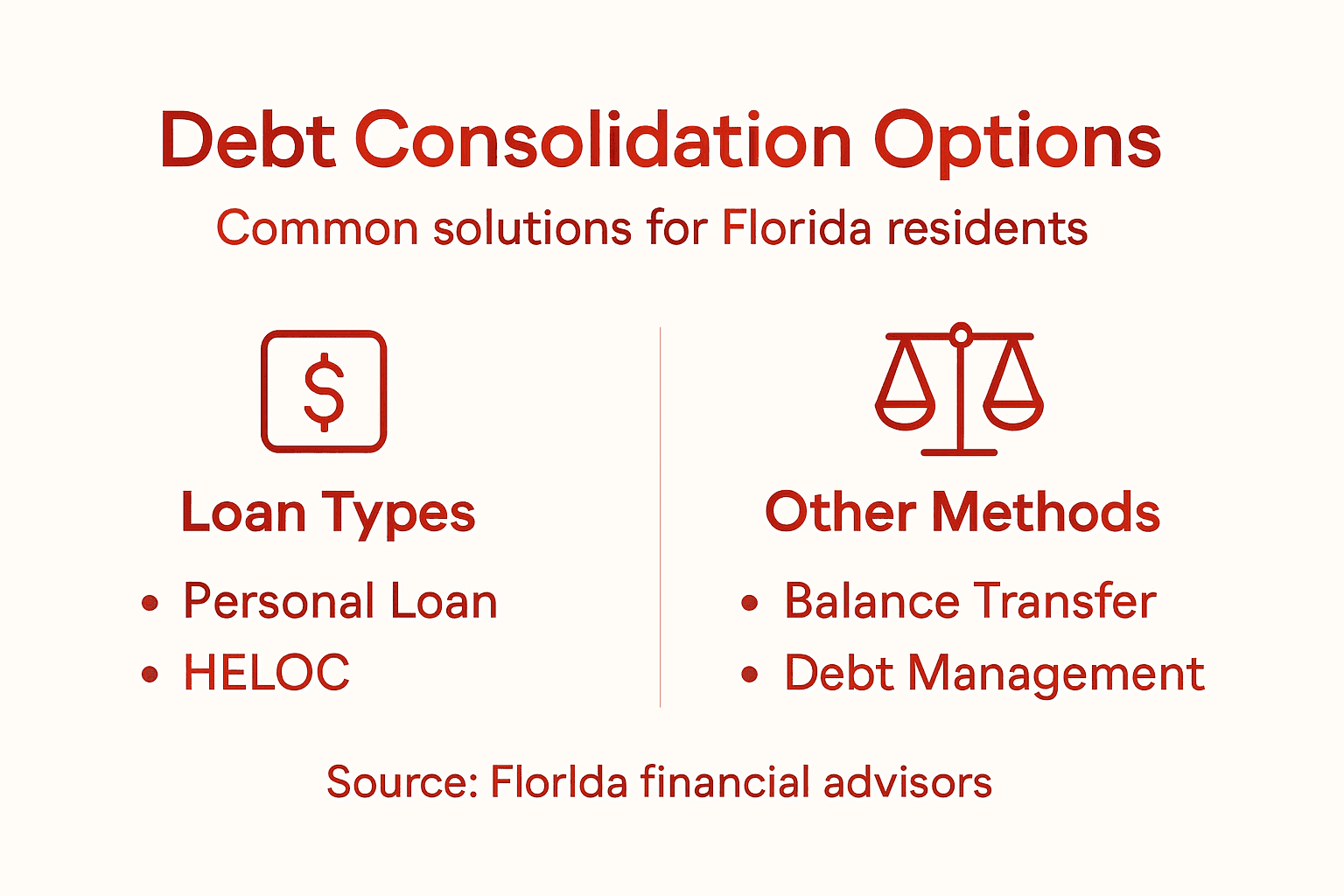
Here are the main paths Jacksonville families can take:
Here is a quick comparison of common debt consolidation methods:
| Method | Typical Interest Rates | Credit Impact | Best For |
|---|---|---|---|
| Balance Transfer Card | 0% (promo), 15-25% post | Temporary credit dip | Those with good credit, short payoff times |
| Personal Consolidation Loan | 6-14% | Moderate credit effect | Stable income, moderate debt |
| Home Equity Line (HELOC) | 5-10% (variable) | Can affect home equity | Homeowners with equity |
| Debt Management Plan | 0-10% after negotiation | Initial score drop | Lower credit scores, high debt |
Most common debts consolidated include credit card debt, medical expenses, student loans, and personal loans. These are unsecured debts without collateral backing them.
Secured debts like mortgages and auto loans have different consolidation rules. They’re already tied to specific assets, so traditional consolidation doesn’t apply.
Tax debts and legal judgments require specialized legal handling. This is where working with an experienced attorney matters most.
Your credit score determines which options are available. If your credit is strong (670+), personal loans and HELOCs offer competitive rates. Lower credit scores might mean higher rates or qualifying only for debt management plans.
Owning a home opens the HELOC door. Not owning a home limits you to personal loans, balance transfers, or debt management plans.
Pro tip: Compare the total interest paid across all options, not just the monthly payment. A lower monthly payment over a longer timeline can cost significantly more overall.
Florida has specific advantages for debt consolidation. The state’s strong homeowner population means many residents can tap into home equity options. Credit unions across Florida also offer competitive consolidation loans designed for residents facing overwhelming debt.
The process starts with understanding what you owe. List every debt: credit card balances, medical bills, student loans, personal loans. Write down the interest rate and monthly payment for each one. This snapshot shows exactly what consolidation could solve.
Here’s how it typically flows:
The timeline varies. Credit union personal loans in Florida often process in 5 to 10 business days. Balance transfers can happen within a few weeks. Debt management plans take longer because counselors must negotiate with each creditor.
Florida residents consolidating through a credit union benefit from competitive rates and personalized service designed for their unique situations.
Debt consolidation loans offered by credit unions help Florida consumers combine multiple high-interest debts into single lower-interest payments. Many Florida credit unions specialize in this, offering rates 3-6 percentage points lower than credit cards.
Florida’s homestead exemption and property laws also affect HELOC options. If you own a home, you may have substantial equity available for borrowing at favorable rates.
The state has no special income tax, which helps preserve cash flow during consolidation. Your monthly savings go directly toward accelerating debt payoff.
Start by checking your credit score. This determines which options are realistic and what rates you’ll qualify for. Scores above 670 unlock better personal loan options. Below 580 might mean debt management plans work better.
Second, calculate your debt-to-income ratio. Add all monthly debt payments and divide by your gross monthly income. Most lenders want this below 43 percent.
Third, research local options. Florida credit unions, banks, and nonprofit credit counselors all operate in Jacksonville. Comparing terms saves thousands in interest.
Pro tip: Before consolidating, freeze your credit card accounts you’re paying off. This prevents new debt from undermining your consolidation plan.
Florida law protects you during debt consolidation. You have rights as a consumer, and consolidation companies must follow strict rules. Understanding these protections prevents predatory practices from damaging your financial recovery.
Two major legal frameworks shield Florida residents. The Florida Consumer Collection Practices Act regulates how debt collectors behave. The Florida Consumer Protection Act prevents deceptive business practices in consolidation and lending.
Debt collection protections under Florida law mirror federal standards while extending additional safeguards. Debt collectors in Florida must be licensed and cannot engage in harassment or unfair practices.
Here’s what’s strictly prohibited:
You can verify any collector’s legitimacy. Florida requires licenses, so ask for proof before engaging. Many fraudsters claim to be debt collectors when they’re actually scammers.
The Florida Consumer Protection Act prohibits false advertising and bait-and-switch tactics in debt consolidation. Consolidation companies must disclose all fees upfront, explain terms clearly, and keep promises made during sales.
Consolidation firms cannot hide costs or misrepresent savings. If they promise you’ll save $200 monthly, that calculation must be documented and accurate.
The Florida Attorney General’s Office enforces this Act. If a consolidation company violates these rules, you can file a complaint and potentially recover damages.
Debt consolidation isn’t risk-free. While it simplifies payments, it carries hidden costs and potential dangers. Understanding these risks prevents consolidation from becoming another financial trap.
Many Jacksonville families rush into consolidation without weighing alternatives. Sometimes bankruptcy actually solves your situation better than consolidation ever could. The key is honest comparison before committing.
Consolidation companies charge fees that aren’t always obvious:
A $20,000 consolidation with a 2% setup fee costs $400 before you’ve made a single payment. Over a 60-month term, monthly servicing fees add another $1,200 to $3,000.
Worst part? That lower monthly payment masks the total cost. You’re paying more overall because you’re paying longer. Calculating total interest paid over the full timeline reveals the real expense.
Consolidation can backfire. Here are the main dangers:
If you’re consolidating because you overspend, consolidation alone won’t fix it. You need behavioral change too.
Sometimes Chapter 7 bankruptcy actually eliminates unsecured debts completely rather than just reorganizing them. Chapter 13 creates a court-ordered repayment plan that protects you from creditors.
Bankruptcy is worth considering if:
Bankruptcy has credit impact, yes. But consolidation that fails and turns into more debt damages your credit longer. Sometimes bankruptcy’s clean break is better long-term.
Consolidation works best for people with stable income, manageable debt levels, and spending discipline. Bankruptcy works better for overwhelming debt with no realistic repayment path.
Jacksonville families should consult both a consolidation specialist and a bankruptcy attorney. Compare total costs, timeline, credit impact, and success likelihood before deciding.
Pro tip: Before choosing consolidation, calculate: (Total monthly payment × months to payoff) + all fees. Compare that to what you’d pay if you aggressively paid down current debts without consolidating. Sometimes the math shows consolidation actually costs more.
Florida families facing overwhelming debt deserve clear answers and effective solutions. If you are struggling with multiple debts, high interest rates, or the complexity of consolidation options like personal loans or debt management plans, you are not alone. The risks of making the wrong choice can cost you more over time and put your assets like your home in jeopardy.
Understanding your rights under Florida law and evaluating alternatives like bankruptcy can protect your financial future.
At Sacks & Sacks Law, our experienced attorneys provide personalized advice on debt consolidation, bankruptcy options such as Chapter 7 bankruptcy, and consumer protections. We help Jacksonville residents navigate the legal challenges, assess which solution fits their unique situation, and create a clear plan to regain peace of mind.
Don’t wait while debt collectors or unfair practices threaten your stability. Call (904) 396-5557 today to schedule your free debt consolidation consultation and take the first step toward financial freedom.
Debt consolidation involves combining multiple debts into a single debt, typically with one monthly payment, aimed at lowering overall interest rates and simplifying debt management.
The main methods include balance transfer credit cards, personal consolidation loans, home equity lines of credit (HELOCs), and debt management plans through credit counseling agencies.
Applying for a consolidation loan may cause a temporary dip in your credit score. Closing old accounts after paying them off can also reduce your score. However, on-time payments on the new loan can improve your score over time.
Yes, risks include the potential for higher overall costs due to fees, the temptation to accumulate new debt, and the risk of losing collateral if secured loans are used. It’s important to assess your spending habits before consolidating.
 ✓
✓