
Adam Sacks has 25+ years of experience handling military divorce for families stationed at NAS Jacksonville, NS Mayport, and across Northeast Florida. Free consultation: (904) 396-5557.
Call (904) 396-5557 for a Free Military Divorce Consultation
What Makes Military Divorce Different in Florida?
Nearly 19,700 active-duty service members and 7,950 reservists divorced in 2022 alone, making military divorce one of the most common family law proceedings in communities near major installations.[2]
Military divorce is governed by a combination of Florida state law and federal statutes that do not apply to civilian cases, including the Servicemembers Civil Relief Act (50 U.S.C. §§ 3931–3938), which protects active-duty members from default judgments and allows stays of proceedings, and the Uniformed Services Former Spouses’ Protection Act (10 U.S.C. § 1408), which governs the division of military retirement pay as marital property.[3] [4]
Additional federal rules determine whether a former spouse retains TRICARE healthcare, commissary access, and other military benefits after divorce. Getting any of these federal-state intersections wrong can cost you tens of thousands of dollars, years of retirement benefits, or lifetime healthcare eligibility.
As a Jacksonville family law attorney with 25+ years of experience representing families stationed at NAS Jacksonville, NS Mayport, and across Northeast Florida, I handle the full scope of military divorce law.
The key differences between military and civilian divorce in Florida:
- Federal protections (SCRA): Active-duty service members can delay divorce proceedings, prevent default judgments, and get extensions to respond to petitions
- Military pension division (USFSPA): Military retirement pay is divisible as marital property under 10 U.S.C. § 1408, but only through proper court orders submitted to DFAS[3]
- Benefit eligibility rules: The 20/20/20 and 20/20/15 rules determine whether a former spouse keeps TRICARE, commissary access, and other military benefits after divorce
- BAH and military pay: Basic Allowance for Housing, Basic Allowance for Subsistence, and special pay affect child support and alimony calculations
- Deployment complications: Custody, time-sharing, and court appearances are all affected when a parent is deployed overseas
- Jurisdiction issues: A service member’s legal residence, duty station, and domicile may all be in different states, creating complex filing questions
An attorney who does not understand these federal-state intersections can file incorrect pension division orders, miss benefit eligibility windows, or fail to invoke SCRA protections when they matter most.
Jacksonville: Florida’s Largest Military Community
Jacksonville’s military presence generates $9.1 billion in economic impact, 17% of the entire Duval County economy, making it the largest military community in Florida and one of the largest on the East Coast.[1]
With 68,060 military jobs, six major installations, and approximately 150,000 service members, dependents, and retirees residing in the Jacksonville area, military divorce is not a niche practice here. It is a core part of family law in the Fourth Judicial Circuit.
Duval County family courts handle military divorce cases regularly, and local judges are accustomed to the federal laws that govern SCRA protections, USFSPA pension division, and benefit eligibility rules.
This concentration of military families also means that both parties in a military divorce often have access to JAG legal assistance offices on base, though JAG attorneys cannot represent service members in contested divorce proceedings.
Having a civilian attorney who understands both Florida family law and the federal military statutes is essential for protecting your financial interests and custody rights.
Jacksonville-area military installations:
- Naval Air Station Jacksonville: Over 11,000 military personnel assigned
- Naval Station Mayport: Home port for multiple Navy surface combatants
- Kings Bay Naval Base: Submarine base in nearby Camden County, GA
- Camp Blanding Joint Training Center: Florida National Guard training facility
- Naval Aviation Depot Jacksonville: Major aircraft maintenance facility
- Marine Corps Blount Island Command: Maritime prepositioning force
Approximately 150,000 military personnel, dependents, and retirees reside in the Jacksonville area.[1] That concentration means Duval County family courts handle military divorce regularly, and local attorneys need to know both Florida family law and the federal military laws that override or supplement it.

Filing for Military Divorce in Florida
Florida requires that at least one spouse has been a resident of the state for six months before filing for divorce under F.S. § 61.021, and for military families this residency requirement can be satisfied in several ways that civilian families do not have available.[5]
A service member stationed in Florida, even if their legal domicile or Home of Record is another state, can establish residency by being stationed here for at least six months.
A military spouse living in Florida for six months also meets the threshold regardless of where the service member is currently stationed. This creates complex jurisdiction questions because a service member’s legal residence, duty station, and domicile may all be in different states, and the first spouse to file typically controls which state’s laws govern the divorce.
Florida is a no-fault divorce state under F.S. § 61.052, meaning you need only prove the marriage is irretrievably broken, though adultery is now a factor in alimony determinations under the 2023 reform. For military families at NAS Jacksonville or NS Mayport, filing is typically done in Duval County Circuit Court. Residency can be established by:
- Being stationed in Florida (even if your legal domicile is another state)
- Maintaining Florida as your Home of Record
- Living in Florida as a military spouse for at least six months
Where to file: You can file in the county where either spouse resides. For military families stationed at NAS Jacksonville or NS Mayport, that is typically Duval County Circuit Court.
Jurisdiction challenges: A service member stationed in Florida can file here, but their spouse in another state may also have jurisdiction. If both states have jurisdiction, the first to file typically controls. Your attorney must analyze which state’s laws are more favorable before filing.
Florida is a no-fault divorce state (F.S. § 61.052), meaning you only need to prove the marriage is “irretrievably broken.” Neither spouse needs to prove wrongdoing, though adultery is now a factor in alimony determinations under the 2023 reform.
SCRA Protections for Active-Duty Service Members
The Servicemembers Civil Relief Act (50 U.S.C. §§ 3931–3938) provides critical federal protections for active-duty service members who cannot participate in civil court proceedings, including divorce, due to military duty.[4]
SCRA ensures that a service member deployed overseas, on temporary duty, or otherwise unable to appear in court receives a fair opportunity to participate before any binding decisions are made.
The Act’s protections include a minimum 90-day stay of proceedings upon request, prohibition of default judgments against absent service members, a 6% interest rate cap on pre-service debts, and the right to terminate residential leases without penalty upon deployment or PCS orders. SCRA does not prevent a divorce from proceeding entirely. It ensures the process is fair.
To invoke SCRA protections, the service member or their attorney must submit a letter or motion to the court along with a commanding officer’s letter confirming that military duties prevent appearance and indicating when the member will be available. Once the member is available, the case resumes under normal Florida procedures.
Key SCRA protections in divorce:
- Stay of proceedings: A service member can request a minimum 90-day delay of any civil court proceeding, including divorce, if military duty prevents participation. Additional stays may be granted.
- Protection from default judgment: A court cannot enter a default judgment against a service member who fails to appear due to military service. The court must appoint an attorney to represent the absent member’s interests.
- Interest rate cap: Pre-service debts are capped at 6% interest during active duty, which can affect property division calculations.
- Lease termination: Service members can terminate residential leases without penalty upon deployment or PCS orders, relevant when dividing marital housing.
How to invoke SCRA: The service member (or their attorney) must submit a letter or motion to the court requesting a stay, along with a letter from their commanding officer confirming that military duties prevent appearance and stating when the member will be available.
SCRA does not prevent divorce from proceeding entirely. It ensures the service member gets a fair opportunity to participate. Once the member is available, the case moves forward under normal Florida procedures.
Military Pension Division Under USFSPA
The Uniformed Services Former Spouses’ Protection Act (10 U.S.C. § 1408) allows, but does not require, Florida courts to divide military retirement pay as marital property in a divorce proceeding.[3] The maximum that can be divided is 50% of disposable retired pay, or up to 65% when combined with child support and alimony garnishments.
USFSPA is one of the most complex and consequential aspects of military divorce because mistakes in the pension division order can be permanent: the Defense Finance and Accounting Service (DFAS) will reject improperly drafted orders, and retroactive corrections are extremely difficult to obtain.
Disposable retired pay is calculated as gross retired pay minus deductions for VA disability compensation, Survivor Benefit Plan premiums, and amounts owed to the government. VA disability pay and Combat-Related Special Compensation (CRSC) are federally protected and cannot be divided.
Florida courts typically calculate the former spouse’s share using the marital fraction: the ratio of years of marriage overlapping with military service to total creditable service, multiplied by the retirement benefit amount.
Understanding USFSPA is critical because mistakes in the pension division order can be permanent: DFAS will reject improperly drafted orders, and retroactive corrections are extremely difficult.
What counts as disposable retired pay:
- Gross retired pay minus deductions for disability compensation, Survivor Benefit Plan premiums, and amounts owed to the government
- Does NOT include VA disability pay (which is not divisible)
- Does NOT include Combat-Related Special Compensation (CRSC)
How pension division is calculated: Florida courts typically use a formula based on the marital share of retirement: the portion of military service that overlapped with the marriage, divided by total creditable service, multiplied by the retirement benefit.
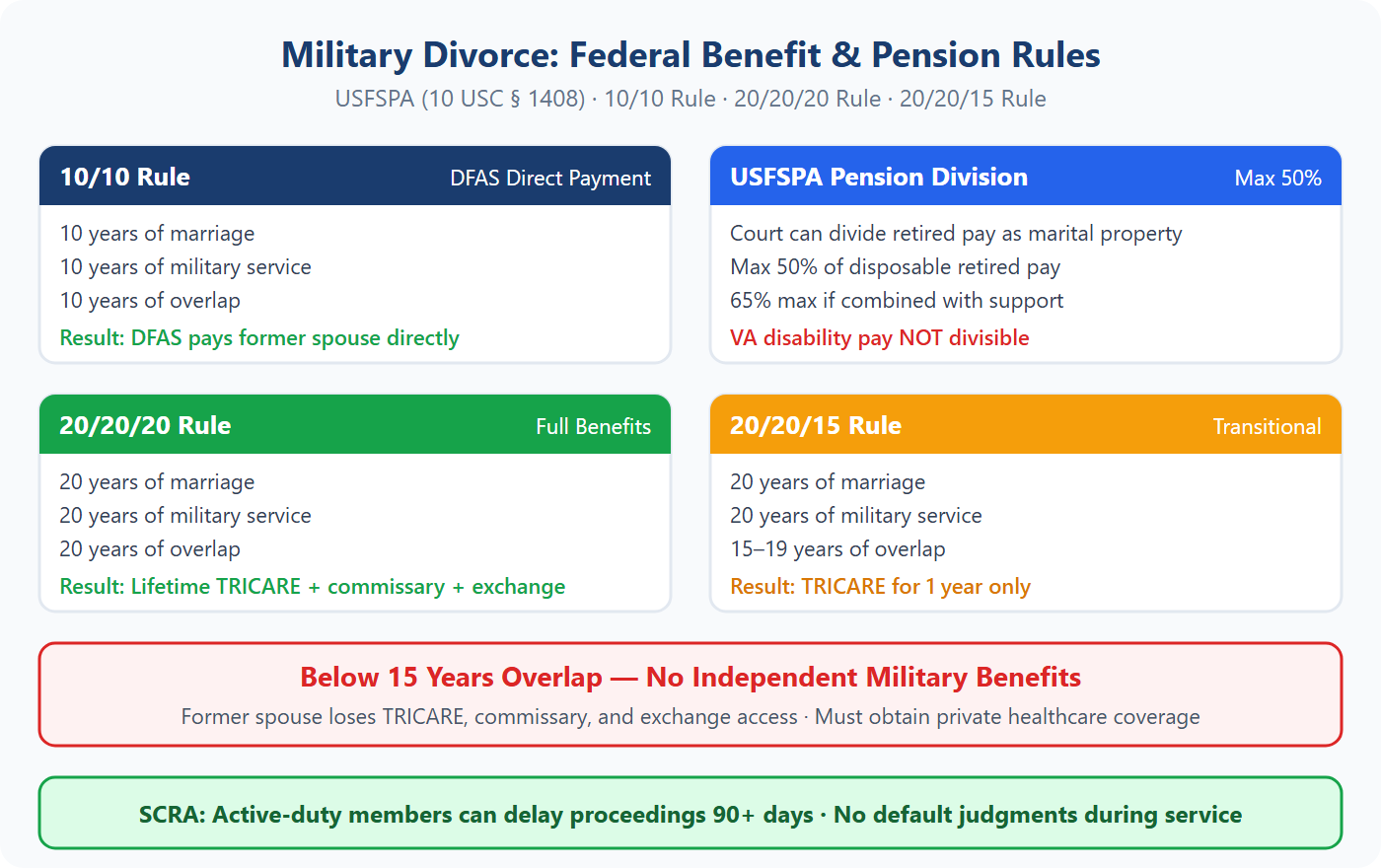
The 10/10 Rule: Direct Payments from DFAS
The 10/10 rule determines whether a former spouse receives their court-ordered share of military retirement directly from DFAS (Defense Finance and Accounting Service) or must collect payments from the service member personally, a distinction that has significant enforcement and financial planning implications.[3]
To qualify for direct DFAS payments, three conditions must all be met: at least 10 years of marriage, at least 10 years of creditable military service, and at least 10 years of overlap between the marriage and the period of military service.
If all three conditions are satisfied, DFAS sends the former spouse’s share directly each month, eliminating the need to depend on the service member for voluntary compliance.
If the 10/10 threshold is not met, the former spouse is still legally entitled to their court-ordered share of retirement. They simply must collect it from the service member directly, which creates enforcement challenges and the risk of nonpayment. Understanding this rule before finalizing your divorce is critical to structuring a reliable payment arrangement.
The 10/10 rule requires:
- At least 10 years of marriage
- At least 10 years of creditable military service
- At least 10 years of overlap between the marriage and military service
If all three conditions are met, DFAS pays the former spouse’s share directly. If not, the former spouse is still entitled to their court-ordered share. They just have to collect it from the service member, which creates enforcement challenges.
Important: The 10/10 rule only affects the payment method, not the right to a share of retirement. A former spouse married for 5 years can still receive a court-ordered share of military pension. They just cannot get direct DFAS payments.
The 20/20/20 and 20/20/15 Benefit Rules
The 20/20/20 and 20/20/15 rules are federal benefit eligibility thresholds that determine whether a former military spouse retains TRICARE healthcare coverage, commissary and exchange access, and other military benefits after divorce, and losing eligibility can mean hundreds of thousands of dollars in lifetime healthcare costs.
The 20/20/20 rule requires 20 years of marriage, 20 years of military service, and 20 years of overlap between the two to qualify for full lifetime benefits.
The 20/20/15 rule applies when there are at least 15 but fewer than 20 years of overlap, providing only one year of transitional TRICARE coverage after the divorce is finalized.
Former spouses who fall below the 15-year overlap threshold lose all independent military healthcare eligibility and must obtain coverage through the ACA marketplace, an employer, or the Continued Health Care Benefit Program at full cost.
These thresholds are non-negotiable federal law, and timing the divorce filing around them can be worth hundreds of thousands of dollars in lifetime benefits.
20/20/20 Rule (full benefits):
- 20 years of marriage
- 20 years of military service
- 20 years of overlap between marriage and service
- Benefits retained: Full TRICARE coverage, commissary and exchange access, Space-A travel
20/20/15 Rule (transitional benefits):
- 20 years of marriage
- 20 years of military service
- At least 15 years (but less than 20) of overlap
- Benefits retained: TRICARE coverage for one year after divorce, then must find alternative coverage
Less than 15 years overlap: No independent military healthcare benefits. The former spouse must obtain coverage through the ACA marketplace, employer, or COBRA (up to 36 months through the Continued Health Care Benefit Program at full cost).
These benefit rules are non-negotiable: they are federal law. But many divorcing spouses do not know about them until it is too late. If your divorce is finalized one month before hitting the 20/20/20 threshold, you lose lifetime healthcare benefits worth hundreds of thousands of dollars.
BAH, BAS, and Military Pay in Divorce
Military compensation includes significantly more than base pay, and Florida courts consider all income sources when calculating child support under the F.S. § 61.30 guidelines and determining alimony, including allowances that are tax-free.[5]
Basic Allowance for Housing (BAH) and Basic Allowance for Subsistence (BAS) are both counted as income for support calculations in Florida, even though they are not subject to federal income tax.
This distinction is critical because a service member’s total compensation is substantially higher than their taxable income suggests, which affects both the child support guidelines calculation and the alimony determination under the 2023 reform’s 35% income difference cap.[6]
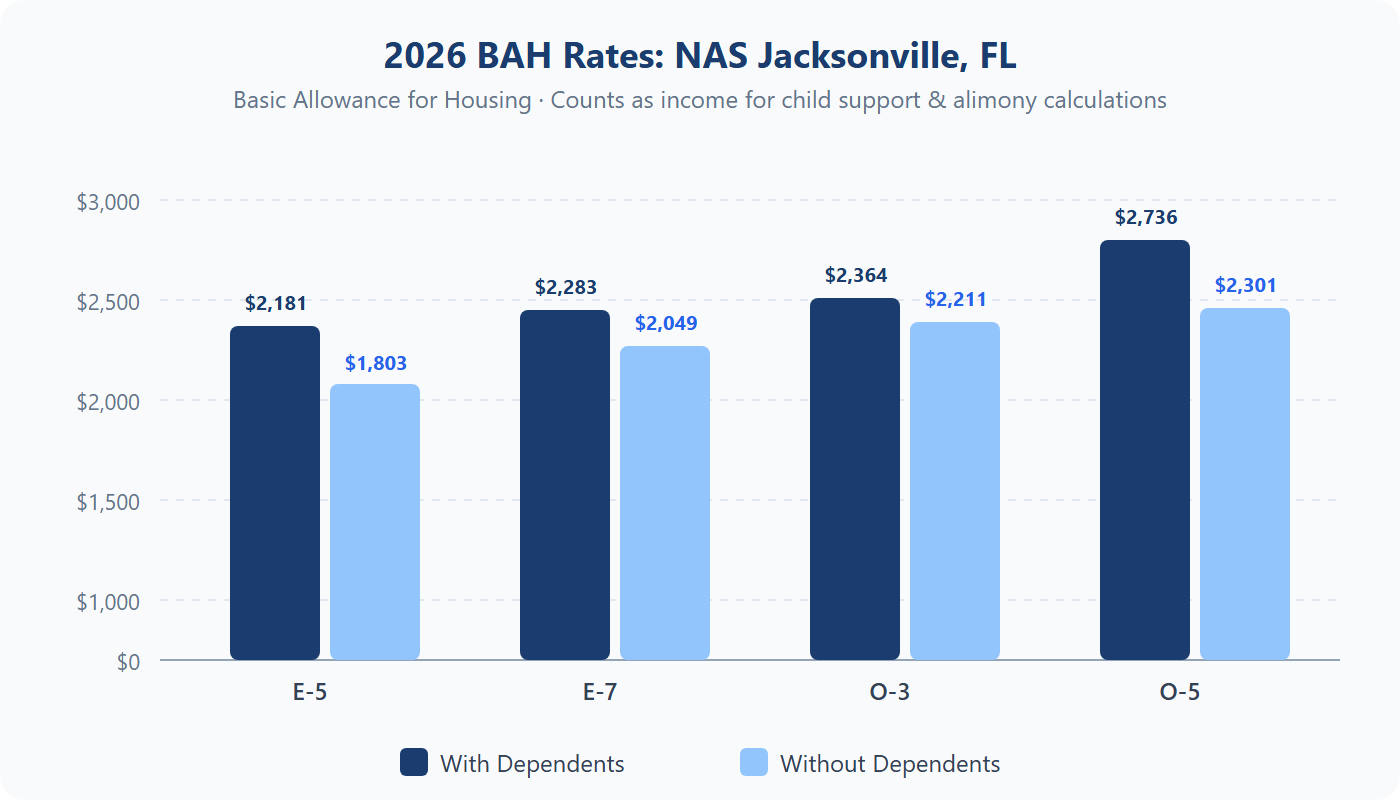
For an E-7 stationed at NAS Jacksonville in 2026, BAH with dependents is $2,283 per month, over $27,000 per year in tax-free income that must be included in support calculations.[7] Special and incentive pays, including flight pay, hazardous duty pay, sea pay, and combat pay, are also counted, as are reenlistment and retention bonuses earned during the marriage.
| Pay Grade | BAH w/ Dependents | BAH w/o Dependents | Difference |
|---|---|---|---|
| E-5 | $2,181/mo | $1,803/mo | $378/mo |
| E-7 | $2,283/mo | $2,049/mo | $234/mo |
| O-3 | $2,364/mo | $2,211/mo | $153/mo |
| O-5 | $2,736/mo | $2,301/mo | $435/mo |
2026 BAH rates for NAS Jacksonville, FL.[7]
Income components considered in Florida military divorce:
- Base pay: The primary compensation, taxable
- BAH (Basic Allowance for Housing): Tax-free, but counted as income for support calculations in Florida
- BAS (Basic Allowance for Subsistence): Tax-free food allowance, also counted as income
- Special and incentive pays: Flight pay, hazardous duty pay, sea pay, combat pay
- Bonuses: Reenlistment bonuses and retention bonuses earned during the marriage are marital property
The tax-free nature of BAH and BAS is significant. A service member’s total compensation is higher than their taxable income suggests, which affects both child support guidelines calculations and alimony determinations.
Child Custody and the 50/50 Presumption in Military Divorce
Florida’s 2023 family law reform (Ch. 2023-301) created a rebuttable presumption of equal time-sharing between parents, and this presumption applies to military families just as it does to civilians, but military service creates unique custody challenges that require specialized legal planning.[6]
A parent cannot exercise 50/50 time-sharing while deployed overseas, and Permanent Change of Station (PCS) orders can trigger relocation disputes under F.S. § 61.13001, which requires court approval before moving a child more than 50 miles.
Florida law specifically addresses deployment through F.S. § 61.13002, which allows temporary custody modifications during deployment that automatically revert when the service member returns, ensuring that no court can permanently alter custody based solely on a parent’s military service.
Military regulations also require service members with dependents to maintain a Family Care Plan designating a caregiver during deployment, though these plans do not override court custody orders.
Building a parenting plan that accounts for deployment schedules, makeup time provisions, and virtual visitation is essential for military families seeking stable custody arrangements.
However, military service creates unique custody challenges:
- Deployment: A parent cannot exercise 50/50 time-sharing while deployed. Florida law (F.S. § 61.13002) addresses temporary custody modifications during deployment.
- PCS moves: Permanent Change of Station orders can trigger relocation disputes. Florida requires court approval to move a child more than 50 miles (F.S. § 61.13001).
- Family Care Plans: Military regulations require service members with dependents to have a Family Care Plan designating a caregiver during deployment. This does not override court custody orders.
- No deployment penalty: Under both federal and Florida law, a court cannot permanently modify custody based solely on a parent’s military deployment or mobilization.
The key to military custody is building a parenting plan that accounts for the realities of military service, including deployment schedules, makeup time provisions, and virtual visitation during absences.
How Deployment Affects the Divorce Process
Deployment does not stop a divorce from proceeding. It changes the timeline, the procedural requirements, and how both parties participate in the case. Under the Servicemembers Civil Relief Act (50 U.S.C. § 3931), a deployed service member can request a minimum 90-day stay of all proceedings, which most Duval County judges grant automatically.[4]
However, many Jacksonville family court judges now allow telephonic or video testimony for deployed service members, reducing unnecessary delays while still protecting SCRA rights.
A deployed service member can also grant their attorney a limited power of attorney to make decisions and sign documents during the divorce, and the court can enter temporary orders for child support, custody, and spousal support that remain in effect until the deployed parent returns for a final hearing.
SCRA prevents the court from entering a final judgment against a deployed member who has not had the opportunity to participate. Planning ahead matters significantly: working with your attorney to establish temporary orders before a known deployment can protect your interests while you are overseas. Here is what happens step by step:
- SCRA stay: The deployed spouse can request a minimum 90-day stay of all proceedings. Most judges grant this automatically.
- Remote participation: Many Duval County judges now allow telephonic or video testimony for deployed service members, reducing the need for delays.
- Power of attorney: A deployed service member can grant their attorney a limited power of attorney to make decisions and sign documents during the divorce.
- Temporary orders: The court can enter temporary child support, custody, and spousal support orders that remain in effect until the deployed parent returns and a final hearing is held.
- No default judgment: SCRA prevents the court from entering a final judgment against a deployed service member who has not had the opportunity to participate.
Planning matters here. If you know deployment is coming, working with your attorney to establish temporary orders before departure can protect your interests while you are overseas.
Alimony in Military Divorce After the 2023 Reform
Florida’s 2023 alimony reform (Ch. 2023-301) eliminated permanent alimony and restructured the rules for the four remaining types (bridge-the-gap, rehabilitative, durational, and temporary) and these changes directly impact how alimony is calculated, awarded, and coordinated with military pension division in military divorce cases.[6]
For long-term military marriages of 20 or more years, the elimination of permanent alimony means that durational alimony, capped at the length of the marriage, is now the maximum available.
The 2023 reform also introduced a general cap of 35% of the difference between the parties’ net incomes for durational alimony, and Florida courts include tax-free BAH and BAS allowances in this income calculation. Adultery is now a relevant factor in alimony determinations under the reform, which can arise in military divorces involving extended deployment separations.
For military families with long service records, the interaction between alimony reform and USFSPA pension division creates complex financial planning issues that must be coordinated carefully to avoid double-dipping.
Key changes affecting military families:
- Permanent alimony eliminated: Long-term military marriages (20+ years) no longer result in permanent alimony. Durational alimony is the maximum, capped at the length of the marriage.
- 35% income difference cap: Durational alimony generally cannot exceed 35% of the difference between the parties’ net incomes. BAH and BAS are included in this calculation.
- Adultery is now a factor: The 2023 reform made adultery a relevant factor in alimony determinations, which can arise in military divorces involving deployment separations.
- Marriage length categories changed: Short-term (under 10 years), moderate (10–20 years), long-term (20+ years). These thresholds affect the duration and amount of alimony available.
For military families with long service records, the interaction between alimony reform and pension division creates complex financial planning issues. A portion of retirement may go to the former spouse under USFSPA, while alimony provides additional support, but the two must be coordinated to avoid double-dipping.
VA Disability Pay and Divorce
VA disability compensation is not divisible as marital property in a Florida divorce, a critical distinction governed by federal law (38 U.S.C. § 5301) that many attorneys without military divorce experience get wrong.
While VA disability pay is the veteran’s separate property and cannot be divided or garnished, Florida courts can and do consider it as income when calculating child support under F.S. § 61.30 and when determining alimony under the 2023 reform.[5]
Combat-Related Special Compensation (CRSC) is similarly protected from division or garnishment. The most significant pitfall in this area is the retirement waiver trap: when a veteran waives a portion of retired pay to receive VA disability compensation on a dollar-for-dollar offset basis, the former spouse’s court-ordered share of retirement shrinks correspondingly.
Some service members pursue this strategy deliberately to reduce their ex-spouse’s share of the pension. This area requires an attorney who understands both the federal protections and the adversarial strategies opposing parties use to manipulate the retirement-disability balance in their favor.
- VA disability pay is the veteran’s separate property: Federal law (38 U.S.C. § 5301) exempts it from division
- But it counts as income: Florida courts can consider VA disability when calculating child support and alimony
- Retirement waiver trap: When a veteran waives retired pay to receive VA disability (dollar-for-dollar offset), the former spouse’s share of retirement shrinks. Some service members do this deliberately to reduce their ex-spouse’s share.
- CRSC is also protected: Combat-Related Special Compensation cannot be divided or garnished
This area requires an attorney who understands both the federal protections and the strategies that opposing parties use to manipulate the retirement/disability balance.
7 Mistakes That Cost Military Families in Divorce
Military divorce involves federal laws, benefit eligibility thresholds, and pension division procedures that create unique opportunities for costly errors: errors that civilian divorce attorneys may not even recognize.
In my 25 years of handling military divorce cases in Jacksonville, I have seen families lose lifetime TRICARE healthcare by finalizing one month too early, accept pension division orders that DFAS rejected for formatting deficiencies, undervalue tax-free BAH and BAS allowances in support calculations, and fail to address the Survivor Benefit Plan or Thrift Savings Plan in the divorce decree.
Each of these mistakes can cost tens of thousands of dollars or more, and many are irreversible once the judgment is entered.
The federal-state intersection governing military divorce (SCRA, USFSPA, DFAS procedures, and benefit eligibility rules) requires an attorney who practices in this area regularly, not a general family law attorney learning these statutes for the first time on your case. Here are the seven most common mistakes I see:
- Not invoking SCRA when eligible: Active-duty members who do not request a stay may face default judgments or unfavorable rulings entered without their input.
- Accepting a pension division order without DFAS review: If the order does not meet DFAS formatting requirements, it will be rejected. Your attorney should draft the order to DFAS specifications from the start.
- Ignoring the 20/20/20 threshold: If you are close to 20 years of overlap between marriage and service, timing the divorce filing can mean the difference between lifetime TRICARE and no coverage.
- Failing to account for the Survivor Benefit Plan (SBP): SBP provides a survivor annuity if the retiree dies. Former spouses can be designated as SBP beneficiaries, but this must be addressed in the divorce decree and filed with DFAS within one year.
- Undervaluing BAH and BAS in support calculations: These tax-free allowances represent thousands per month in real income. Excluding them understates the service member’s actual compensation.
- Not addressing the Thrift Savings Plan (TSP): TSP is a separate retirement account from military pension. It requires its own court order (Retirement Benefits Court Order) for division.
- Using a civilian divorce attorney: Military divorce requires knowledge of SCRA, USFSPA, DFAS procedures, benefit eligibility rules, and military pay structures. A general family law attorney may not know these federal laws.
Why Choose Adam Sacks for Military Divorce
I have been handling military divorce cases in Jacksonville for over 25 years, long enough to know that the federal laws governing military divorce change how everything works, from filing requirements and SCRA timelines to pension division orders submitted to DFAS and benefit eligibility calculations that can be worth hundreds of thousands of dollars over a lifetime.
Jacksonville is a military town with 68,060 military jobs and six major installations, and a significant percentage of the families I represent have a connection to NAS Jacksonville, NS Mayport, Camp Blanding, or one of the other installations in the area.[1]
I understand the realities of military life (the deployments, the PCS moves, the uncertainty of operational schedules) and I build legal strategies around those realities rather than ignoring them.
My background as a former Assistant State Attorney for the State of Florida gives me courtroom trial experience that translates directly into effective negotiation and aggressive litigation when the other side is unreasonable.
Jacksonville is a military town. A significant percentage of the families I represent have a connection to NAS Jacksonville, NS Mayport, or one of the other installations in the area. I understand the realities of military life (the deployments, the PCS moves, the uncertainty) and I build legal strategies around those realities rather than ignoring them.
As a former Assistant State Attorney, I spent years in the courtroom before transitioning to family law. That trial experience means I can negotiate effectively when the other side is reasonable and litigate aggressively when they are not.
As a Florida Supreme Court Certified Family Mediator, I also know how to resolve military divorce through mediation when it makes sense, saving time and money while still protecting your interests.
My psychology degree from the University of Massachusetts gives me an understanding of the emotional dynamics in military divorce that most attorneys do not have. Deployment stress, reintegration challenges, and the unique pressures of military life all affect how families navigate divorce. I factor those realities into every case.
Adam Sacks earned his J.D. from Western Michigan University Cooley Law School, where he received a Book Award for top academic performance. He served as an Assistant State Attorney in Seminole County before transitioning to private family law practice.
He is a Florida Supreme Court Certified Family Mediator and a member of the Florida Bar (Bar #248370) since 2000. At Sacks & Sacks, Adam provides personal, family-run legal representation.
What Happens When You Call Sacks & Sacks
When you call our office at (904) 396-5557, you speak directly with me, attorney Adam Sacks. Military divorce requires an immediate assessment of which federal laws apply to your situation, how they interact with Florida family law, and what strategic decisions need to be made early to protect your financial interests and custody rights.
During your free consultation, I will ask about your branch, rank, years of service, deployment status, and current duty station because these details determine SCRA applicability, USFSPA pension division procedures, benefit eligibility under the 20/20/20 and 20/20/15 rules, and how BAH, BAS, and special pay factor into child support and alimony calculations.[3]
With 25+ years of family law experience, a background as a former state prosecutor, and certification as a Florida Supreme Court Certified Family Mediator, I can handle your military divorce through negotiation, mediation, or trial, whichever approach best protects your interests. Here is exactly what happens:
- You talk to me: not a paralegal, not an intake coordinator. I answer your questions directly during a free consultation.
- I assess your military situation: I will ask about your branch, rank, years of service, deployment status, and where you are stationed. These details determine which federal laws apply and how they interact with Florida law.
- We identify your priorities: Pension division, custody, benefits retention, or all of the above. I will give you an honest assessment of what to expect.
- I build a strategy: Every military divorce is different. I develop a plan that accounts for SCRA timelines, USFSPA requirements, benefit eligibility thresholds, and Florida family law.
- I fight for your interests: Whether through negotiation, mediation, or trial, I protect your rights at every stage.
Military divorce requires a military divorce attorney. Call me at (904) 396-5557. Free consultation, no obligation.
What Our Clients Say

“I was going through a difficult divorce and custody situation. Adam was honest with me about what to expect, prepared me for mediation, and fought for the best outcome. He genuinely cares about his clients and their families.”
Hackie G., Google Review
“I went to Adam for a custody case. He treated me like a person and genuinely fought for my child. His knowledge of family law and mediation was exactly what I needed.”
Robert, Avvo Review
“Adam helped me through a very stressful divorce. He was always available when I had questions, and he got things resolved faster than I expected. Highly recommend.”
Linda J., Google Review
Frequently Asked Questions About Military Divorce in Jacksonville
Can I file for divorce in Florida if I am stationed here but my legal residence is another state?
Yes. Florida requires that at least one spouse has been a resident for six months before filing (F.S. § 61.021).[5] Being stationed in Florida for six months or more satisfies this requirement, even if your Home of Record is a different state.
Your spouse can also file in Florida if they have been living here for six months, regardless of where you are stationed.
How is military retirement pay divided in a Florida divorce?
Under the USFSPA (10 U.S.C. § 1408), Florida courts can divide military retirement as marital property.[3] The court typically awards the former spouse a percentage based on the marital share: the ratio of years of marriage overlapping with military service to total creditable service.
The maximum DFAS will pay directly is 50% of disposable retired pay. If the 10/10 rule is met, DFAS pays the former spouse directly; otherwise, the service member must make payments.
What happens to TRICARE benefits after a military divorce?
It depends on the 20/20/20 and 20/20/15 rules. If the marriage lasted 20+ years, military service lasted 20+ years, and they overlapped for 20+ years, the former spouse keeps full TRICARE coverage for life.
With 15–20 years of overlap, TRICARE continues for one year post-divorce. Below 15 years of overlap, the former spouse loses TRICARE eligibility and must find alternative healthcare.
Can my spouse take my VA disability pay in a divorce?
No. VA disability compensation is federally protected and cannot be divided as marital property. However, Florida courts can consider VA disability as income when calculating child support and alimony.
Be aware of the retirement waiver trap: if you waive retired pay to receive VA disability, it can reduce the amount your former spouse receives from your pension under USFSPA.
How does deployment affect child custody in Florida?
In my experience, the biggest concern for deployed parents is losing custody while they are overseas. Florida law (F.S. § 61.13002) specifically addresses this: a court can make temporary custody modifications during deployment, but these changes automatically revert when the service member returns.
No court can permanently change custody based solely on deployment. I help my clients set up temporary custody plans before deployment so their rights are protected.
What is the difference between the 10/10 rule and the 20/20/20 rule?
The 10/10 rule determines whether a former spouse receives their share of military retirement directly from DFAS. It requires 10 years of marriage, 10 years of service, and 10 years of overlap.
The 20/20/20 rule determines whether a former spouse keeps military benefits (TRICARE, commissary, exchange) after divorce. It requires 20 years of marriage, 20 years of service, and 20 years of overlap. They serve completely different purposes.
How long does a military divorce take in Jacksonville?
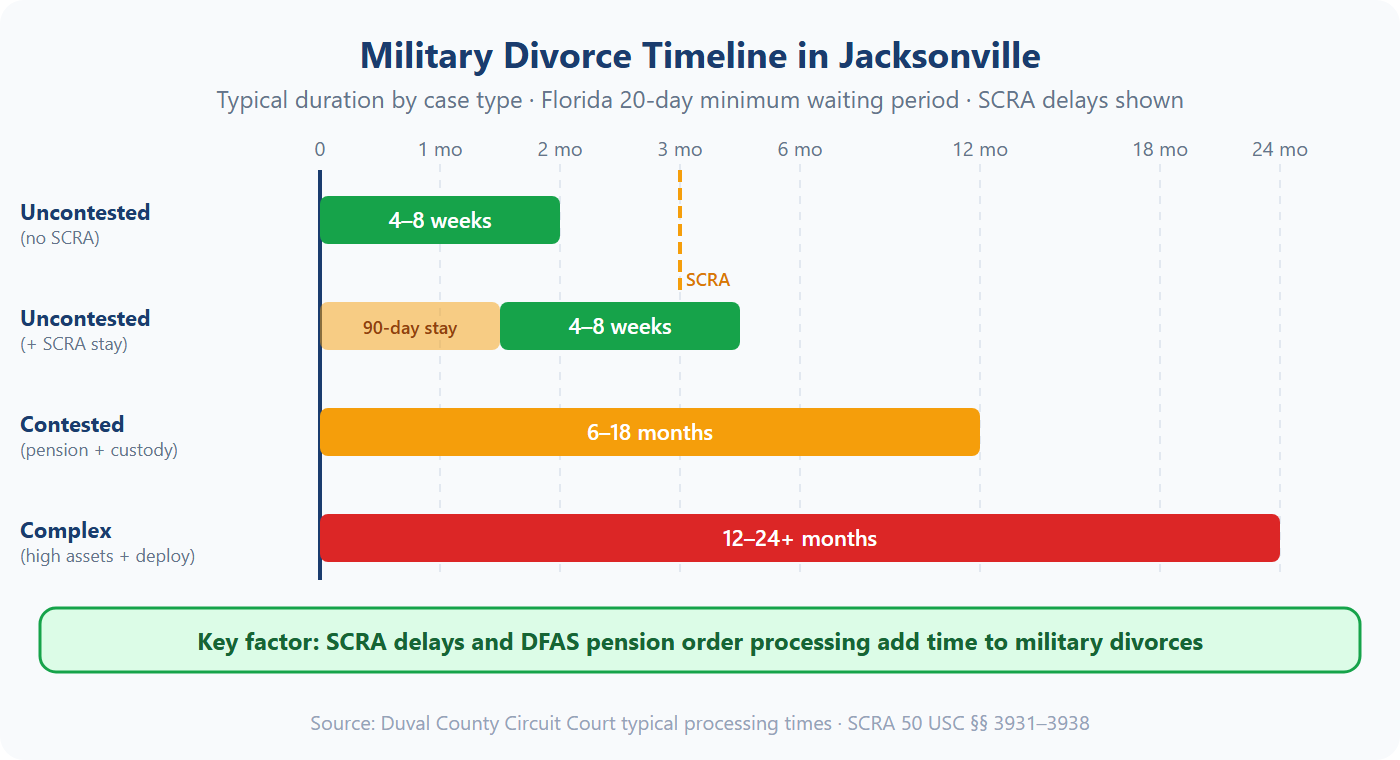
If both parties agree and no SCRA delays are involved, a military divorce can be finalized in 4–8 weeks (the same as any uncontested Florida divorce, with the 20-day minimum waiting period). If the service member invokes SCRA, add at least 90 days.
Contested military divorces with pension division, custody disputes, and benefit issues typically take 6–18 months. The biggest factor is whether both parties can participate in proceedings without deployment interruptions.
Sources:
[1] News4Jax, Jacksonville, Florida News, Weather, Sports, WJXT Channel 4. (2025, October 1). Government shutdown may leave military families without paychecks. Local banks are ready to help [Video]. WJXT. newsforjax.com
[2] OneOp/DMDC, Divorce in the Ranks: Supporting Military Spouses Navigating Divorce (2025). oneop.org
[3] Defense Finance and Accounting Service, USFSPA FAQs. dfas.mil
[4] U.S. Department of Justice, Servicemembers Civil Relief Act (SCRA). justice.gov
[5] The Florida Legislature, F.S. § 61.021: Residence Requirements for Dissolution. flsenate.gov
[6] The Florida Legislature, Ch. 2023-301, Laws of Florida (SB 1416). laws.flrules.org
[7] NAS Jacksonville Naval Housing, 2026 BAH Rates. jacksonvillenavalhousing.com