
Call (904) 396-5557 — Same-day document preparation. Free consultation.
What Is a Fast Divorce in Florida?
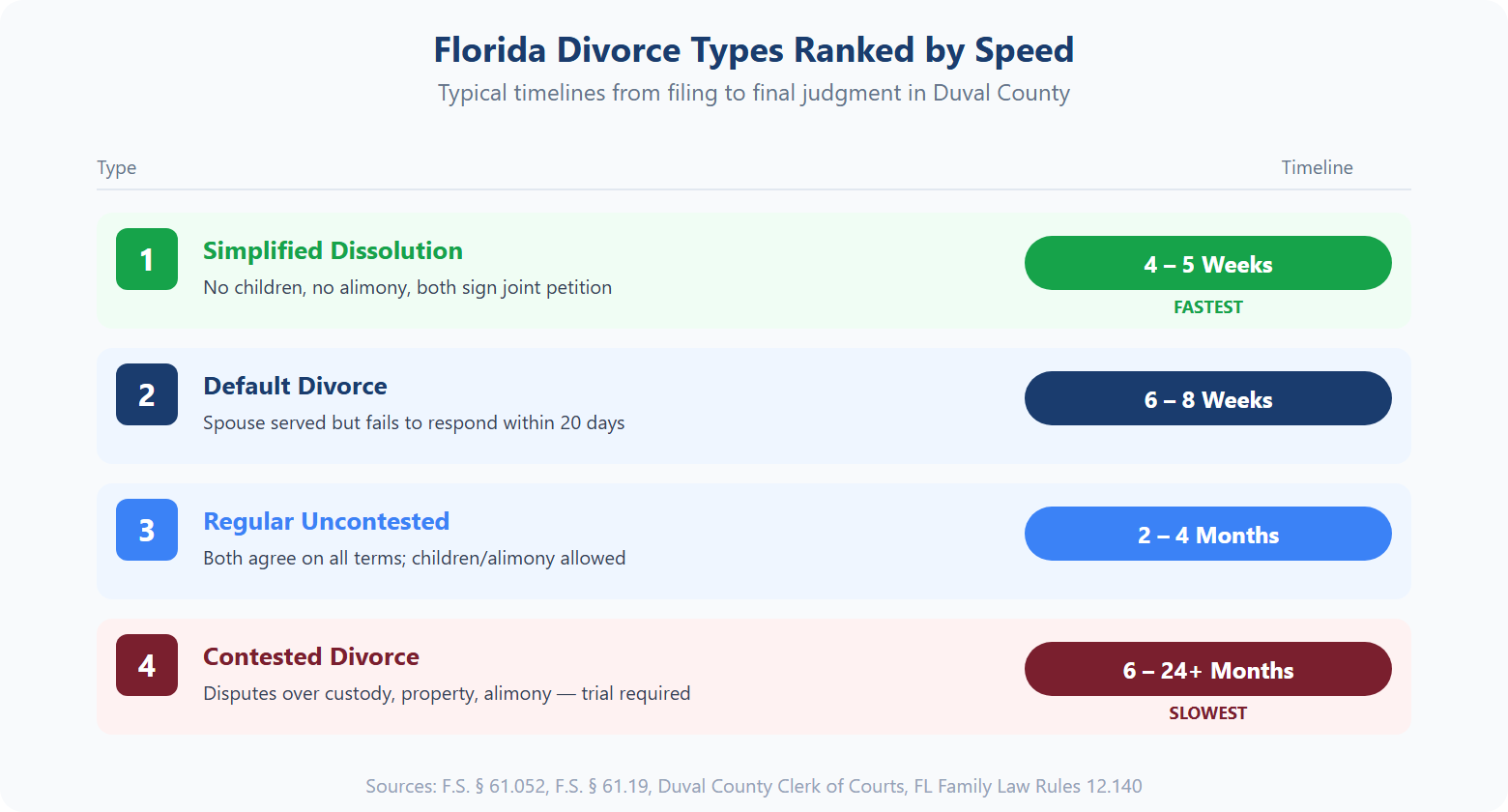
A “fast divorce” is not a separate legal category under Florida law — it refers to the fastest available dissolution paths that allow couples to finalize their divorce in weeks rather than the months or years required by contested litigation. The quickest option is simplified dissolution (Form 12.901(a) under F.S. § 61.043), which can be finalized in approximately 4 to 5 weeks from the date both spouses file a joint petition with the court. [1] A regular uncontested divorce where both spouses agree on all terms — property division, child custody, support, and alimony — typically takes 2 to 4 months in Duval County, while a default divorce under Florida Family Law Rule 12.140, where the other spouse is served but does not respond within 20 days, can be completed in 6 to 8 weeks. [2] At Sacks & Sacks in Jacksonville, attorney Adam Sacks prepares your divorce documents the same day you visit our office, ensuring your fast divorce stays on the fastest possible track.
The common thread is agreement and efficiency. When both spouses cooperate (or when one doesn’t respond), the court process moves quickly because there’s nothing to litigate. No depositions, no trial, no months of discovery. You file, you wait through the mandatory 20-day period under F.S. § 61.19, and you attend a brief final hearing [3].
At Sacks & Sacks, I’ve handled hundreds of fast divorces for Jacksonville families. The key differentiator isn’t just which path you choose — it’s how quickly your attorney can get your paperwork right the first time. Errors and omissions are the number one reason “fast” divorces get delayed.
Simplified Dissolution: The Fastest Path (4–5 Weeks)
Florida’s simplified dissolution under F.S. § 61.052(2) and F.S. § 61.043 is the fastest legal path to ending a marriage in the state, designed specifically for couples with straightforward financial situations who agree on the division of all assets and debts and have no minor children. [1] The entire process can be completed in approximately 30 days from the date both spouses file a joint petition with the Duval County Clerk of Courts, making it significantly faster than both the regular uncontested dissolution (2–4 months) and the contested divorce process (6–24+ months). Both spouses must jointly file Form 12.901(a), attend the final hearing together, and waive their rights to trial and appeal. [4] While the speed is appealing, the permanent waiver of appeal rights means that any mistakes in the property or debt division cannot be corrected after the judge signs the final judgment — making attorney review essential even in simplified cases.
To qualify for simplified dissolution in Florida, you must meet all of these requirements:
- No minor or dependent children — and the wife is not pregnant
- Both spouses agree on division of all property and debts
- Neither spouse seeks alimony
- Both spouses file a joint petition — Form 12.901(a) [4]
- At least one spouse has lived in Florida for 6+ months
- Both spouses attend the final hearing together
The tradeoff for speed is significant: simplified dissolution waives your right to a trial and your right to appeal. Once the judge signs the final judgment, it’s done. That’s why having an attorney review your settlement agreement before filing is critical — you won’t get a second chance to fix an unfair deal.
Regular Uncontested Divorce: Fast with More Flexibility (2–4 Months)
If you have minor children, need alimony provisions in your settlement, or do not meet the strict eligibility requirements for simplified dissolution, a regular uncontested divorce is your next fastest option for ending your marriage in Florida. It typically takes 2 to 4 months in Duval County from the date the petition is filed to entry of the final judgment by the court. [1] Unlike simplified dissolution, the regular uncontested process allows you to include child custody arrangements and a parenting plan, negotiate spousal support under the 2023 alimony reform framework (Ch. 2023-301), divide complex property including retirement accounts and business interests, and preserve your full appeal rights after the final judgment is entered. This path offers the best balance of speed and legal protection for Jacksonville families who agree on all terms but have circumstances that exceed the narrow scope of simplified dissolution.
The key requirement is the same: both spouses must agree on all terms. The difference is that regular uncontested divorce allows:
- Minor children (with a parenting plan and child support agreement)
- Alimony provisions in the marital settlement agreement
- One spouse to file and serve the other (rather than a joint petition)
- Only the petitioner to attend the final hearing (respondent attendance optional)
- Full appeal rights preserved
The extra time comes from the service-and-response process. After the petition is filed, the other spouse has 20 days to respond. Then there’s the 20-day mandatory waiting period before a final hearing can be scheduled. But when your paperwork is prepared correctly and filed promptly, the process moves through the system quickly.
Default Divorce: When Your Spouse Won’t Respond (6–8 Weeks)
Sometimes one spouse wants a fast divorce but the other will not cooperate, refuses to sign paperwork, or simply cannot be located despite reasonable efforts. Florida law provides a legal solution for these situations through the default divorce process under Florida Family Law Rule of Procedure 12.140, which allows the court to proceed and enter a final judgment without the non-responding spouse’s participation. [2] After the petition for dissolution is properly served, the respondent has 20 days to file an answer with the court. If no response is filed within that window, the petitioner can file a Motion for Default with the Duval County Clerk, and the court can then grant the divorce based on the terms requested in the original petition. The entire default divorce process typically takes 6 to 8 weeks in Jacksonville’s Fourth Judicial Circuit, making it a viable fast-track option when one spouse is uncooperative or unreachable.
Here’s how it works:
- File the petition and have your spouse formally served
- Wait 20 days — if your spouse doesn’t file a response, they’re in default
- File a Motion for Default with the Duval County Clerk
- Attend a final hearing — the judge reviews your proposed terms and enters a final judgment
In a default divorce, the court can grant the terms you requested in your petition — including child custody, support, and property division — without your spouse’s participation. However, the judge still reviews the terms for fairness, especially when children are involved.
Default divorce is faster than a contested case but requires proper service. If your spouse was never properly served, any default judgment can be overturned. I make sure the service is documented correctly so your judgment stands.
How Much Does a Fast Divorce Cost in Jacksonville?
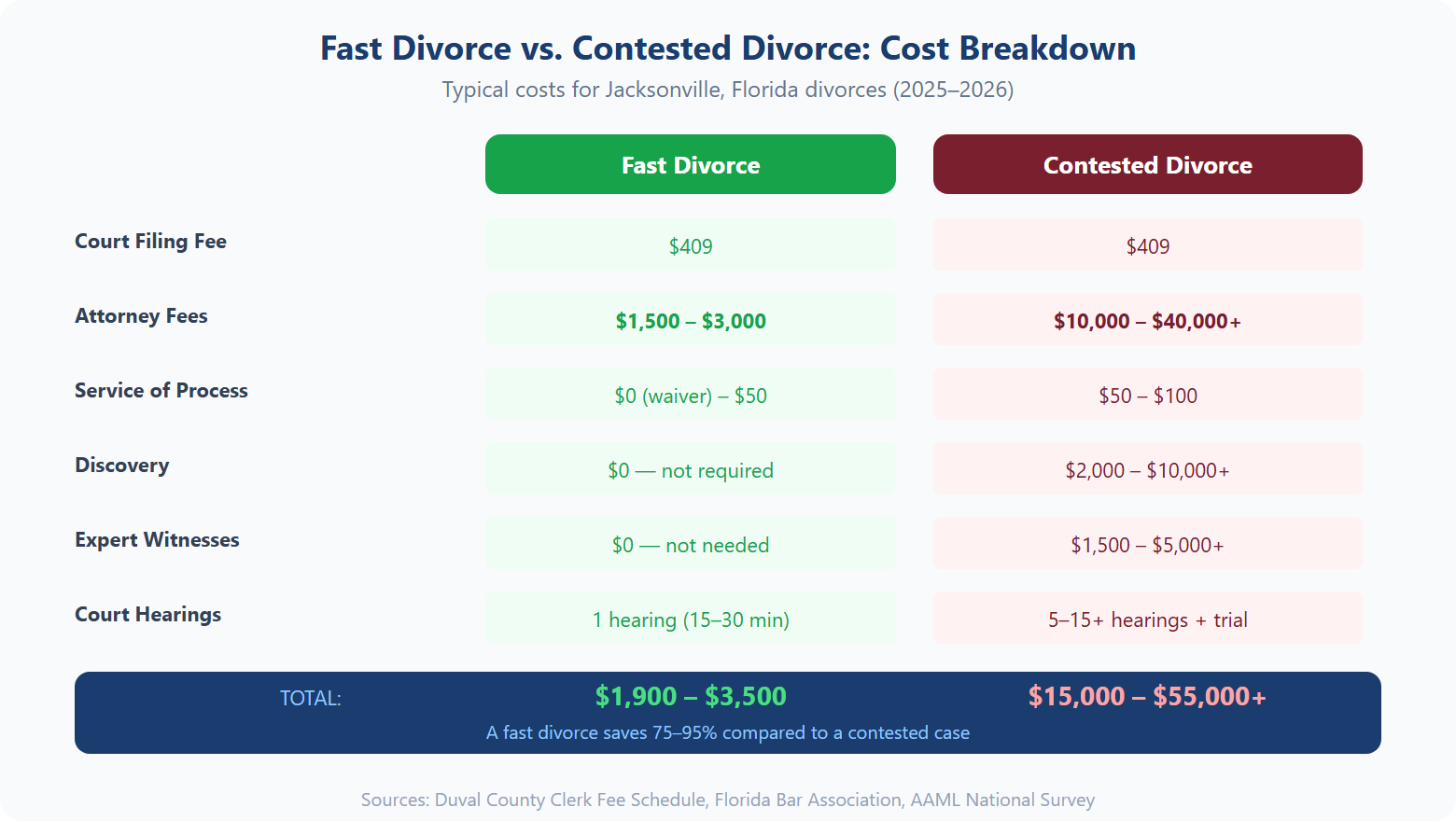
A fast divorce in Jacksonville costs significantly less than a contested divorce because it eliminates the expenses that make litigation expensive — the months of discovery, depositions of witnesses, expert witness fees for business valuators and forensic accountants, and multiple court hearings before a Duval County judge. [5] The total cost for a fast divorce in Jacksonville typically ranges from approximately $1,900 to $3,500, which includes the court filing fee, flat-rate attorney fees, and any required parenting course costs if minor children are involved. By comparison, a contested divorce that proceeds through discovery, mediation, and trial can cost $15,000 to $55,000 or more. At Sacks & Sacks, attorney Adam Sacks offers transparent flat-fee pricing for fast divorces so you know exactly what you will pay before the process begins, with no hourly billing surprises or unexpected retainer demands.
Here’s what you’ll typically pay:
- Duval County filing fee: $409 (same for simplified and regular dissolution) [1]
- Attorney fees: $1,500–$3,000 for an uncontested or simplified case (flat fee at our firm)
- Service of process: $0 if your spouse signs a waiver; up to $50 for formal service
- Parenting course: $25–$40 per person if you have minor children (required under F.S. § 61.21) [6]
Total: approximately $1,900–$3,500 — compared to $15,000–$55,000+ for a contested divorce with trial.
At Sacks & Sacks, we offer flat-fee pricing for fast divorces. You know exactly what you’ll pay before we start. No hourly billing surprises, no $5,000 retainer demands.
Same-Day Document Preparation at Sacks & Sacks
The single biggest cause of divorce delays in Jacksonville is not the court’s schedule or the mandatory 20-day waiting period under F.S. § 61.19 — it is the paperwork. Incomplete forms, missing financial disclosures, improperly notarized signatures, and formatting errors send cases back to the Duval County Clerk’s office and force filers to start over, adding weeks or months to what should be a straightforward process. [3] At Sacks & Sacks, attorney Adam Sacks eliminates that bottleneck with same-day document preparation — meaning you come to our Jacksonville office with your financial information and the details of your agreement, and you leave with your complete divorce filing packet prepared, reviewed, and ready to submit. This is not an online form-generation service; it is full attorney preparation by a licensed Florida lawyer with over 25 years of family law experience who reviews every term for legal compliance and fairness.
Here’s how it works: you come to our Jacksonville office with your financial information and the details of your agreement with your spouse. I prepare your complete divorce packet — petition, marital settlement agreement, financial affidavit, and all required forms — while you’re here. You leave with everything ready to file.
This isn’t a document preparation mill. I’m a licensed Florida attorney with over 25 years of family law experience. I review every term of your agreement, flag potential problems, and make sure your paperwork will pass the judge’s review the first time. That’s the difference between “fast” and “fast and done right.”
Florida Requirements for Filing a Fast Divorce
Regardless of which fast divorce path you choose — simplified dissolution, regular uncontested, or default divorce — Florida has baseline legal requirements that apply to every dissolution of marriage filed in the state. [3] These requirements are established under Chapter 61 of the Florida Statutes and the Florida Family Law Rules of Procedure, and failure to satisfy any one of them will result in your petition being rejected by the Duval County Clerk of Courts or dismissed by the judge. The good news for Jacksonville residents seeking a fast divorce is that Florida’s requirements are among the most streamlined in the country: there is no mandatory separation period, no waiting period beyond the 20-day minimum under F.S. § 61.19, and no requirement to prove fault. Meeting these requirements before you file ensures your case moves through the Fourth Judicial Circuit without unnecessary delays or rejected filings. Here are the baseline requirements:
- Residency: At least one spouse must have lived in Florida for 6 months before filing (F.S. § 61.021)
- Grounds: Florida is a no-fault state — you only need to state the marriage is “irretrievably broken” (F.S. § 61.052)
- Financial disclosure: Both spouses must complete a financial affidavit (Form 12.902(b) or 12.902(c)) — even in simplified cases
- Waiting period: 20 days from filing before a final judgment can be entered (F.S. § 61.19)
- Parenting course: Required for all cases with minor children — 4-hour minimum, petitioner within 45 days, respondent within 45 days of service (F.S. § 61.21) [6]
There is no mandatory separation period in Florida. You don’t have to live apart before filing. And unlike some states, Florida doesn’t impose a 60-day or 90-day waiting period — the 20-day minimum is one of the shortest in the country.
Documents You Need for a Fast Divorce
Having the right documents organized and ready before your appointment with attorney Adam Sacks speeds up the entire fast divorce process and enables same-day document preparation at our Jacksonville office. Florida Family Law Rules of Procedure require specific financial disclosures, identification information, and asset and debt documentation for every dissolution filing, and arriving at your appointment with these items already gathered allows us to prepare your complete divorce packet — petition, marital settlement agreement, financial affidavit, and all required court forms — in a single visit. [5] The more organized and complete your documentation is when you come in, the faster your case moves from consultation to filing to the final hearing before a Duval County judge. Here is what to bring to your appointment:
For all fast divorces:
- Marriage certificate (or date and location of marriage)
- Both spouses’ full legal names, addresses, dates of birth, and Social Security numbers
- Employment and income information for both spouses
- List of all assets: real estate, vehicles, bank accounts, retirement accounts, investments
- List of all debts: mortgage, car loans, credit cards, student loans
- Agreement on how to divide property and debts
If you have children, also bring:
- Children’s names, dates of birth, and Social Security numbers
- Proposed parenting plan (time-sharing schedule)
- Childcare and health insurance cost information
- Each parent’s work schedule
When you come to Sacks & Sacks with these documents, I can prepare your entire filing packet in a single visit. The more organized you are coming in, the faster we move.
7 Mistakes That Slow Down a Fast Divorce
After handling hundreds of fast divorces in Jacksonville’s Fourth Judicial Circuit over the past 25+ years, I have identified the same avoidable errors that consistently delay cases that should move quickly through the system. These mistakes range from filing the wrong dissolution form and submitting incomplete financial affidavits, to skipping the mandatory parenting course required under F.S. § 61.21 for cases involving minor children. [6] Each error can add weeks or months to your timeline and, in some cases, force you to withdraw and refile your petition entirely. The good news is that every one of these mistakes is preventable with proper legal preparation. Working with an experienced Jacksonville divorce attorney who prepares your documents correctly the first time eliminates the most common sources of delay. Here are the seven most frequent mistakes I see:
- Incomplete financial affidavit — Judges won’t approve a settlement if financial disclosure is missing or inconsistent. Both spouses must complete this form fully.
- Wrong divorce type — Filing for simplified dissolution when you have children or want alimony means starting over with the correct forms.
- Improper service — If your spouse isn’t served correctly, the entire case can be thrown out. Use a process server or ensure the waiver of service is properly executed.
- Unsigned or unnotarized documents — Several forms require notarization. Missing signatures send paperwork back to the clerk.
- No marital settlement agreement — Even in a simplified dissolution, you need a written agreement on property and debt division. Verbal agreements don’t count.
- Skipping the parenting course — If you have children, both parents must complete the 4-hour course before the final hearing. The judge will not schedule your hearing without certificates of completion [6].
- Changing your mind mid-process — If one spouse decides they want alimony or disagrees on property terms after filing, your uncontested case becomes contested. Reach full agreement before filing.
Can You Get a Fast Divorce with Children?
Yes, you can get a fast divorce with children in Florida — but you cannot use the simplified dissolution process, which is restricted to couples without minor or dependent children. If you have children, a regular uncontested divorce is your fastest available path, typically taking 2 to 4 months in Duval County from filing to the final judgment. [1] The key requirement is that both parents must agree on all child-related issues before filing, including the time-sharing schedule, parental responsibility allocation, child support amount calculated under Florida’s Income Shares Model (F.S. § 61.30), and how medical insurance, childcare, and extracurricular costs are divided. Since July 1, 2023, Florida’s 50/50 custody presumption under Ch. 2023-301 means your parenting plan should start from an equal time-sharing framework. Both parents must also complete a court-approved 4-hour parenting course under F.S. § 61.21 before the final hearing can be scheduled. [6]
To keep it fast, you and your spouse need to agree on:
- Time-sharing schedule: Florida’s 50/50 custody presumption (effective July 1, 2023 under Ch. 2023-301) means courts start from equal time-sharing
- Parenting plan: A detailed plan covering holidays, vacations, school schedules, and decision-making authority
- Child support: Calculated using Florida’s Income Shares Model (F.S. § 61.30), based on both parents’ incomes and the time-sharing arrangement
- Health insurance and childcare costs: How these are split between parents
Both parents must also complete a court-approved 4-hour parenting course (F.S. § 61.21). The petitioner has 45 days from filing; the respondent has 45 days from service [6]. Online courses are available and typically cost $25–$40.
Property Division in a Fast Divorce
Choosing a fast divorce does not mean skipping the important details when it comes to dividing your marital property and debts. Florida follows the equitable distribution framework under F.S. § 61.075, which means marital property is divided fairly based on the circumstances of the marriage — not necessarily in an equal 50/50 split. [3] In a fast uncontested divorce, you and your spouse have the advantage of deciding the division yourselves through your marital settlement agreement, rather than leaving the decision to a Duval County judge who does not know your family’s financial situation. Your MSA must address every category of marital assets and liabilities in sufficient detail to satisfy the court’s review at the final hearing, and any omission or ambiguity can delay the judge’s approval or create enforcement problems after the divorce is finalized.
In a fast divorce, you and your spouse decide the split — not a judge. Your marital settlement agreement (MSA) should address:
- Real estate: Who keeps the marital home? Is it being sold? How is equity divided?
- Vehicles: Who keeps which car? Who’s responsible for any remaining loan?
- Bank accounts and investments: How are checking, savings, and brokerage accounts split?
- Retirement accounts: 401(k)s, IRAs, and pensions may require a Qualified Domestic Relations Order (QDRO)
- Debts: Credit cards, mortgages, student loans, medical bills — who pays what?
The advantage of a fast divorce is that you control the outcome. In a contested case, a judge divides your property after reviewing evidence — and neither side may be happy with the result. When you agree on terms beforehand, you both walk away with the division you chose.
Alimony in a Fast Divorce (2023 Reform Impact)
If you are using simplified dissolution, neither spouse can request alimony — that is one of the strict eligibility requirements for this accelerated process. However, if you are pursuing a regular uncontested divorce in Jacksonville, alimony provisions can be included in your marital settlement agreement and resolved as part of the fast divorce process without requiring contested litigation. [7] Florida’s 2023 alimony reform (SB 1416, Ch. 2023-301) fundamentally changed the spousal support landscape by eliminating permanent alimony entirely, capping all awards at 35% of the difference between the spouses’ net incomes, and establishing strict durational limits tied to the length of the marriage. Understanding these changes is critical when negotiating alimony terms in a fast divorce, because an agreement that does not reflect the current law may be rejected by the judge at the final hearing or may leave you with terms that are either unenforceable or less favorable than what the statute allows.
Florida’s 2023 alimony reform (SB 1416, Ch. 2023-301) changed the landscape significantly:
- Permanent alimony eliminated — no longer available for any marriage length
- Three types remain: bridge-the-gap (up to 2 years), rehabilitative (up to 5 years), and durational (tied to marriage length)
- 35% income cap: Alimony cannot exceed 35% of the difference between the spouses’ net incomes or the recipient’s reasonable need, whichever is less
- Marriage length thresholds: Under 3 years = generally no alimony; short-term (3–10 years) = up to 50% of marriage length; moderate (10–20 years) = up to 60%; long-term (20+ years) = up to 75%
In a fast divorce, you can agree to alimony terms that differ from what a court would order — as long as both spouses consent. Many couples use this flexibility to structure payments that work for both parties’ financial situations.
Why Choose Adam Sacks for Your Fast Divorce
I started my career as a prosecutor for the State of Florida, which taught me how to prepare cases quickly, accurately, and with the attention to detail that judges expect in their courtrooms. When I transitioned into family law over 20 years ago, I brought that same efficiency and precision to divorce cases — and it is the reason my fast divorce clients consistently move through the Fourth Judicial Circuit system without the delays, rejected filings, and do-overs that plague attorneys and self-represented filers who treat paperwork as an afterthought. When you come to my Jacksonville office, your documents are prepared that same day — not “sometime this week,” not “within 10 business days,” and not after multiple rounds of revisions. I review every term of your marital settlement agreement against Florida’s current statutes, including the 2023 alimony and custody reforms, so your filing is correct the first time.
I’m also a Florida Supreme Court Certified Family Mediator, which means I’ve seen what happens when divorces go sideways. Couples who thought they agreed on everything walk into my office after their DIY filing got rejected, or after they realized their settlement agreement left out critical details. My job is to make sure your fast divorce actually stays fast — no rejected filings, no do-overs, no surprises at the final hearing.
Adam Sacks earned his J.D. from Western Michigan University Cooley Law School, where he received a Book Award for top academic achievement. He served as an Assistant State Attorney in Seminole County before transitioning to private family law practice. He is a Florida Supreme Court Certified Family Mediator and has been a member of the Florida Bar (Bar #248370) since 2000. At Sacks & Sacks, Adam and his wife Melanie — one of Jacksonville’s most experienced bankruptcy attorneys — provide personal, family-run legal representation.
What Happens When You Call
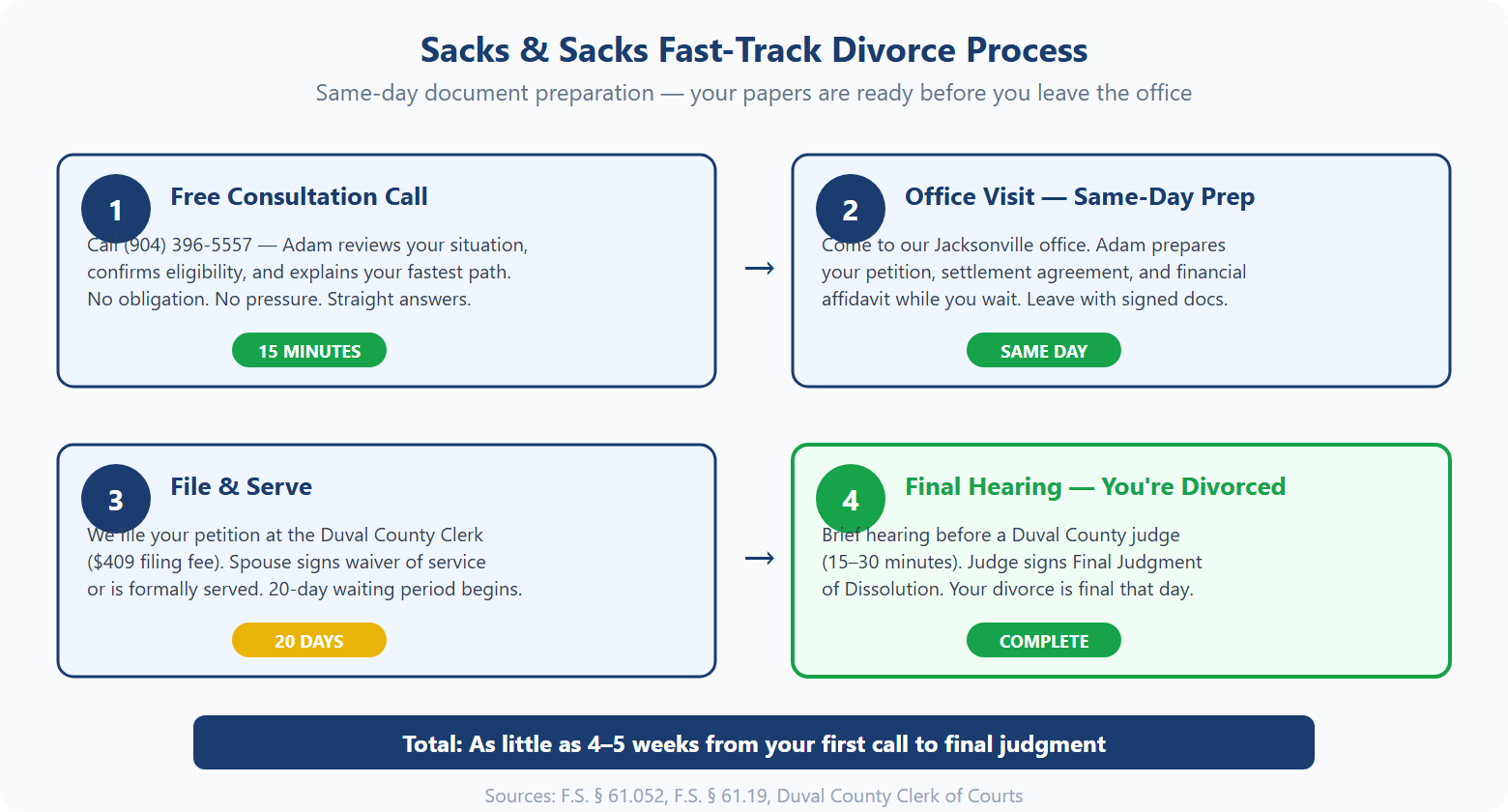
When you call (904) 396-5557, you will speak directly with attorney Adam Sacks about your fast divorce — not a paralegal, not an intake coordinator, and not a call center. I handle every initial consultation personally because the first conversation determines which fast divorce path is right for your situation, what documents you need to bring, and what your flat-fee cost will be. Most clients who contact our Jacksonville office for a fast divorce are able to schedule a same-day or next-day office visit, during which I prepare their complete divorce filing packet while they are present. There is no charge for the initial phone consultation, and I will give you an honest assessment of your timeline, costs, and any potential complications before you decide to move forward. Here is exactly what the process looks like from your first call to the final judgment:
- Free phone consultation — You talk directly to me. I’ll ask about your situation, confirm which fast divorce path fits, and tell you exactly what to bring to your appointment. No charge, no obligation.
- Same-day office visit — Bring your financial information and your agreement terms. I prepare your complete divorce packet — petition, MSA, financial affidavit, all required forms — while you’re here. You leave with everything ready to file.
- Filing and service — We file your petition with the Duval County Clerk ($409 filing fee). If your spouse needs to be served, we coordinate that. If it’s a simplified dissolution, both of you file together.
- Final hearing — After the 20-day waiting period, we schedule your final hearing. I prepare you for what the judge will ask. The hearing typically takes 15–30 minutes — and you walk out divorced.
The whole process can be done in as little as 4–5 weeks for simplified cases, or 2–4 months for regular uncontested divorces with children.
Ready to move forward? Call (904) 396-5557 for your free consultation. Same-day document preparation — leave your first appointment with everything ready to file.
What Our Clients Say

Hackie G. — “Adam is a wonderful attorney, he is always on top of things and is very dedicated. He worked hard for us, and we are blessed to have had him represent us.” — Google Review
Robert — “Adam Sacks’ work ethic and dedication stood out since day one. He was not only understanding of my situation but provided expert guidance every step of the way.” — Google Review
Linda J. — “Adam Sacks is the best family law attorney I have ever known. He treated me like a person — never just another case.” — Google Review
Frequently Asked Questions About Fast Divorce in Jacksonville
What is the fastest way to get divorced in Florida?
The fastest way is through simplified dissolution of marriage (Form 12.901(a)), which can be finalized in approximately 4–5 weeks. Both spouses must have no minor children, agree on all property and debt division, waive alimony, and file a joint petition. Both must attend the final hearing. This path waives your right to appeal. If you have children or need alimony, a regular uncontested divorce (2–4 months) is the next fastest option [1].
How much does a fast divorce cost in Jacksonville?
The Duval County filing fee is $409 for both simplified and regular dissolution. Attorney fees for a fast uncontested divorce typically range from $1,500–$3,000 (flat fee at our firm). Total cost is approximately $1,900–$3,500, compared to $15,000–$55,000+ for a contested divorce. At Sacks & Sacks, we offer flat-fee pricing with no hourly billing surprises [1].
Can I get a fast divorce if we have children?
Yes, but you must use a regular uncontested divorce — not simplified dissolution. Both parents need to agree on a parenting plan, time-sharing schedule, and child support. Both must complete a 4-hour parenting course (F.S. § 61.21). With full agreement and completed paperwork, an uncontested divorce with children typically takes 2–4 months in Duval County [6].
What happens if my spouse won’t sign the divorce papers?
If your spouse is served but doesn’t respond within 20 days, you can file a Motion for Default under FL Family Law Rule 12.140. The court can then proceed without your spouse’s participation and grant the terms in your petition. A default divorce typically takes 6–8 weeks. If your spouse can’t be found, service by publication is available but adds additional time [2].
Do I need a lawyer for a fast divorce in Florida?
You’re not legally required to have an attorney, but I strongly recommend it. In my 25 years of practice, I’ve seen countless DIY divorces get rejected for incomplete paperwork, missing financial disclosures, or improperly drafted settlement agreements. The cost of fixing these errors — both in time and money — almost always exceeds the cost of hiring an attorney to do it right the first time. An experienced attorney also ensures your settlement agreement protects your rights.
Is there a waiting period for divorce in Florida?
Yes — Florida requires a minimum 20-day waiting period from the date of filing before a final judgment can be entered (F.S. § 61.19). This waiting period cannot be waived. However, there is no mandatory separation period — you don’t need to live apart before filing. Florida’s 20-day minimum is one of the shortest mandatory waiting periods in the United States [3].
What’s the difference between simplified dissolution and uncontested divorce?
Simplified dissolution is faster (4–5 weeks vs. 2–4 months) but has strict requirements: no children, no alimony, both spouses must attend the hearing, and you waive your appeal rights. A regular uncontested divorce allows children, alimony, and preserves appeal rights. Both require full agreement on all terms. For a detailed comparison, see our uncontested divorce page [4].
Sources:
[1] Duval County Clerk of Courts, Fee Schedules — Family Law. duvalclerk.com
[2] Florida Family Law Rules of Procedure, Rule 12.140 — Defaults and Final Judgments Thereon. flcourts.gov
[3] F.S. § 61.052, Dissolution of Marriage; F.S. § 61.19, Final Judgment — When Entered. leg.state.fl.us
[4] Florida Supreme Court, Form 12.901(a) — Petition for Simplified Dissolution of Marriage. flcourts.gov
[5] Florida Bar Association, Consumer Pamphlet: Divorce in Florida. floridabar.org
[6] F.S. § 61.21, Parenting Course Authorized; Fees. leg.state.fl.us
[7] F.S. § 61.08, Alimony; Ch. 2023-301 (SB 1416), Florida Alimony Reform Act. flsenate.gov