
Need temporary custody now? Call (904) 396-5557 — Adam Sacks files emergency and temporary custody orders in Jacksonville.
What Is a Temporary Custody Order in Florida?
A temporary custody order is a court order that establishes parenting time, decision-making authority, and child support on a provisional basis while a divorce, paternity, or custody case is working through the court system. In Florida, these orders are governed by F.S. § 61.13 and the Florida Family Law Rules of Procedure. [1] Because family cases in Duval County can take six months to over two years to reach final judgment, temporary orders serve as the enforceable framework that governs where children live, how time is shared between parents, who pays support, and who makes decisions about education and healthcare during litigation. Violating a temporary custody order constitutes contempt of court, punishable by fines, attorney fee sanctions, and jail time. As a Jacksonville family law attorney with over 25 years of experience, I file both emergency and standard temporary custody motions in the Fourth Judicial Circuit — call (904) 396-5557 for a free consultation.
Divorce and custody cases in Florida can take 6 months to over 2 years to resolve. Children cannot wait that long for stability. A temporary custody order ensures that from the moment a case is filed, there are enforceable rules about where the children live, how time is shared between parents, who pays child support, and who makes decisions about education, healthcare, and extracurricular activities.
Temporary orders remain in effect until the court enters a final judgment — or until the court modifies the temporary order based on changed circumstances. Violating a temporary custody order is contempt of court, punishable by fines, attorney fee sanctions, and jail time. [1]
Emergency vs. Standard Temporary Custody
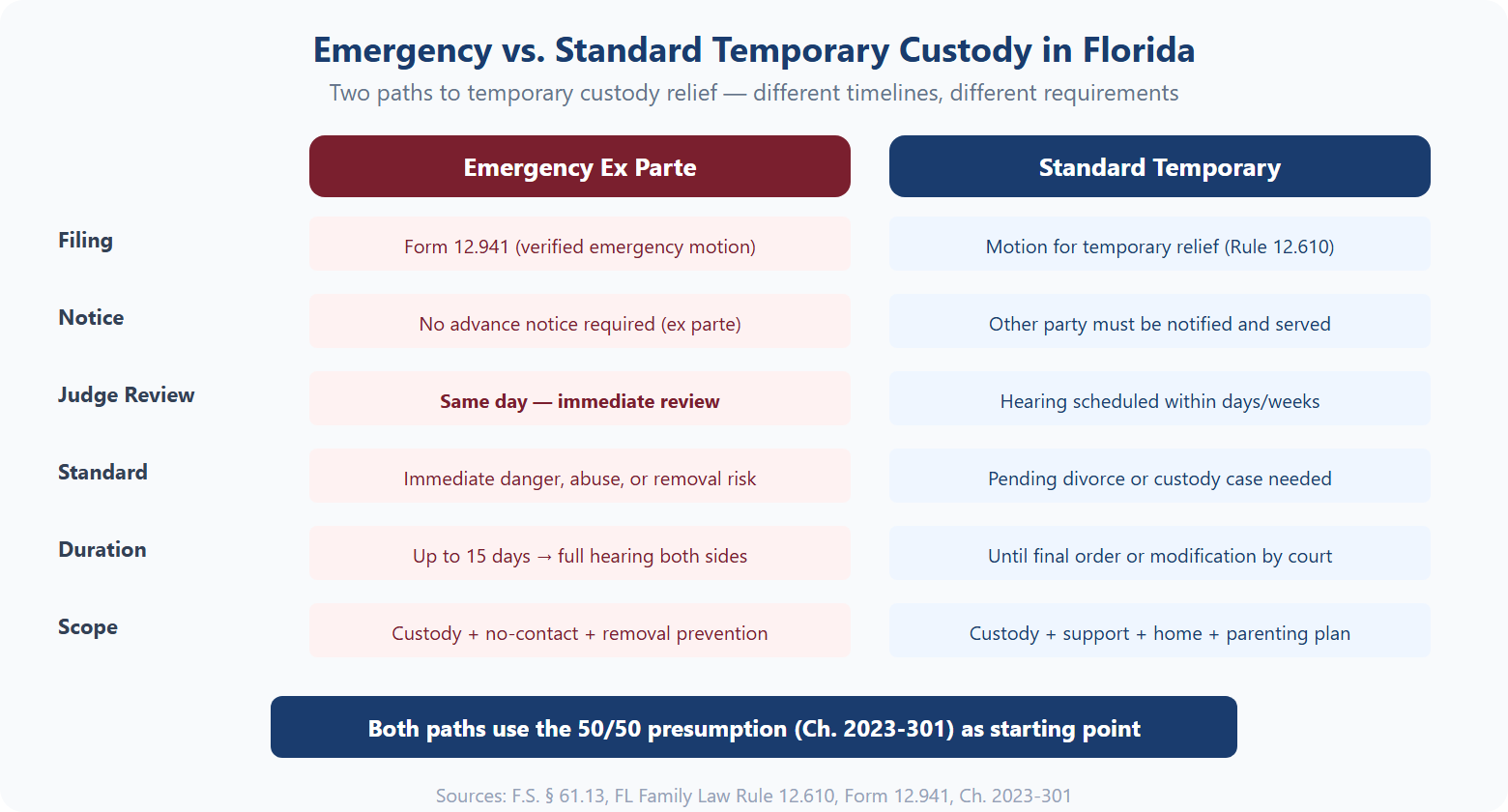
Florida provides two distinct paths to temporary custody relief, and choosing the right one depends on whether a child faces immediate danger or the family simply needs an enforceable arrangement while the case is pending. Emergency ex parte orders under Form 12.941 allow a judge to issue same-day custody relief without notifying the other parent — but only when the child faces imminent harm from abuse, neglect, domestic violence, substance abuse, abandonment, or risk of removal from the state. [3] Standard temporary custody motions follow the normal hearing process, where both parents receive notice, appear before the judge, and present evidence. In my 25 years handling custody cases in Jacksonville’s Fourth Judicial Circuit, I have filed both types — and knowing which path fits your situation is the first critical decision in any temporary custody case.
Emergency Ex Parte Custody Orders
When a child faces immediate danger — abuse, neglect, domestic violence, or risk of being removed from Florida — you can file an emergency motion for temporary custody (Form 12.941). [3] The judge reviews your sworn petition the same day, without the other parent being present or notified (ex parte). If the judge finds sufficient grounds, a temporary custody order is issued immediately.
Emergency custody orders are typically valid for up to 15 days, at which point the court schedules a full hearing where both parents appear and present evidence. The order is enforceable by law enforcement from the moment the judge signs it — the other parent does not need to be served first. [3]
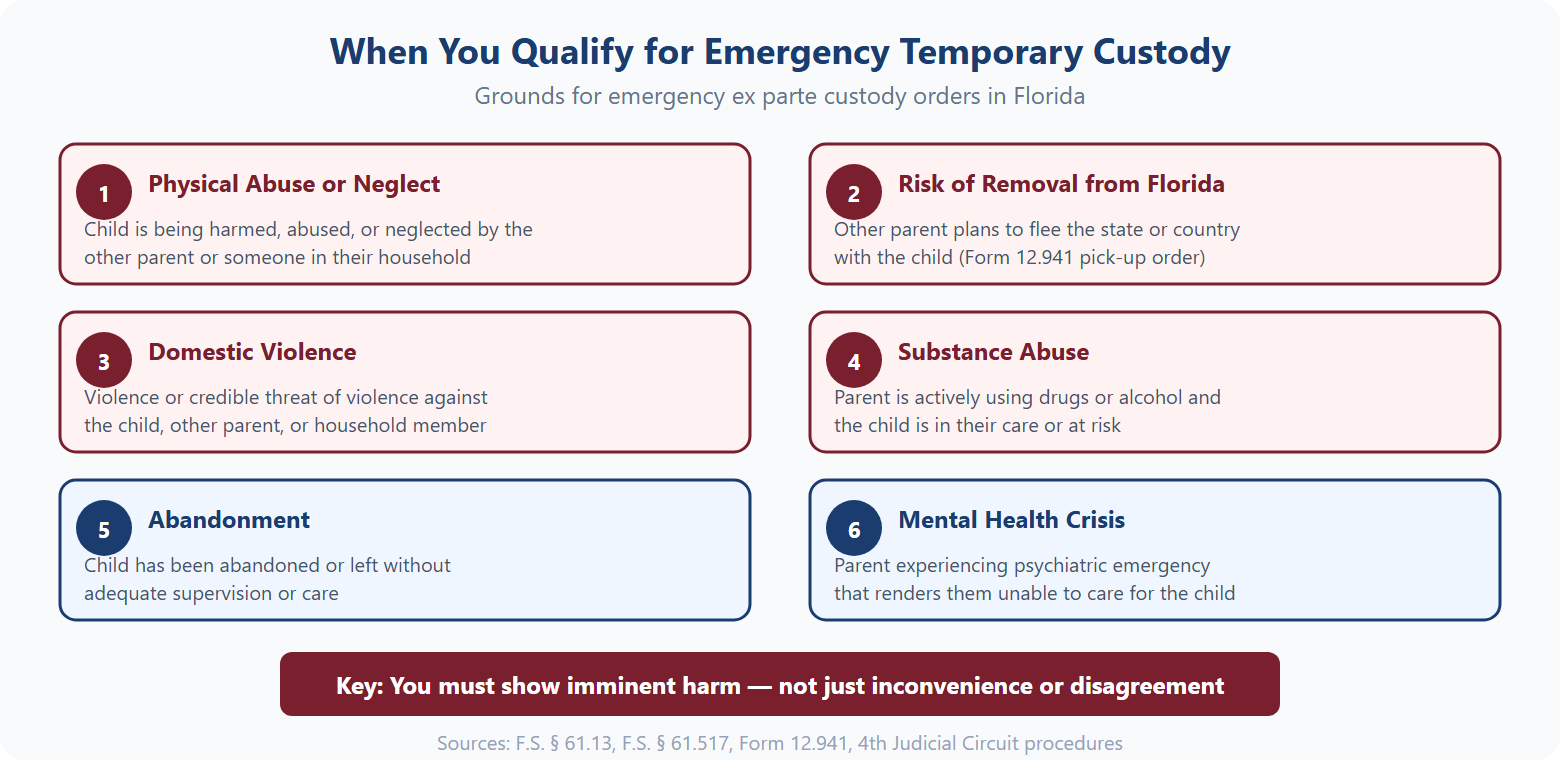
Grounds for emergency temporary custody include:
- Physical abuse or neglect of the child
- Risk of removal from Florida — the other parent plans to flee the state or country with the child
- Domestic violence — violence or credible threat against the child, other parent, or household member
- Substance abuse — the parent with custody is actively using drugs or alcohol
- Abandonment — the child has been left without adequate care or supervision
- Mental health crisis — the custodial parent is experiencing a psychiatric emergency
Standard Temporary Custody Orders
In non-emergency situations — such as when parents separate and need a custody arrangement while the divorce is pending — either parent can file a motion for temporary relief. The other parent must be notified and served. The court schedules a hearing (typically within days to a few weeks), both parents present their positions, and the judge issues a temporary order.
Standard temporary custody orders address the same issues as final orders but on a provisional basis: time-sharing schedules, parental responsibility allocation, child support, exclusive use of the marital home, and temporary alimony.
What a Temporary Custody Order Can Include
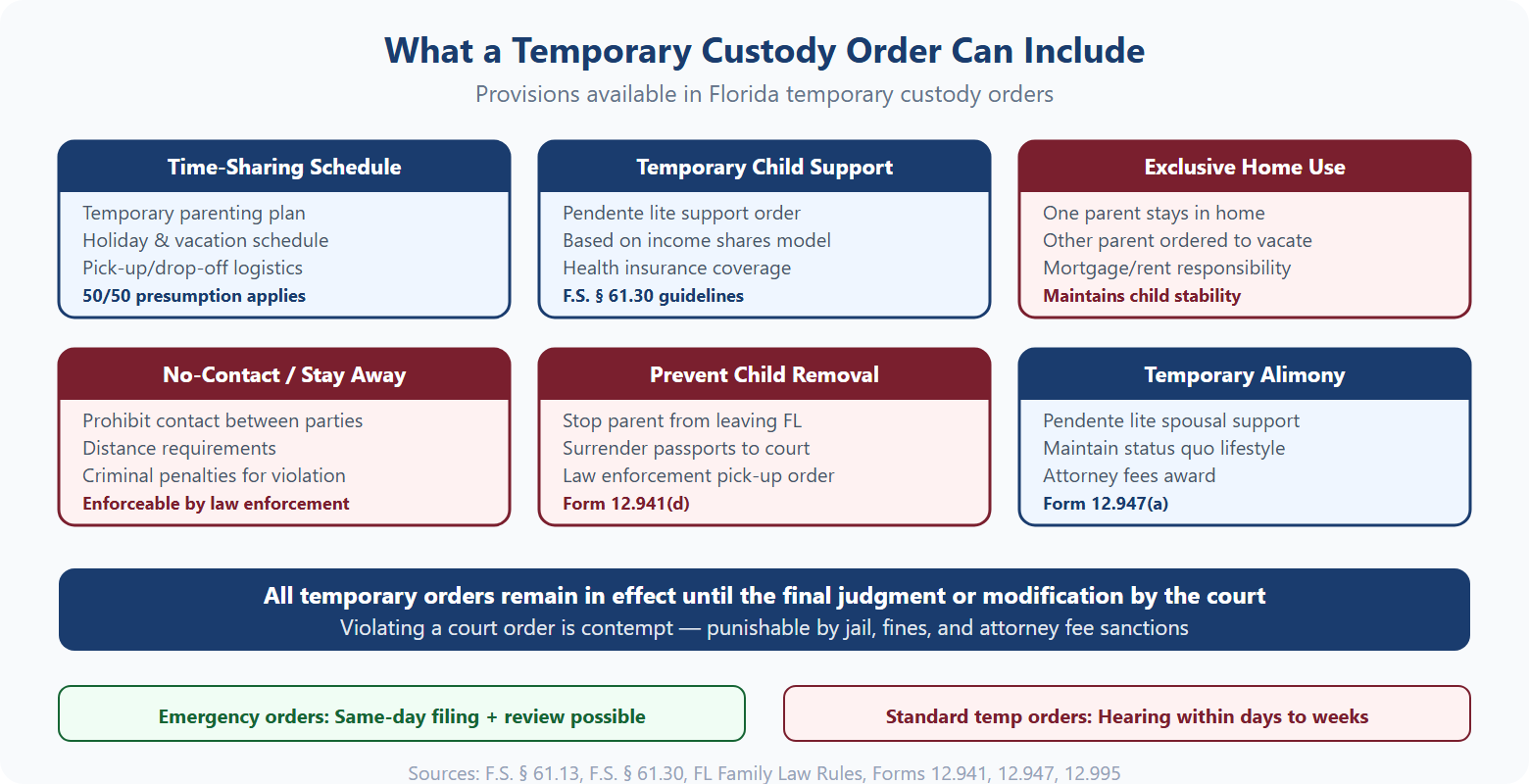
A Florida temporary custody order is comprehensive and can address every aspect of the children’s living situation on a provisional basis until the court enters a final judgment. Under F.S. § 61.13, temporary orders cover time-sharing schedules for weekdays, weekends, holidays, and school breaks; parental responsibility allocation for decisions about education, healthcare, and extracurricular activities; primary residence designation for school enrollment; temporary child support calculated under the F.S. § 61.30 income shares model; exclusive use of the marital home; pendente lite alimony under Form 12.947; no-contact provisions in domestic violence situations; passport surrender and travel restrictions to prevent removal of children from Florida; and temporary attorney fee awards. [1] [5] Each provision is enforceable by law enforcement from the moment the judge signs the order, giving families stability while the underlying case proceeds through litigation.
- Temporary time-sharing schedule: Which parent has the children on which days, including weekdays, weekends, holidays, school breaks, and summer vacation
- Temporary parental responsibility: Whether parents share decision-making (shared parental responsibility) or one parent has sole authority over specific decisions
- Primary residence designation: Where the children primarily live for school enrollment and stability purposes
- Temporary child support: Calculated under the F.S. § 61.30 income shares model, including health insurance and uncovered medical expenses [4]
- Exclusive use of the marital home: One parent may be awarded temporary exclusive occupancy to maintain the children’s stability
- Temporary alimony: Pendente lite spousal support to maintain the status quo during litigation (Form 12.947) [5]
- No-contact or stay-away provisions: In domestic violence situations, the court can prohibit contact between the parties
- Prevention of child removal: The court can order passport surrender and prohibit removing children from Florida (Form 12.941(d)) [3]
- Temporary attorney fees: The court can order the higher-earning spouse to contribute to the other’s attorney fees
How to Get a Temporary Custody Order in Jacksonville
The process for obtaining a temporary custody order in Duval County follows a structured five-step sequence that begins with filing the appropriate motion at the Duval County Clerk of Courts, Family Law Division. Whether you file an emergency motion using Form 12.941 or a standard motion for temporary relief, the court evaluates your request against the 20 best-interest factors under F.S. § 61.13(3) and Florida’s rebuttable presumption of equal time-sharing under Ch. 2023-301. [1] [2] In emergency situations involving abuse, neglect, or flight risk, a judge can review your sworn petition the same day and issue an order without the other parent present. For standard temporary relief, the court schedules a hearing within days to a few weeks, and both parents present evidence and arguments. Having experienced legal representation at this stage is critical because the temporary order you receive today often sets the framework for the final custody outcome.
Step 1: File the Appropriate Motion
For emergencies, file Form 12.941 (Emergency Verified Motion for Child Pick-Up Order) at the Duval County Clerk of Courts, Family Law Division. For standard temporary relief, file a Motion for Temporary Custody and Support. [3] Your attorney prepares the motion with specific factual allegations supported by evidence.
Step 2: Serve the Other Parent (Standard) or Proceed Ex Parte (Emergency)
In standard cases, the other parent must be properly served with notice of the motion and hearing date. In emergency cases, the judge reviews your petition without notice to the other party — but the other parent will be served and given an opportunity to be heard at the follow-up hearing. [1]
Step 3: Attend the Hearing
At the hearing, both parents (or their attorneys) present evidence and arguments. The judge considers the 20 best-interest factors under F.S. § 61.13(3) and the 50/50 time-sharing presumption. [1] [2] Bring documentation: school records, medical records, photos, text messages, police reports, and witness statements.
Step 4: Court Issues the Temporary Order
The judge issues a written temporary custody order specifying the time-sharing schedule, parental responsibilities, child support amount, and any other provisions. This order is immediately enforceable — both parents must comply from the date it’s signed.
Step 5: Order Remains in Effect Until Final Judgment
The temporary order governs the family’s arrangements until the court enters a final judgment of dissolution (divorce decree) or a final custody order. Either parent can request a modification of the temporary order if there is a substantial change in circumstances.
The 50/50 Presumption and Temporary Custody
Since July 1, 2023, Florida law establishes a rebuttable presumption that equal time-sharing is in the child’s best interest (Ch. 2023-301, codified in F.S. § 61.13(2)(c)). [2] This presumption applies to temporary custody orders, not just final orders — meaning the court starts every temporary custody hearing from the position that a 50/50 schedule is appropriate. A parent seeking more than equal time must prove by a preponderance of the evidence that 50/50 is not in the child’s best interest, typically by presenting evidence of domestic violence, substance abuse, geographic distance, or a work schedule that makes equal sharing impractical. Common equal time-sharing schedules used in temporary orders include alternating weeks, 2-2-3 rotations, and 3-4-4-3 patterns. If you are defending against a request for less than 50%, the presumption works in your favor and the other parent bears the full burden of proof. Understanding how this presumption shapes temporary custody hearings in Jacksonville is essential to building an effective legal strategy.
In practice, this means:
- The court starts from the position that a 50/50 time-sharing schedule is appropriate
- The parent seeking a different arrangement must prove by a preponderance of the evidence that equal time is not in the child’s best interest
- Common schedules include alternating weeks, 2-2-3 rotations, and 3-4-4-3 patterns
- The presumption can be rebutted by evidence of domestic violence, substance abuse, geographic distance, or a parent’s work schedule that makes equal sharing impractical
If you are seeking more than 50% of time-sharing in a temporary order, you need to present compelling evidence that the other parent’s home environment, behavior, or circumstances make equal time harmful to the child. If you are defending against a request for less than 50%, the presumption works in your favor — the other parent bears the burden of proof.
The 20 Best-Interest Factors Judges Consider
When deciding temporary custody arrangements in Jacksonville, Florida judges evaluate the same 20 statutory factors under F.S. § 61.13(3) that apply to final custody orders. [1] These factors provide the legal framework judges use to determine time-sharing schedules, parental responsibility allocation, and whether to deviate from the 50/50 presumption established by Ch. 2023-301. [2] In temporary custody hearings, where judges often have 30 minutes or less to evaluate a family’s circumstances, knowing which factors carry the most weight for your specific situation is critical. Factors related to domestic violence, substance abuse, and each parent’s willingness to facilitate a close parent-child relationship consistently receive the greatest judicial attention. As a former state prosecutor with over 25 years of courtroom experience, I help my clients present targeted evidence aligned with the factors most relevant to their case. The 20 factors are:
- Each parent’s capacity to facilitate a close parent-child relationship
- Each parent’s capacity to honor the time-sharing schedule
- Each parent’s capacity to act upon the child’s needs (vs. parent’s own desires)
- Length of time the child has lived in a stable environment
- Geographic viability of the parenting plan
- Moral fitness of the parents
- Mental and physical health of the parents
- The child’s home, school, and community record
- The child’s preference (if sufficiently mature)
- Each parent’s knowledge of the child’s circumstances
- Each parent’s capacity to provide a consistent routine
- Each parent’s capacity to communicate and cooperate
- Evidence of domestic violence, sexual violence, child abuse, or neglect
- Evidence of false allegations of abuse
- Parenting tasks historically performed by each parent
- Each parent’s demonstrated capacity to maintain substance-free environment
- Each parent’s capacity to protect the child from ongoing litigation
- Developmental stages and needs of the child
- Each parent’s capacity to arrange for the child’s care
- Any other factor relevant to the best interest of the child
Factor #13 (domestic violence) and #16 (substance-free environment) are particularly critical in emergency temporary custody cases — they are often the basis for rebutting the 50/50 presumption.
Modifying a Temporary Custody Order
Temporary custody orders are not permanent, and Florida courts can modify them when circumstances change materially after the original order was entered. To request a modification, you must file a written motion demonstrating a substantial change in circumstances that was not anticipated at the time the temporary order was issued. [1] Common grounds for modification include a parent’s relocation or change in work schedule, new evidence of abuse, neglect, or substance abuse, a parent’s failure to comply with the existing order, changes in the child’s needs such as starting school or developing medical issues, and domestic violence or the issuance of a new restraining order. The court evaluates modification requests using the same 20 best-interest factors under F.S. § 61.13(3) and the 50/50 time-sharing presumption. Temporary support provisions — including child support amounts, alimony, and exclusive home use — can also be modified based on changed financial circumstances during the pendency of the case.
Common grounds for modification include:
- A parent’s relocation or change in work schedule
- New evidence of abuse, neglect, or substance abuse
- A parent’s failure to comply with the existing order
- The child’s changing needs (e.g., starting school, medical issues)
- Domestic violence or a new restraining order
The court can also modify temporary support provisions — child support amounts, alimony, and exclusive home use — based on changed financial circumstances.
Enforcing a Temporary Custody Order
If the other parent violates a temporary custody order — failing to return the children on time, denying your court-ordered time-sharing, or ignoring child support obligations — Florida law provides several enforcement mechanisms to compel compliance. Violating any provision of a temporary custody order constitutes contempt of court under F.S. § 61.13, which can result in fines, make-up time-sharing, attorney fee sanctions, and incarceration. [1] In cases involving immediate danger, such as a parent fleeing the state with a child or refusing to return children after a scheduled exchange, you can file an emergency motion for same-day judicial relief. Law enforcement can also enforce custody exchanges when the court order contains a police enforcement provision. Documenting every violation with photos, screenshots, calendar records, and witness statements is essential because a pattern of noncompliance strengthens your position in both temporary and final custody proceedings. Your enforcement options include:
- Motion for Contempt: File a motion asking the court to hold the violating parent in contempt. Contempt can result in fines, attorney fees, make-up time, and even jail time. [1]
- Motion to Enforce: Ask the court to enter a specific order compelling compliance, potentially with a police enforcement provision
- Motion for Emergency Relief: If the violation creates an immediate danger (e.g., the other parent has fled with the child), file an emergency motion
- Involvement of Law Enforcement: If a court order specifies that law enforcement can enforce custody exchanges, you can request a police escort
Document every violation with photos, screenshots, calendar records, and witness statements. A pattern of violations strengthens your position in both the temporary and final custody proceedings.
Common Mistakes in Temporary Custody Cases
Temporary custody hearings in Jacksonville move fast, and mistakes made early in the process can define the trajectory of your entire case. In my 25 years of family law practice in the Fourth Judicial Circuit, I have seen parents lose valuable time-sharing, damage their credibility with judges, and create enforcement problems that follow them through final judgment — all because of avoidable errors during the temporary custody phase. The temporary order establishes a status quo that courts are reluctant to change, which means the arrangement you accept or receive at this stage often becomes the baseline for the permanent order. Under Florida’s 50/50 presumption (Ch. 2023-301), understanding the legal landscape before your hearing is more important than ever. [2] Filing too late, presenting insufficient evidence, or agreeing to informal arrangements without court orders are among the most costly mistakes I see. Here are the six most common ones to avoid:
- Not filing for temporary relief soon enough: The longer you wait, the more the other parent establishes a “status quo” that the court may be reluctant to change. File for temporary custody as soon as separation occurs.
- Filing an emergency motion without true emergency grounds: Judges take emergency filings seriously. Filing without genuine grounds for emergency relief (abuse, violence, removal risk) damages your credibility and can result in sanctions.
- Agreeing to informal arrangements instead of court orders: Verbal agreements or text-message parenting schedules are not enforceable. If the other parent changes their mind, you have no legal recourse without a court order.
- Ignoring the temporary order: Violating your own temporary custody order — even if you believe it’s unfair — is contempt of court. The proper remedy is to file a motion for modification, not to take matters into your own hands.
- Not bringing evidence to the hearing: Temporary custody hearings are evidentiary hearings. Bring school records, medical records, police reports, text messages, photos, and witnesses. The judge decides based on what you present.
- Failing to understand the 50/50 presumption: Since 2023, the court starts from equal time-sharing. If you want more than 50%, you must present evidence showing why that’s in the child’s best interest — not just why you’re the “better” parent.
Why Choose Adam Sacks for Your Temporary Custody Case
I’ve handled temporary custody cases in the Fourth Judicial Circuit for over 25 years — from routine pendente lite motions to same-day emergency filings where a child’s safety was at immediate risk. Every temporary custody case is urgent because the order you get today sets the framework for your family’s life during what could be a year or more of litigation.
My background as a former prosecutor for the State of Florida gives me a courtroom advantage that most family law attorneys don’t have. I know how to present evidence under pressure, cross-examine witnesses, and make persuasive arguments to judges who have full dockets and limited time. In temporary custody hearings, you often have 30 minutes or less to make your case — experience matters.
I’m also a Florida Supreme Court Certified Family Mediator. When both parents are reasonable and the children’s safety isn’t at risk, I know how to negotiate temporary arrangements that protect my client’s interests without the expense and conflict of a full hearing. But if the other side is unreasonable, hiding children, or creating a dangerous environment, I’m prepared to file emergency motions and fight in court the same day.
Adam Sacks earned his J.D. from Western Michigan University Cooley Law School, where he received a Book Award for the highest grade in his class. He served as an Assistant State Attorney in Seminole County before transitioning to private practice. He holds a bachelor’s degree in Psychology from the University of Massachusetts — directly relevant to understanding the emotional dynamics of custody disputes. He is a Florida Supreme Court Certified Family Mediator and a member of the Florida Bar (Bar #248370) since 2000.
What Happens When You Call Our Office
When you call (904) 396-5557, you speak directly with me — attorney Adam Sacks. Temporary custody cases require immediate legal analysis, so I handle these consultations personally rather than routing you through a paralegal or intake coordinator. During your free consultation, I will assess whether your situation qualifies for emergency ex parte relief under Form 12.941 or a standard motion for temporary custody, identify the evidence you need to present at your hearing, and explain how Florida’s 50/50 time-sharing presumption applies to your specific circumstances. [2] If your children face immediate danger from abuse, domestic violence, or risk of removal from the state, I can prepare and file an emergency motion the same day you call. With over 25 years of experience in Jacksonville’s Fourth Judicial Circuit and a background as a former state prosecutor, I bring the courtroom preparation and advocacy your family needs at this critical stage. Here is exactly what the process looks like:
- You speak with me directly. Temporary custody cases require immediate analysis — I handle these consultations personally.
- Urgency assessment. I’ll determine whether your situation qualifies for emergency ex parte relief or a standard motion for temporary custody.
- Same-day filing when children are at risk. If your children are in immediate danger, we can prepare and file an emergency motion the same day you call.
- Evidence strategy. I’ll tell you exactly what documentation to gather, what to bring to the hearing, and how to strengthen your position under the 20 best-interest factors.
- Hearing preparation and representation. I’ll prepare you for what to expect in court and represent you at the hearing — presenting evidence, examining witnesses, and arguing for the custody arrangement that protects your children.
Need a temporary custody order? Call Adam Sacks now at (904) 396-5557. Free consultation. Same-day emergency filing available.
Client Reviews — See What People Are Saying

See all Google reviews for Sacks & Sacks Law
Frequently Asked Questions About Temporary Custody Orders in Jacksonville
How fast can I get a temporary custody order in Florida?
In emergencies (abuse, violence, child removal risk), a judge can review your petition and issue a temporary order the same day you file. [3] For standard temporary custody motions, a hearing is typically scheduled within days to a few weeks after filing. The full hearing on an emergency order is held within 15 days. [1]
How long does a temporary custody order last in Florida?
A temporary custody order remains in effect until the court enters a final judgment (divorce decree or final custody order) or until the court modifies the temporary order. [1] Since divorce cases can take 6–18+ months, temporary orders often govern the family’s arrangements for an extended period. Either parent can request a modification based on changed circumstances.
Does the 50/50 presumption apply to temporary custody orders?
Yes. Florida’s rebuttable presumption of equal time-sharing (Ch. 2023-301, effective July 1, 2023) applies to all custody determinations, including temporary orders. [2] The court starts from 50/50 and adjusts based on the evidence. A parent seeking more than equal time must prove that 50/50 is not in the child’s best interest.
What qualifies as an emergency for temporary custody in Florida?
You must show the child faces imminent harm — not just inconvenience or parental disagreement. Recognized grounds include physical abuse or neglect, domestic violence, risk of the child being removed from Florida, active substance abuse by the custodial parent, abandonment, and mental health emergencies. [3] Filing a frivolous emergency motion can damage your credibility and result in sanctions.
Can I get temporary custody without a divorce filing?
Yes. Temporary custody orders can be entered in paternity cases, custody modification cases, and domestic violence injunction proceedings — not just divorces. [1] If you were never married to the other parent, you would file a paternity action to establish custody rights, and temporary custody can be part of that filing.
What happens if the other parent violates the temporary custody order?
Violating a court order is contempt of court. You can file a Motion for Contempt, which can result in fines, make-up time-sharing, attorney fees, and jail time. [1] If the violation creates immediate danger (e.g., the other parent has fled with the child), file an emergency motion and contact law enforcement.
Will the temporary custody order affect my final custody outcome?
Temporary orders do not legally bind the court in the final determination. However, they create a status quo that judges are often reluctant to disrupt. If a child has been thriving under a temporary arrangement for months, the court may be inclined to continue it as the permanent arrangement. This is why getting the right temporary order from the start matters so much.
Sources:
[1] Florida Statutes, F.S. § 61.13 — Support of Children; Parenting and Time-Sharing; Powers of Court (2024). 20 best-interest factors, parental responsibility, time-sharing. leg.state.fl.us
[2] Florida Legislature, Ch. 2023-301 (SB 1416/HB 1301) — Dissolution of Marriage; Parenting and Time-Sharing. Effective July 1, 2023. 50/50 rebuttable presumption, alimony reform. flsenate.gov
[3] Florida Courts, Form 12.941 — Emergency Verified Motion for Child Pick-Up Order. Ex parte emergency custody procedure. flcourts.gov
[4] Florida Statutes, F.S. § 61.30 — Child Support Guidelines; Income Shares Model. flsenate.gov
[5] Florida Courts, Form 12.947(a) — Motion for Temporary Support and Other Relief. Pendente lite spousal support and attorney fees. fljud13.org
[6] Florida Statutes, F.S. § 61.517 — Temporary Emergency Jurisdiction. Grounds for emergency custody jurisdiction. flsenate.gov
[7] Florida Courts, 2022-2024 Biennial Report: Court Filings and Statistics. 3.5 million+ cases in FL trial courts. flcourts.gov