

Facing divorce in Jacksonville can mean confronting tough questions about money and stability just as life feels most uncertain.
Understanding what alimony means in Florida is central to protecting your financial future, especially now that new laws in the state have reshaped spousal support into time-limited financial assistance instead of lifelong payments.
This guide breaks down how courts decide support, what affects your obligations, and the different ways alimony might impact you as you plan for the next chapter.
Alimony represents a critical financial support mechanism for divorcing spouses in Florida, designed to address economic disparities after marriage dissolution. Unlike child support, which focuses exclusively on children’s needs, alimony provides direct financial assistance to the spouse experiencing significant economic hardship following divorce.
In the state of Florida, alimony serves several key purposes:
Spousal support is not automatically guaranteed. Courts carefully evaluate multiple factors when determining alimony, including:
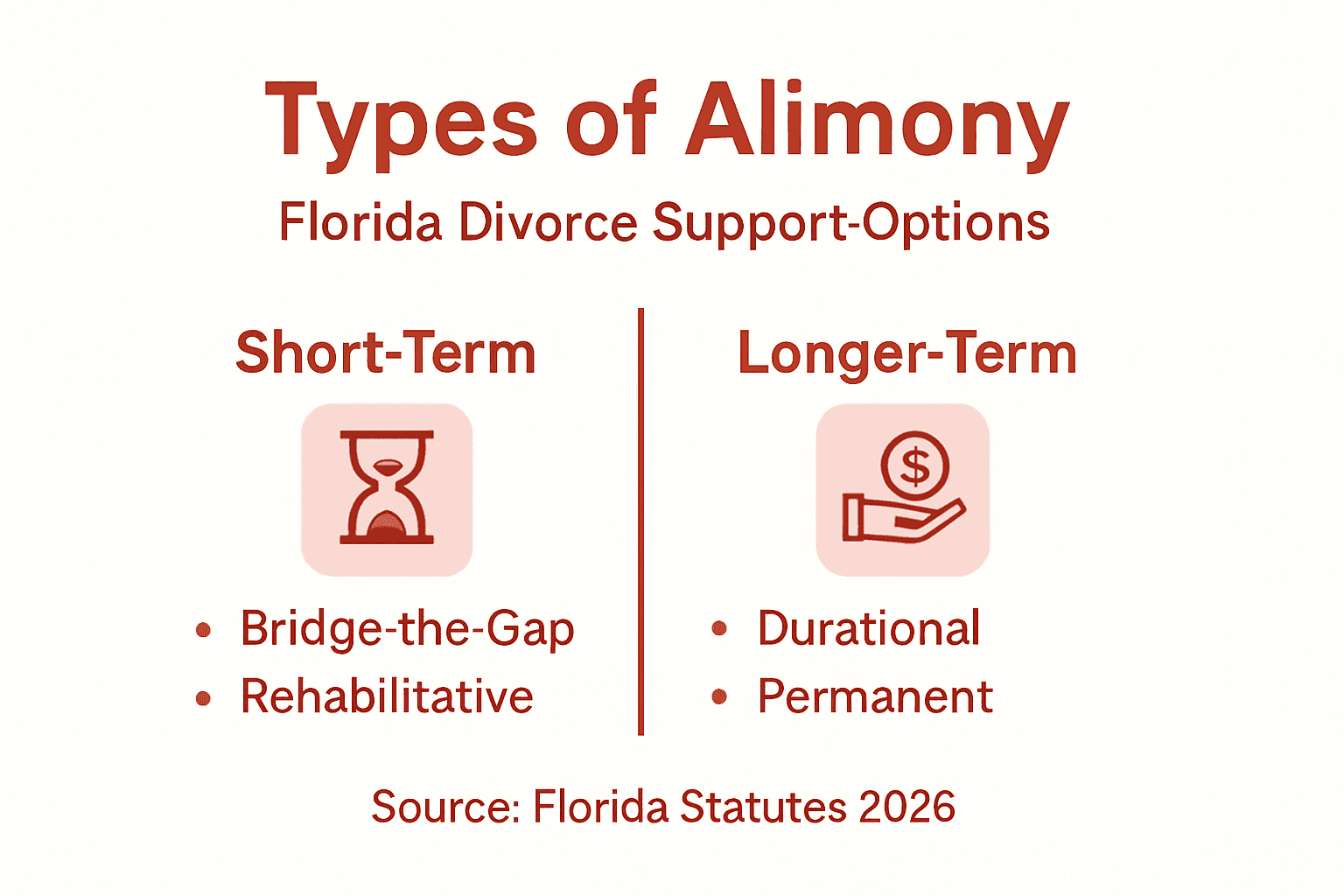
Florida recognizes several types of alimony, each addressing different financial needs and circumstances. Financial support mechanisms can range from temporary rehabilitative payments to more permanent arrangements designed to provide long-term economic assistance.

Florida’s alimony landscape has undergone significant transformations, with recent legislative reforms dramatically reshaping how spousal support is structured and awarded. Alimony laws in Florida now emphasize more flexible and time-limited support mechanisms designed to promote financial independence for both parties.
The primary types of alimony in Florida for 2026 include:
Durational alimony has become particularly significant following the 2023 reforms. This type of support is now structured with strict guidelines that consider:
Courts now approach alimony with a more strategic perspective, aiming to create temporary financial bridges rather than permanent dependent arrangements. The goal is to support the lower-earning spouse while simultaneously encouraging economic self-sufficiency.
Pro tip: Carefully document your financial contributions and career sacrifices during marriage, as these factors can significantly influence alimony determinations.
Alimony calculation in Florida is a complex process that requires careful examination of multiple financial and personal factors. Florida statute guidelines provide a comprehensive framework for determining spousal support, ensuring a fair and equitable approach to financial settlements.
The court evaluates several critical factors when calculating alimony:
Judicial discretion plays a significant role in alimony determinations. Judges assess each case individually, considering the unique circumstances that impact a spouse’s financial independence. This means no two alimony calculations are exactly alike, with courts balancing economic fairness against the goal of promoting self-sufficiency.
The calculation process typically involves a detailed financial analysis that examines:
Alimony is not about punishment or reward, but about creating economic balance and supporting a fair transition between married and single life.
Pro tip: Gather comprehensive financial documentation, including tax returns, income statements, and evidence of career sacrifices, to strengthen your alimony negotiation position.
The following table summarizes what influences Florida alimony calculations:
| Factor Considered | Influence on Outcome |
|---|---|
| Marriage Length | Affects duration and amount |
| Earning Capacity | Determines support necessity |
| Age and Health | Adjusts feasibility of employment |
| Standard of Living | Sets baseline for support calculation |
In Florida’s legal landscape, alimony is not an automatic entitlement but a carefully evaluated financial remedy. Alimony laws in Florida establish strict criteria that demand comprehensive proof of financial need and economic interdependence between divorcing spouses.
The key legal criteria for alimony eligibility include:
Statutory limitations now impose critical restrictions on alimony awards. These modern legal frameworks aim to prevent long-term financial dependency and encourage economic self-sufficiency. Courts must now consider:
The burden of proof rests entirely on the spouse seeking support. This means meticulously documenting financial circumstances, career sacrifices, and economic challenges throughout the marriage becomes crucial for a successful alimony claim.
Pro tip: Maintain detailed financial records, including tax returns, employment history, and documentation of career interruptions, to strengthen your potential alimony case.
Florida’s alimony framework establishes precise guidelines for financial obligations, carefully structured to balance economic fairness and realistic support mechanisms. Alimony laws in Florida define specific parameters that govern the duration and extent of spousal support payments.
The duration of alimony varies significantly based on marriage length and specific support type:
Termination conditions for alimony are equally specific and include:
The legal system intentionally designs these financial obligations to provide temporary support while encouraging economic self-sufficiency. Courts meticulously assess each spouse’s potential for future earnings, professional development, and financial stability when determining support duration.
Navigating alimony requires dispelling persistent myths that can lead to unrealistic expectations and financial complications. Alimony laws in Florida highlight critical misconceptions that divorcing spouses must understand to protect their economic interests.
Common misconceptions about alimony include:
Financial risks associated with misunderstanding alimony are substantial:
The legal system intentionally creates complex frameworks to ensure fair, context-specific support that adapts to each unique marital circumstance. Assumptions can lead to costly legal mistakes and prolonged financial uncertainty.
Alimony can be complex and emotionally draining, especially when facing financial uncertainty after divorce. This article highlights crucial challenges like proving financial need, understanding various support types such as durational alimony, and navigating strict legal criteria that affect your financial future.
If you are struggling with questions about your alimony obligations or eligibility, you deserve personalized guidance that protects your interests and helps you plan ahead.
At Sacks and Sacks Law, our team offers over 50 years of combined expertise in cutting through Florida’s evolving alimony laws. We specialize in ensuring you receive fair support or fulfill your responsibilities without undue burden.
Don’t let misconceptions or lack of information cost you financial stability. Act now by calling (904) 396-5557 to schedule your free alimony consultation and take the first step toward a secure financial future after divorce.
Alimony in Florida is a financial support mechanism awarded by the court during a divorce to address economic disparities between spouses after the dissolution of marriage.
Florida recognizes several types of alimony including Bridge-the-Gap Alimony, Rehabilitative Alimony, and Durational Alimony, each designed to meet different financial needs and circumstances of the spouses.
Alimony is calculated based on various factors, including the duration of the marriage, the income and earning capacity of both spouses, age, health, standard of living during the marriage, and contributions made to the marriage.
To qualify for alimony in Florida, the recipient must demonstrate financial need, the paying spouse’s ability to pay, an economic disparity between the parties, and document contributions to the marriage, including any career sacrifices.
 ✓
✓