
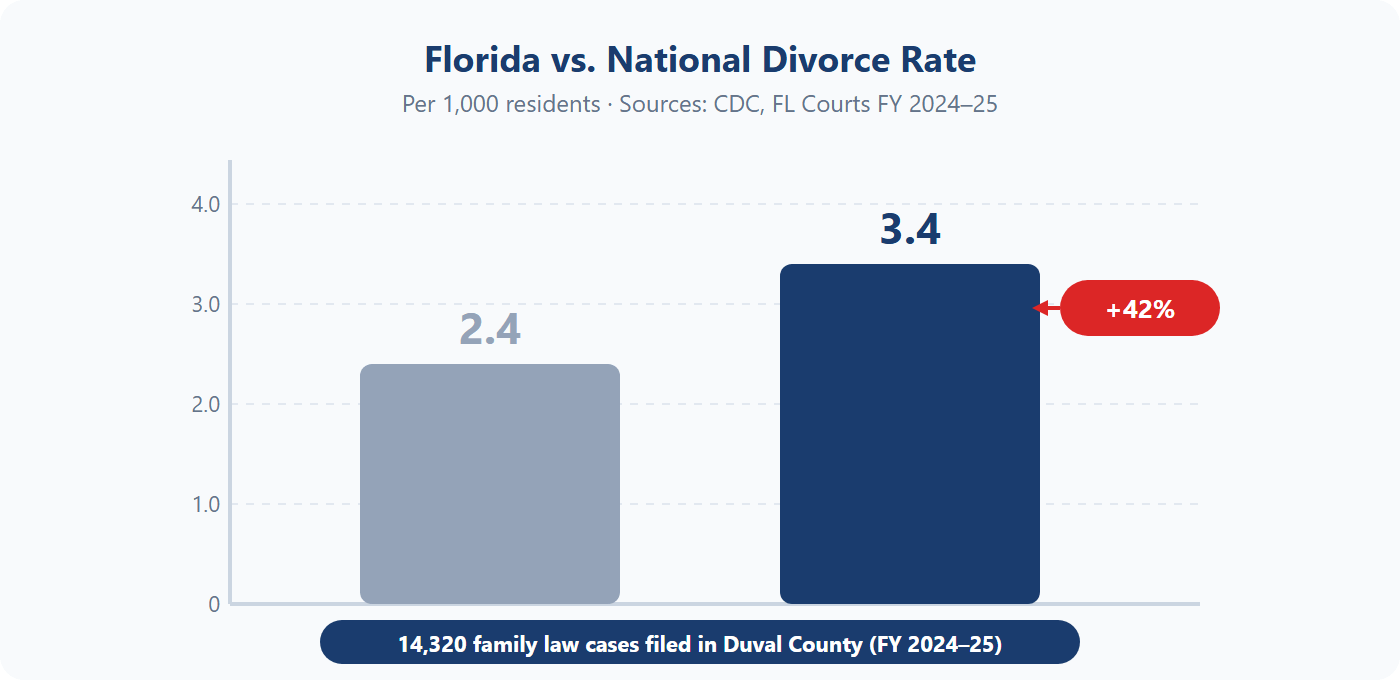
Bottom line: Duval County courts processed 14,320 family law cases in fiscal year 2024–25, and Florida’s divorce rate ranks among the top 10 nationally. [1]
Whether you’re facing divorce, a custody dispute, or questions about Florida’s 2023 alimony reform, you need a lawyer who knows the local courts. Adam Sacks has spent 25+ years handling family law cases in Jacksonville: a former state prosecutor, a Florida Supreme Court Certified Mediator, and a father who understands what’s at stake.
Jacksonville Family Law by the Numbers
Florida families filed 240,019 family law cases statewide during fiscal year 2024–25. Of those, 14,320 were filed in Duval County, one of the highest totals among Florida’s 20 judicial circuits. [1]
Statewide, 158,861 cases were dissolution of marriage (divorce) filings, making divorce the most common family law matter by far. Those numbers include contested and uncontested divorces, custody modifications, child support enforcement actions, paternity disputes, and domestic violence injunctions.
For Jacksonville families, the volume means that Fourth Judicial Circuit judges handle a heavy caseload. Cases that are not properly prepared can stall or produce unfavorable outcomes.
Understanding the local landscape helps you appreciate why hiring an experienced Jacksonville family law attorney matters.
Courts move faster when your filings are complete, your evidence is organized, and your attorney knows the expectations of the judges hearing your case. Adam Sacks has practiced in these courts for over 25 years and understands how to keep your case on track.
Florida’s divorce rate of approximately 3.4 per 1,000 residents is roughly 40–50% higher than the national average. [2] The state consistently ranks among the top 10 nationally for divorce filings.
These numbers reflect what many Jacksonville families already know: family law disputes are common here, and having an experienced local attorney makes a real difference in how your case resolves.
What Is Family Law?
Family law covers any legal matter related to family relationships, including divorce, child custody, child support, alimony, paternity, adoption, and domestic violence protection.
While divorce is the most common family law case in Florida, the practice area extends to any dispute that affects how a family is structured, how children are raised, and how marital assets and debts are divided.
In Florida, family law cases are governed primarily by Chapter 61 of the Florida Statutes, which sets the rules for dissolution of marriage, parenting plans, support obligations, and property distribution. Because Florida is an equitable distribution state (not a community property state), courts divide assets based on fairness rather than a strict 50/50 split.
Every family law case is different. The outcome depends on the specific facts, the applicable statutes, and how effectively your attorney presents your position to the court.
Family law cases handled at Sacks & Sacks include:
- Adoption
- Asset and debt division
- Child custody and time-sharing
- Child support
- Divorce (including contested, uncontested, and fast divorce)
- Emergency motions and restraining orders
- High net worth divorce
- Mediation
- Military divorce
- Paternity
- Same-sex divorce
- Spousal support and alimony
Each of these areas has its own rules under Florida law. A Jacksonville family law attorney can explain which laws apply to your situation and what outcomes are realistic.

What Family Law Courts in Jacksonville Can and Cannot Do
Jacksonville family law cases are heard in the Fourth Judicial Circuit of Florida, which covers Duval, Clay, and Nassau counties. Family division judges in the Fourth Circuit handle divorces, custody disputes, child support matters, paternity actions, domestic violence injunctions, and adoption proceedings.
To file a family law case in Jacksonville, at least one party must have been a Florida resident for six months prior to filing. Once your case is assigned to a judge, that judge typically handles it from start to finish. That includes temporary hearings, mediation referrals, and the final trial if your case does not settle.
The court has broad authority to issue orders that affect your finances, your property, and your time with your children. But there are important limits on what a judge can and cannot do.
What Courts Can Do
- Enter a judgment of divorce and dissolve a marriage
- Award custody (time-sharing) of minor children
- Divide property, debts, and assets when a marriage ends
- Order child support and enforce it through wage withholding
- Order alimony based on the factors in F.S. § 61.08
- Issue restraining orders, injunctions, and contact restrictions
- Approve or modify parenting plans and visitation schedules
What Courts Cannot Do
- Force either spouse to change their behavior, habits, or attitude
- Grant a request that Florida law does not authorize
- Validate one party over the other regarding past disagreements
- Guarantee a specific outcome (but a strong legal argument and proper evidence significantly improve your position)
Whether your case is heading to trial or toward settlement, having a Jacksonville family law lawyer who is prepared for either path gives you the strongest position.
Florida’s 2023 Alimony Reform: What SB 1416 Changed
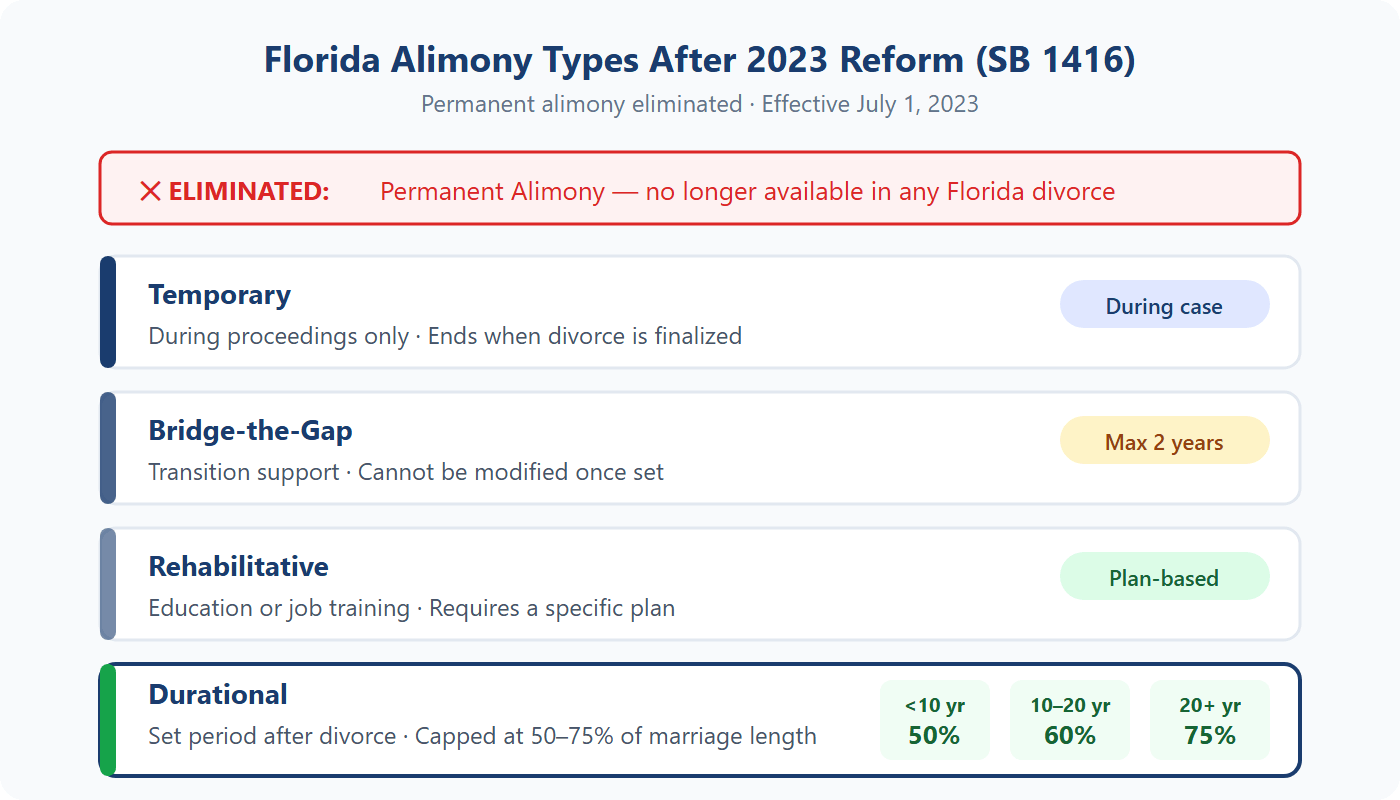
On July 1, 2023, Florida Senate Bill 1416 took effect and eliminated permanent alimony. This was one of the biggest changes to Florida family law in decades. [3]
Before this reform, Florida judges could award permanent, lifetime alimony to a dependent spouse, particularly after long-term marriages. SB 1416 replaced that framework with durational caps tied to the length of the marriage, giving both parties more predictability about how long support will last.
The law also added an adultery provision, allowing courts to consider marital misconduct when determining alimony awards. For anyone going through a divorce in Jacksonville today, understanding the new rules is critical. They affect how much support you may receive or owe, how long payments will last, and what evidence matters most in court.
Four Types of Alimony That Remain
Florida now recognizes four types of alimony under the reformed law:
- Temporary alimony. Awarded during the divorce proceedings, before a final judgment. Ends when the divorce is finalized.
- Bridge-the-gap alimony. Helps a spouse transition from married to single life. Limited to two years and cannot be modified.
- Rehabilitative alimony. Supports a spouse who needs education or job training to become self-supporting. Requires a specific rehabilitation plan approved by the court.
- Durational alimony. Provides support for a set period after the divorce. Duration is capped based on how long the marriage lasted.
Durational Alimony Caps by Marriage Length
Under SB 1416, durational alimony cannot exceed these limits: [4]
- Short-term marriage (under 10 years): alimony cannot last more than 50% of the marriage length
- Moderate-term marriage (10–20 years): capped at 60% of the marriage length
- Long-term marriage (over 20 years): capped at 75% of the marriage length
Courts still consider each spouse’s income, earning capacity, standard of living, and contributions to the marriage when setting the amount. The paying spouse must have the ability to pay. The receiving spouse must demonstrate need.
Alimony ends automatically if the recipient remarries or if either party dies. A court can also modify or terminate alimony based on a significant change in circumstances.

What Happens to Children During a Florida Divorce?
Florida does not use the term “custody.” Instead, courts establish a parenting plan that determines time-sharing (how much time each parent spends with the child) and parental responsibility (who makes decisions about the child’s education, health care, and welfare).
Under Florida’s 2023 updates, there is now a statutory presumption that equal (50/50) time-sharing is in the child’s best interest. The court starts from that baseline unless evidence shows that a different arrangement would better serve the child.
This presumption does not guarantee equal time, but it shifts the burden. The parent seeking a majority time-sharing schedule must present evidence explaining why equal time would be detrimental.
Parents should also understand that Florida courts focus entirely on the child’s best interest, not on rewarding or punishing either parent. Factors like each parent’s willingness to support the child’s relationship with the other parent, the stability of each home, and the child’s own preferences all play a role in the final parenting plan.
Florida courts start from a presumption that shared parental responsibility is in the child’s best interest. This means both parents have equal input on major decisions unless the court finds that shared responsibility would be harmful to the child. [5]
What a Parenting Plan Must Include
- A detailed time-sharing schedule, including weekdays, weekends, holidays, and school breaks
- Which parent is responsible for health care, education, and extracurricular decisions
- How the parents will communicate about the child’s needs
- Transportation arrangements for time-sharing exchanges
The court evaluates 20 factors under Florida Statute § 61.13 to determine the arrangement that serves the child’s best interest. These include each parent’s willingness to support the child’s relationship with the other parent, the child’s preference (depending on age and maturity), and the stability of each home environment.
If parents cannot agree on a plan, the court will create one. Having a family law attorney who understands how Jacksonville judges approach these cases gives you a significant advantage.
How Is Child Support Calculated in Jacksonville?
Florida uses the income shares model under F.S. § 61.30 to calculate child support. [6] The formula considers both parents’ net income and aims to provide the child with the same financial support they would have received if the family stayed together.
In practice, the court adds both parents’ net monthly incomes together, looks up the combined amount on Florida’s guideline schedule to determine the total child support need, and then splits that obligation proportionally based on each parent’s share of the combined income.
The calculation also adjusts for the number of overnights each parent has. If you have your child for 73 or more overnights per year (20% or more of the total), the formula reduces your support obligation to reflect the direct costs you already cover during that time.
Understanding how this formula works is essential. Even small changes in income reporting, deductions, or time-sharing schedules can shift the monthly support amount by hundreds of dollars.
Key factors in the calculation:
- Both parents’ net monthly income. Gross income minus taxes, mandatory deductions, and certain allowable expenses.
- Number of children. Florida’s guideline schedule adjusts support amounts based on total children.
- Health insurance and medical costs. Including premiums and uninsured medical expenses for the child.
- Child care costs. Daycare and after-school care necessary for a parent to work.
- Overnight time-sharing. If a parent has the child for 20% or more of overnights (73+ nights per year), support obligations are adjusted downward.
Child support can be modified when there is a substantial change in circumstances. Examples include a significant change in either parent’s income, a change in the child’s needs, or a modification to the time-sharing schedule.
5 Mistakes That Can Hurt Your Jacksonville Family Law Case
The opposing attorney will look for any mistake you make. In family law, even seemingly minor errors can have lasting consequences on your finances, your parenting time, and your children’s well-being.
Jacksonville family courts decide cases based on evidence and legal arguments, not on who deserves to win or who was wronged in the marriage. A poorly timed social media post, a missed financial disclosure, or an emotional outburst in court can undermine months of preparation.
In my 25 years of practicing family law in Jacksonville, I have seen otherwise strong cases weakened by avoidable mistakes. Here are the most common ones we see, and how to avoid them:
- Making decisions based on emotion instead of strategy. Divorce and custody cases are stressful. But agreeing to unfavorable terms out of guilt, anger, or exhaustion can affect your finances and your children for years. Avoid common divorce mistakes.
- Not understanding Florida-specific rules. Florida law has unique provisions: no permanent alimony, equitable (not equal) property division, and a preference for shared parental responsibility. Assuming the law works like other states leads to bad decisions.
- Posting on social media during your case. Screenshots of social media posts are routinely used as evidence in custody and divorce proceedings. Anything you post can be taken out of context and used against you.
- Neglecting documentation. Financial records, communication logs, and records of your involvement with your children all matter. Courts base decisions on evidence, not claims. Start organizing documents early.
- Waiting too long to get legal advice. The earlier you consult with a Jacksonville family law attorney, the more options you have. Waiting until you’re served with papers puts you at a disadvantage. Avoid custody action mistakes.
Can You Settle Family Law Issues Without Going to Court?
Yes, and in many cases, it is the better option. The majority of family law cases in Florida are resolved without a trial, through mediation, negotiation, or collaborative law.
Florida courts actively encourage settlement. In the Fourth Judicial Circuit, judges typically require mediation before a family law case can proceed to trial, and experienced mediators help both sides find workable solutions on issues like time-sharing, property division, and support.
Settlement gives you more control over the outcome, costs significantly less than litigation, and typically resolves faster. An uncontested divorce can be finalized in weeks rather than the six to twelve months a contested case often takes.
That said, settlement only works when both parties negotiate in good faith. You need an attorney who is fully prepared to go to trial if the other side refuses to agree to fair terms. Florida courts encourage mediation, and many family law disputes are resolved through negotiation or alternative dispute resolution.
Your options for settling outside of court:
- Mediation. A neutral third party helps both sides reach an agreement. In Florida, mediation is often required before a family law case can go to trial.
- Uncontested divorce. When both spouses agree on all terms (property division, custody, support), the divorce can be finalized faster and at significantly lower cost. Learn about uncontested divorce.
- Collaborative law. Both parties and their attorneys agree to negotiate in good faith without going to court.
Even in mediation and settlement negotiations, you need an attorney who is prepared to go to trial if the other side won’t agree to fair terms. That readiness is what gives you real bargaining power at the table.
Why Choose Adam Sacks as Your Jacksonville Family Law Attorney
I started my legal career as a prosecutor for the State of Florida, serving as an Assistant State Attorney in the Eighteenth Judicial Circuit. For two years, I tried criminal cases in Seminole County, standing in front of judges and juries, presenting evidence, cross-examining witnesses, and arguing motions under pressure.
That courtroom experience gave me something that most family law attorneys simply do not have: the confidence and the skill set to take your case to trial if that is what it takes to protect your rights.
I have carried that trial-ready mentality into every family law case I have handled over the past 25 years in Jacksonville. Opposing counsel know that when I represent a client, we are fully prepared to go the distance.
But I’m also a Florida Supreme Court Certified Family Mediator. That means I know how to get results at the negotiation table, too. I’ve mediated hundreds of cases. I understand how to find common ground when it exists, and how to fight for my clients when it doesn’t.
Before law school, I earned a degree in psychology from the University of Massachusetts. That training shows up every day in my practice. Divorce and custody cases aren’t just legal disputes. They’re deeply personal, emotional situations. I read people well, I listen carefully, and I adjust my approach to what each client needs.
I’ve been doing this for over 25 years. I treat my clients like people, never just another case. I set realistic expectations, tell you the truth about where your case stands, and fight for the best outcome.
Adam Sacks earned his J.D. from Western Michigan University Cooley Law School, where he received a Book Award for top academic performance and was selected for the Elder Law Clinic based on academic excellence.
He served as an Assistant State Attorney in Seminole County before transitioning to private family law practice in 2004. He is a Florida Supreme Court Certified Family Mediator and has been a member of the Florida Bar (Bar #248370) since 2000. Verify his credentials on Martindale-Hubbell, Justia, and Avvo.
What Happens When You Call Our Office
When you come to our office, you sit down with me. Not a paralegal, not a junior associate, and not someone who will hand your file off to another attorney after the first meeting. I personally handle every consultation because I believe the attorney who evaluates your case should be the same attorney who represents you.
During our meeting, I will listen to your situation in detail, ask the questions that matter for building a strong legal strategy, explain your options under current Florida law, and give you an honest assessment of where things stand. That includes the strengths and weaknesses of your position.
There is no pressure, no obligation, and no sugarcoating. You will leave the consultation knowing exactly what you are facing and what it will take to get the outcome you need. Here is how the process works:
- Free consultation. You call (904) 396-5557 and schedule a meeting. During the consultation, I review your situation, explain the relevant Florida law, and tell you what I think about your case. No pressure, no obligation.
- Case evaluation and strategy. If you decide to hire us, I build a strategy tailored to your goals. Whether we’re aiming for a negotiated settlement or preparing for trial, you’ll know the plan and the reasoning behind it.
- Representation and advocacy. I handle the filings, the court appearances, the negotiations, and the communication with opposing counsel. You stay informed at every step. I don’t disappear after you sign the retainer.
- Resolution. We work toward the best possible outcome, whether that means a favorable settlement at mediation or a strong result at trial.
At Sacks & Sacks, we offer flexible payment plans and appointment times. We know that family law cases don’t wait for convenient schedules.
Call me directly at (904) 396-5557. I’ll give you a free consultation and tell you exactly what I think about your case. No pressure, no obligation. Just honest advice from someone who’s been doing this for 25 years.
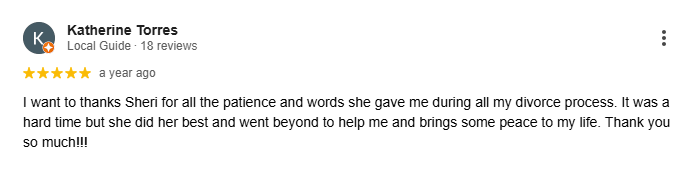
What Our Clients Say

Frequently Asked Questions About Jacksonville Family Law
How much does a family law attorney cost in Jacksonville?
Initial consultations at Sacks & Sacks are free. Beyond that, fees depend on the complexity of your case.
An uncontested divorce may cost $1,500–$5,000, while contested cases involving custody disputes and significant assets typically range from $5,000–$25,000 or more. I discuss fees openly during the consultation so there are no surprises.
How long does a divorce take in Florida?
Florida requires a minimum 20-day waiting period after filing before a divorce can be finalized. An uncontested divorce can be completed in as little as 4–6 weeks. Contested divorces typically take 6–12 months, and complex cases with custody disputes or significant assets may take longer.
What is the new alimony law in Florida?
Florida Senate Bill 1416, effective July 1, 2023, eliminated permanent alimony entirely. [3] The state now allows four types of alimony: temporary, bridge-the-gap, rehabilitative, and durational.
Durational alimony is capped at 50–75% of the marriage length depending on whether the marriage was short-term, moderate-term, or long-term. See the full breakdown above.
How is child custody determined in Florida?
Florida uses “time-sharing” instead of “custody.” Courts evaluate 20 factors under F.S. § 61.13, with the child’s best interest as the primary standard. Both parents start with a presumption of shared parental responsibility.
In my experience as both a litigator and a certified family mediator, most custody disputes can be resolved without going to trial. But you need an attorney who’s prepared to go to trial if the other side won’t negotiate fairly.
Do I need a lawyer for an uncontested divorce in Florida?
You’re not legally required to hire a lawyer, but I strongly recommend it. An attorney ensures your settlement agreement is legally sound, protects your rights regarding property division and support, and handles the required court filings correctly.
Many “uncontested” divorces become contested when one party disagrees on specific terms. At that point, not having legal counsel puts you at a serious disadvantage.
How is child support calculated in Florida?
Florida uses the income shares model under F.S. § 61.30. [6] The court looks at both parents’ net income, the number of children, health insurance costs, daycare costs, and the time-sharing schedule. If a parent has the child for 73 or more overnights per year (20%+), the support amount is adjusted. See the full breakdown above.
What should I bring to my first meeting with a family law attorney?
Bring financial documents (recent tax returns, pay stubs, bank and retirement account statements), a list of assets and debts, any existing court orders or agreements, identification, and a written timeline of key events.
If children are involved, bring information about their school, medical needs, and current living arrangements. The more prepared you are, the more I can accomplish in our first meeting.
Sources:
[1] Florida Courts, Statistical Reference Guide, Fiscal Year 2024–25, Chapter 2: Overall Statistics. flcourts.gov
[2] CDC, Divorce Rates by State. cdc.gov
[3] Florida Senate, SB 1416: Alimony. flsenate.gov
[4] Florida Statutes § 61.08: Alimony. leg.state.fl.us
[5] Florida Statutes § 61.13: Custody and Support of Children. leg.state.fl.us
[6] Florida Statutes § 61.30: Child Support Guidelines. leg.state.fl.us