
Bottom Line: A contested divorce in Florida costs $10,000–$30,000+ and takes 6 months to 2+ years depending on disputed issues like property, custody, and alimony. [1]
Florida requires mandatory mediation before trial, and 70–90% of contested divorces settle without a full trial. [2] Led by Adam Sacks: 25+ years of family law experience, former state prosecutor, Florida Supreme Court Certified Mediator.
Call (904) 396-5557 for a free contested divorce consultation with Adam Sacks.
What Is a Contested Divorce in Florida?
A contested divorce occurs when spouses cannot agree on one or more key issues (property division, child custody, alimony, child support, or debt allocation) and need a Florida court to decide. Under Florida’s no-fault divorce law (F.S. § 61.052), you do not need to prove wrongdoing, adultery, or abandonment to file for dissolution of marriage. [3]
You only need to show the marriage is “irretrievably broken.” In Jacksonville’s Fourth Judicial Circuit, contested divorces typically cost between $10,000 and $30,000 or more and take 6 months to over 2 years to resolve, depending on how many issues remain in dispute and whether the case ultimately proceeds to trial before a Duval County judge. [1]
Attorney Adam Sacks, a former state prosecutor and Florida Supreme Court Certified Mediator with 25+ years of experience, represents Jacksonville families through every phase of contested dissolution proceedings, from initial filing through mediation and, when necessary, trial.
But “no-fault” only means you don’t need a reason to divorce. It does not mean the process is simple. When spouses disagree on how to divide assets, who gets custody of the children, or whether one spouse owes alimony, the case becomes contested. A judge then resolves each disputed issue at trial unless the parties reach agreement through mediation or negotiation first.
In Duval County, contested divorces make up the majority of dissolution cases that require significant court time. The filing fee alone is $409, and most contested cases require a Jacksonville family law attorney to navigate the discovery process, mandatory financial disclosures, and court hearings. [4]
Contested vs. Uncontested Divorce: Key Differences
An uncontested divorce means both spouses agree on every issue (property division, custody, child support, alimony, and debt allocation) and submit a signed marital settlement agreement to the Duval County court for approval.
A contested divorce means disagreement on at least one issue, which requires the court to intervene through discovery, mandatory mediation, and potentially a full trial before a judge. The practical differences between these two paths are significant in terms of cost, timeline, emotional toll, and the level of control you retain over the outcome.
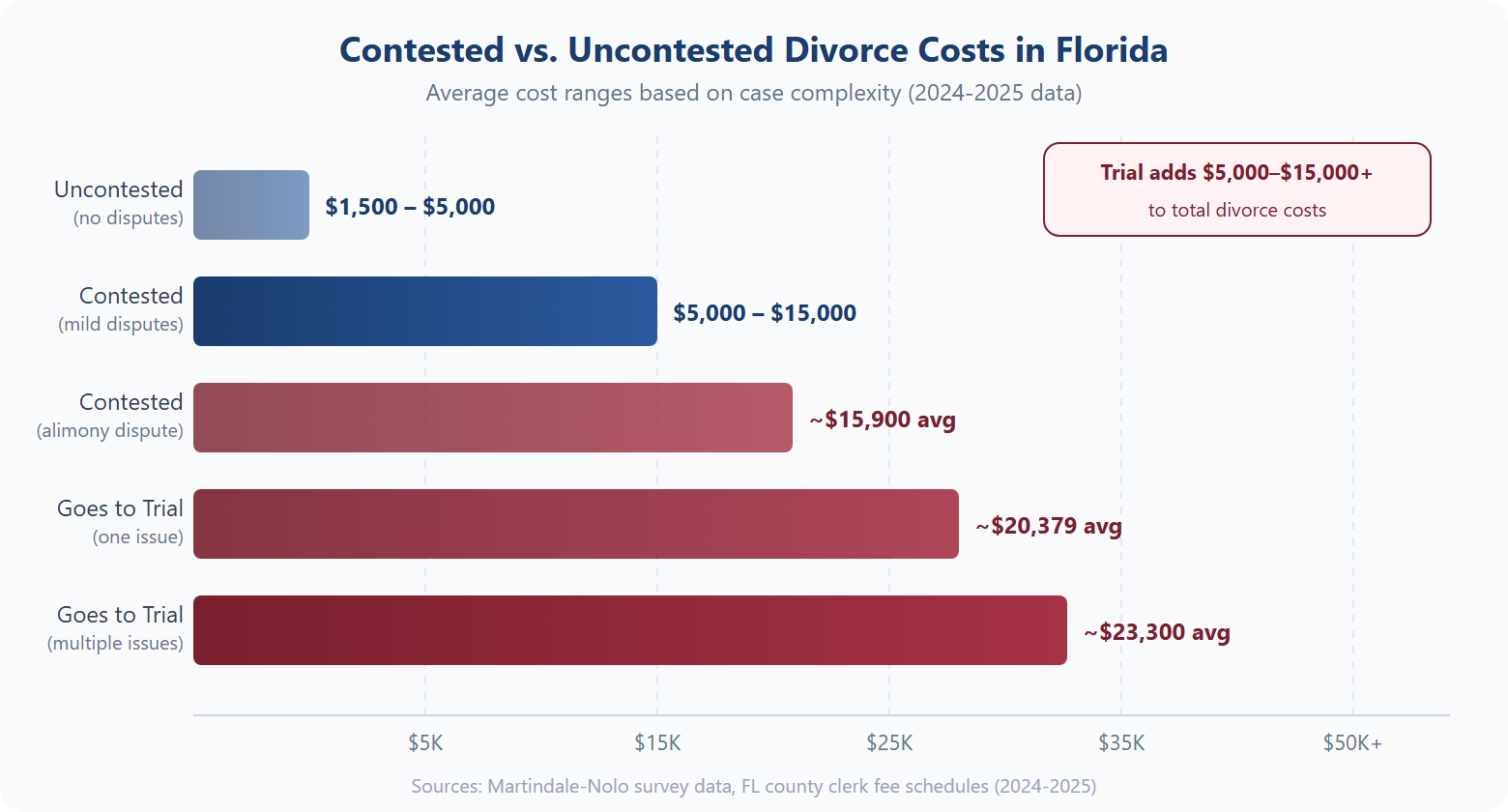
An uncontested divorce in Jacksonville typically costs $1,500 to $5,000 and concludes in 4 to 12 weeks, while a contested case ranges from $10,000 to $30,000 or more and can take 6 months to over 2 years. [1] Here is how they compare across key factors:
- Cost: Uncontested divorces typically cost $1,500–$5,000 total. Contested divorces range from $10,000–$30,000+, and cases that go to trial average $20,379–$23,300. [1]
- Timeline: An uncontested divorce can be finalized in 4–8 weeks. Contested cases take 6 months to 2+ years. [2]
- Attorney involvement: Uncontested divorces can sometimes be handled with limited legal help. Contested cases almost always require full representation through discovery, mediation, and potentially trial.
- Court appearances: Uncontested divorces may require only one brief hearing. Contested cases involve multiple hearings, depositions, and possibly a multi-day trial.
- Control: In an uncontested divorce, you and your spouse control the outcome. In a contested divorce, a judge makes final decisions if you cannot reach agreement.
Important: A divorce that starts as contested does not have to stay contested. Many cases settle during mediation or negotiation after the discovery phase reveals each side’s financial reality.
How Much Does a Contested Divorce Cost in Jacksonville?
The average contested divorce in Jacksonville that involves an alimony dispute costs approximately $15,900, according to the Martindale-Nolo survey of divorce costs nationwide. [1]
Cases that proceed to trial on a single contested issue average $20,379, and trials involving multiple disputed issues, such as combined property division, custody, and alimony disputes, average $23,300.
The total cost depends on the complexity of your marital estate, the number of issues in dispute, whether expert witnesses such as forensic accountants or business valuators are needed, and how cooperative or adversarial your spouse is during the discovery and mediation phases.
The Duval County filing fee for a dissolution of marriage petition is $409, but attorney fees, discovery costs, mediator fees, and potential guardian ad litem appointments make up the bulk of the expense. [4] Here is where the money typically goes in a Jacksonville contested divorce:
- Filing fee: $409 in Duval County (plus $10 for e-filing). [4]
- Attorney fees: Jacksonville divorce attorneys typically charge $250–$500 per hour. A moderately contested case may require 40–100+ attorney hours.
- Discovery costs: Financial disclosures, depositions, subpoenas, and expert witnesses (business valuators, forensic accountants) can add $2,000–$10,000+.
- Mediation fees: Mediators charge $150–$300 per hour, typically split between both parties. A full-day mediation session runs $1,500–$3,000.
- Guardian ad litem: If custody is disputed, the court may appoint a guardian ad litem ($2,500–$5,000+) to investigate the children’s best interests.
- Trial costs: If your case goes to trial, expect additional attorney preparation time, witness fees, and exhibit costs, adding $5,000–$15,000+ to the total.
The single biggest cost driver is the level of disagreement. Couples who settle most issues through mediation and only litigate one or two points save significantly compared to those who fight over every asset.
How Long Does a Contested Divorce Take in Florida?
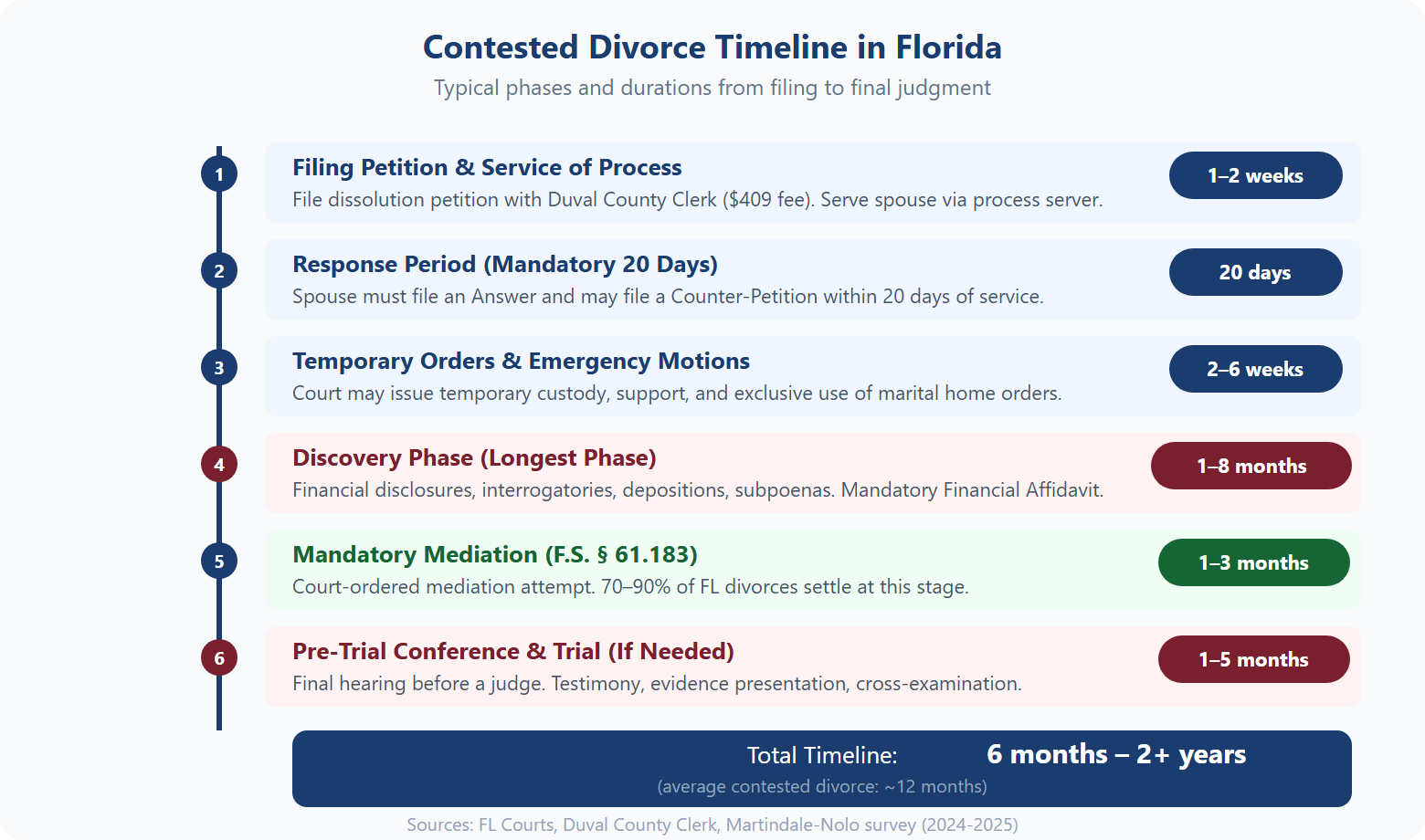
The average contested divorce in Florida takes approximately 12 months from the date the petition is filed to entry of the final judgment, but the actual range spans from 6 months to well over 2 years depending on the complexity of the disputed issues and the level of cooperation between the parties. [2]
Highly complex cases (particularly those involving business valuations, forensic accounting to trace hidden assets, retirement account division, or contested custody evaluations by a guardian ad litem) can extend to 3 years or longer.
In Duval County’s Fourth Judicial Circuit, court scheduling backlogs, the volume of family law cases on the docket, and the availability of mediation sessions all influence how quickly your case moves through the system.
Florida law requires a mandatory 20-day waiting period after filing before any final judgment can be entered (F.S. § 61.19), but contested cases rarely resolve anywhere near that minimum.
The timeline depends on several factors:
- Number of disputed issues: Cases with disputes over property, custody, AND alimony take longer than those with only one contested issue.
- Discovery complexity: Cases involving business ownership, retirement accounts, hidden assets, or real estate in multiple states require more extensive discovery (1–8 months).
- Court backlog: Duval County’s Fourth Judicial Circuit handles a heavy family law docket, which can delay hearing dates by weeks or months.
- Spouse cooperation: If one spouse delays responding to discovery requests, misses deadlines, or refuses to participate in mediation, the timeline extends significantly.
- Mediation success: Cases that settle at mediation can wrap up months sooner than those requiring a full trial.
Common Issues in Contested Divorces
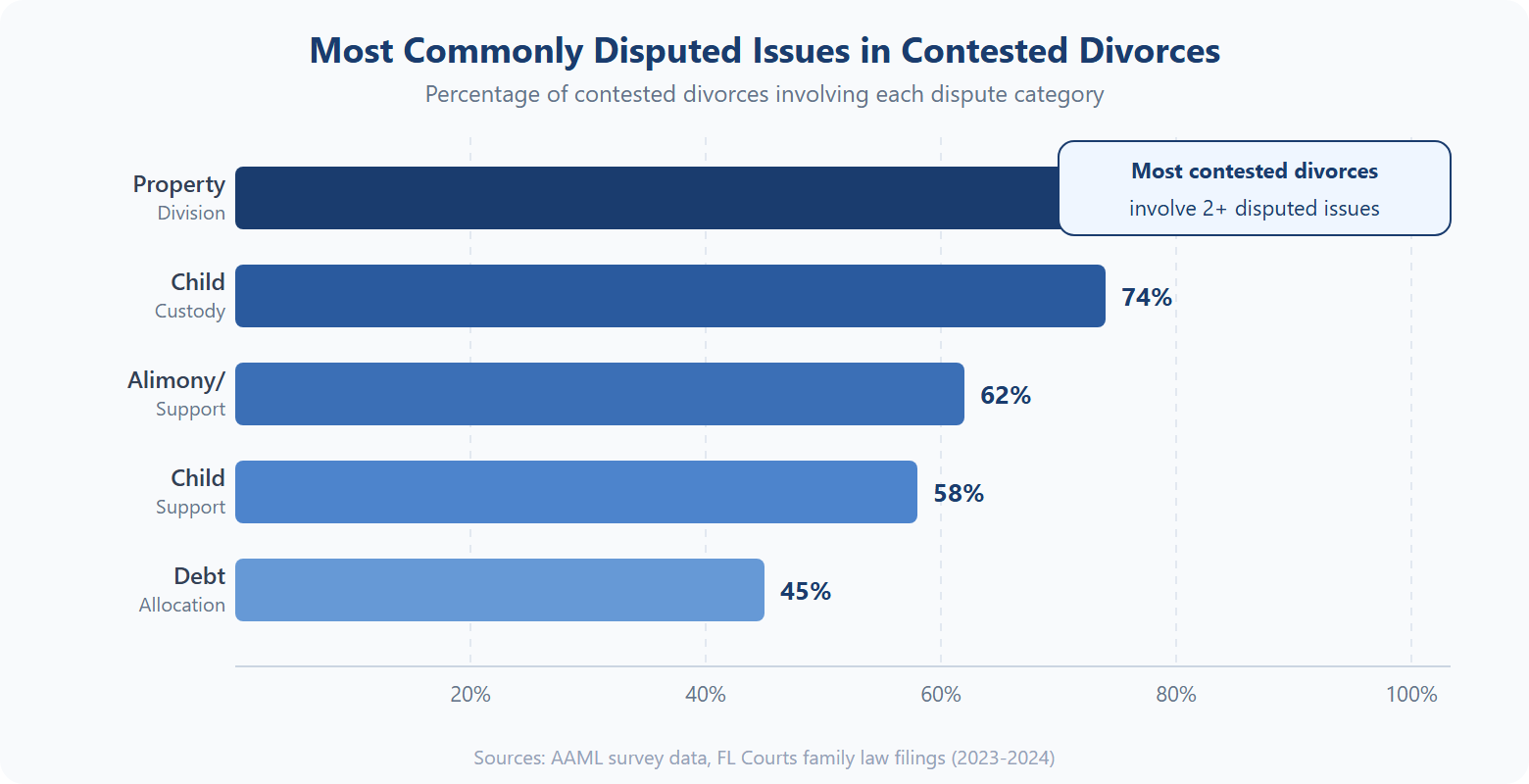
Property division is the most commonly disputed issue in contested divorces, appearing as a point of contention in roughly 82% of all contested dissolution cases according to the American Academy of Matrimonial Lawyers. [5]
Child custody disputes follow closely behind, involved in approximately 74% of contested cases, while alimony disagreements arise in about 62% and child support conflicts in 58%.
In Jacksonville, these disputes are shaped by Florida-specific statutes including the 2023 custody reform creating a 50/50 time-sharing presumption (Ch. 2023-301), the elimination of permanent alimony under SB 1416, and Florida’s equitable distribution framework under F.S. § 61.075. [6] [3]
Understanding the five primary areas of conflict in contested divorces helps you prepare for what lies ahead in your case:
- Child custody and time-sharing: Florida now presumes 50/50 time-sharing under the 2023 reform law (Ch. 2023-301). [6] A parent seeking more than 50% must prove it serves the child’s best interests using 20 statutory factors under F.S. § 61.13.
- Child support: Florida uses the Income Shares Model (F.S. § 61.30) based on both parents’ combined income and the time-sharing schedule. Disputes arise over imputed income, extraordinary expenses, and deviation from guidelines.
- Alimony/spousal support: The 2023 alimony reform (SB 1416) eliminated permanent alimony and capped durational alimony at 35% of the income difference between spouses. [6] Marriage length now determines eligibility: short (3–9 years), moderate (10–20 years), or long (20+ years).
- Equitable distribution of property: Florida divides marital property “equitably,” not necessarily equally. Under F.S. § 61.075, the court weighs 10 statutory factors including each spouse’s contribution to the marriage, economic circumstances, and the duration of the marriage. [3]
- Debt allocation: Marital debts (mortgages, credit cards, loans taken during the marriage) are divided using the same equitable distribution framework as assets.
The Contested Divorce Process in Florida (Step by Step)
Florida’s contested divorce process follows a structured legal path through the Fourth Judicial Circuit court system in Jacksonville, moving through eight distinct phases from the initial petition through final judgment.
The process is governed by Florida Family Law Rules of Procedure and Chapter 61 of the Florida Statutes, which establish mandatory timelines for financial disclosure, discovery, and mediation before the court will schedule a trial. [3]
While each case is different, understanding the procedural roadmap helps you anticipate costs, prepare for deadlines, and make informed decisions at every stage.
In my 25+ years handling contested divorces in Duval County, I have guided hundreds of clients through this process, and the single most important factor in achieving a favorable outcome is preparation. Here is what to expect at each stage of a contested divorce in Florida:
Step 1: Filing the Petition for Dissolution
One spouse (the “petitioner”) files a Petition for Dissolution of Marriage with the Duval County Clerk of Court. The petition identifies the disputed issues and requests specific relief (custody arrangement, alimony amount, property division). Filing fee: $409. [4]
Step 2: Service of Process
The other spouse (the “respondent”) must be formally served with the petition. This can be done by a process server, sheriff’s office, or by waiver of service if the respondent agrees.
Step 3: Answer and Counter-Petition (20 Days)
The respondent has 20 days to file an Answer responding to each allegation. The respondent may also file a Counter-Petition raising additional issues or requesting different relief.
Step 4: Temporary Orders
Either party can request temporary orders for custody, child support, alimony, and exclusive use of the marital home while the divorce is pending. These orders remain in effect until the final judgment. For urgent situations, our firm handles emergency motions and temporary custody orders.
Step 5: Mandatory Financial Disclosure
Both parties must file a Financial Affidavit disclosing all income, assets, debts, and expenses. Florida Rule of Family Law Procedure 12.285 requires mandatory disclosure within 45 days of service of the petition.
Step 6: Discovery
The most time-consuming phase. Both sides gather evidence through interrogatories (written questions), requests for production (documents), depositions (sworn testimony), and subpoenas. High net worth divorces often require business valuations and forensic accounting.
Step 7: Mandatory Mediation
Florida law requires mediation in contested family cases (F.S. § 61.183). A certified mediator helps both parties negotiate a settlement. Between 70–90% of Florida divorces settle at or after mediation. [2]
Step 8: Trial
If mediation fails to resolve all issues, the case goes to trial before a judge (no jury in Florida divorce cases). Both sides present evidence, call witnesses, and make legal arguments. The judge issues a Final Judgment resolving all disputed issues.
Mandatory Mediation in Florida Contested Divorces
Under F.S. § 61.183, Florida courts require mediation in all contested family law matters before the court will schedule a trial date. This requirement is not optional and applies to every contested divorce in the Fourth Judicial Circuit. [3]
Mediation involves a neutral, Florida Supreme Court certified mediator who facilitates negotiation between the parties in a confidential setting, with the goal of reaching a voluntary settlement on some or all disputed issues.
Between 70% and 90% of contested Florida divorces reach a full or partial agreement through mediation, making it one of the most effective tools for resolving family law disputes without the expense and uncertainty of a trial. [2]
The court will not set your case for trial until a mediation impasse has been formally declared by the mediator, and in many cases the judge will order multiple mediation sessions before allowing a contested matter to proceed to a courtroom hearing.
Mediation costs significantly less than trial ($1,000–$3,000 vs. $15,000–$30,000+ for full litigation) and gives both parties more control over the outcome. In mediation, you negotiate directly with your spouse through a neutral third party. At trial, a judge who does not know your family makes binding decisions.
Key facts about Florida divorce mediation:
- Success rate: 70–90% of contested divorces reach full or partial agreement through mediation. [2]
- Confidentiality: Everything said in mediation is confidential under F.S. § 44.405. Statements cannot be used as evidence at trial.
- Binding effect: If you reach agreement, the mediated settlement becomes a binding court order once approved by the judge.
- Partial agreements: Even if mediation doesn’t resolve everything, narrowing the disputed issues reduces trial time and cost.
As a Florida Supreme Court Certified Family Mediator and trial attorney, I bring a unique perspective to contested divorces. I know how mediation works from both sides of the table, and I know when it’s better to fight in court.
Equitable Distribution: How Florida Divides Property
Florida is an “equitable distribution” state, not a “community property” state, which means the court divides marital property fairly based on the circumstances of the marriage, but not necessarily in an equal 50/50 split.
Under F.S. § 61.075, the court begins with a presumption of equal distribution and then weighs 10 statutory factors to determine whether an unequal division is justified by the evidence presented. [3]
This framework applies to all marital assets and debts acquired during the marriage, including the marital home, retirement accounts, business interests, investment portfolios, vehicles, and outstanding liabilities such as mortgages and credit card debt.
In contested divorces handled in Jacksonville’s Fourth Judicial Circuit, equitable distribution disputes frequently involve complex valuations of closely held businesses, tracing of commingled assets, and disagreements over what qualifies as separate versus marital property. The 10 factors the court considers are:
- Contribution to the marriage, including homemaking and child care
- Economic circumstances of each party
- Duration of the marriage
- Career or educational interruptions by either party
- Contribution to the career or education of the other party
- Desirability of retaining any asset (including a business) intact and free from interference
- Contribution to the acquisition, enhancement, or production of marital and non-marital assets
- Desirability of retaining the marital home for the benefit of minor children
- Intentional dissipation, waste, or destruction of marital assets within 2 years of filing
- Any other factor necessary to achieve equity and justice
What counts as marital property? Anything acquired during the marriage, including real estate, vehicles, bank accounts, retirement funds, stock options, and business interests. Gifts and inheritances received by one spouse individually are generally non-marital, unless they were commingled with marital assets.
Child Custody in Contested Divorces
Florida’s 2023 custody reform (Ch. 2023-301, effective July 1, 2023) created a rebuttable presumption that equal 50/50 time-sharing serves the child’s best interests, fundamentally changing how contested custody cases are litigated in the Fourth Judicial Circuit and across the state. [6]
Under this law, a parent seeking more than 50% of overnights now bears the burden of proving by a preponderance of the evidence that an unequal arrangement better serves the child’s welfare.
The court evaluates 20 statutory factors under F.S. § 61.13, including each parent’s willingness to support the child’s relationship with the other parent, evidence of domestic violence or substance abuse, the stability of each home environment, and the child’s established school and community ties.
In my 25+ years handling contested custody disputes in Jacksonville, I have seen this presumption shift negotiation dynamics significantly, making strong evidentiary preparation more important than ever for parents seeking a majority time-sharing arrangement.
The court evaluates 20 factors under F.S. § 61.13 to determine the best parenting plan and time-sharing schedule, including:
- Each parent’s willingness to encourage a close relationship with the other parent
- The moral fitness of the parents
- The mental and physical health of the parents
- The child’s home, school, and community record
- Each parent’s capacity to provide a consistent routine
- Evidence of domestic violence or substance abuse
In my experience handling contested custody cases in Jacksonville, the 50/50 presumption has made it harder for one parent to exclude the other, but it also means that clear evidence of unfitness, domestic violence, or neglect carries even more weight when presented effectively to the judge.
Alimony After Florida’s 2023 Reform
The 2023 alimony reform law (SB 1416, Ch. 2023-301, effective July 1, 2023) made sweeping changes to spousal support in Florida that directly and significantly affect how alimony is negotiated and litigated in contested divorce cases throughout Jacksonville and the Fourth Judicial Circuit. [6]
The most consequential change was the complete elimination of permanent alimony for all new cases, which had been available in Florida for decades. The reform also introduced a hard cap limiting alimony awards to 35% of the difference between the spouses’ net incomes and established strict durational limits tied to the length of the marriage.
These changes have made contested alimony disputes more predictable in some respects but have also created new areas of litigation around income imputation, the definition of reasonable need, and whether existing permanent alimony orders qualify for modification under the new law. Here are the key provisions that affect contested divorces:
- Permanent alimony eliminated: No new permanent alimony awards in Florida. Existing permanent alimony can now be modified or terminated more easily.
- Three remaining types: Bridge-the-gap (up to 2 years, non-modifiable), rehabilitative (up to 5 years, requires a plan), and durational (tied to marriage length).
- 35% income cap: Alimony cannot exceed 35% of the difference between the spouses’ net incomes, or the recipient’s demonstrated need, whichever is less.
- Marriage length thresholds: Under 3 years = no alimony presumed. Short (3–9 years) = up to 50% of marriage length. Moderate (10–20 years) = up to 60%. Long (20+ years) = up to 75%.
These changes significantly impact alimony negotiations in contested divorces. The 35% cap and elimination of permanent alimony give both sides clearer parameters, which can make settlement more predictable.
7 Common Mistakes in Contested Divorces
After 25+ years of representing clients in contested divorces throughout Jacksonville’s Fourth Judicial Circuit, I have seen the same avoidable mistakes cost people thousands of dollars, damage their credibility with the judge, and produce worse outcomes on custody, property division, and alimony.
Florida’s contested divorce process involves strict procedural requirements (mandatory financial disclosure, discovery deadlines, mediation obligations, and evidentiary rules at trial) and missteps at any stage can have lasting consequences.
The following seven mistakes are the ones I see most often, and every one of them is preventable with proper legal guidance from an experienced Jacksonville family law attorney.
Understanding these pitfalls before you file can save you significant time, money, and stress throughout your contested dissolution proceedings.
- Hiding assets or income: Florida requires full financial disclosure. If the court discovers hidden assets, you face sanctions, adverse inferences, and possible contempt. It’s never worth the risk.
- Using children as leverage: Judges see through this immediately. Withholding time-sharing or badmouthing the other parent in front of children hurts your credibility and can result in a less favorable custody order.
- Social media posts: Photos of vacations, new purchases, or new relationships during a pending divorce can be used as evidence against you. Assume everything is discoverable.
- Making major financial moves: Do not empty bank accounts, rack up new debt, sell assets, or change beneficiaries after filing. The court’s standing order typically freezes marital assets during the divorce.
- Refusing mediation: Mediation is mandatory in Florida, but some parties go in with no intention of negotiating. Judges notice, and an unreasonable stance at mediation can hurt you at trial.
- Representing yourself in a complex case: While Florida allows self-representation, contested divorces involving children, significant assets, or alimony are too complex for most people to handle alone. One mistake in discovery or at trial can cost far more than attorney fees.
- Letting emotions drive decisions: Fighting over a $5,000 item that costs $10,000 in attorney fees to litigate is not a win. The best contested divorce outcomes come from strategic decisions based on what matters most, not emotional reactions.
Why Choose Adam Sacks for Your Contested Divorce
I started my legal career as a prosecutor for the State of Florida, trying criminal cases in court before a jury. That experience gave me something most family law attorneys don’t have: real courtroom confidence. When your contested divorce goes to trial, you need an attorney who has done this hundreds of times and is completely comfortable in front of a judge. I am.
But I’m also a Florida Supreme Court Certified Family Mediator. That means I understand negotiation and compromise just as well as I understand litigation.
In my experience, the best outcomes in contested divorces happen when your attorney is prepared to go to trial, but skilled enough to get a better result at the mediation table. I’ve been doing this for over 25 years, and I know when to push, when to compromise, and when to take the case all the way to a judge.
Adam Sacks earned his J.D. from Western Michigan University Cooley Law School, where he received a Book Award for the highest grade in his class. He served as an Assistant State Attorney in Seminole County before transitioning to private practice.
He holds a bachelor’s degree in Psychology from the University of Massachusetts, giving him unique insight into the emotional dynamics of high-conflict divorces and custody disputes. He is a Florida Supreme Court Certified Family Mediator and a member of the Florida Bar (Bar #248370) since 2000.
What Happens When You Call Our Office
When you call (904) 396-5557, you will speak directly with attorney Adam Sacks, not a paralegal, not an intake coordinator, and not a junior associate. I personally handle every contested divorce consultation because the first conversation is where strategy begins.
During your free consultation, I will listen to the details of your situation, identify the contested issues, assess the strength of your position on custody, property, and alimony, and give you an honest evaluation of what to expect in terms of cost, timeline, and likely outcomes based on my 25+ years of experience in Jacksonville’s Fourth Judicial Circuit.
There is no pressure and no obligation, just straightforward legal advice from a former state prosecutor and Florida Supreme Court Certified Mediator who has handled hundreds of contested divorces. Here is exactly what the process looks like:
- You talk to me directly. Not a paralegal, not a junior associate. I’ll take your call or return it personally the same day.
- Free consultation. I’ll listen to your situation (what’s in dispute, what you want, what you’re worried about) and give you an honest assessment of where you stand.
- Straight answers. I’ll tell you the likely cost range, timeline, and what I think a realistic outcome looks like. No false promises, no scare tactics.
- Strategy session. If you decide to move forward, we build a plan together: mediation strategy, discovery priorities, and what we need to prove at trial if it comes to that.
- Immediate action if needed. If your situation requires emergency relief (temporary custody, restraining orders, asset preservation), we can file motions quickly.
Ready to discuss your contested divorce? Call Adam Sacks directly at (904) 396-5557 for a free consultation. No pressure, no obligation, just honest advice from a Jacksonville divorce attorney with 25+ years of experience.
Client Reviews: See What People Are Saying
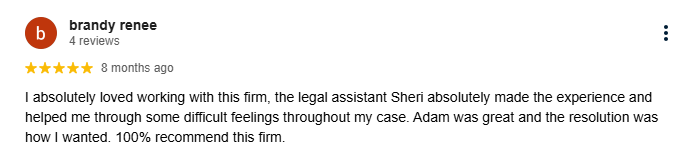
See all Google reviews for Sacks & Sacks Law
Frequently Asked Questions About Contested Divorce in Jacksonville
How much does a contested divorce cost in Jacksonville, Florida?
A contested divorce in Jacksonville typically costs $10,000–$30,000+, depending on the number of disputed issues and whether the case goes to trial. Cases with alimony disputes average about $15,900, while cases that reach trial on multiple issues average $23,300. [1]
The Duval County filing fee is $409. Attorney fees account for the largest portion, with Jacksonville divorce lawyers charging $250–$500 per hour on average.
How long does a contested divorce take in Florida?
Most contested divorces take 6 months to 2 years, with the average being approximately 12 months. [2] The timeline depends on discovery complexity, court scheduling in Duval County, whether mediation succeeds, and how cooperative both parties are. Highly complex cases with business valuations or custody evaluations can take 3+ years.
Can a contested divorce become uncontested?
Yes, and it happens frequently. Many divorces that start as contested become uncontested after both parties complete financial discovery and understand the realistic range of outcomes. Mediation resolves 70–90% of contested Florida divorces. [2]
In my experience, once both sides see the true financial picture, the motivation to settle increases significantly.
What happens if my spouse won’t agree to anything?
If your spouse refuses to negotiate or participate in mediation in good faith, the case proceeds to trial. A Duval County judge will make all decisions about property division, custody, alimony, and support based on the evidence presented.
The judge’s decision is binding. An uncooperative spouse may also face sanctions for failing to comply with discovery obligations or court orders.
Is Florida a 50/50 state for divorce?
Florida is an “equitable distribution” state, not a 50/50 community property state. The court starts with a presumption of equal distribution but can divide property unequally based on 10 factors under F.S. § 61.075. [3] However, for child custody, Florida now presumes 50/50 time-sharing as of July 1, 2023. [6]
Do I need a lawyer for a contested divorce in Florida?
Technically no: Florida allows self-representation. But I strongly advise against it in contested cases. The discovery process, financial affidavit requirements, evidentiary rules, and trial procedures are complex.
One mistake (a missed deadline, an incomplete financial disclosure, an inadmissible piece of evidence) can permanently affect your custody, property, and financial outcome. The cost of an experienced attorney is almost always less than the cost of a bad result.
What is the difference between a contested and uncontested divorce in Florida?
In an uncontested divorce, both spouses agree on every issue (property, custody, support, debt) and submit a signed settlement agreement to the court. It can be finalized in 4–8 weeks for $1,500–$5,000.
In a contested divorce, at least one issue is in dispute and must be resolved through mediation or trial. It takes 6 months to 2+ years and costs $10,000–$30,000+. [1]
Sources:
[1] Martindale-Nolo, Average Cost of Divorce Survey. lawyers.com
[2] Florida Courts, Alternative Dispute Resolution Annual Report FY 2024-2025; Martindale-Nolo survey data on mediation settlement rates. flcourts.gov
[3] Florida Statutes, Title VI, Chapter 61: Dissolution of Marriage; Support; Custody (F.S. §§ 61.052, 61.075, 61.183). flsenate.gov
[4] Duval County Clerk of Courts, Filing Fees Schedule. duvalclerk.com
[5] American Academy of Matrimonial Lawyers, Survey on Contested Divorce Issues. aaml.org
[6] Florida Legislature, SB 1416 (Ch. 2023-301): Alimony Reform and Parental Time-Sharing Presumption, eff. July 1, 2023. flsenate.gov