
Adam Sacks is a Florida Supreme Court Certified Family Mediator and a trial attorney with 25+ years of experience. He can advocate for you at the mediation table or take your case to court if mediation fails. Free consultation: (904) 396-5557.
Call (904) 396-5557 for a Free Mediation Consultation
What Is Family Mediation in Florida?
Family mediation is a structured, confidential negotiation process where a neutral, court-certified mediator helps divorcing spouses or co-parents reach agreements on contested issues including custody, child support, alimony, and property division, without a judge deciding the outcome.
In Florida, mediation resolves roughly 65% of family cases through full agreement, and another 10% reach partial agreements that narrow the issues remaining for trial.[1] Governed by F.S. § 61.183, mediation is ordered by most Duval County family law judges before a contested case can proceed to trial.[2]
Unlike litigation, mediation gives both parties control over the terms of their settlement, which produces higher compliance rates and fewer post-judgment enforcement actions.
As a Florida Supreme Court Certified Family Mediator and trial attorney with 25+ years of experience, I represent clients at the mediation table while remaining fully prepared for court if negotiations fail.
Mediation is a structured negotiation process where a neutral, court-certified mediator helps divorcing spouses or co-parents reach agreements on contested issues.
Unlike a judge, the mediator does not make decisions or impose rulings. Both parties (typically with their attorneys present) negotiate directly, with the mediator facilitating productive conversation and identifying compromises.
In Florida, mediation is governed by F.S. § 61.183, which authorizes courts to refer contested family law cases to mediation before trial.[2] The statute covers disputes involving:
- Parental responsibility and time-sharing (custody)
- Child support and modification of support
- Alimony and spousal support
- Property division and equitable distribution
- Relocation disputes
Mediation agreements become legally binding once signed by both parties and approved by the court. The result is a settlement that both sides helped create, which means higher compliance rates and fewer post-judgment modifications.
When Florida Courts Require Mediation
Most Duval County family law judges order mediation before allowing a contested case to proceed to trial, making it a near-universal requirement in Jacksonville family courts.
Under F.S. § 61.183, a court may refer any contested family case to mediation, and in practice, nearly all contested divorces, custody disputes, child support modifications, and relocation cases go through mediation first.[2]
Florida courts also order mediation under F.S. § 44.102, which authorizes court-ordered mediation across civil case types and includes specific provisions for cases involving domestic violence.[3]
The only common exception is when there is documented evidence of domestic violence between the parties, though even then a party may request mediation with appropriate safety measures in place.
Understanding when mediation is mandatory versus voluntary (and how to prepare strategically for either scenario) is essential to protecting your interests in a Jacksonville family law case.
Mediation is typically required when:
- Contested divorce: When spouses disagree on property division, alimony, or other financial matters
- Custody and time-sharing disputes: When parents cannot agree on a parenting plan
- Child support modifications: When one parent seeks to change an existing support order
- Relocation cases: When a parent wants to move more than 50 miles with a child
- Post-judgment modifications: When circumstances change and existing orders need updating
Exceptions: Courts generally do not order mediation when there is evidence of domestic violence between the parties (F.S. § 44.102(2)(c)), though a party can still request it with safety provisions in place.
Mediation vs. Litigation: Cost Comparison
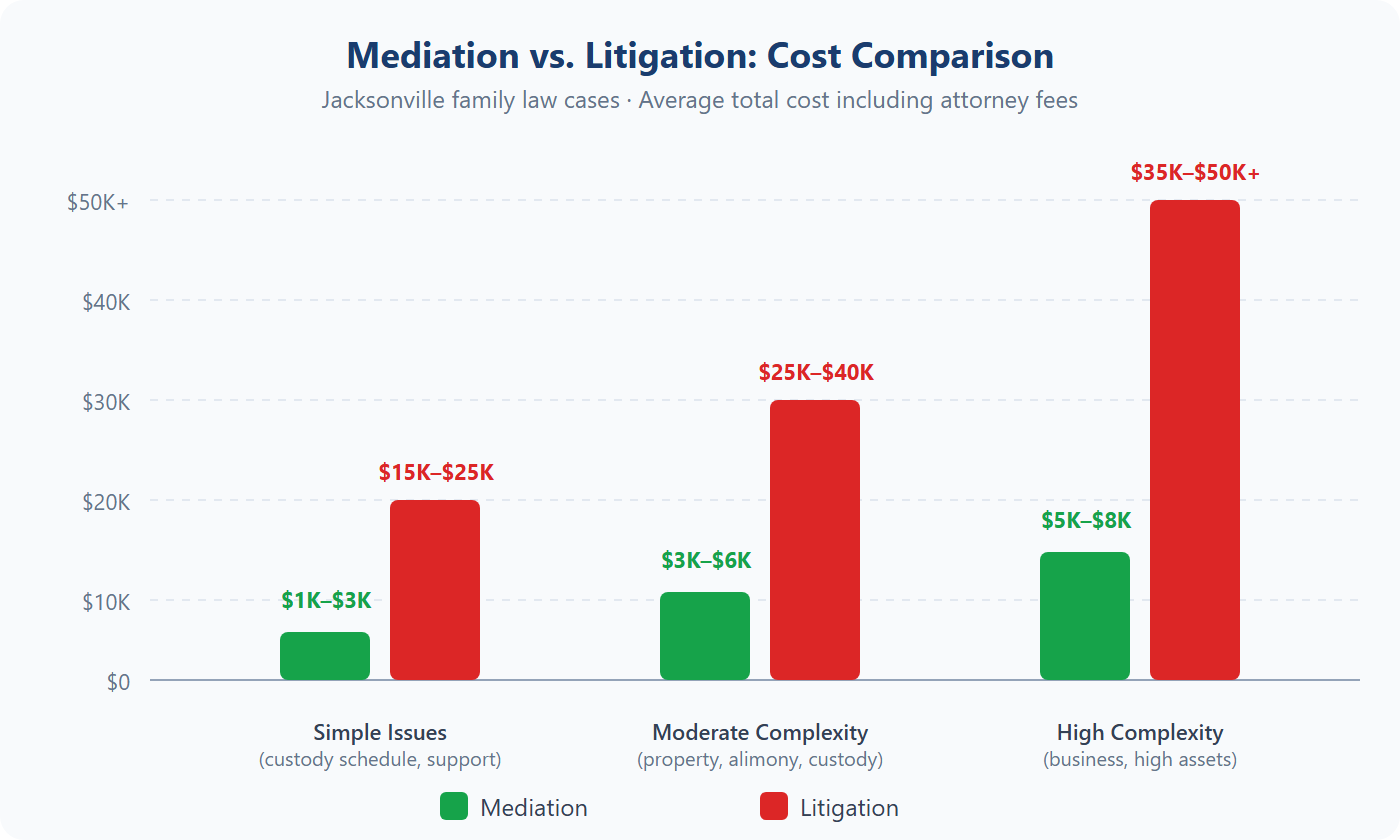
Family mediation in Jacksonville costs $1,000–$8,000 on average, while contested litigation typically runs $15,000–$50,000+ in total attorney fees and court costs, a savings of roughly 60%.[4]
The primary cost driver in contested litigation is attorney time spent on depositions, interrogatories, motions practice, discovery disputes, court appearances, and trial preparation, all of which compound over a 12–24 month timeline.
Mediation compresses that process into a handful of focused sessions, typically lasting 3–6 hours each, where both parties negotiate directly with a neutral mediator facilitating productive discussion. The mediator’s fee (usually $150–$350 per hour in Duval County) is typically split between the parties.
When you add your attorney’s preparation and attendance time, the total cost of mediation remains a fraction of what a contested trial demands. For families already under financial pressure from separation, the cost difference between mediation and litigation is often the deciding factor.
| Factor | Mediation | Litigation |
|---|---|---|
| Total cost | $1,000–$8,000 | $15,000–$50,000+ |
| Timeline | 2–6 months | 12–24+ months |
| Who decides | You and your spouse | A judge |
| Privacy | Confidential (§ 44.405) | Public court record |
| Compliance rate | Higher (self-determined) | Lower (court-imposed) |
| Emotional impact | Lower conflict | Adversarial |
| Control over outcome | Full | None |
The biggest cost driver in litigation is attorney time: depositions, motions, discovery, court appearances, and trial preparation add up fast. Mediation compresses that process into a handful of focused sessions.
How Long Does Mediation Take vs. Litigation?
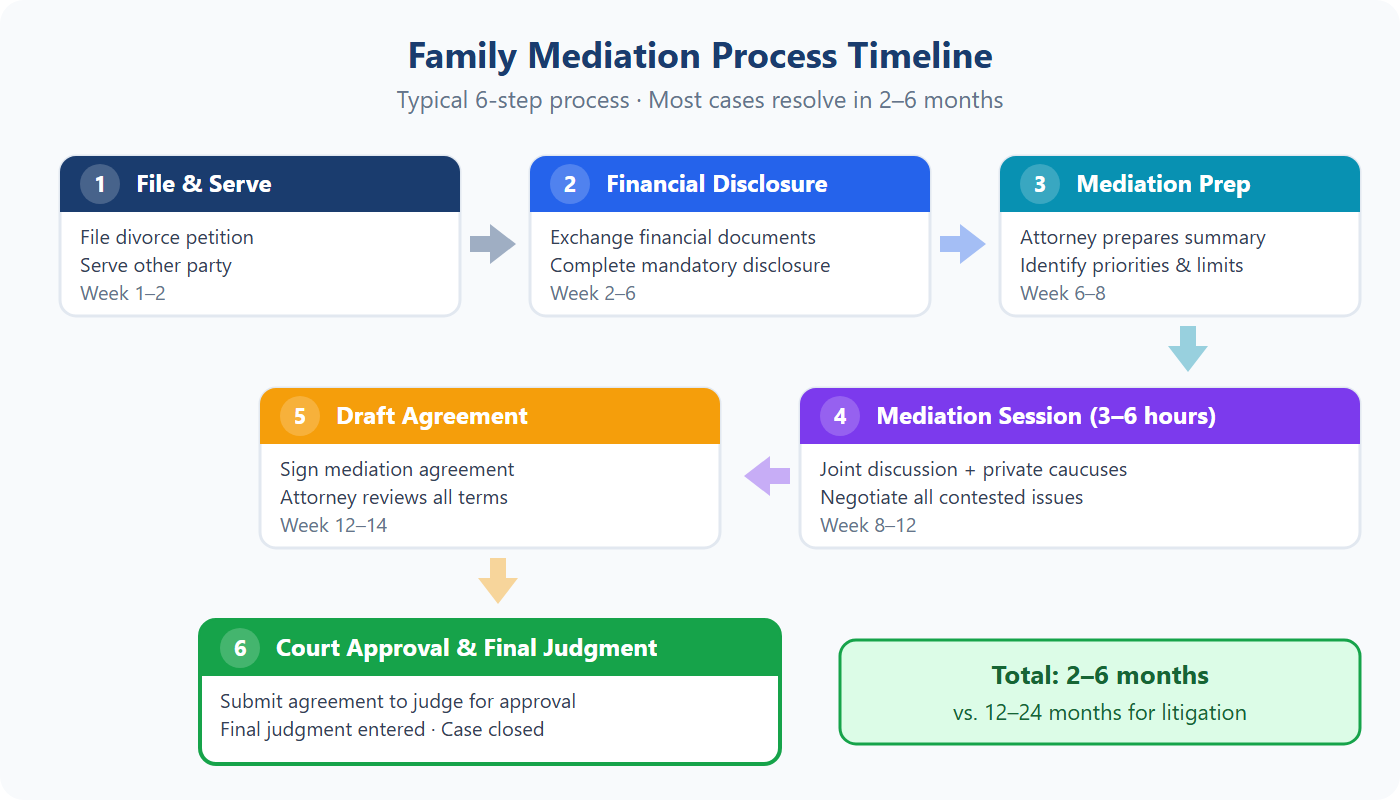
Mediation typically resolves a family law case in 2–6 months from filing to court-approved settlement, compared to 12–24 months for contested litigation in Duval County.[4]
A single mediation session usually lasts 3–6 hours, and many cases settle in one session, though complex divorces involving significant assets, business valuations, or multiple contested custody issues may require two or three sessions.
Pre-mediation preparation by your attorney (including gathering financial documents, drafting a mediation summary, and identifying key negotiation points) typically takes 2–4 weeks. Once both parties sign the mediation agreement, your attorney submits it to the court for final approval, which is usually finalized within another 2–4 weeks.
Compare that timeline to contested litigation, which involves discovery, depositions, subpoenas, pre-trial motions, continuances, and a trial date that may be months away due to court backlogs in the Fourth Judicial Circuit.
Here is how the timeline breaks down:
- Mediation session: A single mediation session usually lasts 3–6 hours. Many cases settle in one session; complex cases may require two or three.
- Pre-mediation preparation: Your attorney prepares a mediation summary, gathers financial documents, and identifies key negotiation points, typically 2–4 weeks.
- Post-mediation filing: Once both parties sign the mediation agreement, your attorney submits it to the court for approval, usually finalized within 2–4 weeks.
Compare that to contested litigation, which involves discovery (interrogatories, depositions, subpoenas), pre-trial motions, continuances, and a trial date that may be months away due to court backlogs.
The 6-Step Mediation Process in Florida
Florida’s family mediation process follows a structured six-step format designed to keep discussions productive and focused on resolution, moving from opening statements through issue identification, joint discussion, private caucuses, negotiation, and a final written agreement.
The mediator, who must be a Florida Supreme Court Certified Family Mediator with at least 40 hours of specialized training,[5] controls the process while remaining neutral, helping both parties move from entrenched positions toward workable compromises.
Your attorney participates at every stage, advocating for your interests, identifying problems in the other side’s proposals, and ensuring you do not agree to terms that could harm you in the long run.
In my experience handling family mediation cases in Jacksonville over 25 years, most progress happens during the private caucus phase, where the mediator meets separately with each party to explore possible compromises and reality-test positions away from the adversarial dynamic of joint sessions.
- Opening statements: The mediator explains the process, ground rules, and confidentiality. Each party (or their attorney) gives a brief overview of the issues.
- Issue identification: The mediator works with both sides to list every contested issue: property, custody, support, debts, and any other disputes.
- Joint discussion: Both parties discuss the issues together with the mediator facilitating. The goal is to understand each side’s priorities and concerns.
- Private caucuses: The mediator meets separately with each party to explore possible compromises, discuss strategy, and reality-test positions. This is where most progress happens.
- Negotiation and agreement: The mediator moves between the parties, relaying offers and counteroffers, until agreements are reached on each issue.
- Written agreement: All agreements are put in writing, signed by both parties and their attorneys, and submitted to the court for final approval.
Your attorney is with you through every step. A good mediation attorney does not just sit quietly. They advocate for your interests, identify problems in the other side’s proposals, and make sure you do not agree to terms that will hurt you later.

What Issues Can Mediation Resolve?
Florida family mediation can address virtually every contested issue in a divorce or custody case, from equitable distribution of marital property and debts to parental responsibility, time-sharing schedules, child support, and alimony determinations.[2]
Under F.S. § 61.183, courts refer contested matters to mediation precisely because the process can resolve complex, interconnected disputes (including business valuations, retirement account division, tax implications of property splits, relocation permissions, and college expense agreements) in a single coordinated negotiation rather than through piecemeal court hearings.
Mediation is particularly effective for children’s issues because parents who create their own parenting plans tend to follow them more consistently than court-imposed orders.
The 2023 family law reform (Ch. 2023-301) further underscores mediation’s value: with the 50/50 time-sharing presumption and elimination of permanent alimony, both parties now enter mediation with clearer legal parameters that facilitate settlement. The most common issues resolved through mediation include:
Financial issues:
- Equitable distribution of marital property and debts
- Alimony type, amount, and duration (under the 2023 reform)
- Division of retirement accounts, pensions, and investments
- Business valuations and division of business interests
- Tax implications of property division
Children’s issues:
- Parental responsibility (sole vs. shared)
- Time-sharing schedules (including holidays, school breaks, and summers)
- Child support calculations and adjustments
- Decision-making authority (education, healthcare, religion)
- Relocation and travel permissions
Other issues:
- Life insurance requirements
- Health insurance coverage for children
- College expense agreements
- Name changes
7 Benefits of Mediation Over Litigation
Florida courts processed 20,808 family mediation cases in FY 2024–2025, a volume that reflects how strongly the judicial system favors mediation as the primary dispute resolution mechanism in family law.[1]
The advantages of mediation over litigation are measurable across every dimension that matters to families going through divorce or custody disputes: cost, timeline, privacy, emotional impact on children, compliance with final agreements, and the preservation of a functional co-parenting relationship.
Mediation costs roughly 60% less than contested litigation, resolves cases in months rather than years, keeps sensitive family details out of public court records under F.S. § 44.405 confidentiality protections, and produces agreements that both parties helped create, which means higher voluntary compliance and fewer post-judgment enforcement actions.[4] [3]
For parents who will be co-parenting for years after the divorce is finalized, mediation builds a foundation for cooperation rather than resentment.
- Lower cost: Average savings of 60% compared to contested litigation[4]
- Faster resolution: 2–6 months vs. 12–24 months for litigation
- You control the outcome: You decide the terms, not a judge who met your family 30 minutes ago
- Confidential: Mediation discussions are protected under F.S. § 44.405 and cannot be used in court[3]
- Better for children: Lower-conflict process reduces emotional harm to kids caught between parents
- Higher compliance: People follow through on agreements they helped create; court-imposed orders generate more enforcement actions
- Preserves co-parenting relationships: You will be co-parenting with this person for years; mediation builds a foundation for cooperation rather than resentment
Mediation Success Rates in Florida
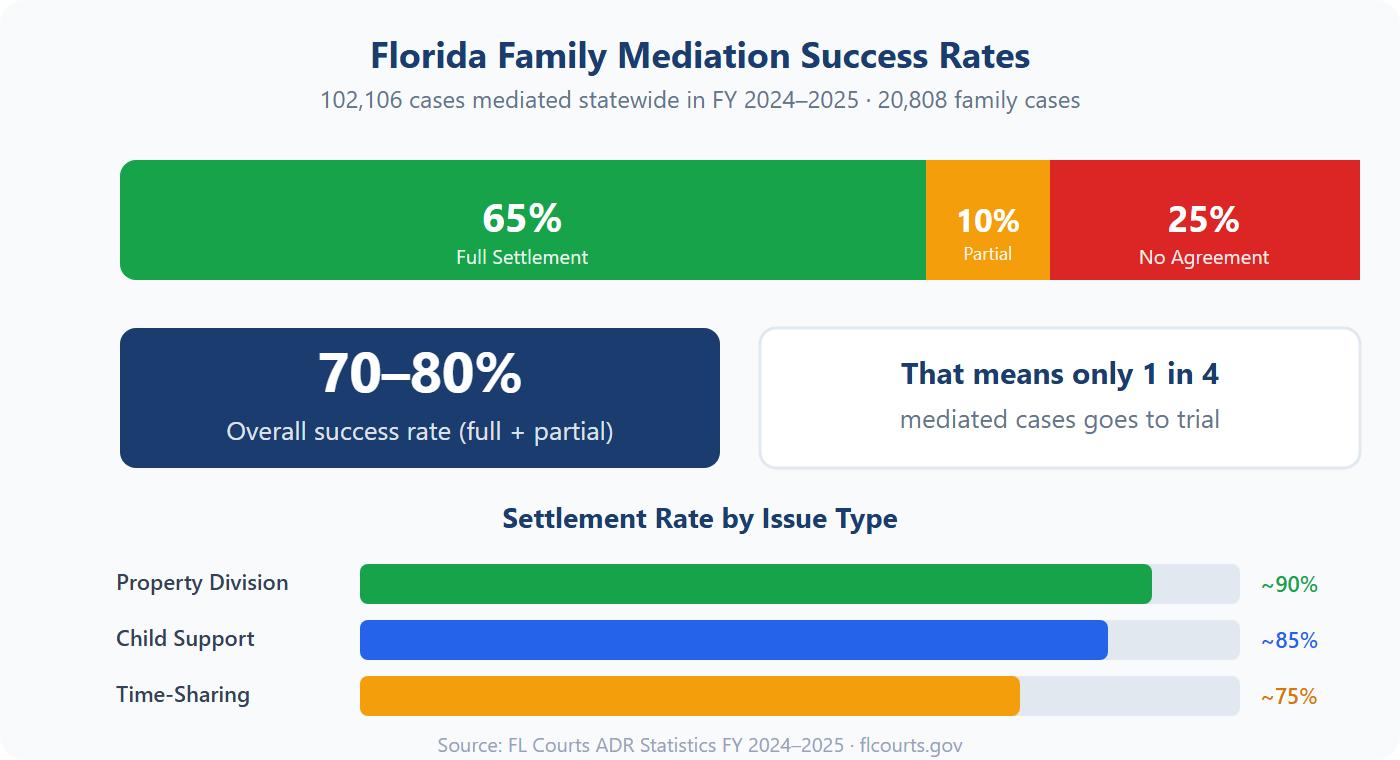
Family mediation in Florida succeeds in 70–80% of cases, with roughly 65% reaching full settlement and another 10% achieving partial agreements that narrow the contested issues remaining for trial.[1]
These resolution rates reflect data from over 102,000 mediation cases processed by Florida courts in FY 2024–2025, making the state one of the most active mediation jurisdictions in the country.
Success rates vary by issue type: property division and child support disputes settle at the highest rates because financial guidelines and formulas provide clear anchors for negotiation, while time-sharing and alimony disputes settle at moderate to high rates depending on the complexity of the family’s circumstances.
The 2023 elimination of permanent alimony has actually improved mediation settlement rates for spousal support because both sides now negotiate within defined durational limits. Even the 25% of cases that do not settle at mediation still benefit from the process: mediation narrows contested issues, clarifies positions, and often leads to settlement before trial.
The remaining 25% of cases that do not settle at mediation still benefit from the process. Mediation narrows the contested issues, clarifies each side’s position, and often leads to settlement before trial even when the mediation session itself does not produce an agreement.
Success rates vary by issue type:
- Property division: Highest settlement rate (financial issues lend themselves to compromise)
- Child support: High settlement rate (guidelines provide a formula that anchors negotiation)
- Time-sharing: Moderate to high (emotionally charged but parents often find workable schedules)
- Alimony: Moderate (the 2023 reform eliminated permanent alimony, which actually makes mediation easier because both sides know the durational limits)
What Happens If Mediation Fails?
If mediation does not produce a full agreement, your case proceeds to trial on the unresolved issues, but you are not starting over.
Any partial agreements reached during mediation remain binding once signed, and the mediation process itself narrows the contested issues, clarifies each party’s position, and often establishes a framework that leads to settlement before the trial date.
The mediator files an impasse report with the court without disclosing what was discussed, preserving the confidentiality protections of F.S. § 44.405.[3] Some Duval County judges order a second mediation attempt if substantial progress was made in the first session.
Having an attorney who is both a certified mediator and a trial lawyer is critical at this stage: if your attorney understands mediation strategy and courtroom litigation equally well, there is no gap between the negotiation table and the courtroom.
I shift strategy immediately when a case moves toward trial, using insights gained during mediation to build a stronger litigation position.
Here is what happens next:
- Impasse declared: The mediator files an impasse report with the court (without disclosing what was discussed)
- Pre-trial preparation: Your attorney prepares for trial on the remaining unresolved issues
- Possible second mediation: Some judges order a second mediation attempt, especially if progress was made in the first session
- Trial: A judge hears evidence and makes final decisions on all contested issues
Having an attorney who is both a certified mediator and a trial lawyer matters here. If your mediator-attorney knows the case is heading to trial, they can shift strategy immediately. There is no gap between the mediation table and the courtroom.
Mediation Confidentiality Under Florida Law
Everything said during mediation is confidential and legally protected under F.S. § 44.405, which establishes a broad privilege covering all communications made during the mediation process.[3]
This statutory protection means that nothing discussed during mediation (including offers, admissions, concessions, and settlement proposals) can be used as evidence in court if the case proceeds to trial. The mediator cannot be called as a witness, and notes or documents created specifically for mediation are privileged.
This confidentiality is the foundation that makes honest negotiation possible: both parties can explore compromises, float creative solutions, and make concessions without fear that those statements will be weaponized against them later.
The only exceptions to mediation confidentiality are threats of violence, evidence of child abuse or neglect, and the signed mediation agreement itself, which becomes part of the court record once filed for judicial approval. Understanding these protections allows you to negotiate freely and strategically.
- Nothing discussed during mediation can be used as evidence in court
- The mediator cannot be called as a witness at trial
- Offers, admissions, and concessions made during mediation cannot be referenced later
- Notes and documents created for mediation are privileged
This confidentiality is essential because it allows both parties to negotiate honestly. You can explore compromises, float creative solutions, and make concessions during mediation without fear that those statements will be used against you if the case goes to trial.
Exceptions: Confidentiality does not cover threats of violence, evidence of child abuse, or a signed mediation agreement (which becomes a court record once filed).
What Does a Mediator Actually Do?
A Florida Supreme Court Certified Family Mediator must complete 40 hours of specialized training and meet continuing education requirements before they can facilitate family disputes.[5]
The mediator’s role is fundamentally different from that of a judge or an attorney: they serve as a neutral facilitator who does not take sides, does not make binding decisions, and does not provide legal advice to either party.
Instead, the mediator acts as a communication bridge between the parties, translating emotional statements into productive negotiation language, reality-testing each side’s positions against likely trial outcomes, suggesting creative solutions that neither party may have considered, and documenting all agreements in clear, enforceable language.
The mediator’s neutrality is what makes the process work, but it also means the mediator cannot protect your legal rights. That is your attorney’s job. Having your own experienced family law attorney present at mediation ensures that every proposed agreement serves your interests and that you fully understand the long-term legal implications of what you are signing.
- Neutral facilitator: The mediator does not take sides, make decisions, or give legal advice
- Communication bridge: They help translate emotional statements into productive negotiation language
- Reality check: Mediators help parties understand the likely outcome if the case goes to trial, which motivates settlement
- Creative problem-solver: They suggest solutions that neither party may have considered
- Agreement drafter: They document all agreements in clear, enforceable language
However, a mediator cannot protect your legal rights. That is your attorney’s job. Having your own attorney at mediation ensures that every agreement serves your interests and that you understand the legal implications of what you are signing.
How the 50/50 Presumption Affects Mediation
Florida’s 2023 family law reform (Ch. 2023-301) created a rebuttable presumption of equal time-sharing between parents, fundamentally changing the dynamics of family mediation in Jacksonville and throughout the state.[6]
Before this reform, mediation often started from whatever arrangement had been established during separation, which gave an advantage to the parent with more physical custody at the time of filing.
Now, mediation begins from a legal baseline of 50/50, and any parent seeking more than equal time bears the burden of proving that 50/50 is not in the child’s best interest, the same standard that would apply at trial. This shift also affects child support calculations and alimony determinations, since equal time-sharing changes the financial formula.
Understanding how the presumption operates before walking into mediation is critical to effective negotiation, and your attorney should know how to leverage it when it helps your case or argue around it when it does not.
- Starting point shifted: Mediation now begins from a baseline of 50/50, not from whatever arrangement existed during separation
- Burden of proof reversed: A parent seeking more than 50% time must demonstrate why equal sharing is not in the child’s best interest
- Stronger negotiating position for equal-time parents: If you want 50/50 and the other side does not, the law is on your side going into mediation
- Alimony impact: Equal time-sharing can affect child support calculations and alimony determinations
Understanding how this presumption works before walking into mediation is critical. Your attorney should use it as leverage when it helps your case, and know how to argue around it when it does not.
7 Mistakes That Derail Family Mediation
Family mediation in Jacksonville fails most often not because the issues are irreconcilable, but because one or both parties make avoidable strategic and emotional errors that undermine the negotiation process.
In my 25 years as a Florida Supreme Court Certified Family Mediator and trial attorney, I have seen mediation sessions collapse over hidden assets, emotional decision-making, refusal to compromise, and the decision to attend without legal counsel.
Florida requires full financial disclosure in family cases, and mediation agreements that are later found to rest on incomplete or fraudulent information can be voided by the court entirely.
The 2023 family law reform (Ch. 2023-301) has also introduced new considerations (particularly around alimony and the 50/50 presumption) that parties unfamiliar with the current law often mishandle at the mediation table.[6] Here are the seven most common mistakes I see:
- Going without an attorney: The mediator is neutral, not your advocate. Without legal counsel, you may agree to terms that seem fair now but cost you thousands later.
- Hiding assets or income: Florida requires full financial disclosure. If the other side discovers hidden assets later, the court can void the entire agreement.
- Letting emotions drive decisions: Wanting to “win” or punish your spouse leads to bad agreements. Focus on outcomes that work for your family long-term.
- Refusing to compromise: Mediation requires flexibility. If you go in demanding everything, you will end up in court where a judge gives you less.
- Not preparing financially: Bring complete financial documents: tax returns, pay stubs, bank statements, retirement account values, and debt records.
- Ignoring tax consequences: Property division, alimony, and retirement account splits all have tax implications. A $200,000 IRA is not the same as $200,000 in home equity after taxes.
- Agreeing under pressure: Do not sign anything you do not fully understand. A good attorney will pause the session if you need time to think.
Why Choose Adam Sacks for Mediation?
I am one of the few family law attorneys in Jacksonville who is both a Florida Supreme Court Certified Family Mediator and a trial attorney. That dual perspective changes everything about how I represent you in mediation.
Most attorneys walk into mediation thinking only about negotiation. I walk in knowing exactly what will happen if we go to trial instead, because I have tried these cases.
I spent my first years as an Assistant State Attorney prosecuting cases for the State of Florida. That courtroom experience taught me how to prepare for the worst while working toward the best outcome at the table.
My psychology degree from the University of Massachusetts gives me an edge that other attorneys do not have. I read people. I understand what the other side actually wants, not just what they are asking for. That insight helps me find compromises that both parties can live with, which is the difference between a mediation that settles and one that falls apart.
When I sit across the table as your attorney, the other side knows two things: I will negotiate in good faith, and I will not hesitate to take this case to trial if they are unreasonable. That combination (willingness to cooperate and willingness to fight) gets better results than either approach alone.
Adam Sacks earned his J.D. from Western Michigan University Cooley Law School, where he received a Book Award for top academic performance. He served as an Assistant State Attorney in Seminole County before transitioning to private family law practice.
He is a Florida Supreme Court Certified Family Mediator and a member of the Florida Bar (Bar #248370) since 2000. At Sacks & Sacks, Adam provides personal, family-run legal representation.
What Happens When You Call Sacks & Sacks
When you call our office at (904) 396-5557, you speak directly with me, attorney Adam Sacks, a Florida Supreme Court Certified Family Mediator and trial lawyer with 25+ years of experience in Jacksonville family law.
I do not route mediation consultations through a paralegal or intake coordinator because every case requires an immediate assessment of the contested issues, your goals, and whether mediation is likely to succeed or whether you should prepare for litigation.
During your free consultation, I will evaluate your situation, give you an honest assessment of how mediation compares to going to trial for your specific circumstances, and begin building a strategy that identifies what to ask for, what to concede, and where the other side is likely to push back.
If you hire me, I prepare your case with complete financial documentation and a mediation summary, and I sit beside you at the table protecting your interests at every stage. Here is exactly what the process looks like:
- You talk to me, not a paralegal, not an intake coordinator. I answer your questions directly during a free consultation.
- I assess your case: I will ask about your situation, the contested issues, and what outcome you want. I will give you an honest assessment of whether mediation makes sense or whether you should prepare for litigation.
- We build a strategy: If you hire me, I develop a mediation plan: what to ask for, what to concede, and where the other side is likely to push back.
- I prepare your case: I gather financial documents, draft a mediation summary, and prepare you for what to expect.
- I advocate at the table: During mediation, I am in the room with you, protecting your interests and making sure you do not agree to anything that hurts you long-term.
Ready to resolve your case through mediation? Call me at (904) 396-5557. Free consultation, no obligation.
What Our Clients Say
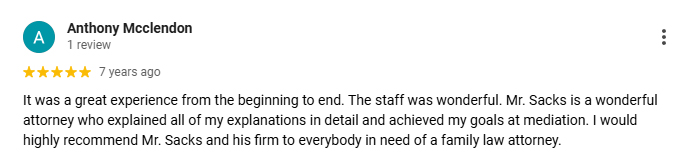
“I was going through a difficult divorce and custody situation. Adam was honest with me about what to expect, prepared me for mediation, and fought for the best outcome. He genuinely cares about his clients and their families.”
Hackie G., Google Review
“I went to Adam for a custody case. He treated me like a person and genuinely fought for my child. His knowledge of family law and mediation was exactly what I needed.”
Robert, Avvo Review
“Adam helped me through a very stressful divorce. He was always available when I had questions, and he got things resolved faster than I expected. Highly recommend.”
Linda J., Google Review
Frequently Asked Questions About Mediation in Jacksonville
How much does family mediation cost in Jacksonville?
Family mediation in Jacksonville typically costs $1,000–$8,000 total, depending on the complexity of the issues and the number of sessions required.[4]
This includes the mediator’s fee (usually $150–$350 per hour, split between the parties) plus your attorney’s time preparing for and attending mediation. Compare that to contested litigation, which averages $15,000–$50,000+ in attorney fees alone.
Is mediation required before divorce trial in Florida?
In most cases, yes. Under F.S. § 61.183, Duval County judges routinely order mediation before allowing a contested divorce or custody case to proceed to trial.[2]
The only common exception is cases involving documented domestic violence. Even if mediation is not court-ordered, it is almost always worth trying: it is faster, cheaper, and gives you more control over the outcome.
Can I bring my attorney to mediation?
Absolutely, and you should. In my experience, clients who attend mediation with legal counsel get significantly better outcomes than those who go alone.
Your attorney prepares you beforehand, advocates for your interests during the session, reviews any proposed agreements for legal issues, and makes sure you do not waive rights you do not realize you have. The mediator is neutral and cannot give you legal advice. That is your attorney’s job.
What happens if we cannot agree on everything during mediation?
If mediation does not produce a full agreement, the mediator declares an impasse on the unresolved issues. Any partial agreements you did reach still stand.
The unresolved issues proceed to trial, where a judge makes the final decision. Many cases actually settle between the mediation session and the trial date, because the mediation process helped both sides understand the likely outcome.
Is what I say during mediation confidential?
Yes. Florida Statute § 44.405 makes mediation communications confidential and privileged.[3] Nothing you say during mediation (including offers, admissions, or concessions) can be used against you in court. The mediator cannot be called as a witness. This protection allows honest negotiation without fear of legal consequences.
How long does a mediation session last?
A typical family mediation session lasts 3–6 hours, though complex cases with significant assets or multiple contested issues may take longer. Most cases settle in one or two sessions. I prepare my clients thoroughly before mediation so we use the time efficiently and do not waste hours on issues that could have been resolved beforehand.
What is the difference between a mediator and an attorney?
A mediator is a neutral third party who facilitates negotiation: they do not take sides, make decisions, or give legal advice to either party. An attorney represents your interests and advocates for the best possible outcome for you.
In mediation, you need both: the mediator to facilitate the process and your own attorney to protect your rights. I am both a certified mediator and a trial attorney, which means I understand exactly how mediators think and how to use the process to my client’s advantage.
Sources:
[1] Florida Courts, Alternative Dispute Resolution Statistics, FY 2024–2025. flcourts.gov
[2] The Florida Legislature, F.S. § 61.183: Mediation of Contested Issues. flsenate.gov
[3] The Florida Legislature, F.S. § 44.405: Confidentiality and Privilege; Mediation. flsenate.gov
[4] American Bar Association, Family Mediation Cost Comparison Guide. americanbar.org
[5] Florida Courts, Mediator Qualifications: Family Mediation. flcourts.gov
[6] The Florida Legislature, Ch. 2023-301, Laws of Florida (SB 1416). laws.flrules.org