
Adam Sacks has helped Jacksonville fathers and mothers resolve paternity cases for over 25 years. Call (904) 396-5557 for a free consultation.
Need to establish or challenge paternity? Call (904) 396-5557. Free consultation, no obligation.
What Is Paternity Under Florida Law?
Paternity is the legal determination of who a child’s father is under Florida law, and it is the foundational step that unlocks every right and obligation a father has with respect to his child.
Under Florida Statute Chapter 742, establishing paternity gives the father enforceable legal rights (and simultaneously imposes legal obligations), including the right to custody and time-sharing, the obligation to pay child support, inheritance rights, and the child’s access to the father’s medical insurance and government benefits such as Social Security and VA survivor benefits.[2]
Without legal paternity, an unmarried father in Florida has no standing to petition for custody, no right to make decisions about the child’s education or healthcare, and no legal recourse if the mother restricts his access to the child.
In my 25 years of practice in Jacksonville, paternity cases are among the most consequential family law matters I handle because the outcome determines whether a father-child relationship will be legally recognized and protected.
This distinction matters because biology alone does not create legal fatherhood in Florida. A man can be the biological father and still have zero legal rights to his child if paternity has never been established through one of the methods recognized under F.S. § 742.10.
For married couples, paternity is automatic: the husband is the presumed legal father under F.S. § 742.091. But for the nearly half of Florida children born to unmarried parents, establishing paternity requires affirmative legal action.
Why Establishing Paternity Matters in Jacksonville
Paternity is not just a formality or a piece of paperwork. It is the legal gateway to virtually every right and obligation a father has under Florida law, and the consequences of failing to establish it are severe and far-reaching.
Nearly 46% of Florida births occur outside of marriage,[1] which means tens of thousands of fathers across the state lack enforceable parental rights simply because they have never taken the affirmative legal step of establishing paternity.
Without legal paternity, an unmarried father in Florida cannot petition for custody, make decisions about his child’s upbringing, object to an adoption, or pass on critical government benefits.
For mothers, the absence of established paternity means bearing sole financial responsibility for the child with no ability to obtain a child support order. Here is a detailed look at what is at stake. Without established paternity, an unmarried father cannot:
- Request custody or time-sharing: courts cannot issue a parenting plan without established paternity
- Make decisions about the child: education, healthcare, religious upbringing
- Object to adoption: a mother can place a child for adoption without the father’s consent if paternity is not established
- Receive child support: mothers cannot obtain a support order without a legal father
- Pass on benefits: Social Security survivor benefits, military allowances, VA benefits, and inheritance rights all require legal paternity
For mothers, establishing paternity secures the right to child support payments and ensures both parents share financial responsibility. For children, it provides access to family medical history, health insurance from either parent, and the legal relationship with both parents that Florida law recognizes as a fundamental right.
5 Ways to Establish Paternity in Florida
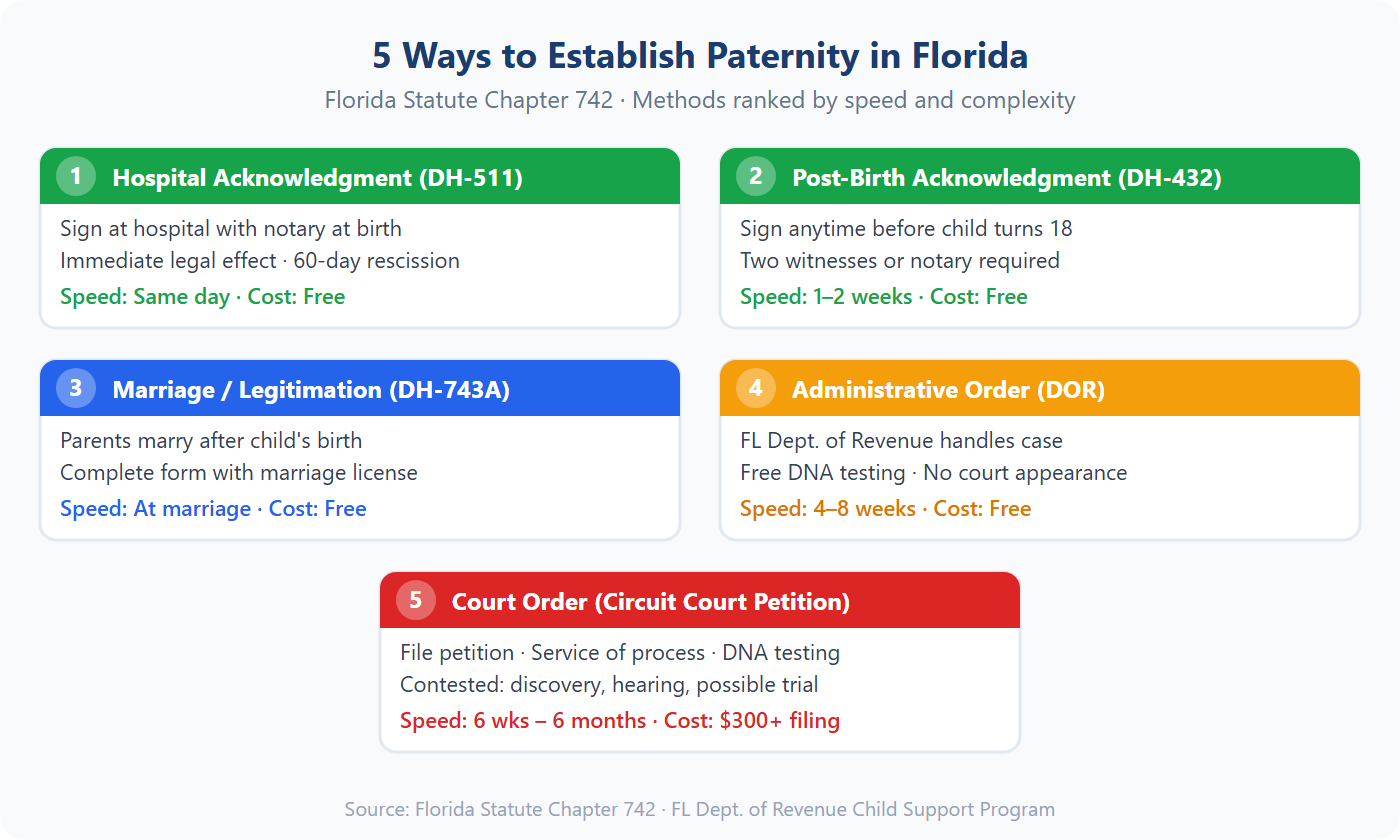
Florida law provides multiple paths to establish legal paternity, and choosing the right method depends on your specific circumstances, whether both parents agree on the child’s parentage, and how quickly you need the matter resolved. Each method carries different requirements, timelines, costs, and legal implications.[2]
The simplest approach (signing a voluntary acknowledgment at the hospital) takes effect immediately and costs nothing, while a contested court petition involving DNA testing and custody disputes can take three to six months or longer.
The Florida Department of Revenue also offers an administrative path that establishes paternity through genetic testing without requiring a court appearance.
In my Jacksonville practice, I help fathers and mothers select the method that best protects their rights and achieves their goals in the most efficient way possible. Here are the five methods recognized under Florida law:
1. Marital Presumption (Automatic)
If the mother is married when the child is born, her husband is the legal father under F.S. § 742.091. No additional action is needed: the hospital records the husband as the father on the birth certificate. This presumption applies even if the husband is not the biological father, and it can only be overturned through a court proceeding.
2. Voluntary Acknowledgment at the Hospital (DH-511 Form)
This is the quickest and easiest method for unmarried parents. Both parents sign the Paternity Acknowledgment form (DH-511) at the hospital in the presence of a notary provided by the hospital.[3]
The father becomes the legal father immediately upon signing. The hospital forwards the form to the Florida Bureau of Vital Statistics, and the father’s name is added to the birth certificate.
Important: Either parent can rescind (cancel) the acknowledgment within 60 days of signing. After 60 days, the acknowledgment becomes a legally binding determination of paternity and can only be challenged by proving fraud, duress, or material mistake of fact.
3. Voluntary Acknowledgment After Birth (DH-432 Form)
At any time before the child turns 18, both parents can sign an Acknowledgment of Paternity form (DH-432) in the presence of two witnesses or a notary public.
This form is available at local Florida Health Department offices, the Bureau of Vital Statistics in Jacksonville, or the Department of Children and Families. The completed form is mailed to the Bureau of Vital Statistics to update the birth certificate.
4. Legitimation Through Marriage (DH-743A Form)
If the unmarried mother later marries the child’s biological father, the husband becomes the legal father upon marriage under F.S. § 742.091. To add the father’s name to the birth certificate, the parents complete the Affirmation of Common Child(ren) Born in Florida form (DH-743A) when applying for their marriage license.
5. Court Order or Administrative Order
When parents cannot agree on paternity, either parent (or the Florida Department of Revenue) can file a petition to establish paternity through the court system. The court will order DNA testing if paternity is disputed.
Alternatively, the Department of Revenue’s Child Support Program can establish paternity administratively through genetic testing without going to court, issuing an Administrative Order of Paternity that has the same legal effect as a court judgment.[3]
DNA Paternity Testing in Florida
Modern DNA paternity tests are 99.99% accurate when performed by an AABB-accredited laboratory, making them the gold standard for determining biological parentage in both legal and personal contexts.[4]
Florida courts rely on these results as conclusive evidence of biological paternity, and a properly conducted court-admissible DNA test will either establish or exclude a man as the biological father with near-absolute certainty.
The testing process itself is simple and non-invasive (it involves a cheek swab collected from the alleged father and the child), but the distinction between a home test and a legal test is critical. Home tests purchased online are not admissible in any Florida court because they lack chain-of-custody documentation.
If you need results that will hold up in a paternity proceeding, custody case, or child support action, you must obtain a court-admissible test from an accredited facility with verified identity protocols and documented sample handling.
There are two types of paternity tests available:
| Feature | Home / Peace of Mind Test | Legal / Court-Admissible Test |
|---|---|---|
| Cost | $130 – $300 | $300 – $500 |
| Collection | Self-collected cheek swab at home | Collected by trained professional at approved facility |
| Chain of Custody | No: cannot be used in court | Yes: verified identity, documented handling |
| Results | 3 – 5 business days | 5 – 10 business days |
| Court Admissible | No | Yes |
| Accuracy | 99.99%+ | 99.99%+ |
Court-ordered testing: When a judge orders DNA testing in a paternity case, the court designates the laboratory and one or both parents may be ordered to pay the testing costs. If the Department of Revenue handles the case administratively, there is no cost for the genetic test.[3] DNA results from court-ordered tests typically arrive within 2–4 weeks.
Florida’s Good Dad Act: What Changed in 2023
Florida’s Good Dad Act (HB 775), effective July 1, 2023, fundamentally changed the legal landscape for unmarried fathers who establish paternity, granting them the same presumptive right to equal time-sharing that married and divorced fathers have long enjoyed.[5]
Before this landmark legislation, an unmarried father, even one who had formally established paternity through a signed acknowledgment or court order, had limited recourse if the mother restricted his access to the child or made unilateral decisions about the child’s education, healthcare, or upbringing.
The Good Dad Act closed that gap by ensuring that once paternity is established, unmarried fathers are entitled to petition for 50/50 time-sharing under the same rebuttable presumption that applies in divorce proceedings.
Combined with Florida’s broader 50/50 time-sharing presumption enacted the same year, this law represents the most significant expansion of unmarried fathers’ rights in Florida’s history.
Key provisions of the Good Dad Act:
- Equal parenting time: Once paternity is established, unmarried fathers are entitled to seek 50/50 time-sharing under the same rebuttable presumption that applies to married parents (F.S. § 61.13)
- Parental decision-making: Both parents have the right to participate in major decisions about the child’s education, healthcare, and religious upbringing
- Child support adjustments: Support calculations reflect the actual time each parent spends with the child
- Protection against exclusion: Makes it significantly harder for one parent to unilaterally cut the other out of the child’s life once paternity is confirmed
Combined with Florida’s 50/50 time-sharing presumption (Ch. 2023-301), this means that unmarried fathers who establish paternity now have the same starting point in custody proceedings as divorced fathers, a dramatic shift from prior law where unmarried fathers often started at a significant disadvantage.[6]

Fathers’ Rights After Establishing Paternity
Once paternity is legally established in Florida, a father gains the full range of parental rights under F.S. § 742.105, which places him on equal legal footing with the mother in all matters relating to the child.[2]
This is a transformative moment in any unmarried father’s relationship with his child because it converts what may have been an informal, unprotected arrangement into a legally enforceable set of rights and obligations.
With the passage of the Good Dad Act in 2023 and the 50/50 time-sharing presumption, these rights now carry real weight in Duval County courtrooms. Fathers who establish paternity can petition for equal custody, participate in major decisions about the child’s life, and block the mother from relocating with the child without court approval.
In my Jacksonville practice, I help fathers understand and exercise every one of these rights. Here is the complete list of parental rights a father gains upon establishing paternity:
- Time-sharing and custody: the right to petition for a parenting plan with equal (50/50) time-sharing as the presumptive starting point
- Decision-making authority: shared responsibility for education, medical care, extracurricular activities, and religious upbringing
- Right to object to adoption: no adoption can proceed without the legal father’s consent or termination of parental rights
- Right to object to relocation: the mother cannot move more than 50 miles with the child without the father’s agreement or court approval under F.S. § 61.13001
- Inheritance and benefits: the child is legally entitled to Social Security survivor benefits, VA benefits, military allowances, and inheritance from the father
- Access to records: school records, medical records, and other documentation related to the child
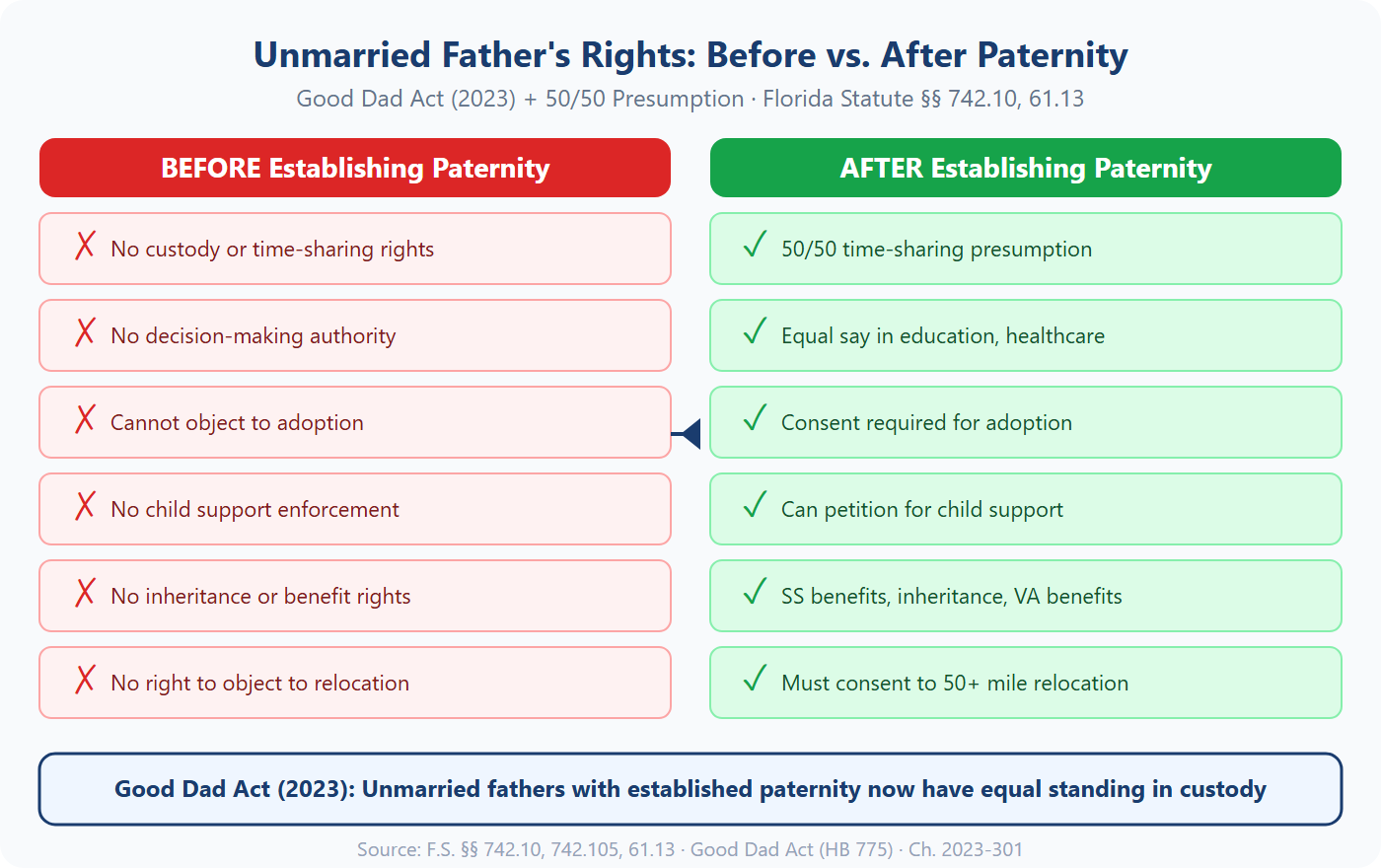
Critical point for unmarried fathers: Being listed on the birth certificate is not enough to enforce these rights. You must have paternity legally established through one of the methods above (a signed acknowledgment or court/administrative order) before any court can enforce your parenting rights.
Mothers’ Rights in Paternity Cases
Under Florida law, the mother of a child born outside of marriage is the child’s sole legal parent until paternity is established through a signed acknowledgment or court order.
This default legal status gives the mother full and exclusive decision-making authority over every aspect of the child’s life (including education, healthcare, religious upbringing, and where the child lives), but it also means she bears sole financial responsibility for raising the child.
Many mothers in Jacksonville contact my office specifically because they want to establish paternity in order to obtain a child support order and ensure that both parents share the financial burden of raising their child.
Establishing paternity also gives the child access to the father’s health insurance, Social Security survivor benefits, VA benefits, and inheritance rights. Florida law treats paternity establishment as beneficial for both parents and the child, and the process can be initiated by either the mother or the father.
Establishing paternity benefits mothers by:
- Securing child support: Florida uses the income shares model (F.S. § 61.30) to calculate both parents’ financial obligations based on their combined income
- Health insurance coverage: the court can order the father to provide health insurance for the child
- Shared financial responsibility: medical expenses, childcare costs, and educational expenses can be divided between both parents
- Enforcement tools: once a support order is in place, the Florida Department of Revenue can enforce it through wage garnishment, license suspension, and other mechanisms
Mothers can file a paternity petition in circuit court or request assistance from the Florida Department of Revenue’s Child Support Program, which will handle paternity establishment and child support enforcement at no cost.[3]
Paternity Disestablishment: Challenging Incorrect Paternity
Florida’s paternity disestablishment statute (F.S. § 742.18) provides a legal remedy for a man who discovers he is not the biological father of a child for whom he has been paying support or named as the legal father. This statute allows him to petition the circuit court to terminate his paternity status and prospectively end his child support obligation.[2]
Disestablishment cases are among the most emotionally complex matters I handle in my Jacksonville practice because they involve a man who has been acting as a father, often for years, only to learn through DNA evidence that the biological relationship does not exist.
The legal process is strict and requires meeting several specific statutory requirements simultaneously, including having DNA results obtained within 90 days of filing the petition. If any requirement is not met, the court will deny the petition regardless of the DNA evidence. This process requires:
- Newly discovered evidence: an affidavit stating that new evidence about paternity has come to light since the original determination
- DNA test results: scientific testing conducted within 90 days before filing that shows the petitioner cannot be the biological father
- Current on child support: the petitioner must be current on all support payments or show that any delinquency was due to inability to pay
- No prior adoption: the petitioner must not have adopted the child
- Child under 18: the petition must be filed while the child is still a minor
When disestablishment is blocked: Even with DNA proof, the court will deny the petition if the man, after learning he is not the biological father, married the mother, signed a voluntary acknowledgment, consented to being named on the birth certificate, or voluntarily promised to support the child in writing.
These actions show the man accepted parental responsibility with full knowledge.
If relief is granted, it is prospective only: the man’s previous child support payments are not refunded. The court will also order a new birth certificate removing the former father’s name.
Florida’s Putative Father Registry
Florida maintains a Putative Father Registry through the Department of Health, and it serves a single critical purpose: protecting the parental rights of men who believe they may have fathered a child with a woman they are not married to.[7]
Registering with this state-maintained database ensures the father receives legal notice if the mother seeks to place the child for adoption, which is the most important protection the registry provides.
Without registration, Florida law allows an adoption to proceed without the biological father’s knowledge or consent, permanently terminating his parental rights before he even knows the child exists. The registration process is simple and inexpensive, requiring only a Claim of Paternity form and a nine-dollar filing fee.
I strongly advise any unmarried man in Jacksonville who believes he may have fathered a child to register immediately, as the protection it provides against the permanent loss of parental rights is invaluable relative to the minimal cost and effort involved.
Key facts about the Putative Father Registry:
- Filing fee: $9 for the Claim of Paternity form
- Who should register: Any man who believes he may have fathered a child and wants to protect his parental rights
- Why it matters: If a man is not registered and the mother consents to an adoption, the adoption can proceed without the biological father’s knowledge or consent
- Timing: Registration should be filed as early as possible, ideally before the child is born or immediately after
The registry does not establish paternity by itself, but it ensures the registered man receives legal notice of any adoption proceedings involving the child. Without registration, an unmarried biological father risks losing all parental rights permanently.
Paternity and Child Support in Jacksonville
Establishing paternity directly triggers the legal ability to obtain a child support order, making it the essential first step for any mother seeking financial support from an unmarried father or any father seeking to formalize the financial obligations both parents share.
Florida calculates child support using the income shares model under F.S. § 61.30, which combines both parents’ net monthly incomes and applies a statutory schedule to determine the minimum support need based on the number of children.
The amount each parent pays is proportional to their share of the combined income, and the calculation also factors in the number of overnights each parent has with the child, with 73 overnights per year triggering a substantial time-sharing adjustment that can significantly reduce the paying parent’s obligation.
In Jacksonville paternity cases, I always address child support as part of the initial filing to ensure my clients’ financial rights are protected from the outset.
Key child support facts after paternity is established:
- Retroactive support: The court can order child support retroactive to the date the paternity petition was filed, or even to the child’s birth in some circumstances
- Income includes: Salary, bonuses, commissions, rental income, disability benefits, and most other income sources
- Imputed income: If a parent is voluntarily unemployed or underemployed, the court can impute income based on earning capacity
- Health insurance: The court can order either parent to provide health insurance for the child if available at a reasonable cost
- Enforcement: The Florida Department of Revenue can enforce support orders through wage garnishment, tax refund interception, license suspension, and contempt proceedings
For detailed information about how child support is calculated, see our Jacksonville Child Support page.
Paternity and Child Custody / Time-Sharing
Once paternity is established, either parent can petition the Duval County Circuit Court for a parenting plan that outlines time-sharing and custody arrangements, including the overnight schedule, holiday rotation, decision-making authority, and communication protocols.
Under the 2023 reforms including both the Good Dad Act and the 50/50 time-sharing presumption, the court now begins with a rebuttable presumption of equal (50/50) time-sharing for all parents, including unmarried fathers who have established paternity.[6]
This means the court starts from the position that equal time with both parents is in the child’s best interest, and a parent who seeks a different arrangement must present evidence explaining why equal time would be detrimental.
In my Jacksonville practice, I advise every father who establishes paternity to immediately file for a formal parenting plan, because without one, neither parent has enforceable time-sharing rights, leaving the parent who physically has the child in a position to control access unilaterally.
The court considers 20 factors under F.S. § 61.13(3) when determining the best interests of the child, including:
- Each parent’s willingness to encourage a close relationship between the child and the other parent
- The moral fitness of each parent
- The mental and physical health of each parent
- The child’s home, school, and community record
- Each parent’s ability to provide a consistent routine and stable environment
- Evidence of domestic violence or substance abuse
For unmarried fathers: The Good Dad Act ensures that once paternity is confirmed, you start on equal footing with the mother. But establishing paternity alone does not create a parenting plan. You must either agree on a plan with the other parent or petition the court to create one.
How Long Does a Paternity Case Take?
The timeline for establishing paternity in Jacksonville depends on the method used, whether the case is contested, and the complexity of any related issues such as custody, time-sharing, or child support that are addressed alongside the paternity determination.
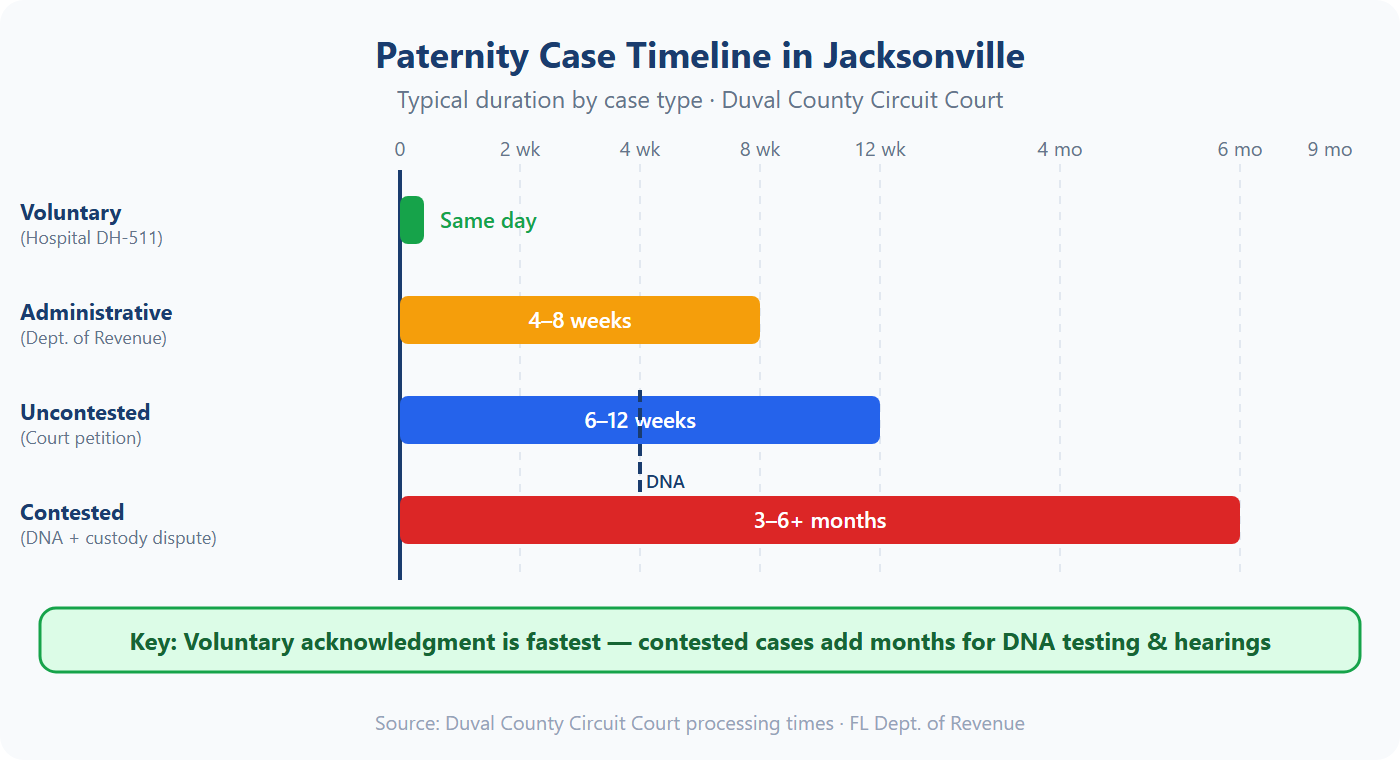
A voluntary acknowledgment signed at the hospital takes effect immediately on the day of signing, while a contested court petition involving disputed parentage, DNA testing, and custody disputes can take three to six months or longer to resolve.
The Florida Department of Revenue offers an administrative path that typically takes four to eight weeks and includes free genetic testing.
In my experience handling paternity cases across Duval County and northeast Florida for over 25 years, the single biggest factor affecting timeline is whether both parents cooperate or whether the case requires litigation. Here is a detailed breakdown of typical timelines by method:
| Method | Timeline | Notes |
|---|---|---|
| Voluntary at hospital (DH-511) | Same day | Immediate legal effect upon signing |
| Voluntary after birth (DH-432) | 1 – 2 weeks | Time for form processing and birth certificate update |
| Administrative order (DOR) | 4 – 8 weeks | Genetic testing + processing; no court appearance required |
| Uncontested court petition | 6 – 12 weeks | Filing + service + hearing; DNA test adds 3-4 weeks |
| Contested court petition | 3 – 6 months | Discovery, DNA testing, potential trial |
| Disestablishment petition | 3 – 9 months | DNA test required within 90 days before filing; court review |
Factors that extend the timeline: Difficulty locating the other parent for service of process, contested DNA results requiring retesting, disputes over custody or support connected to the paternity petition, and court scheduling backlogs in Duval County Circuit Court.
7 Common Mistakes in Jacksonville Paternity Cases
- Assuming the birth certificate is enough. Being listed on the birth certificate does not give an unmarried father enforceable custody or time-sharing rights under Florida law. The birth certificate is a vital records document, not a legal determination of paternity. You need a signed voluntary acknowledgment of paternity (DH-511 or DH-432) or a court or administrative order to establish legal paternity and gain the right to petition for custody, time-sharing, and decision-making authority. Without one of these legal instruments, a mother can restrict the father’s access to the child, make unilateral decisions about the child’s upbringing, and even consent to an adoption without the father’s knowledge or consent. This is the single most common misconception I encounter in my Jacksonville paternity practice, and it catches many well-intentioned fathers off guard when they realize their name on the birth certificate carries no legal weight in a custody dispute.
- Waiting too long to establish paternity. The longer you wait, the harder it becomes: witnesses move, relationships deteriorate, and courts may question why you delayed. For fathers concerned about adoption, failing to register with the Putative Father Registry can result in permanent loss of rights.
- Signing the DH-511 without understanding the consequences. The hospital acknowledgment creates binding legal paternity after 60 days. If you have any doubt about biological paternity, do not sign until DNA testing is completed.
- Using a home DNA test and expecting it to hold up in court. Home paternity tests are not admissible in Florida courts because they lack chain-of-custody documentation. If you need results for legal purposes, get a court-admissible test from an AABB-accredited facility.
- Not filing for a parenting plan after establishing paternity. Paternity alone does not create a custody arrangement. Without a court-ordered parenting plan, neither parent has enforceable time-sharing rights, which means the parent who has the child can effectively control access.
- Ignoring the disestablishment timeline. If you discover you are not the biological father, you must file a petition while the child is under 18 and you must have DNA results from within 90 days of filing. Missing these deadlines can mean you remain the legal father permanently.
- Trying to handle a contested case without an attorney. Paternity cases that involve disputed parentage, custody disputes, or disestablishment require navigating complex evidentiary rules and statutory requirements. A single procedural error can delay your case by months or result in an unfavorable ruling.
Why Choose Adam Sacks for Your Paternity Case?
I have handled paternity cases in Jacksonville for over 25 years: from straightforward voluntary acknowledgments that are resolved in a single meeting to highly contested disputes involving court-ordered DNA testing, custody battles over time-sharing arrangements, and complex disestablishment petitions where a man discovers he is not the biological father of the child he has been supporting.
Every case is different in its facts and circumstances, but they all have one thing in common: someone’s fundamental relationship with their child is on the line, and the legal outcome will shape that relationship for decades to come.
As a former Assistant State Attorney who tried criminal cases for the State of Florida, I bring courtroom skills and litigation confidence that most family law attorneys simply do not have.
As a Florida Supreme Court Certified Family Mediator with a psychology degree from UMass, I also understand when negotiation serves my clients better than a trial. That combination of skills is what sets my paternity practice apart.
What I bring to your paternity case:
- Courtroom experience that matters. I started my career as a prosecutor for the State of Florida. That background gave me the trial skills and courtroom confidence that most family law attorneys simply don’t have. When the other side knows your attorney will take the case to trial, negotiations tend to go better.
- Certified mediator and litigator. As a Florida Supreme Court Certified Family Mediator, I know how to resolve cases at the negotiation table when that’s in your best interest. But I’m always prepared to fight in court if that’s what it takes.
- Psychology background. My degree in psychology from UMass gives me insight into the emotional dynamics of paternity cases, especially when children are caught in the middle of parental conflict.
- Personal attention. When you call my office, you work with me, not a paralegal, not a junior associate. I treat my clients like people, not case numbers.
Adam Sacks earned his J.D. from Western Michigan University Cooley Law School, where he received a Book Award for top academic performance. He served as an Assistant State Attorney in Seminole County before transitioning to private family law practice.
He holds a degree in psychology from the University of Massachusetts and has been a member of the Florida Bar (#248370) since 2000.
What Happens When You Call Our Office?
When you call (904) 396-5557, you will speak directly with me about your paternity situation during a free, no-obligation consultation.
I personally handle every initial paternity consultation because these cases involve fundamental questions about a parent’s legal relationship with their child, and you deserve experienced guidance from the start, not a screening call with a receptionist or a paralegal intake form.
Whether you are a father seeking to establish paternity and obtain custody rights under the Good Dad Act, a mother pursuing child support from an uninvolved father, or someone who needs to challenge or disestablish incorrect paternity, I will give you a candid assessment of your legal options based on 25 years of family law experience in Jacksonville.
Here is exactly what happens:
- You talk to me. I personally handle the initial consultation, not a secretary, not an intake coordinator. You tell me your situation, and I listen.
- I assess your case. I’ll explain which paternity method applies to your situation, what the process looks like, and what outcomes are realistic. No sugarcoating, no runaround.
- We discuss your rights. Whether you’re a father seeking custody, a mother pursuing child support, or someone challenging incorrect paternity, I’ll explain exactly where you stand under Florida law.
- You decide next steps. There’s no pressure and no obligation. If you want to move forward, I’ll outline the strategy and costs. If you need time to think about it, that’s fine too.
Ready to discuss your paternity case? Call me at (904) 396-5557 for a free consultation. I’ll tell you exactly what I think about your case: honest advice from someone who’s been doing this for 25 years.
Client Reviews
Don’t just take my word for it. Hear from people who’ve been in your situation:
“Adam was absolutely amazing! I’m a young father and he fought for my rights like I was family. He explained everything in plain English and made sure I understood every step. I now have 50/50 time-sharing with my daughter thanks to him.”
Hackie G., Google Review
“Best lawyer I’ve ever used! Adam truly fights for my child and me. He set realistic expectations and then exceeded them. Highly recommend to any father going through custody issues.”
Robert, Google Review
“My experience with Adam was awesome. He knocked it outta the park and made a most unpleasant situation manageable. He gave us compassionate guidance through the whole process.”
Linda J., Google Review

Frequently Asked Questions About Paternity in Jacksonville
Does being on the birth certificate make you the legal father in Florida?
Not necessarily. For married couples, being on the birth certificate confirms the marital presumption of paternity. But for unmarried parents, being listed on the birth certificate alone does not create legally enforceable parental rights.
You need a signed Paternity Acknowledgment (DH-511 or DH-432) or a court/administrative order establishing paternity before you can petition for custody, time-sharing, or enforce any parental rights under Florida law.
Can a mother refuse a paternity test in Florida?
A mother cannot unilaterally refuse a court-ordered paternity test. If either parent or the Department of Revenue files a paternity petition, the court can order all parties (mother, alleged father, and child) to submit to DNA testing.
If the mother willfully fails to present the child for testing, the court can issue a default ruling against her, potentially establishing paternity based on the available evidence.
How much does it cost to establish paternity in Jacksonville?
The cost varies by method. Signing the voluntary acknowledgment at the hospital (DH-511) is free. Filing a paternity petition in Duval County Circuit Court costs approximately $300 in filing fees plus attorney fees.
If the Department of Revenue handles the case through their Child Support Program, there is no cost for genetic testing or the administrative order. In my experience, most straightforward paternity cases, where both parents cooperate, can be resolved for significantly less than a contested case that requires litigation.
What rights does an unmarried father have before establishing paternity?
Under Florida law, an unmarried father has essentially no enforceable rights regarding his child until paternity is legally established. The mother is the sole legal parent and has full decision-making authority.
She can move with the child, make all medical and educational decisions, and even consent to adoption without the father’s knowledge, unless the father has registered with the Florida Putative Father Registry. This is why I always tell fathers: don’t wait. Establish paternity as soon as possible.
Can I get custody if I’m not married to the mother?
Yes, but only after paternity is established. Once paternity is confirmed, the Good Dad Act (effective July 1, 2023) ensures that unmarried fathers have the same rights to seek 50/50 time-sharing as married or divorced fathers.
The court applies the same 20 best-interest factors under F.S. § 61.13(3) regardless of whether the parents were ever married. You will need to file a petition for a parenting plan to formalize your custody arrangement.
How do I challenge paternity if I’m not the biological father?
Florida’s disestablishment statute (F.S. § 742.18) provides a specific legal process. You must file a petition in circuit court with newly discovered evidence of non-paternity, DNA test results from within 90 days showing you cannot be the father, and proof that you are current on child support.
The petition must be filed while the child is under 18. Important: disestablishment can be blocked if you voluntarily acknowledged paternity, married the mother, or consented to being on the birth certificate after learning you were not the biological father.
What is the Putative Father Registry and do I need to register?
The Putative Father Registry is maintained by the Florida Department of Health and serves as a notification system for adoption proceedings. If you believe you may have fathered a child and the mother is not married to you, registering for $9 ensures you will receive legal notice if the mother attempts to place the child for adoption.
Without registration, an adoption can proceed without your knowledge or consent. I strongly recommend that any man in this situation register immediately. The cost is minimal and the protection is essential.
Sources:
[1] Centers for Disease Control and Prevention, Stats of the States: Births to Unmarried Mothers (2023 data). cdc.gov
[2] Florida Legislature, Chapter 742: Determination of Parentage (2025 Florida Statutes). leg.state.fl.us
[3] Florida Department of Revenue, Child Support Program: Establish Paternity. floridarevenue.com
[4] PaternityUSA. (2026, March 13). Accurate DNA paternity testing from AABB accredited lab. PaternityUSA. paternityusa.com
[5] Florida Legislature, HB 775: Good Dad Act (effective July 1, 2023). flsenate.gov
[6] Florida Legislature, Ch. 2023-301: 50/50 Time-Sharing Presumption (F.S. § 61.13). flsenate.gov
[7] Florida Department of Health, Putative Father Registry. floridahealth.gov