
Ready for an uncontested divorce? Call (904) 396-5557 — Adam Sacks handles uncontested divorces in Jacksonville with flat-fee pricing.
What Is an Uncontested Divorce in Florida?
An uncontested divorce means both spouses agree on every issue — property division, debt allocation, child custody, child support, and alimony — and submit a written marital settlement agreement to the court for approval, eliminating the need for discovery, depositions, contested motions, or a trial. The judge reviews your agreement at a brief final hearing lasting approximately 15 to 30 minutes, confirms that both parties entered it voluntarily and with full knowledge of their rights, and signs the final judgment of dissolution of marriage. [1] In Jacksonville, an uncontested divorce typically costs $1,500 to $5,000 total — a fraction of the $15,000 to $50,000 or more that a contested case requires — and can be finalized in as little as 4 weeks through simplified dissolution or 2 to 4 months through a regular uncontested process filed in Duval County’s Fourth Judicial Circuit. Attorney Adam Sacks offers flat-fee pricing and same-day document preparation for uncontested divorces.
In Florida, the legal term is “dissolution of marriage.” Florida is a no-fault state — the only ground for divorce is that the marriage is “irretrievably broken” (F.S. § 61.052). [1] Neither spouse needs to prove fault, adultery, or wrongdoing. If both of you agree the marriage is over and can settle the terms, you qualify for an uncontested divorce.
An uncontested divorce is the fastest, cheapest, and least stressful way to end a marriage in Florida. But “uncontested” does not mean “simple.” Even when both parties agree, the marital settlement agreement must comply with Florida law — and if it doesn’t, the judge will reject it. That’s why having an experienced attorney draft or review the agreement is critical.
Uncontested vs. Contested Divorce — Cost, Time, and Stress
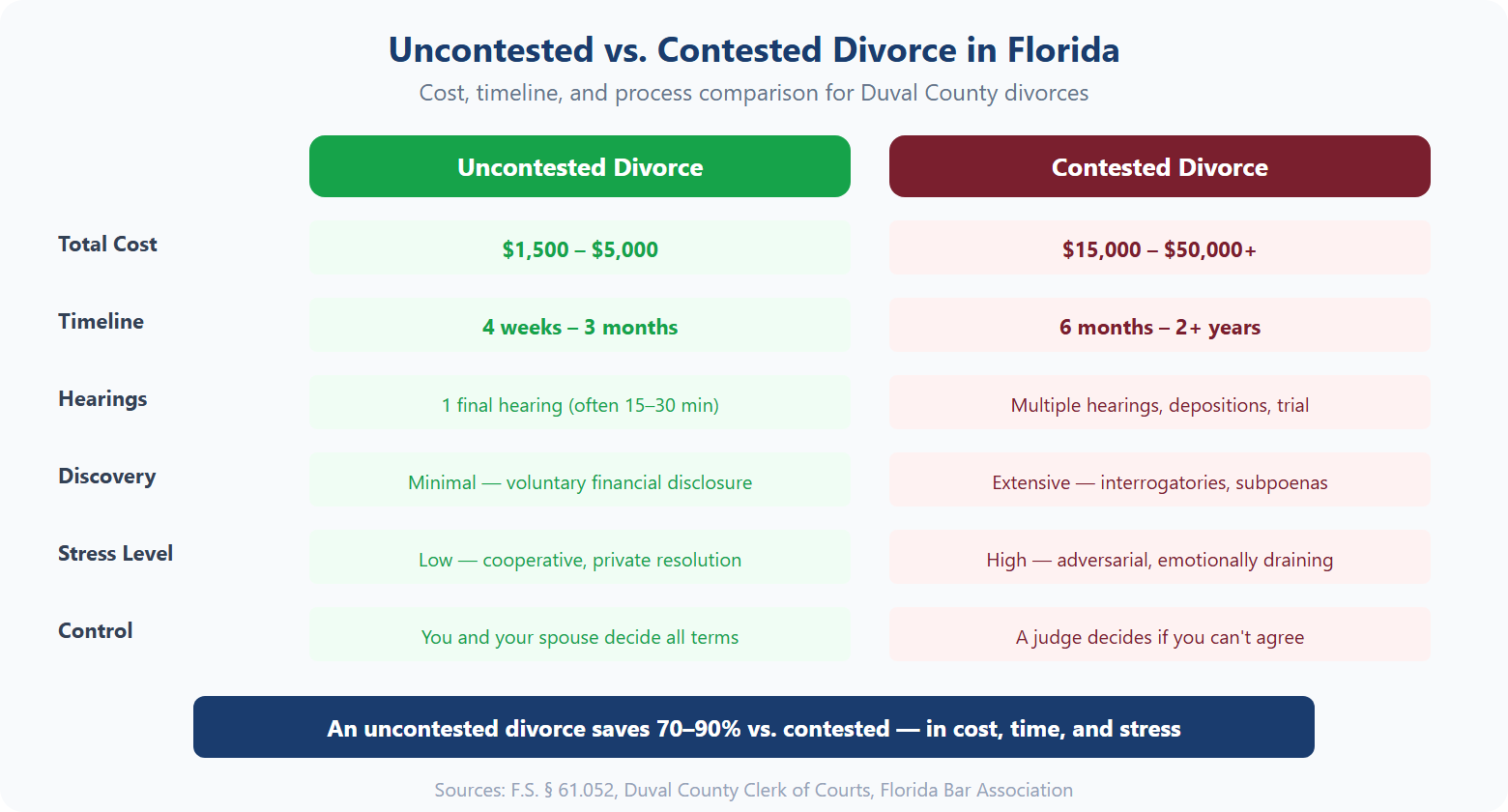
The difference between an uncontested and contested divorce is substantial across every measurable dimension — cost, timeline, number of court appearances, emotional toll on the family, and the degree of control you retain over the final outcome. Choosing an uncontested path when both spouses are able to reach agreement can save tens of thousands of dollars in attorney fees, months or even years of litigation, and the stress of having a Duval County judge make binding decisions about your property, children, and financial future. Understanding these differences is essential for making an informed decision about how to proceed with your dissolution of marriage in Florida. [1] Here is a detailed comparison across the key factors that matter most to Jacksonville families navigating the divorce process:
- Cost: An uncontested divorce in Jacksonville typically costs $1,500–$5,000 total (attorney fees + filing fee). A contested divorce costs $15,000–$50,000+ when custody, alimony, and property are disputed. [1]
- Timeline: Uncontested divorces can be finalized in 4 weeks (simplified) to 3 months (regular). Contested divorces take 6 months to 2+ years.
- Hearings: Uncontested requires one final hearing lasting 15–30 minutes. Contested involves multiple hearings, depositions, mediation, and potentially a multi-day trial.
- Control: In an uncontested divorce, you and your spouse decide all terms. In a contested divorce, a judge decides for you — and neither side may be happy with the result.
Simplified vs. Regular Uncontested Divorce
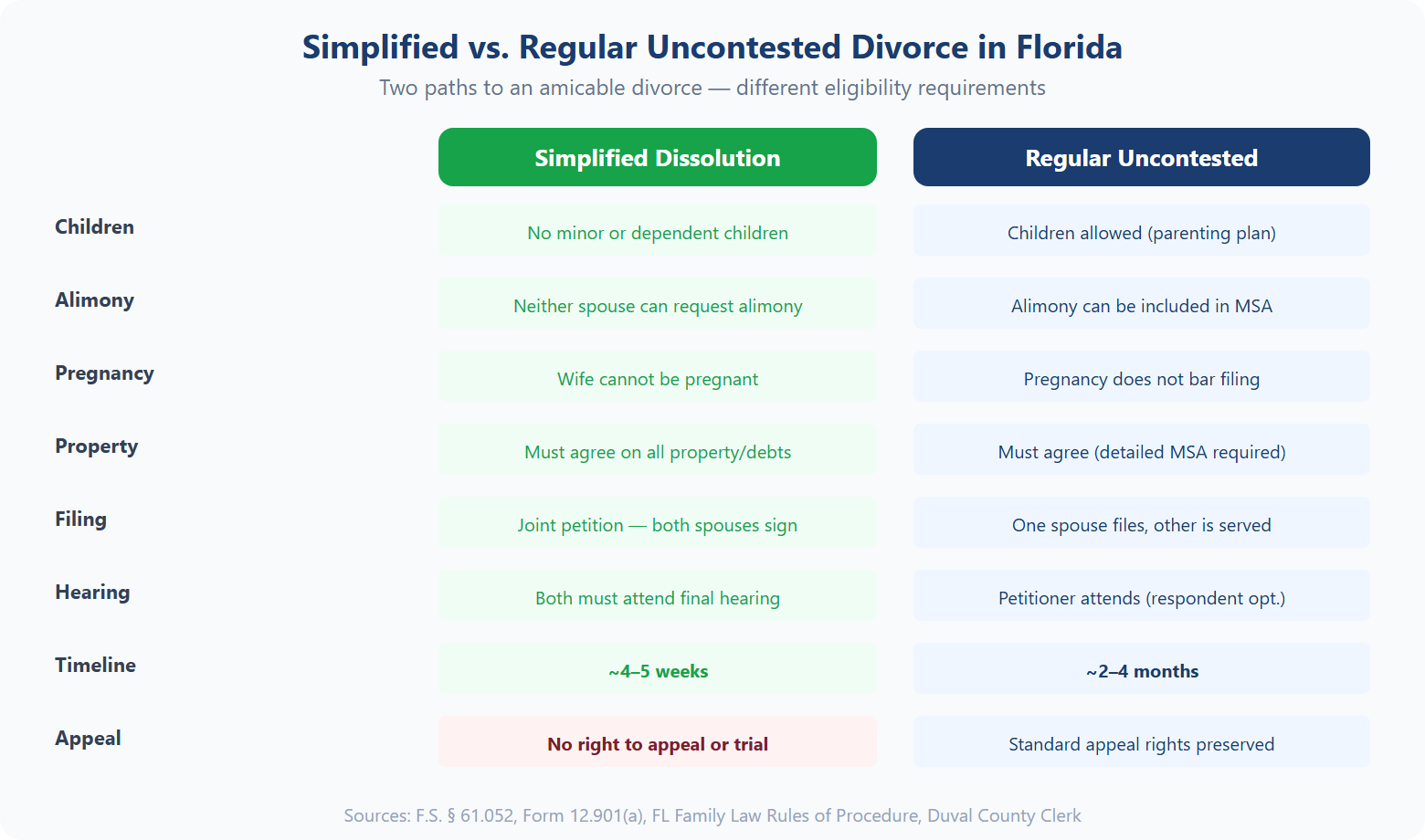
Florida offers two distinct legal paths for ending a marriage through an uncontested divorce, and choosing the right one depends on whether you have minor children, whether either spouse is seeking alimony, and how much control you want to retain over your appeal rights after the final judgment is entered. The simplified dissolution of marriage under F.S. § 61.043 is the fastest option, typically finalized in 4 to 5 weeks, but it carries significant restrictions and permanently waives your right to appeal. [4] The regular uncontested dissolution takes longer — generally 2 to 4 months in Duval County — but accommodates families with children, allows alimony provisions, and preserves full appeal rights. Understanding the eligibility requirements and tradeoffs of each path is critical before you file, because choosing the wrong form can delay your case or, worse, lock you into an agreement you cannot later challenge. Here is a detailed breakdown of both options:
Simplified Dissolution of Marriage
The simplified dissolution (Form 12.901(a)) is the fastest option — typically 4–5 weeks from filing to final judgment. [4] Both spouses file a joint petition, and both must attend the final hearing. However, it has strict eligibility requirements:
- No minor or dependent children, and the wife is not pregnant
- Neither spouse is seeking alimony
- Both spouses agree on division of all assets and debts
- Both spouses agree the marriage is irretrievably broken
- Both spouses will attend the final hearing
- Both spouses waive the right to a trial and appeal
Important: By filing a simplified dissolution, you give up your right to a trial and your right to appeal. If you later discover that your spouse hid assets or was dishonest about debts, you have very limited recourse. This is why I recommend attorney review even for simplified dissolutions.
Regular Uncontested Dissolution
If you have children, one spouse wants alimony, or you have complex property to divide, you need a regular dissolution — but it can still be uncontested if both parties agree on all terms. One spouse files the petition, the other is served (or signs a waiver of service), and both sign a comprehensive marital settlement agreement (MSA). [5]
The regular uncontested process takes 2–4 months, is more thorough than a simplified dissolution, and preserves your appeal rights. If children are involved, you must also file a parenting plan that addresses:
- Time-sharing schedule (the 50/50 presumption under Ch. 2023-301 applies as a starting point) [6]
- Parental responsibility allocation (shared or sole)
- Child support calculated under F.S. § 61.30 income shares model [7]
- Holiday and school break schedules
- Communication protocols between parents
- Decision-making authority for education, healthcare, and extracurriculars
How to Get an Uncontested Divorce in Duval County
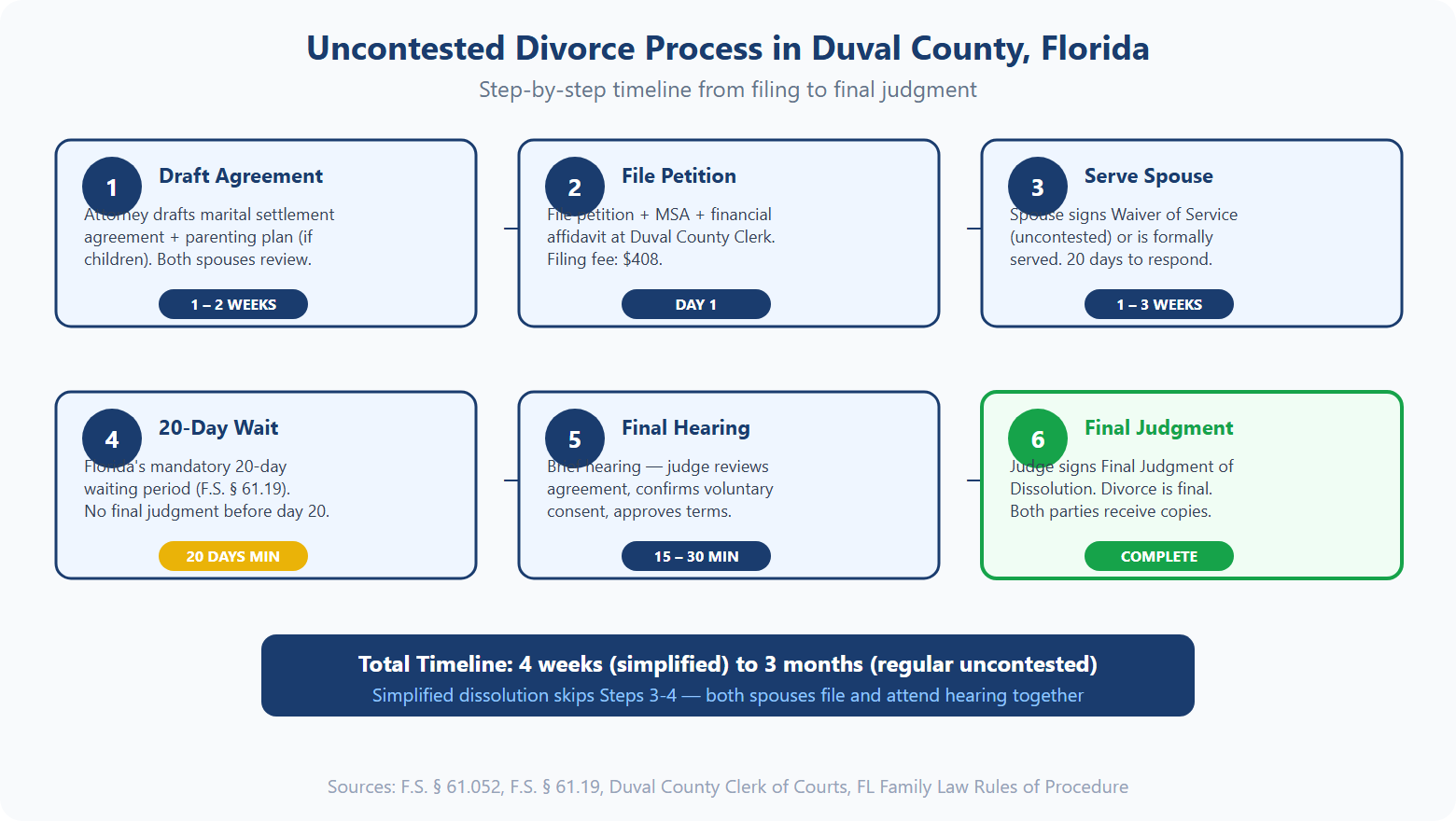
Filing an uncontested divorce in Jacksonville involves a straightforward six-step process through the Duval County Clerk of Courts and the Fourth Judicial Circuit, beginning with drafting the marital settlement agreement and concluding with a brief final hearing before a judge. While the process is simpler and faster than a contested divorce, each step has specific legal requirements under Florida Family Law Rules of Procedure that must be followed precisely — incomplete forms, missing financial affidavits, or improperly notarized agreements are among the most common reasons uncontested filings are rejected or delayed. [5] At Sacks & Sacks, attorney Adam Sacks prepares every document, ensures compliance with all filing requirements, and represents you at the final hearing. Here is the step-by-step process for filing an uncontested divorce in Jacksonville:
Step 1: Draft the Marital Settlement Agreement
Your attorney drafts the MSA — a legally binding contract that covers property division, debt allocation, alimony (if applicable), and child-related provisions (if applicable). For divorces with children, the parenting plan and child support worksheet are attached as exhibits to the MSA. Both spouses must review, negotiate if needed, and sign the agreement before a notary. [5]
Step 2: Prepare the Financial Affidavit
Both spouses complete a financial affidavit (Form 12.902(b) for income under $50,000/year or Form 12.902(c) for income of $50,000+). This discloses all income, expenses, assets, and liabilities — the court requires it to verify that the settlement is fair. [5]
Step 3: File the Petition at Duval County Clerk
File the petition for dissolution (Form 12.901(b)(1), (b)(2), or (b)(3) depending on your situation), the MSA, financial affidavits, and any required cover sheets at the Duval County Clerk of Courts, 501 W. Adams St., Jacksonville. Filing fee: $408. [2]
Step 4: Serve or Waive Service
In an uncontested divorce, the respondent (non-filing spouse) typically signs a Waiver of Service, acknowledging they received the petition and waiving formal service. This saves time and the cost of a process server. [1]
Step 5: 20-Day Mandatory Waiting Period
Florida law (F.S. § 61.19) imposes a 20-day waiting period from the date of filing before the court can enter a final judgment. [3] The court can waive this only if an earlier judgment is necessary to avoid injustice.
Step 6: Attend the Final Hearing
After the waiting period, you attend a brief final hearing (typically 15–30 minutes). The judge asks a few questions to confirm: the marriage is irretrievably broken, both parties understand the agreement, the agreement was entered voluntarily, and the terms are fair (especially regarding children). The judge then signs the Final Judgment of Dissolution of Marriage. Your divorce is final. [1]
How Much Does an Uncontested Divorce Cost in Jacksonville?
The total cost of an uncontested divorce in Jacksonville typically ranges from $1,500 to $5,000, making it one of the most affordable ways to legally end a marriage in Florida. This figure includes the Duval County court filing fee, attorney fees for drafting the marital settlement agreement and all required documents, process server costs if formal service is needed, and the mandatory parenting course fee for cases involving minor children. [2] By comparison, a contested divorce in Jacksonville costs $15,000 to $50,000 or more when custody, alimony, and property division are disputed and the case proceeds through discovery, mediation, and potentially a multi-day trial. [1] At Sacks & Sacks, we offer flat-fee pricing for uncontested divorces so you know the exact cost before we begin — with no hourly billing surprises. Here is the detailed cost breakdown:
- Court filing fee: $408 (Duval County Clerk of Courts) [2]
- Attorney fees: $1,000–$4,500 depending on complexity (flat-fee pricing available)
- Process server: $0 (waived in most uncontested cases) to $50 if formal service is needed
- Parenting course: $20–$50 if minor children are involved (required by F.S. § 61.21) [8]
Total: $1,500–$5,000 for most uncontested divorces in Jacksonville — a fraction of the $15,000–$50,000+ that contested divorces cost.
Fee waivers are available for those who qualify as indigent — the Duval County Clerk’s office can provide an Application to Determine Civil Indigent Status. [2]
Florida Requirements for an Uncontested Divorce
To file an uncontested divorce in Florida, both spouses must meet a specific set of eligibility requirements established under Chapter 61 of the Florida Statutes and the Florida Family Law Rules of Procedure. [1] These requirements apply regardless of whether you choose the simplified dissolution path or the regular uncontested dissolution process, and failure to satisfy any one of them can result in your petition being dismissed or your case being reclassified as contested. The requirements cover residency, grounds for dissolution, the completeness of your written agreement, financial disclosure obligations, and — if minor children are involved — a parenting plan that complies with Florida’s 50/50 time-sharing presumption under Ch. 2023-301. [6] An experienced Jacksonville divorce attorney can ensure you meet every requirement before filing. Here is what you need to qualify:
- Residency: At least one spouse must have been a Florida resident for at least 6 months before filing (F.S. § 61.021). Residency can be proven by a Florida driver’s license, voter registration, or an affidavit from a corroborating witness.
- No-fault grounds: The marriage must be “irretrievably broken” — both spouses agree that the marriage cannot be saved (F.S. § 61.052). [1]
- Complete agreement: Both spouses must agree on every issue — property division, debt allocation, alimony, child custody, child support, and parenting time. Any single unresolved issue makes the divorce contested.
- Written settlement agreement: The agreement must be in writing, signed by both parties, and notarized (Form 12.902(f)(1) with children or 12.902(f)(2) without). [5]
- Financial disclosure: Both spouses must complete and exchange financial affidavits, even in an uncontested divorce. The court needs to verify that the settlement is equitable.
- Parenting plan (if children): If minor children are involved, you must file a parenting plan that addresses time-sharing, parental responsibility, child support, and other child-related provisions. The plan must comply with the 50/50 presumption under Ch. 2023-301. [6]
- Parenting course (if children): Both parents must complete a court-approved parenting course before the final hearing (F.S. § 61.21). [8]
What the Marital Settlement Agreement Must Cover
The marital settlement agreement (MSA) is the legally binding backbone of every uncontested divorce in Florida, and its completeness and precision determine whether the judge will approve your dissolution at the final hearing or send you back to address deficiencies. [5] Under Florida law, the MSA must address every aspect of the marital estate — real property, personal property, financial accounts, retirement assets, debts, alimony, health insurance, tax filing, and name changes — in sufficient detail that neither party can later claim ambiguity or misunderstanding. For divorces involving minor children, the MSA also incorporates a comprehensive parenting plan addressing time-sharing, parental responsibility, child support, and related provisions. In my experience drafting hundreds of settlement agreements for Jacksonville families, the most common reason judges reject an MSA is insufficient specificity — particularly around retirement account division and debt indemnification. The agreement must cover all of the following:
- Real property: Who keeps the marital home, who is responsible for the mortgage, and how equity is divided
- Personal property: Vehicles, furniture, jewelry, electronics, and other tangible assets
- Financial accounts: Bank accounts, investment accounts, stock options, and cryptocurrency
- Retirement accounts: 401(k)s, pensions, IRAs — may require a Qualified Domestic Relations Order (QDRO) for division
- Debts and liabilities: Credit card debt, student loans, car loans, medical bills — who is responsible for each
- Alimony: Type (bridge-the-gap, rehabilitative, or durational under the 2023 reform), amount, and duration — or an explicit waiver of alimony [6]
- Health and life insurance: Who maintains coverage, who pays premiums, beneficiary designations
- Tax filing: How taxes are filed for the year of divorce, who claims dependents
- Name change: Whether either spouse will restore a former name
If children are involved, the MSA also incorporates the parenting plan as an exhibit, covering custody, time-sharing, child support, medical expenses, extracurricular costs, and college savings.
When an Uncontested Divorce Becomes Contested
Many divorces that begin as uncontested become contested when unexpected disagreements emerge during the drafting, disclosure, or filing process — and understanding the most common triggers can help you avoid this costly transition. Once even a single issue becomes disputed, your case shifts from the streamlined uncontested track to the full contested process, which involves discovery, mandatory mediation, and potentially a trial before a Duval County judge. This transition can increase your costs from $1,500–$5,000 to $15,000–$50,000 or more and extend your timeline from weeks to months or years. [1] In my 25+ years of family law practice in Jacksonville, I have seen divorces go from fully agreed to bitterly contested over issues that could have been resolved with proper legal guidance from the start. The most common triggers that convert an uncontested divorce into a contested one include:
- Hidden assets or debts: One spouse discovers the other has undisclosed bank accounts, real estate, or debt
- Custody disagreements: Parents initially agree but then can’t settle on a time-sharing schedule that works for both
- Alimony disputes: One spouse expects alimony that the other refuses to pay — or the amount and duration can’t be agreed upon
- Property valuation: The marital home, a business, or a retirement account is worth more (or less) than one spouse believed
- New relationship: One spouse begins dating, which triggers jealousy or changes the emotional dynamic
- Pressure or coercion: One spouse agreed to unfair terms under emotional pressure and later wants to renegotiate
This is why I always recommend having an attorney involved from the start — even in an “easy” uncontested divorce. An attorney protects you from agreeing to terms you don’t fully understand, ensures the MSA is legally sound, and can help resolve disagreements before they escalate into a contested case.
The 50/50 Presumption in Uncontested Divorce
Since July 1, 2023, Florida law establishes a rebuttable presumption that equal 50/50 time-sharing is in the child’s best interest under Ch. 2023-301, codified at F.S. § 61.13(2)(c). [6] This presumption applies to uncontested divorces just as it does to contested ones, meaning your parenting plan must start from a 50/50 framework when submitted to the Duval County court for approval. If both parents agree to a different arrangement — such as a primary-residence schedule with liberal visitation for the other parent — the judge may ask questions at the final hearing to confirm the deviation serves the child’s best interest and was not the result of coercion, intimidation, or one parent’s undue influence over the other. Understanding how this presumption shapes your parenting plan is essential for drafting an agreement that will pass judicial review without delay or additional hearings.
In an uncontested divorce, you have the flexibility to craft a time-sharing schedule that works for your family — alternating weeks, 2-2-3 rotations, 3-4-4-3 patterns, or any arrangement both parents agree to. But if the plan deviates significantly from 50/50, the judge may ask questions at the final hearing to ensure the arrangement is truly in the child’s best interest and was not the result of coercion.
Common time-sharing schedules in Jacksonville uncontested divorces:
- Alternating weeks: One week with each parent (true 50/50)
- 2-2-3 rotation: Two days with Parent A, two days with Parent B, three-day weekend alternating
- 5-2-2-5 schedule: Five days with one parent, two days with the other, then switch
- Primary residence with liberal visitation: One parent has school-week time, the other has weekends and extended summer
Common Mistakes in Uncontested Divorce
Even though an uncontested divorce is the simplest path to dissolution in Florida, it carries legal risks that many Jacksonville residents underestimate — particularly when filing without an attorney or relying on online form-preparation services. After handling hundreds of uncontested divorces in the Fourth Judicial Circuit over the past 25+ years, I consistently see the same preventable mistakes that cost people time, money, and legal rights they cannot recover. These errors range from incomplete financial disclosure that can void the agreement years later, to choosing simplified dissolution when a regular uncontested filing would have been more appropriate, to overlooking the 2023 alimony reform’s impact on spousal support provisions. [6] The following seven mistakes are the ones I encounter most frequently, and every one of them can be avoided with proper legal guidance from an experienced divorce attorney.
- Filing without an attorney to save money: The $1,000–$2,500 you spend on attorney fees is a fraction of what you could lose by signing an unfair agreement. Attorneys catch issues — hidden debts, retirement account division, tax consequences — that DIY filers miss.
- Not completing financial disclosure: Even in an uncontested divorce, Florida requires financial affidavits from both spouses. Failing to disclose assets can void the agreement later — and may constitute fraud on the court.
- Overlooking retirement accounts: 401(k)s, pensions, and IRAs accumulated during the marriage are marital assets. Dividing them requires a QDRO (Qualified Domestic Relations Order), which must be drafted correctly or the plan administrator will reject it.
- Agreeing to terms under pressure: If your spouse is pressuring you to agree quickly, that’s a red flag. You have the right to take time, consult an attorney, and negotiate. An agreement signed under duress can be challenged later. [1]
- Ignoring the 2023 alimony reform: The 2023 law (Ch. 2023-301) eliminated permanent alimony and changed the rules for all types of spousal support. Make sure your MSA reflects the current law — not pre-2023 expectations. [6]
- Not addressing all debts: Couples focus on dividing assets but forget about debts. Creditors don’t care what your divorce agreement says — if both names are on a credit card, both are liable. Your MSA should include indemnification provisions.
- Choosing simplified dissolution when you shouldn’t: Simplified dissolution waives your right to trial and appeal. If there is any complexity in your finances or if you have any doubt about your spouse’s honesty, file a regular uncontested dissolution instead.
Why Choose Adam Sacks for Your Uncontested Divorce
I’ve handled hundreds of uncontested divorces in the Fourth Judicial Circuit over the past 25+ years — and I can tell you that “uncontested” doesn’t mean “risk-free.” Even when both parties agree, there are pitfalls: unfair property splits that you don’t recognize until later, child support calculations that don’t account for all income sources, alimony provisions that don’t reflect the 2023 reform, and retirement account divisions that require precise legal drafting.
My background as a former prosecutor for the State of Florida gives me the analytical precision to catch these issues before they become problems. I review every MSA line by line, test every provision against Florida law, and make sure your agreement protects you today and in the future. And as a Florida Supreme Court Certified Family Mediator, I know how to help couples resolve the small disagreements that can turn an uncontested divorce into a contested one.
I offer flat-fee pricing for uncontested divorces — you know the total cost upfront, with no hourly billing surprises. My goal is to get you through the process quickly, fairly, and with the confidence that your agreement is legally sound.
Adam Sacks earned his J.D. from Western Michigan University Cooley Law School, where he received a Book Award for the highest grade in his class. He served as an Assistant State Attorney in Seminole County before transitioning to private practice. He holds a bachelor’s degree in Psychology from the University of Massachusetts. He is a Florida Supreme Court Certified Family Mediator and a member of the Florida Bar (Bar #248370) since 2000.
What Happens When You Call Our Office
When you call (904) 396-5557, you will speak directly with attorney Adam Sacks about your uncontested divorce — not a paralegal, not an intake coordinator, and not a voicemail system. I personally handle every uncontested divorce consultation because the initial conversation is where I evaluate whether your case truly qualifies as uncontested, identify any potential issues that could delay or complicate your filing, and provide a clear flat-fee quote so you know the exact cost before committing. Most uncontested divorces I handle in Jacksonville are finalized within 4 to 12 weeks of the initial call, and my same-day document preparation ensures your paperwork is ready to file at your first office visit. There is no charge for the initial consultation, and there is no obligation to retain our firm afterward. Here is what the process looks like:
- You speak with me directly. I handle uncontested divorce consultations personally — not a paralegal or intake coordinator.
- Case evaluation. I’ll assess whether your divorce qualifies as uncontested, whether simplified dissolution is an option, and whether there are any issues that need to be resolved before filing.
- Clear pricing. I’ll quote you a flat fee for your uncontested divorce — covering the MSA, parenting plan (if needed), financial affidavits, filing, and representation at the final hearing. No hourly billing, no surprises.
- Fast drafting. I draft the settlement agreement and all required documents, working with both spouses (or their attorneys) to finalize terms.
- Filing and hearing. I file everything with the Duval County Clerk, schedule the final hearing, and represent you in court. Most uncontested divorces are finalized within 4–12 weeks of the initial call.
Ready for an uncontested divorce in Jacksonville? Call Adam Sacks now at (904) 396-5557. Free consultation. Flat-fee pricing. Fast results.
Client Reviews — See What People Are Saying

See all Google reviews for Sacks & Sacks Law
Frequently Asked Questions About Uncontested Divorce in Jacksonville
How long does an uncontested divorce take in Florida?
A simplified dissolution can be finalized in 4–5 weeks. A regular uncontested dissolution typically takes 2–4 months, depending on how quickly both parties sign the marital settlement agreement and when the court schedules the final hearing. Florida imposes a mandatory 20-day waiting period from filing before the judge can enter the final judgment (F.S. § 61.19). [3]
How much does an uncontested divorce cost in Jacksonville?
The Duval County filing fee is $408. [2] Attorney fees for an uncontested divorce typically range from $1,000–$4,500 depending on complexity (children, alimony, property). Total cost: $1,500–$5,000 for most cases. Many Jacksonville divorce attorneys, including our firm, offer flat-fee pricing for uncontested divorces.
Do I need an attorney for an uncontested divorce?
You are not legally required to have an attorney, but I strongly recommend it. An attorney ensures the marital settlement agreement is legally compliant, protects your rights in property division and child custody, identifies issues you may not be aware of (hidden debts, retirement account division, tax consequences), and prevents the agreement from being rejected by the judge. The cost of an attorney is minimal compared to the risk of a flawed agreement.
What’s the difference between simplified and regular uncontested divorce?
Simplified dissolution (Form 12.901(a)) requires no children, no alimony, and both spouses at the hearing — it takes about 4–5 weeks and waives your right to appeal. [4] Regular uncontested dissolution allows children, alimony, and complex property division — it takes 2–4 months and preserves your appeal rights. Both require complete agreement between spouses.
Can an uncontested divorce become contested?
Yes. If disagreements arise during the process — over custody, alimony, property, or anything else — the divorce becomes contested. This is common and is one of the main reasons to have an attorney from the start. An experienced attorney can help resolve disagreements through mediation or negotiation before the case escalates to litigation.
Does the 50/50 custody presumption apply in uncontested divorce?
Yes. Florida’s rebuttable presumption of equal time-sharing (Ch. 2023-301, effective July 1, 2023) applies to all custody determinations, including uncontested divorces. [6] Your parenting plan should start from a 50/50 framework. If you and your spouse agree on a different arrangement, the judge may ask about it at the final hearing to ensure it serves the child’s best interest.
What if my spouse agrees now but changes their mind later?
Until the final judgment is signed, either spouse can withdraw consent and contest any issue — which converts the divorce to contested. After the final judgment, the terms are binding. The MSA can only be modified through a motion to the court showing a substantial change in circumstances (for custody and support) or through a separate civil action for fraud or duress (for property division). This is why getting the agreement right the first time matters.
Sources:
[1] Florida Statutes, F.S. § 61.052 — Dissolution of Marriage (2025). No-fault grounds, requirements for dissolution. leg.state.fl.us
[2] Duval County Clerk of Courts, Fee Schedules — Family Law Filing Fees. Divorce petition filing fee: $408. duvalclerk.com
[3] Florida Statutes, F.S. § 61.19 — Entry of Judgment; Waiting Period (2025). 20-day mandatory waiting period before final judgment. leg.state.fl.us
[4] Florida Courts, Form 12.901(a) — Petition for Simplified Dissolution of Marriage. Joint petition form and instructions for simplified dissolution. flcourts.gov
[5] Florida Courts, Form 12.902(f)(1) — Marital Settlement Agreement for Dissolution with Dependent Children. Requirements for written settlement agreements. flcourts.gov
[6] Florida Legislature, Ch. 2023-301 (SB 1416/HB 1301) — Dissolution of Marriage; Parenting and Time-Sharing. Effective July 1, 2023. 50/50 presumption, alimony reform. flsenate.gov
[7] Florida Statutes, F.S. § 61.30 — Child Support Guidelines; Income Shares Model (2025). leg.state.fl.us
[8] Florida Statutes, F.S. § 61.21 — Parenting Course Required (2025). Mandatory parenting course for all dissolution cases with minor children. leg.state.fl.us