Need to file for child support after your divorce? Call (904) 396-5557 or contact us online to schedule a consultation with a Jacksonville family law attorney.
Yes — and it happens more often than most parents realize. According to the Florida Department of Revenue, the state manages over 1.1 million child support cases, with new petitions filed every day — many of them after the divorce decree is already entered. [1] Florida law treats child support as a right belonging to the child, not the parents, which means it cannot be permanently waived in a divorce settlement.
Under F.S. § 61.30, either parent can petition the court for a child support order at any time before the child turns 18 (or 19 if still in high school). If your original divorce judgment did not include a child support provision — or if circumstances have changed — you have every right to file.
Common reasons parents file after divorce include a job loss, a new child, a significant income change for either parent, or an original agreement that simply didn’t address support. The court doesn’t penalize you for filing later — the only question is what the guidelines produce based on current income and time-sharing.
Florida uses the Income Shares Model under F.S. § 61.30, which bases support on both parents’ combined net income — not just the paying parent’s. The Florida Department of Revenue reports that the average child support order in Florida is approximately $370 per month, though orders range from under $100 to over $2,000 depending on income and custody arrangements. [2]
The calculation starts with each parent’s net monthly income (gross minus taxes, health insurance, and mandatory deductions). The court then applies the guidelines schedule in F.S. § 61.30(6) to determine the total child support need based on the number of children.
Each parent’s share is proportional to their percentage of combined income. If Parent A earns $5,000/month and Parent B earns $3,000/month, Parent A pays 62.5% of the total support need and Parent B pays 37.5%.
Key factors the court considers:
The 73-night threshold is one of the most important — and misunderstood — factors in Florida child support. Under F.S. § 61.30(11)(b), when the non-majority parent has the child for 73 or more overnights per year (20% of the year), the court applies the substantial time-sharing formula, which can reduce the support obligation by 30-50%. [2]
This matters enormously after divorce because many parents renegotiate their time-sharing schedules. If your ex-spouse now has the children more overnights than the original order anticipated — or fewer — the support calculation changes significantly.
With Florida’s 2023 custody reform (Ch. 2023-301) establishing a rebuttable presumption of 50/50 time-sharing, more parents are reaching equal overnight schedules. Equal overnights don’t eliminate child support — they reduce it based on the income gap between parents. The parent earning more still pays, just at a lower amount.
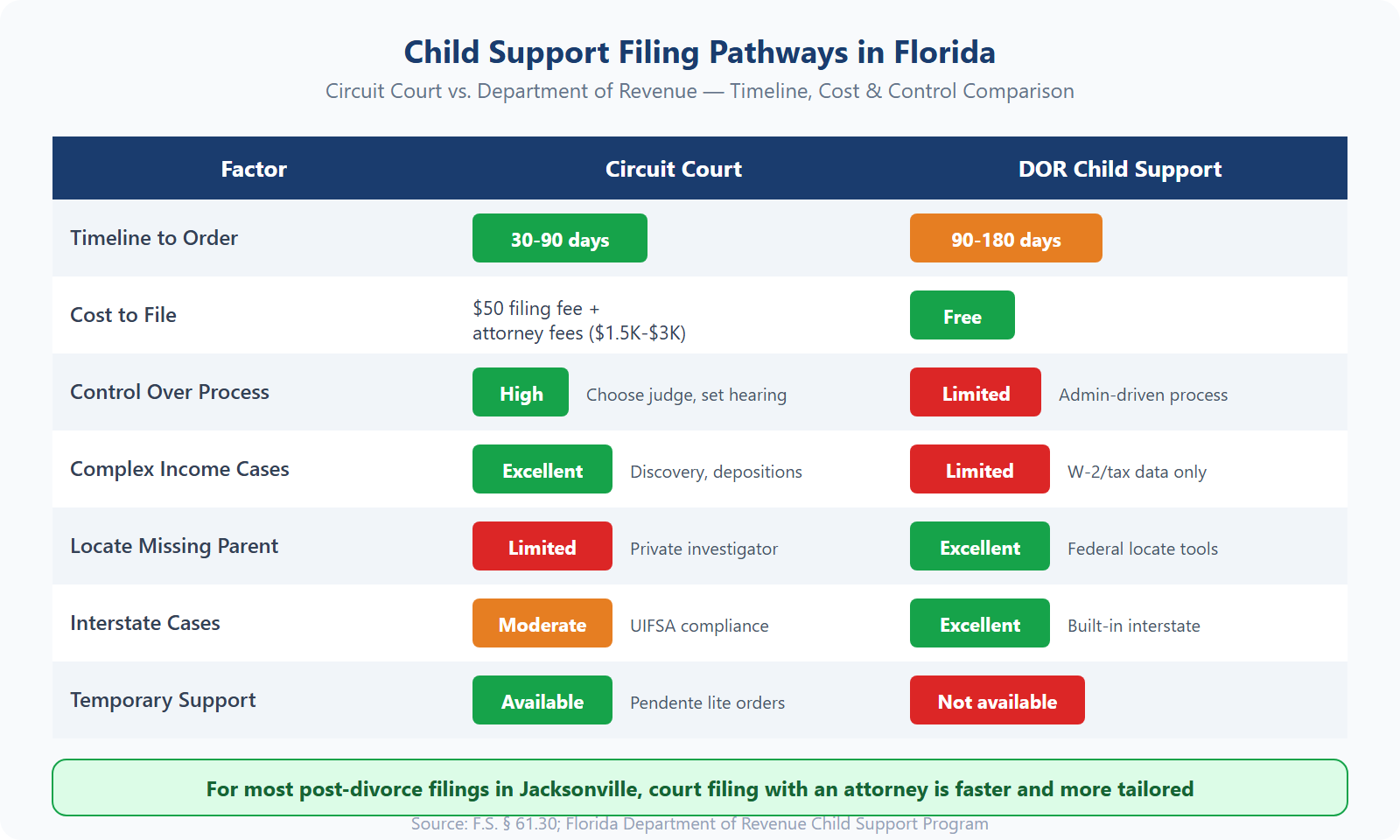
Florida parents have two pathways to establish or modify child support after divorce: filing through the circuit court or applying through the Florida Department of Revenue (DOR) Child Support Program. The DOR handles approximately 70% of all child support cases statewide, making it the most common route for enforcement and modification. [1]
Circuit Court filing is the better option when:
DOR Child Support Program is the better option when:
For most Jacksonville parents filing after divorce — where paternity is established and both parents are known — filing through the Fourth Judicial Circuit Court with an attorney typically produces faster results and more tailored orders.
Filing for child support after a final divorce judgment in Duval County follows a specific process through the Fourth Judicial Circuit. The Duval County Clerk of Courts processes over 12,000 family law filings annually, and child support petitions are among the most common. [3]
Step 1: Gather financial documentation. You’ll need tax returns (2 years), pay stubs (3 months), bank statements, health insurance costs, and daycare expenses. The court requires a Financial Affidavit (Form 12.902(b) for income under $50K or 12.902(c) for income over $50K).
Step 2: File a Supplemental Petition. Because you already have a final divorce judgment, you file a Supplemental Petition to Establish Child Support using Florida Supreme Court Approved Family Law Form 12.947(a). The Duval County filing fee is $50 for a supplemental petition.
Step 3: Serve the other parent. Your ex-spouse must be formally served with the petition. Service can be by process server, sheriff, or waiver of service if your ex agrees to accept the paperwork.
Step 4: Attend the hearing. Both parents submit financial affidavits and the court applies the F.S. § 61.30 guidelines. Most straightforward child support hearings are resolved in a single hearing lasting 30-60 minutes.
Step 5: Receive the order. The judge enters a child support order that typically includes an Income Deduction Order (IDO) directing the paying parent’s employer to automatically withhold support from each paycheck.
Florida courts can award retroactive child support, but the rules depend on your specific situation. Under F.S. § 61.30(17), the court may order support retroactive to the date the petition was filed — or in some cases, earlier. The U.S. Census Bureau reports that only 46.5% of custodial parents receive the full child support they are owed, making retroactive awards a critical tool. [4]
If support was never ordered: The court can award retroactive support back to the date you filed your petition. Some courts will go back further if the other parent had a clear legal obligation and the custodial parent can show the child’s needs went unmet.
If support was ordered but not paid: Florida has no statute of limitations on collecting court-ordered child support arrears. Under F.S. § 95.11(1), child support judgments are enforceable indefinitely. Unpaid support accrues interest at the statutory rate, and the obligation survives even after the child turns 18.
If circumstances changed: When you file a modification petition, the new support amount applies from the date of filing — not retroactively to when the change occurred. This is why acting quickly matters when your income or time-sharing changes significantly.
Under F.S. § 61.14, either parent can petition to modify child support when there is a substantial change in circumstances that is significant, material, involuntary, and permanent. The Florida legislature codified a specific threshold: a modification is presumptively justified when the recalculated amount differs from the current order by at least 15% or $50, whichever is greater. [2]
Common grounds for modification include:
The modification takes effect from the date the petition is filed — not retroactively to when the change happened. Don’t wait to file if your circumstances have changed.
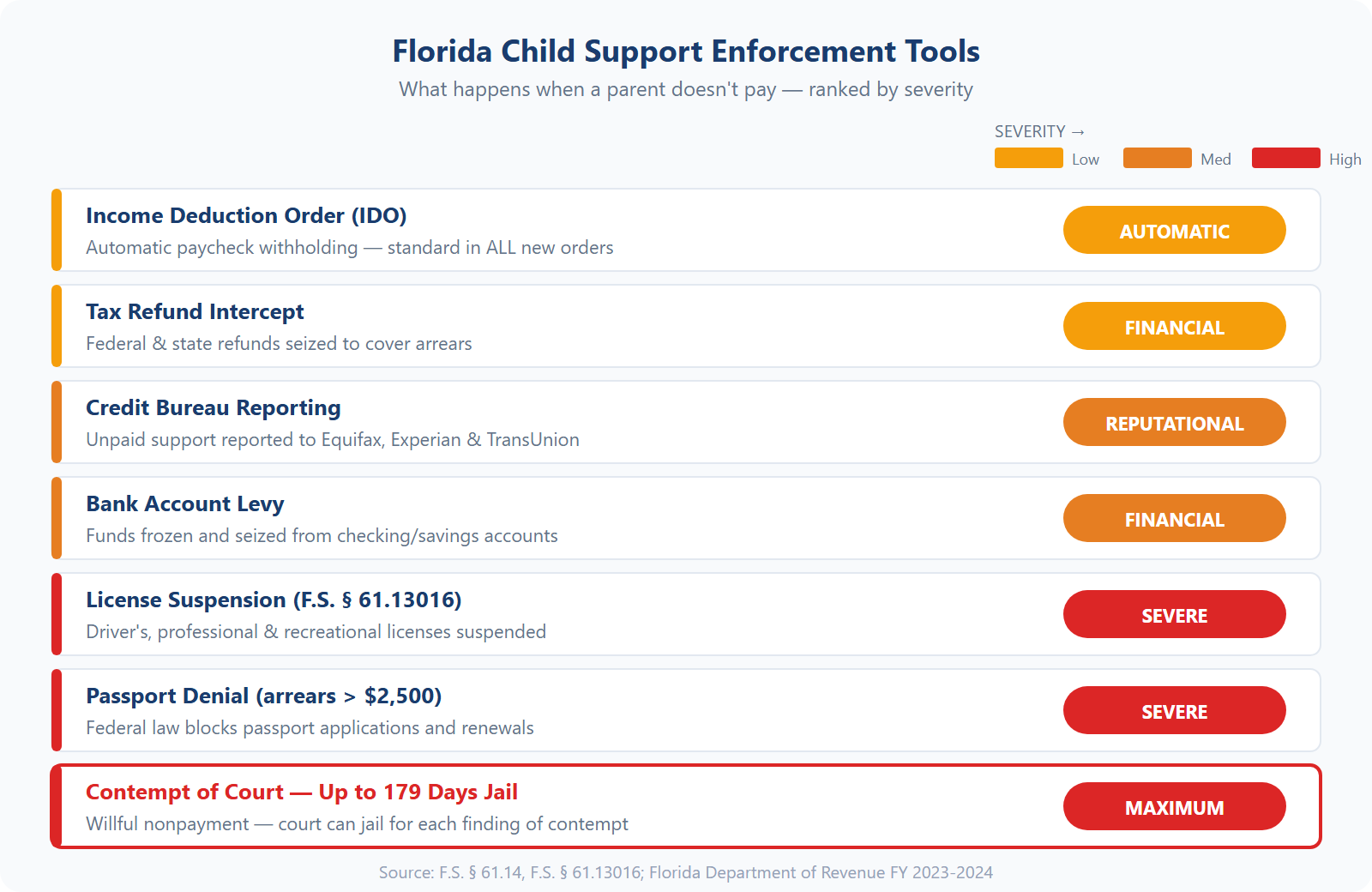
Florida has some of the strongest child support enforcement tools in the country. The Florida Department of Revenue reports collecting over $2.1 billion in child support during FY 2023-2024 using a combination of administrative and judicial enforcement mechanisms. [1]
Administrative enforcement (through DOR):
Judicial enforcement (through the court):
No — Florida has no statute of limitations on collecting court-ordered child support. Under F.S. § 95.11(1), support judgments are enforceable indefinitely, and this obligation does not end when the child turns 18. The U.S. Office of Child Support Services reports that $115.8 billion in child support arrears is owed nationally, with Florida accounting for a significant share. [5]
This means if your ex-spouse owes $50,000 in back support from a decade ago, that debt is still fully collectible. Interest accrues on unpaid balances at the statutory rate, and the DOR can use every enforcement tool available — including wage garnishment, tax intercepts, and license suspension — regardless of how old the debt is.
The child support obligation itself ends when the child turns 18 (or 19 if still in high school), but any arrears that accumulated before that date survive indefinitely. Courts have enforced child support arrears against parents decades after the child reached adulthood.
I’ve handled hundreds of child support cases in Jacksonville, and the single biggest mistake I see is parents filing pro se without understanding the guidelines calculation. The Income Shares Model is a formula — but it’s not simple. Deductions, credits, imputed income, and the time-sharing adjustment all affect the final number, and getting any of them wrong means leaving money on the table or paying more than you should.
An experienced family law attorney ensures your financial affidavit accurately reflects your income and expenses, identifies deductions and credits you’re entitled to, and presents your case to the judge in a way that maximizes your outcome under the guidelines. Whether you’re the parent seeking support or the parent expected to pay, you need someone who knows how the Fourth Judicial Circuit handles these cases.
Ready to file for child support? Call (904) 396-5557 for a consultation. I’ll review your situation, run the guidelines calculation, and tell you exactly what to expect.
Yes. Child support is a right belonging to the child under Florida law, and it cannot be permanently waived by either parent. You can file a Supplemental Petition to Establish Child Support at any time before the child turns 18 (or 19 if still in high school). The court will apply the F.S. § 61.30 guidelines based on current income and time-sharing — not what existed at the time of your divorce. [2]
Through the Duval County circuit court, most child support petitions are resolved within 30-90 days from filing to final hearing. If both parents cooperate and submit their financial affidavits promptly, a hearing can be scheduled within 4-6 weeks. The DOR process typically takes longer — 90-180 days — because of administrative processing timelines. Court filing with an attorney is generally faster.
No — equal time-sharing does not automatically eliminate child support. Under F.S. § 61.30, the substantial time-sharing formula applies when both parents have at least 73 overnights. With 50/50, the parent earning more still pays support based on the income gap between parents. Only when both parents earn exactly the same income with exactly equal overnights does support approach zero. [2]
Yes. Social Security benefits are subject to garnishment for child support under federal law (42 USC § 659), and up to 65% of Social Security payments can be withheld for support arrears. Retirement accounts including pensions and 401(k)s can also be reached through a Qualified Domestic Relations Order (QDRO). Child support is one of the few debts that cannot be discharged in bankruptcy.
Florida courts can impute income to a parent who is voluntarily unemployed or underemployed. Under F.S. § 61.30(2)(b), the court examines the parent’s recent work history, qualifications, and job opportunities to determine earning capacity. If your ex quits a $100,000 job to take a $40,000 job without good reason, the court can calculate support based on the $100,000 earning capacity.
Either option is available to you. Filing directly through the Fourth Judicial Circuit Court with an attorney is typically faster and gives you more control over the process. The DOR is a good option when you need help locating the other parent, need free enforcement services, or the other parent lives out of state. Many parents use the court for the initial order and the DOR for ongoing enforcement.
Yes — either parent can petition to modify child support under F.S. § 61.14 when there is a substantial change in circumstances. The modification must meet the 15% or $50 threshold. However, voluntary income reduction (quitting a job or reducing hours by choice) is not a valid ground — the court will impute income at the parent’s earning capacity. The modification applies from the filing date, not retroactively. [2]
Sources:
[1] Florida Department of Revenue, Child Support Program Statistics FY 2023-2024. floridarevenue.com
[2] Florida Statutes, F.S. § 61.30 — Child Support Guidelines. leg.state.fl.us
[3] Duval County Clerk of Courts, Family Law Division Filing Information. duvalclerk.com
[4] U.S. Census Bureau, Custodial Mothers and Fathers and Their Child Support: 2021. census.gov
[5] U.S. Office of Child Support Services, FY 2023 Preliminary Report. acf.hhs.gov
[6] Florida Statutes, F.S. § 61.14 — Enforcement and Modification of Support Orders. leg.state.fl.us
 ✓
✓Reviewed by
Family Law Attorney & Partner, Sacks & Sacks