
Complex assets at stake? Call (904) 396-5557 — Adam Sacks protects high-value assets in Jacksonville divorces.
What Is a High Net Worth Divorce?
A high net worth divorce is the dissolution of a marriage where the marital estate totals $1 million or more in combined assets. These cases involve far more than dividing a bank account and a house — they require forensic analysis of business interests, investment portfolios, retirement accounts, real estate holdings, and luxury assets that most family law attorneys rarely encounter.
In Florida, high net worth divorces are governed by the same equitable distribution statute that applies to all divorces (F.S. § 61.075), but the complexity of the assets transforms every step of the process. [2] Valuing a closely held business, tracing commingled funds in a brokerage account, or dividing a pension through a Qualified Domestic Relations Order (QDRO) each requires specialized legal and financial expertise.
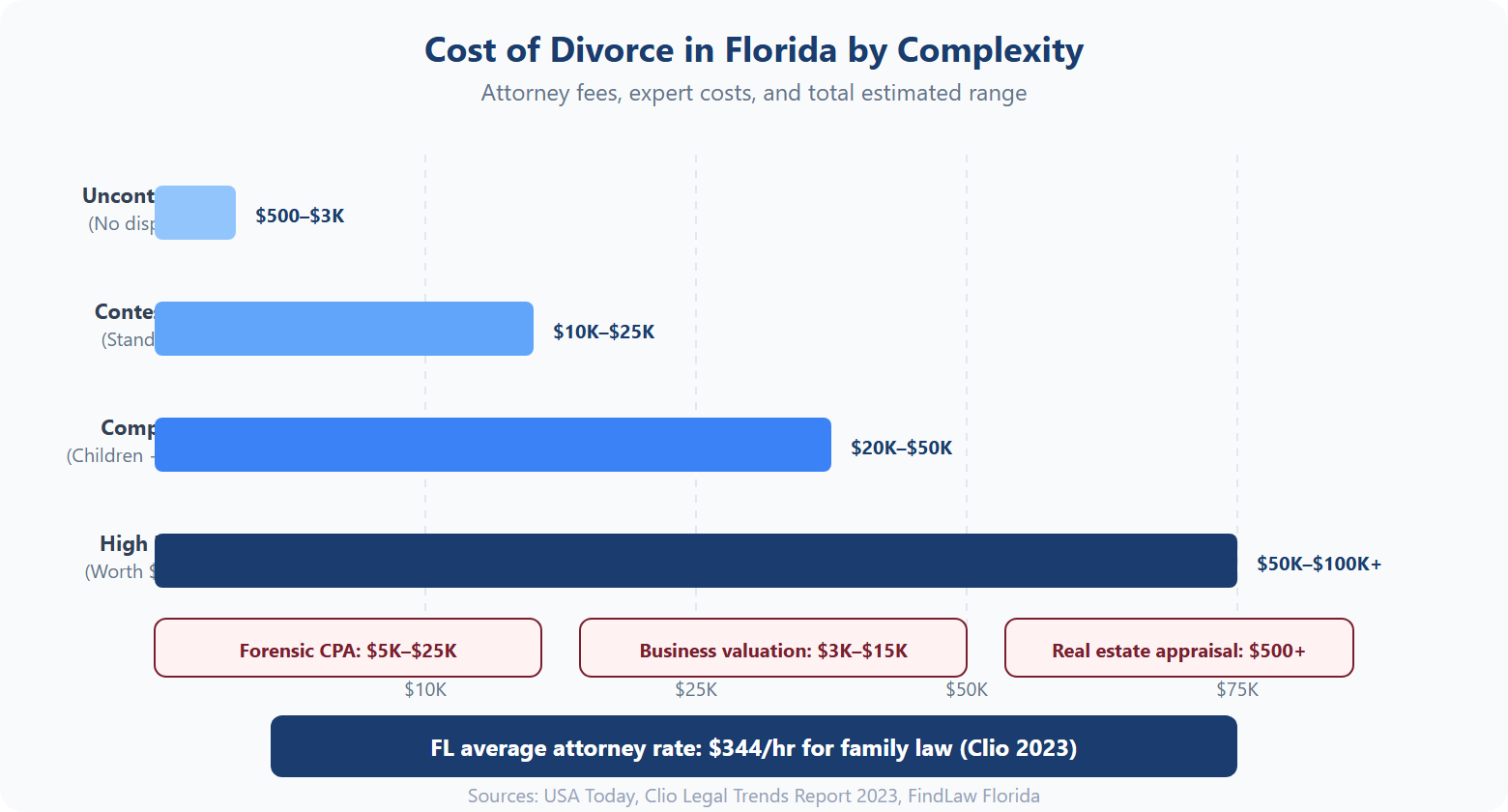
The average cost of a standard contested divorce in Florida is $13,500 without children and $20,300 with children. [1] A high net worth divorce with complex asset division routinely costs $50,000–$100,000+ when you factor in forensic accountants ($5,000–$25,000), business valuation experts ($3,000–$15,000), real estate appraisers, and increased attorney time at an average Florida family law rate of $344/hour. [4]
How Florida Divides Assets: Equitable Distribution
Florida is an equitable distribution state — not a community property state — which means the court divides marital assets and liabilities in a manner that is fair, though not necessarily 50/50. [2] Under F.S. § 61.075, the court begins with a presumption of equal distribution and then weighs 11 statutory factors — including each spouse’s economic circumstances, the duration of the marriage, contributions to the other’s career, and the desirability of retaining a business or professional practice intact. In high net worth cases involving closely held businesses, investment portfolios, multiple real estate holdings, or retirement accounts worth millions of dollars, the equitable distribution analysis is substantially more complex than in a typical divorce. The 2024 HB 521 amendments added enterprise goodwill as an explicit factor, further expanding the scope of what courts must evaluate when dividing marital estates in Jacksonville and throughout the Middle District of Florida. [3]
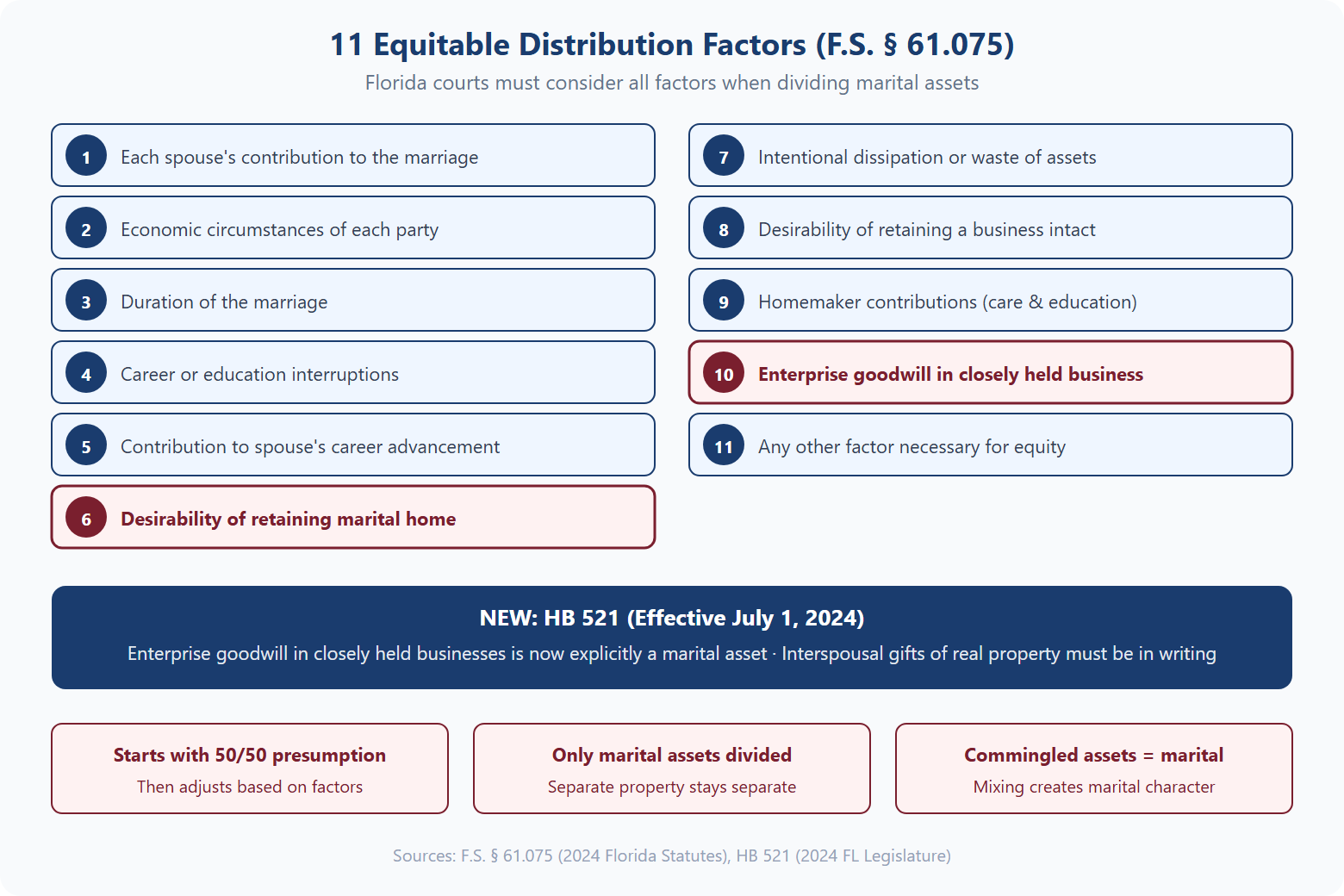
The court begins with a presumption of equal distribution, then considers 11 statutory factors under F.S. § 61.075 to determine whether an unequal split is justified:
- Each spouse’s contribution to the marriage — including homemaking, childcare, and career support
- Economic circumstances of each party at the time of distribution
- Duration of the marriage
- Career or education interruptions — sacrifices made by either spouse
- Contribution to the other spouse’s career advancement or earning capacity
- Desirability of retaining the marital home — especially when minor children are involved
- Intentional dissipation, waste, or destruction of marital assets within 2 years of filing
- Desirability of retaining a business, professional practice, or interest intact and free from claim by the other party
- Homemaker contributions to the care and education of children and to the other spouse’s career
- Enterprise goodwill in closely held businesses (explicitly added by HB 521, effective July 1, 2024) [3]
- Any other factor necessary for equity and justice
The critical first step is classification: only marital assets are subject to division. Assets owned before the marriage, inheritances received individually, and gifts from third parties remain separate property — unless they have been commingled with marital funds. [2] In high net worth cases, tracing the boundary between separate and marital property is often the most heavily litigated issue.
2024 Law Change: HB 521 Overhauls Equitable Distribution
On July 1, 2024, Florida HB 521 made significant changes to the equitable distribution statute (F.S. § 61.075) that directly impact high net worth divorce cases across the state. [3] This legislation — one of the most consequential amendments to Florida’s property division framework in years — addresses long-standing disputes over enterprise goodwill in closely held businesses, clarifies rules governing interspousal transfers of real property, expands the court’s authority to grant interim partial distributions during pending divorce proceedings, and resolves a recurring homestead joinder question. For Jacksonville business owners, medical professionals, attorneys, and entrepreneurs going through a high net worth divorce, HB 521 can substantially increase the marital estate subject to division by requiring courts to value enterprise goodwill at fair market value. Adam Sacks has been advising clients on the practical impact of these changes since the bill’s passage. Key provisions include:
- Enterprise goodwill is now explicitly a marital asset. The court must determine the value of enterprise goodwill in a closely held business at fair market value — defined as the price a willing buyer would pay a willing seller. This resolves years of litigation over whether business goodwill is personal (non-divisible) or enterprise (divisible).
- Interspousal gifts of real property must be in writing. Any transfer of real property between spouses must comply with F.S. § 689.01, similar to any other real estate conveyance. Verbal agreements to gift property between spouses are no longer sufficient.
- Interim partial distribution factors clarified. Courts now have explicit authority to make early asset distributions during the divorce process to prevent loss of assets, pay child-related expenses, and fund attorney fees.
- Homestead joinder clarification. A spouse who joins in the execution of a deed solely to convey homestead property to a third party does not change the character of that property to marital.
Complex Asset Valuation in Jacksonville High Net Worth Divorces
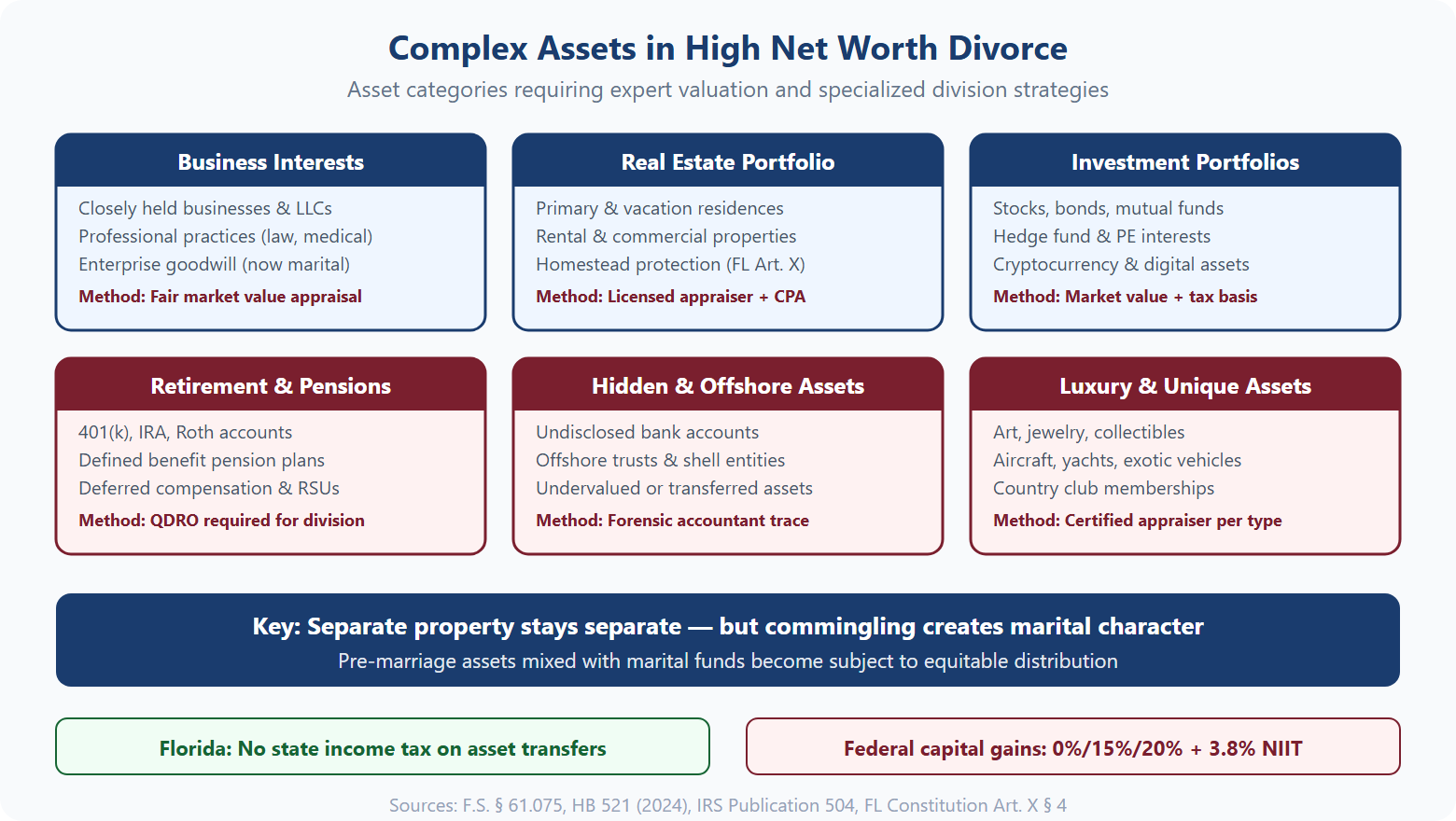
The most contentious phase of any high net worth divorce is identifying, valuing, and classifying every asset in the marital estate — a process that often takes months and requires coordination among forensic accountants, business valuation experts, real estate appraisers, and financial analysts. Each asset category demands a different valuation methodology, and the choice of method can shift the outcome by hundreds of thousands of dollars. In Jacksonville high net worth cases, Adam Sacks works with a network of credentialed financial professionals to ensure that business interests, investment portfolios, retirement accounts, real estate holdings, and digital assets are valued accurately and classified correctly under Florida’s equitable distribution statute (F.S. § 61.075). [2] Failing to retain independent valuation experts is one of the most costly mistakes a spouse can make in a complex asset divorce. The major asset categories and their valuation approaches are outlined below:
Business Interests and Professional Practices
When one or both spouses own a business, the court must determine the fair market value of the marital interest — including enterprise goodwill (now explicitly divisible under HB 521). [3] Business valuation experts typically use one of three methods:
- Income approach: Capitalizes the business’s expected future earnings
- Market approach: Compares to recent sales of similar businesses
- Asset approach: Calculates net asset value (tangible + intangible)
For professional practices (law firms, medical practices, dental offices), the distinction between enterprise goodwill (transferable with the business) and personal goodwill (attributable solely to the practitioner) remains critical — even after HB 521. [3]
Real Estate Holdings
High net worth couples in Jacksonville often own multiple properties — a primary residence, a beach house in Ponte Vedra or Amelia Island, rental properties, and commercial real estate. Each requires a licensed appraiser.
Florida’s homestead exemption (Article X, § 4 of the Florida Constitution) adds complexity: the homestead is protected from forced sale by creditors but is still subject to equitable distribution in divorce. The court often considers whether minor children should remain in the marital home, making this one of the most emotionally and financially significant decisions in the case.
Retirement Accounts and Deferred Compensation
401(k) plans, IRAs, pensions, stock options, restricted stock units (RSUs), and deferred compensation are all potentially divisible marital assets — but dividing them requires precision. A Qualified Domestic Relations Order (QDRO) is required to divide employer-sponsored retirement plans without triggering tax penalties. [5]
The marital portion of a retirement account is typically limited to the contributions and growth during the marriage. Pre-marriage balances remain separate property — but only if properly documented and not commingled.
Investment Portfolios and Digital Assets
Stocks, bonds, mutual funds, hedge fund interests, private equity holdings, and cryptocurrency all require valuation at a specific date (typically the date of filing or a date agreed upon by the parties). Tax basis matters: an asset worth $500,000 with a cost basis of $50,000 has very different after-tax value than one with a $400,000 basis.
Hidden Assets and Forensic Accounting
In high net worth divorces, there is a significant and well-documented risk that one spouse will attempt to conceal, undervalue, or dissipate marital assets before or during the divorce process. Forensic accounting studies estimate that asset concealment occurs in a substantial percentage of high-asset cases, and Florida courts take it seriously — intentional dissipation or waste of marital assets is one of the 11 statutory factors under F.S. § 61.075 that can result in an unequal distribution penalizing the offending spouse. [2] In Jacksonville, where many high net worth couples own closely held businesses, commercial real estate, brokerage accounts, and cryptocurrency holdings, forensic accountants play a critical role in tracing fund movements and uncovering hidden value. [6] Adam Sacks works with experienced forensic accounting professionals to ensure that no asset goes unaccounted for. Common concealment tactics include:
- Transferring assets to friends, family members, or shell companies
- Undervaluing business interests through inflated expenses or deflated revenue
- Creating fictitious debts or loans
- Deferring income, bonuses, or commissions until after the divorce
- Hiding cryptocurrency or digital assets in hard-to-trace wallets
- Overpaying the IRS (refund returned after divorce) or prepaying creditors
A forensic accountant specializing in divorce can trace fund movements, analyze lifestyle versus reported income, audit business records, and uncover undisclosed accounts. Forensic accounting in a high net worth divorce typically costs $5,000–$25,000 depending on the complexity of the financial picture. [6]
Florida courts take asset concealment seriously. Under F.S. § 61.075(1)(i), intentional dissipation, waste, or destruction of marital assets is one of the 11 factors the court considers — and it can result in an unequal distribution that penalizes the offending spouse. [2]
Alimony in High Net Worth Divorce After the 2023 Reform
Florida’s alimony landscape changed dramatically with SB 1416 (Ch. 2023-301), which took effect on July 1, 2023 and represents the most significant overhaul of Florida alimony law in decades. [7] The reform eliminated permanent alimony entirely — a category that previously allowed indefinite spousal support in long-duration marriages — and replaced it with a structured framework that caps durational alimony at 35% of the difference between the parties’ net incomes. For high net worth couples in Jacksonville, this cap creates a hard ceiling on spousal support obligations regardless of the marital lifestyle. The reform also introduced a supportive relationship presumption, established clear durational limits tied to marriage length, and changed the strategic calculus for both the paying and receiving spouse. Understanding how these three remaining alimony types apply to your specific financial circumstances is essential to protecting your interests:
- Bridge-the-gap alimony: Up to 2 years, non-modifiable — assists with short-term transitional needs
- Rehabilitative alimony: Up to 5 years, requires a specific plan for education or training
- Durational alimony: Tied to marriage length — 50% of marriage duration for short (3–9 years), 60% for moderate (10–20 years), 75% for long (20+ years)
For high net worth couples, the 35% cap creates a hard ceiling. If one spouse earns $500,000 and the other earns $100,000, the maximum durational alimony is $140,000/year ($500K − $100K = $400K × 35%). But the court may award less if the recipient’s reasonable needs are lower. [7]
The 2023 reform also added a supportive relationship presumption: if the receiving spouse enters a new romantic relationship involving financial support, the paying spouse can petition for modification or termination. [7]
Tax treatment matters in high net worth cases. Under the Tax Cuts and Jobs Act (TCJA, 2017), alimony payments for divorces finalized after December 31, 2018 are not tax-deductible for the payer and not taxable income for the recipient. [8] This changed the economics of alimony negotiation significantly — especially for high earners in the 37% federal bracket.
Child Custody and Support in Affluent Divorces
Florida’s 50/50 time-sharing presumption (Ch. 2023-301, effective July 1, 2023) applies equally in high net worth cases, establishing that equal parenting time is presumed to serve the child’s best interest unless one party demonstrates otherwise by a preponderance of the evidence. [7] This presumption fundamentally changed custody litigation in Florida — the party seeking a different arrangement now bears the burden of proof, which raises the stakes in every contested custody proceeding. For affluent families in Jacksonville, time-sharing disputes often involve additional layers of complexity that standard custody cases do not, including disagreements over private school tuition and extracurricular expenses that exceed the statutory child support guidelines, international travel restrictions when one parent has business ties abroad, decisions about which residence serves as the primary home for school enrollment, and provisions for nanny or domestic staff employment after the divorce. Florida’s child support guidelines under F.S. § 61.30 use an income shares model, but the guideline table caps at $10,000 in combined monthly net income — giving the court broad discretion to deviate upward in high-income cases. [9]
For affluent families, the parenting plan often needs to address:
- Private school tuition and extracurricular costs (beyond standard child support guidelines)
- Travel and vacation arrangements — including international travel restrictions and passport control
- Multiple residences — which home is primary for school enrollment purposes
- Nanny and domestic staff — who employs them post-divorce
- Trust fund and inheritance provisions for the children
Florida’s child support guidelines (F.S. § 61.30) use an income shares model, but the statutory guideline table only goes up to a combined monthly net income of $10,000. [9] For high net worth parents whose combined income far exceeds this amount, the court has discretion to deviate upward based on the children’s needs and the parents’ ability to pay. This is where the actual lifestyle of the children during the marriage becomes a critical factor.
Prenuptial and Postnuptial Agreements
Prenuptial agreements are common in high net worth marriages and can significantly simplify the divorce process — or complicate it considerably if the agreement is contested. In Florida, prenuptial agreements are governed by the Florida Uniform Premarital Agreement Act (F.S. § 61.079), which establishes specific requirements that must be satisfied for the agreement to be enforceable. [10] When a valid prenup exists, it controls the classification and division of the assets it covers, potentially removing millions of dollars from the equitable distribution analysis. However, prenups commonly contain gaps — they may not address a business started during the marriage, the appreciation of separate property due to marital efforts, or the 2024 HB 521 changes to enterprise goodwill. [3] Adam Sacks has extensive experience both enforcing and challenging prenuptial agreements in Jacksonville divorce proceedings. A prenup must satisfy these requirements to withstand judicial scrutiny:
- Voluntary execution — neither party was coerced or under duress
- Full financial disclosure — both parties must provide complete and accurate disclosure of assets and income
- Not unconscionable at the time of enforcement — the agreement must not be grossly unfair when applied
- Written and signed by both parties before the marriage
Postnuptial agreements (executed during the marriage) are also enforceable in Florida but face greater scrutiny. Courts examine whether the agreement was truly voluntary given the power dynamics of an existing marriage.
If a valid prenup exists, it controls the classification and division of assets it covers. But prenups commonly have gaps — they may not address a business started during the marriage, property appreciation, or the 2024 HB 521 changes to enterprise goodwill. These gaps create room for litigation.
Tax Implications of High Net Worth Divorce
Tax planning is not optional in a high net worth divorce — it can save or cost hundreds of thousands of dollars depending on how assets are divided and structured in the final settlement. While transfers of property between spouses incident to divorce are generally tax-free under IRC § 1041, the recipient takes the transferor’s cost basis, which means a $1 million asset with a $100,000 basis carries a very different after-tax value than one with a $900,000 basis. [8] Florida has no state income tax, but federal capital gains rates of 15–20% plus the 3.8% Net Investment Income Tax can erode substantial value from assets received in a divorce settlement. Retirement account division through QDROs, the post-TCJA alimony tax treatment, and the choice between lump-sum property settlements versus ongoing support payments all have significant tax consequences that must be analyzed before any agreement is finalized. Key tax considerations in high net worth divorce include:
- Capital gains taxes: Transfers of property between spouses incident to divorce are generally tax-free under IRC § 1041. But when the recipient later sells the asset, they take the transferor’s cost basis — potentially triggering significant capital gains. Florida has no state income tax, but federal capital gains rates of 15%–20% plus the 3.8% Net Investment Income Tax (NIIT) apply. [8]
- QDRO and retirement account division: Properly structured QDROs avoid the 10% early withdrawal penalty. Rollovers to an IRA maintain tax deferral. But mistakes in QDRO preparation can trigger immediate taxation. [5]
- Alimony (post-TCJA): For divorces finalized after 2018, alimony is neither deductible by the payer nor taxable to the recipient. This means high-earning payers are funding alimony with after-tax dollars.
- Property settlement vs. alimony: A lump-sum property settlement can sometimes be more tax-efficient than ongoing alimony payments, depending on the parties’ tax brackets and the assets involved.
Asset Protection Strategies
Proactive asset protection — ideally implemented well before a divorce petition is filed — can preserve significant wealth and prevent the erosion of separate property during the equitable distribution process. In Florida, assets owned before the marriage, inheritances received individually, and third-party gifts are classified as separate property under F.S. § 61.075, but only if they have not been commingled with marital funds. [2] Once separate and marital assets are mixed — for example, depositing an inheritance into a joint bank account or using pre-marital funds to renovate the marital home — tracing the separate origins becomes extremely difficult and expensive. For Jacksonville residents with substantial pre-marital wealth, business interests, or family inheritances, Adam Sacks recommends a combination of documentation, entity structuring, and legal instruments to protect assets before litigation begins. Effective legal strategies include:
- Asset tracing: Documenting the separate origins of pre-marital property, inheritances, and gifts to prevent them from being classified as marital property during equitable distribution
- Irrevocable trusts: Assets placed in an irrevocable trust before marriage may be shielded from equitable distribution, depending on the trust’s terms and the contributor’s retained control
- LLC and corporate structuring: Business assets held in properly maintained LLCs or corporations may have some protection — but courts will pierce the corporate veil if the entity is a sham or the funds are commingled
- Emergency asset preservation orders: If you suspect your spouse is dissipating assets, Florida courts can issue emergency temporary injunctions freezing bank accounts, preventing property sales, and preserving the marital estate
Mediation vs. Litigation in High Net Worth Cases
Florida requires mediation in contested divorce cases before trial under F.S. § 61.183, and in high net worth cases this mandatory step often determines whether the divorce resolves in months or drags on for years. Mediation offers distinct advantages for affluent couples, including confidentiality that keeps sensitive financial details and business information out of the public record, cost savings of 40–60% compared to full litigation, and the ability to craft creative settlement structures that a court cannot order — such as phased business buyouts, structured property settlements, or custom arrangements for shared real estate. [11] Adam Sacks brings a unique dual perspective to this process as both a seasoned family law litigator and a Florida Supreme Court Certified Family Mediator, allowing him to negotiate from a position of strength while keeping cases on track toward efficient resolution. Key advantages of mediation in high net worth divorce include:
- Privacy: Mediated agreements are confidential. Court filings in a litigated divorce become public record — exposing financial details, business information, and personal matters.
- Cost savings: Even in complex cases, mediation typically costs 40%–60% less than full litigation. [11]
- Creative solutions: Mediators can facilitate agreements that courts cannot order — such as phased buyouts of business interests, structured property settlements, or custom arrangements for shared assets.
- Speed: A mediated high net worth divorce can be resolved in 4–8 months. A fully litigated one typically takes 12–24+ months.
However, mediation only works if both parties negotiate in good faith. If one spouse is hiding assets, refusing to disclose financial information, or acting in bad faith, litigation becomes necessary. That’s when courtroom experience matters.
Common Mistakes in High Net Worth Divorces
- Failing to get independent business valuations: Accepting your spouse’s valuation of a business they control is one of the most expensive mistakes you can make. Always hire your own valuation expert.
- Ignoring tax consequences: An asset worth $1 million with a $900,000 cost basis is far more valuable than one worth $1 million with a $100,000 basis. After-tax value is what matters.
- Commingling separate property: Depositing an inheritance into a joint account or using pre-marital funds for marital expenses converts separate property to marital property. Once commingled, it’s extremely difficult to trace back.
- Not requesting interim distributions: Under HB 521’s new provisions, you can request early access to marital funds to pay attorney fees and living expenses. Don’t let a cash-poor position force you into a bad settlement.
- Overlooking deferred compensation: Stock options, RSUs, bonus structures, and deferred comp plans vest over time. The marital portion must be calculated based on the “time rule” or “coverture fraction.”
- Social media activity: Photos of luxury purchases, vacations, or new relationships can be used as evidence of hidden income, dissipation, or lifestyle inconsistencies.
Why Choose Adam Sacks for Your High Net Worth Divorce
I started my career as a prosecutor for the State of Florida, trying criminal cases in Seminole County. That experience taught me how to build a case with evidence, cross-examine witnesses, and present arguments to a judge who’s heard it all. When I transitioned to family law over 25 years ago, I brought that courtroom discipline with me — and it’s exactly what high net worth divorces demand.
Complex asset cases require an attorney who can work with forensic accountants, business valuation experts, and financial advisors — and then translate their findings into compelling courtroom arguments. I’ve handled divorces involving closely held businesses, multiple real estate holdings, professional practices, investment portfolios, and retirement accounts that require QDRO preparation. I understand both the financial complexity and the emotional stakes.
I’m also a Florida Supreme Court Certified Family Mediator. Many high net worth cases benefit from skilled mediation rather than full-blown litigation — and I know how to negotiate effectively when significant assets are on the table. But if the other side refuses to negotiate fairly or is hiding assets, I have the trial experience to take the case to court and win.
Adam Sacks earned his J.D. from Western Michigan University Cooley Law School, where he received a Book Award for the highest grade in his class. He served as an Assistant State Attorney in Seminole County before transitioning to private practice. He holds a bachelor’s degree in Psychology from the University of Massachusetts — providing insight into the emotional dynamics that drive high-conflict divorces. He is a Florida Supreme Court Certified Family Mediator and a member of the Florida Bar (Bar #248370) since 2000.
What Happens When You Call Our Office
When you call (904) 396-5557, you will speak directly with Adam Sacks — not a receptionist, not a paralegal, and not a junior associate. High net worth divorce consultations require senior-level analysis from day one because the decisions made in the first weeks of a case often determine its trajectory. Whether you are concerned about a closely held business being undervalued, a spouse dissipating marital assets, a complex retirement account that requires QDRO preparation, or the impact of Florida’s 2024 HB 521 amendments on enterprise goodwill, Adam will assess your financial picture personally and provide a candid evaluation of where you stand, what to expect, and what immediate steps need to be taken to protect your interests. With 25+ years of family law experience and a background as a former state prosecutor, Adam brings the courtroom preparation and financial sophistication that high-value asset cases demand. Here is what to expect:
- You sit down with me — not a paralegal. I handle high net worth consultations personally because these cases require senior-level analysis from day one.
- Comprehensive asset review. I’ll review your financial picture — real estate, businesses, investments, retirement accounts, debts — and identify the key issues that will drive your case.
- Strategy recommendation. I’ll tell you whether mediation or litigation is the better path, what experts we’ll need (forensic accountant, business valuation, appraisers), and what to expect in terms of timeline and cost.
- Immediate protective steps. If there’s a risk of asset dissipation, we can file for emergency asset preservation orders the same day.
- Honest assessment. I’ll give you a straight answer about where you stand — what you’re likely to receive, what the other side will argue, and what the realistic outcomes are.
High net worth divorce? Call Adam Sacks now at (904) 396-5557. Free consultation. Protect your assets, your business, and your family’s future.
Client Reviews — See What People Are Saying

See all Google reviews for Sacks & Sacks Law
Frequently Asked Questions About High Net Worth Divorce in Jacksonville
How much does a high net worth divorce cost in Florida?
A high net worth divorce in Florida typically costs $50,000–$100,000+ in total legal and expert fees. This includes attorney fees (average $344/hour for Florida family law attorneys), forensic accountants ($5,000–$25,000), business valuation experts ($3,000–$15,000), real estate appraisers, and QDRO preparation. [1] [4] The final cost depends on the complexity of the asset portfolio and whether the case settles through mediation or goes to trial.
How does Florida divide assets in a high net worth divorce?
Florida uses equitable distribution under F.S. § 61.075, starting with a 50/50 presumption and then considering 11 statutory factors to determine a fair split. [2] Only marital assets are divided — separate property (pre-marriage, inheritance, gifts) stays with the owner unless it has been commingled. The 2024 HB 521 amendments now explicitly recognize enterprise goodwill in businesses as a divisible marital asset. [3]
What is enterprise goodwill and why does it matter in my divorce?
Enterprise goodwill is the value of a business that exceeds its tangible assets — including reputation, customer relationships, and brand recognition that would transfer to a new owner. Under HB 521 (effective July 1, 2024), Florida now explicitly recognizes enterprise goodwill as a marital asset subject to equitable distribution. [3] If your spouse owns a business, this can significantly increase the marital estate’s value and your share of the division.
Can my spouse hide assets during our divorce?
Spouses in high net worth divorces sometimes attempt to conceal assets by transferring property to third parties, undervaluing businesses, creating fictitious debts, or hiding cryptocurrency. A forensic accountant can trace fund movements and uncover undisclosed accounts. [6] Florida courts penalize asset concealment — it’s one of the 11 equitable distribution factors and can result in an unequal split favoring the innocent spouse. [2]
Is permanent alimony available in Florida high net worth divorces?
No. Florida eliminated permanent alimony effective July 1, 2023 (SB 1416). [7] The three remaining types are bridge-the-gap (up to 2 years), rehabilitative (up to 5 years), and durational (tied to marriage length). Alimony is capped at 35% of the difference between the parties’ net incomes, regardless of wealth.
How long does a high net worth divorce take in Jacksonville?
A high net worth divorce in Jacksonville typically takes 8–18 months if settled through mediation, or 12–24+ months if fully litigated. The timeline depends on asset complexity, the need for forensic accounting and business valuations, and whether the parties can agree on key issues. Florida has a mandatory 20-day waiting period after filing before a final judgment can be entered.
Do I need a prenuptial agreement to protect my assets?
A prenuptial agreement is the strongest form of asset protection in divorce. Under F.S. § 61.079, a valid prenup must be voluntary, based on full financial disclosure, and not unconscionable. [10] If you don’t have a prenup, other strategies exist — including proper documentation of separate property, avoiding commingling, and trust structures. An experienced attorney can help protect your assets even without a prenup.
Sources:
[1] USA Today / Martindale-Nolo, Average Cost of Divorce in Florida. $13,500 without children, $20,300 with children. findlaw.com
[2] Florida Statutes, F.S. § 61.075 — Equitable Distribution of Marital Assets and Liabilities (2024). leg.state.fl.us
[3] Florida Legislature, HB 521 — Equitable Distribution of Marital Assets and Liabilities (2024). Effective July 1, 2024. Enterprise goodwill, interspousal gifts, interim distributions. flsenate.gov
[4] Clio, Legal Trends Report 2023. Average FL family law attorney hourly rate: $344. clio.com
[5] Cornell Law Institute, Qualified Domestic Relations Order (QDRO). Division of retirement accounts under ERISA and IRC § 414(p). law.cornell.edu
[6] Klein Law Group, Forensic Accounting in Divorce: How to Uncover Hidden Assets in Florida. kleinattorneys.com
[7] Florida Legislature, SB 1416 — Dissolution of Marriage (Ch. 2023-301). Effective July 1, 2023. Eliminated permanent alimony, 35% cap, 50/50 custody presumption. flsenate.gov
[8] IRS, Publication 504 — Divorced or Separated Individuals. TCJA alimony tax treatment changes, capital gains on property transfers. irs.gov
[9] Florida Statutes, F.S. § 61.30 — Child Support Guidelines. Income shares model, guideline schedule. flsenate.gov
[10] Florida Statutes, F.S. § 61.079 — Premarital Agreements. Florida Uniform Premarital Agreement Act. flsenate.gov
[11] Florida Courts, Office of Alternative Dispute Resolution Annual Report FY 2024-2025. 102,106 mediation cases statewide. flcourts.gov