
Florida processed 102,106 alternative dispute resolution cases in FY 2024-2025, including 20,808 family law cases — making mediation one of the most widely used tools in the state’s court system [2]. Divorce mediation is a structured process where a neutral third party (the mediator) helps divorcing spouses negotiate agreements on contested issues like child custody, property division, and alimony.
Unlike a judge, the mediator does not make decisions for you. Instead, they facilitate communication, help identify common ground, and guide both parties toward solutions that work for their specific situation. The goal is a voluntary agreement — not a ruling imposed by the court.
In Florida, mediators handling family law cases must be Florida Supreme Court Certified Family Mediators, meaning they have completed specialized training in family dynamics, conflict resolution, and Florida family law. This certification ensures a baseline of competence that protects both parties during the process.
Yes. Under F.S. § 61.183, Florida courts must refer all contested family law cases to mediation before they can proceed to trial [1]. This is not a suggestion — it is a statutory requirement. If you and your spouse disagree on any issue (custody, property, alimony), the court will order mediation before scheduling a final hearing.
There are limited exceptions:
Even in uncontested divorces, mediation can be useful for clarifying terms and ensuring both parties fully understand the agreement before it becomes a court order.
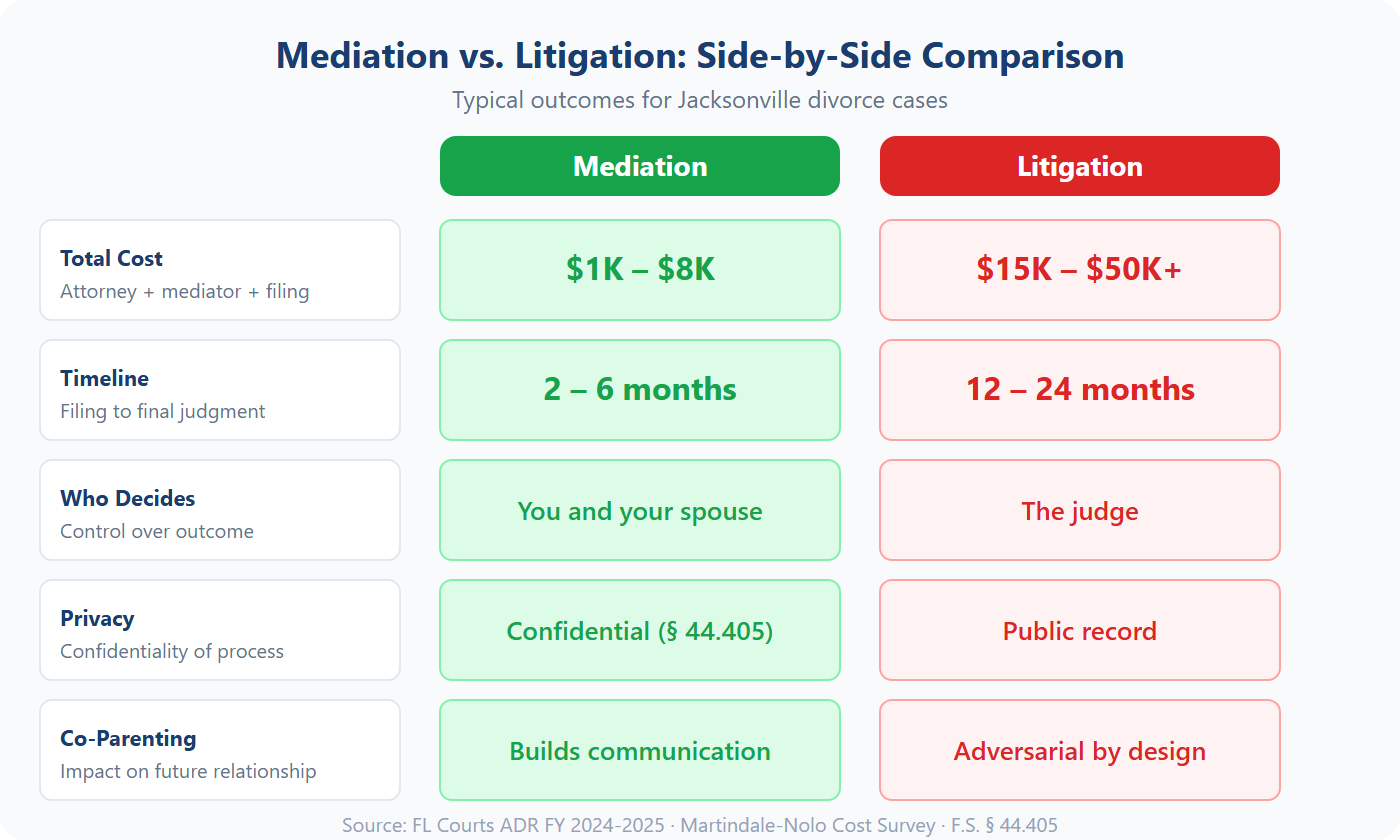
Divorce mediation in Jacksonville typically costs $1,000-$8,000 total — roughly 60% less than traditional litigation, which averages $15,000-$50,000+ when attorney fees, court costs, and expert witnesses are factored in [3]. The cost depends on the complexity of your case and the number of sessions needed.
Here is how mediation costs typically break down:
The cost savings come from avoiding discovery battles, depositions, expert witnesses, and multiple court appearances that drive litigation costs up dramatically.
Yes. Under F.S. § 44.108, Florida circuit courts operate mediation programs with fees based on combined household income — making mediation accessible even when private mediator rates are not affordable [7]:
These court-connected programs use the same Florida Supreme Court Certified mediators required for private mediation. The difference is cost, not quality. If the parties’ combined income exceeds $100,000, they must use a private mediator at market rates ($150-$350/hour in Jacksonville).
To access your circuit’s program, contact the Duval County Clerk’s office or ask the judge at your case management conference. The court will verify income eligibility and schedule mediation through the program.
Mediation settles 70-80% of family law cases before they reach trial — with 65% reaching full settlement and another 10% reaching partial agreements [2]. Beyond the high success rate, mediation offers several advantages over litigation:
You keep control. In litigation, a judge makes the final decisions about your children, your property, and your finances. In mediation, you and your spouse negotiate the terms together. The agreement reflects what both parties can live with — not what a stranger in a robe decided for you.
It is faster. Mediated divorces in Jacksonville typically resolve in 2-6 months. Contested cases that go to trial can take 12-24 months or longer, especially in Duval County where court calendars are crowded.
It protects your privacy. Court proceedings are public record. Anyone can access your financial disclosures, custody arguments, and personal details filed with the court. Mediation discussions are confidential under F.S. § 44.405 and cannot be used as evidence if the case does go to trial [4].
It preserves relationships. If you have children, you will be co-parenting with your spouse for years after the divorce. Mediation builds communication skills and reduces hostility — which directly benefits your kids. Litigation, by design, is adversarial.
It produces more durable agreements. Research consistently shows that mediated agreements have lower rates of post-judgment modification and enforcement actions than court-imposed orders. When both parties helped create the agreement, they are more likely to follow it.
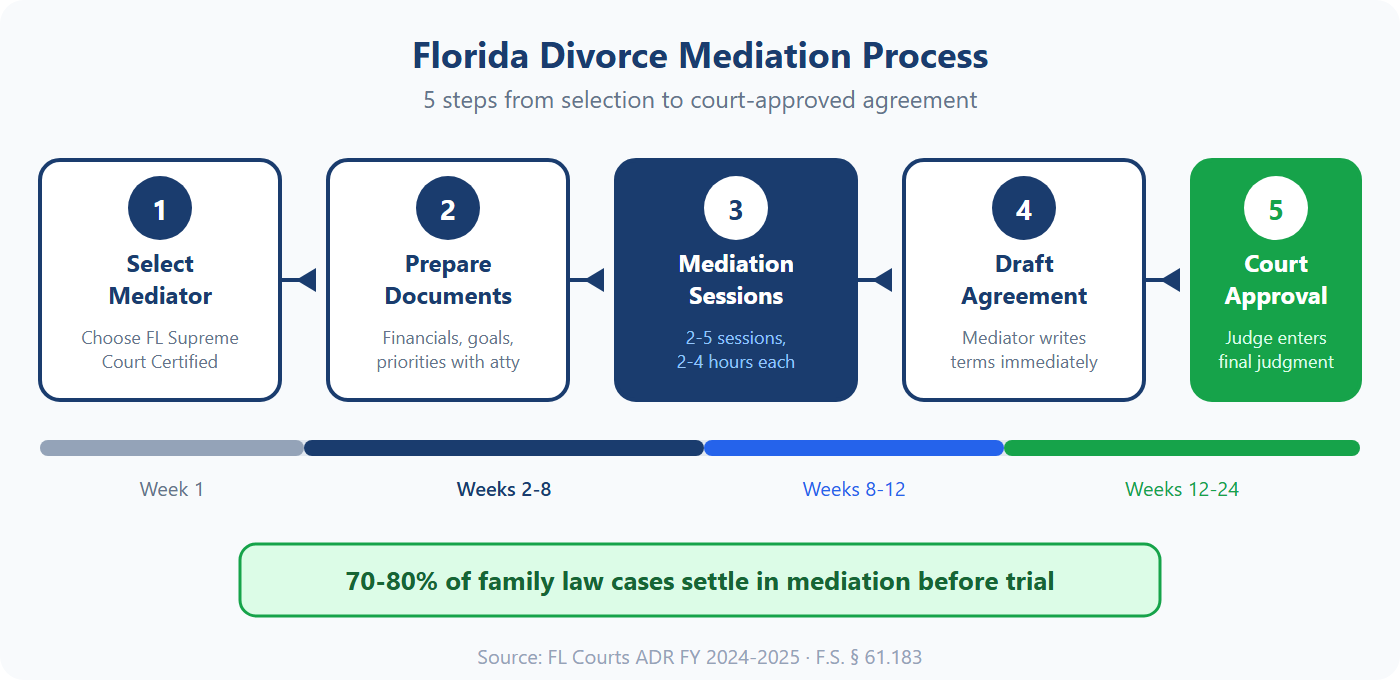
The American Bar Association identifies mediation as the most commonly used ADR method in family law courts nationwide [5]. In Florida, the process follows a structured sequence:
Step 1: Mediator selection. You can choose your own Florida Supreme Court Certified Family Mediator, or the court will assign one. Choosing your own mediator allows you to select someone with experience in the specific issues your case involves (complex property, business valuation, custody disputes).
Step 2: Preparation. Before the first session, gather your financial documents — tax returns, bank statements, retirement account statements, property records, and debt records. Your mediation attorney should review these with you and help you identify your priorities and negotiation boundaries.
Step 3: Mediation sessions. Sessions typically last 2-4 hours. The mediator opens with ground rules, then each party presents their perspective. The mediator may hold joint sessions or “caucus” (meet with each party separately) to explore settlement options. Most cases require 2-5 sessions.
Step 4: Agreement drafting. When the parties reach agreement on an issue, the mediator puts it in writing immediately. This prevents backsliding and ensures clarity. Partial agreements are common — you can resolve some issues in mediation and let the court decide the rest.
Step 5: Court approval. The signed mediation agreement is submitted to the court for approval. In most cases, the judge incorporates the agreement into the final divorce judgment, making it legally enforceable.
Once both parties agree on terms, the mediator drafts a written Marital Settlement Agreement (MSA) during the session. Florida Family Law Rules of Procedure 12.740(f) require that all agreements be memorialized in writing and signed by both parties and their attorneys before anyone leaves [8]. This protects against post-session backtracking.
After signing, the process continues:
The final hearing for an uncontested mediated divorce in Jacksonville is typically brief — often 10-15 minutes. The judge confirms both parties understand the agreement and entered it voluntarily. If children are involved, the judge also verifies the parenting plan meets Florida’s statutory requirements.
While mediation works for most divorcing couples, there are situations where it is not appropriate or effective:
If mediation fails or is not appropriate, the case proceeds to trial where the judge makes the final decisions. Having attempted mediation in good faith is never wasted — it often clarifies the real issues and narrows the disputes that the court needs to resolve.
Yes. Florida Family Law Rules of Procedure 12.740 and 12.741 authorize sanctions against any party who fails to appear at court-ordered mediation without good cause [8]. Consequences can include:
“Good cause” for missing mediation is narrow — a genuine emergency, serious illness, or a scheduling conflict with another court appearance. Simply not wanting to attend or disagreeing with the process does not qualify.
Two major pieces of legislation in 2023 fundamentally changed what gets negotiated in Florida divorce mediation [6]:
50/50 time-sharing presumption (Ch. 2023-301). Florida now presumes that equal time-sharing is in the best interest of the child. In mediation, this means the starting point for custody negotiations has shifted. The parent seeking more than 50% must present specific reasons why, rather than the other parent having to fight for equal time.
Alimony reform (SB 1416). Florida eliminated permanent alimony and capped all awards at 35% of the income difference between spouses. Durational alimony is now tied to strict marriage-length categories. In mediation, this means alimony negotiations have clearer boundaries — both parties know the statutory limits, which makes settlement more predictable.
Together, these reforms make mediation even more effective because the legal framework is now more structured and predictable. When both parties understand the likely court outcome, they have stronger incentives to negotiate a customized agreement rather than rolling the dice at trial.
Considering mediation for your Jacksonville divorce? Call (904) 396-5557 for a free consultation, or contact us online.
Related: Jacksonville Mediation Lawyer | Jacksonville Divorce Lawyer | Child Custody Lawyer
Most mediated divorces in Jacksonville resolve in 2-6 months, compared to 12-24 months for contested cases that go to trial. The actual mediation sessions typically require 2-5 sessions of 2-4 hours each, scheduled over several weeks. Simple cases with few contested issues can finish in a single session [2].
Yes, and you should. Florida law allows each party to have an attorney present during mediation sessions. Your attorney can advise you during caucuses, help you evaluate proposals, and ensure the final agreement protects your legal rights. Even if you attend without an attorney, have one review any agreement before you sign it.
If the parties cannot reach agreement on all issues, the mediator declares an impasse. The case then proceeds to trial, where the judge decides the unresolved issues. Partial agreements reached during mediation remain valid — the court only needs to decide what was not settled. Nothing said in mediation can be used against you at trial under F.S. § 44.405 [4].
Yes. Once both parties sign the mediation agreement and the court approves it, it becomes part of the final divorce judgment and is fully enforceable. Violating the terms can result in contempt of court, just like any other court order. This is why having an attorney review the agreement before signing is critical.
Yes. Under F.S. § 61.183, Florida courts must order mediation for all contested family law issues before trial [1]. Exceptions exist for cases involving domestic violence, emergencies, or prior good-faith mediation attempts that reached impasse. The court covers mediation costs for parties who cannot afford to pay.
Sources:
[1] Florida Legislature, F.S. § 61.183 — Mediation of Contested Issues. leg.state.fl.us
[2] Florida Courts, Alternative Dispute Resolution Statistics FY 2024-2025 (102,106 cases; 20,808 family). flcourts.gov
[3] Martindale-Nolo, Average Cost of Divorce in Florida (2024 survey data). nolo.com
[4] Florida Legislature, F.S. § 44.405 — Confidentiality of Mediation. leg.state.fl.us
[5] American Bar Association, Mediation in Family Law Cases. americanbar.org
[6] Florida Senate, CS/SB 1416 — Dissolution of Marriage (Ch. 2023-301, eff. July 1, 2023). flsenate.gov
[7] Florida Legislature, F.S. § 44.108 — Funding of Mediation and Arbitration. leg.state.fl.us
[8] Florida Courts, Mediation: The Basics (Rules 12.740-12.741, Florida Family Law Rules of Procedure). flcourts.gov
 ✓
✓Written by
Family Law Attorney & Partner, Sacks & Sacks