
Going through a divorce with children? Call (904) 396-5557 for a free consultation with an experienced Jacksonville family law attorney.
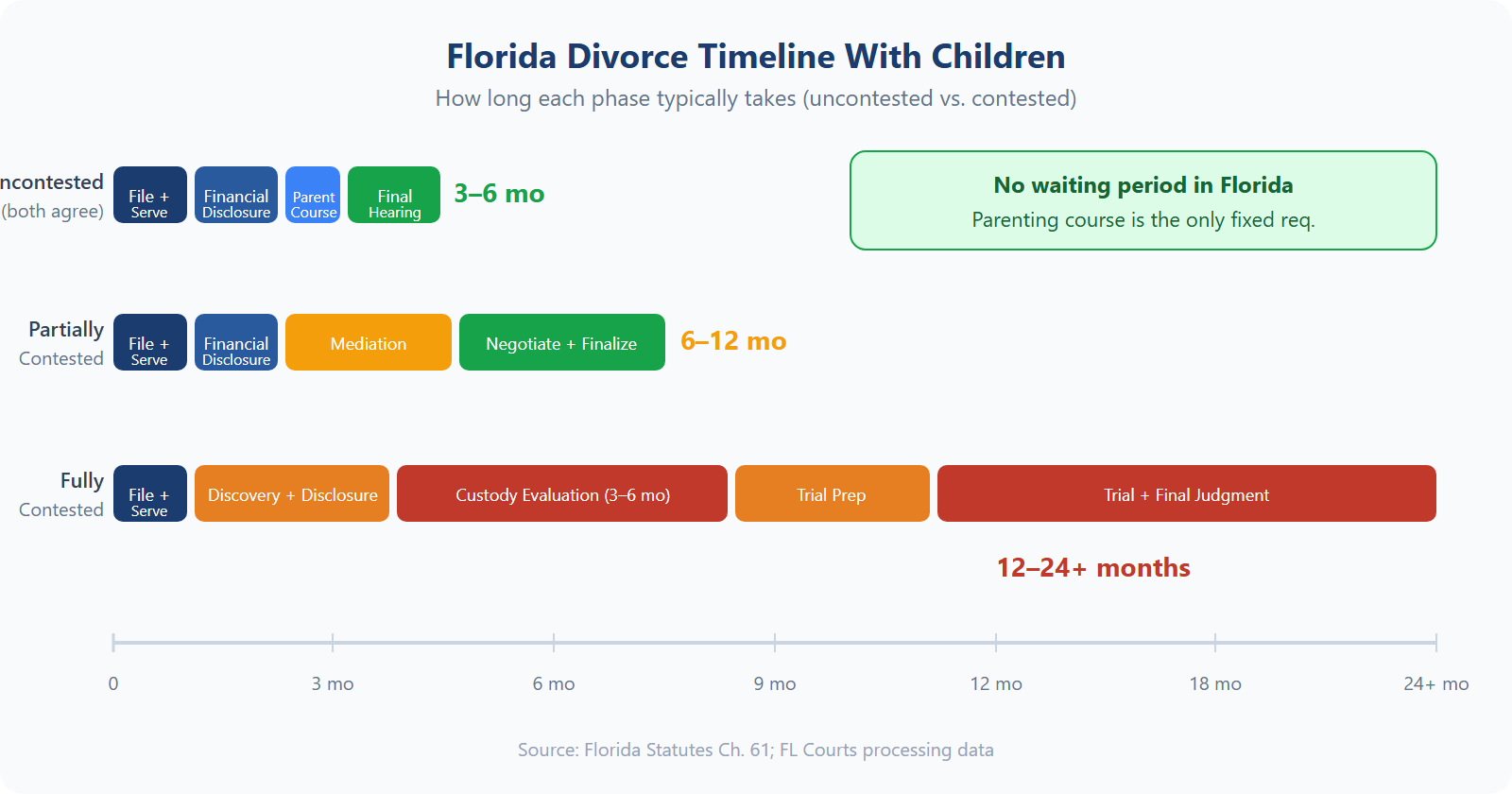
The timeline for a Florida divorce involving children depends primarily on whether the case is contested or uncontested. Children add complexity because the court must approve a parenting plan, calculate child support, and ensure the arrangement serves the child’s best interests under F.S. § 61.13. [1]
Here are realistic timelines for Florida divorces with children:
Compare this to a divorce without children, which can be finalized in as little as 30–60 days through simplified dissolution. The additional requirements when children are involved — parenting plans, parenting courses, support calculations, and potential custody evaluations — add months to the process.
Every divorce involving minor children in Florida must include a court-approved parenting plan. Under F.S. § 61.13, the parenting plan must address: [1]
Negotiating the parenting plan is often the most time-consuming part of a divorce with children. Even when parents generally agree, the details — who gets Thanksgiving, how summer is divided, who makes medical decisions — can take weeks or months to finalize.
Florida’s 2023 family law reform (Ch. 2023-301, effective July 1, 2023) established a rebuttable presumption of equal (50/50) time-sharing. [5] This has had a significant impact on divorce timelines involving children.
Cases that got shorter: When both parents accept the 50/50 starting point, negotiations focus on schedule logistics rather than whether equal time will happen at all. Many cases that would have been contested under the old system now resolve faster because the presumption removes the biggest source of disagreement.
Cases that got longer: When one parent wants to deviate from 50/50, they must now meet a higher burden of proof — “clear and convincing evidence” that equal time would be detrimental to the child. Building this case requires evidence, evaluations, and potentially expert testimony, which extends the timeline significantly.
The court still evaluates all 20 best-interest factors under F.S. § 61.13, but the starting point has shifted. In my experience since the reform took effect, the presumption has reduced timelines in cooperative cases and extended them in high-conflict ones.
When parents cannot agree on a parenting plan, the court may order a custody evaluation (also called a social investigation or parenting evaluation). This is one of the biggest contributors to delay in divorce cases with children. [1]
A typical custody evaluation timeline:
Total evaluation time: 3–6 months from court order to completed report. After the report is delivered, both sides need time to review, potentially depose the evaluator, and prepare for trial — adding another 1–3 months.
Florida law requires both parents to complete a court-approved Parent Education and Family Stabilization Course before the divorce can be finalized. [1] This is mandatory regardless of whether the divorce is contested or uncontested.
The course covers:
Most courses take 4 hours and are available online (approximately $25–$50 per person). While the course itself doesn’t add significant time, many parents delay completing it — and the court will not enter a final judgment until both parents submit proof of completion. Complete it early to avoid delays.
Child support in Florida is calculated using the Income Shares Model under F.S. § 61.30, which considers both parents’ combined net income and the number of overnights each parent has. [1]
The key factors in the calculation:
Under the 2023 reform, the 50/50 presumption means most cases start with equal overnights (182.5 each), which affects the support calculation. If both parents have equal time and similar incomes, child support may be minimal or even zero. This is a significant change from the pre-2023 landscape.
Child support disputes can add 1–3 months to the timeline, particularly when one parent is self-employed (requiring income verification) or when disagreements arise over imputed income.
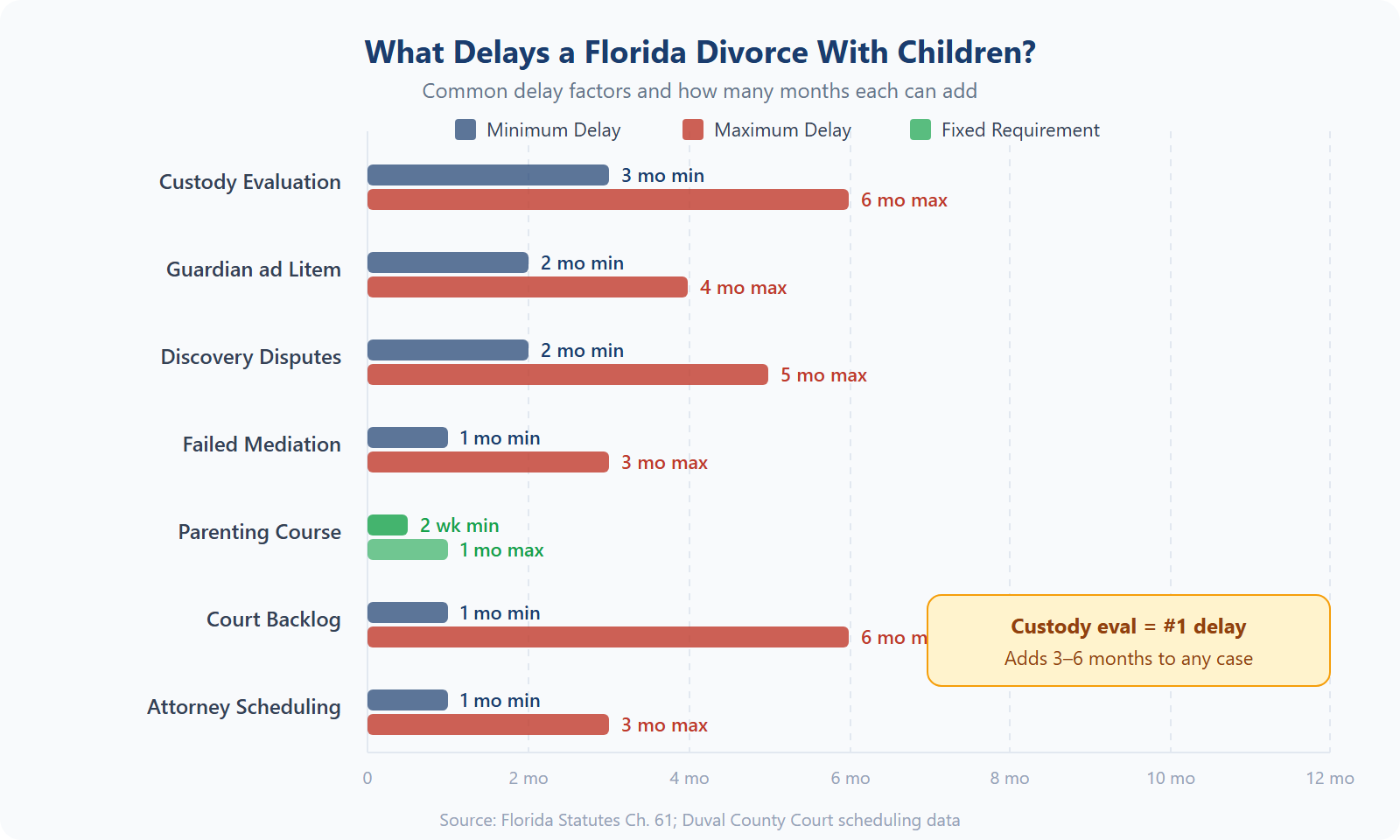
After 25 years of handling divorces with children in Jacksonville, these are the factors that cause the most significant delays: [1]
While you can’t control the court’s calendar, you can control several factors that determine how quickly your divorce is finalized: [1]

When children are involved, the stakes in a divorce are higher — and so is the cost of mistakes. Parenting plans, child support calculations, and the 50/50 presumption all require careful planning and knowledgeable representation.
I’ve been helping Jacksonville families navigate custody and divorce for over 25 years. As both a litigator and a Florida Supreme Court Certified Mediator, I know how to resolve child-related issues efficiently — whether at the negotiation table or in the courtroom.
Call (904) 396-5557 for a free consultation — or send us a message online.
An uncontested divorce with children typically takes 3–6 months in Florida. Both parents must agree on a parenting plan, child support, and all other issues. Both must also complete the mandatory parenting course. Florida has no waiting period, so the timeline depends primarily on court scheduling. [1]
No. Simplified dissolution under F.S. § 61.052(2) is only available to couples with no minor or dependent children and no pregnancy. If you have children, you must file a standard petition for dissolution of marriage, even if the divorce is uncontested. [1]
Since July 1, 2023, Florida presumes equal time-sharing is in the child’s best interest (Ch. 2023-301). If both parents accept 50/50, the parenting plan negotiation is faster. If one parent opposes it, they must present clear and convincing evidence, which typically requires evaluations and extends the timeline by 3–6+ months. [5]
The court will order mediation under F.S. § 61.183. If mediation fails, the judge may order a custody evaluation (3–6 months). After the evaluation, the case goes to trial where the judge decides the parenting plan based on the 20 best-interest factors under F.S. § 61.13. [1]
A full custody evaluation typically takes 3–6 months from the court order to the completed report. It includes individual parent interviews, home visits, psychological testing (if ordered), collateral interviews with teachers and therapists, and a written report with recommendations. [1]
Yes. Both parents must complete a court-approved Parent Education and Family Stabilization Course before the divorce can be finalized. The course takes approximately 4 hours and is available online for $25–$50. The court will not enter a final judgment until both parents submit proof of completion. [1]
Florida uses the Income Shares Model under F.S. § 61.30. The calculation considers both parents’ net incomes, number of overnights (73-night threshold for substantial time-sharing), health insurance costs, daycare, and uncovered medical expenses. Under the 50/50 presumption, many cases start with equal overnights, which affects the calculation. [1]
Sources:
[1] Florida Statutes, Chapter 61 — Dissolution of Marriage; Support; Time-Sharing. flsenate.gov
[2] Centers for Disease Control and Prevention, Stats of the States — Divorce Rates (2023 Data). cdc.gov
[3] Florida Courts, Alternative Dispute Resolution Report, FY 2024-2025. flcourts.gov
[4] Duval County Clerk of Courts, Fee Schedules. duvalclerk.com
[5] Florida Senate, SB 1416 — Dissolution of Marriage (Ch. 2023-301). flsenate.gov
 ✓
✓Written by
Family Law Attorney & Partner, Sacks & Sacks