

Of everything that predicts whether a marriage lasts, one of the strongest signals is also the simplest: how old the couple was on the wedding day. Marry as a teenager and the odds turn against you before married life has really begun.
Teenagers rarely marry in the United States anymore. The small share who do still face some of the steepest divorce odds of any age group.
This page gathers current, sourced data on how often teen marriages end, why they carry extra risk, and how those numbers have shifted over the past three decades.
Marrying young is one of the biggest risk factors for an early divorce. CDC data shows that 48% of first marriages among women who married before age 18 had broken up within 10 years, compared with just 24% of women who married at 25 or older.[1] That gap is close to two to one.
The same national survey found that about one in five first marriages of any age end within five years.[1] For teen couples, that early window is where most of the damage happens, before finances, education, and emotional maturity have caught up with the commitment.
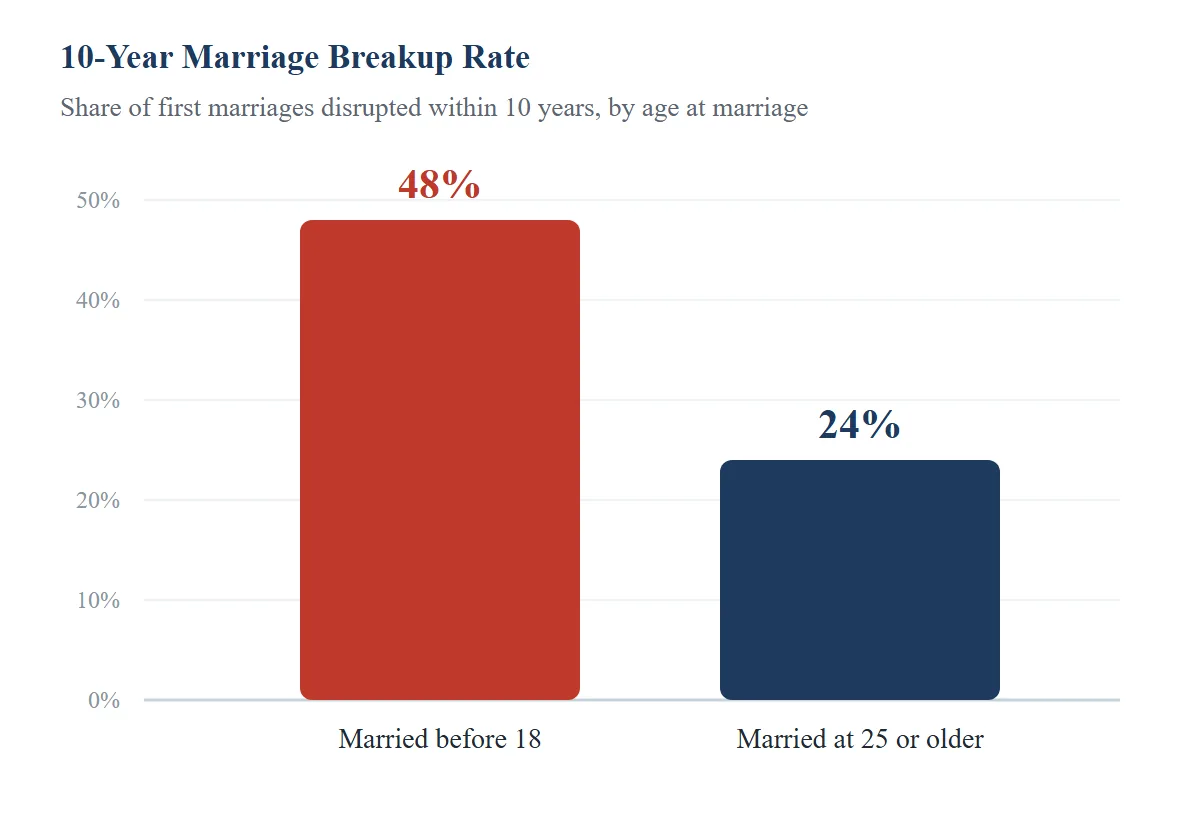
Source: CDC/NCHS, First Marriage Dissolution, Divorce, and Remarriage (Bramlett & Mosher). Women, share of first marriages disrupted within 10 years.
Age is only part of the story. Education tracks closely with marital stability: women with a bachelor’s degree had a first-divorce rate of 13.2 per 1,000, and those with a master’s or higher sat at 11.5, well below the 18.7 rate for women with some college but no degree.[5] Teens who marry young often pause their education, removing one of the clearest protective factors.
Several pressures stack up at once for couples who marry in their teens:
None of these guarantees a split. Together, though, they explain why a marriage started at 17 carries more risk than the same marriage started at 27.

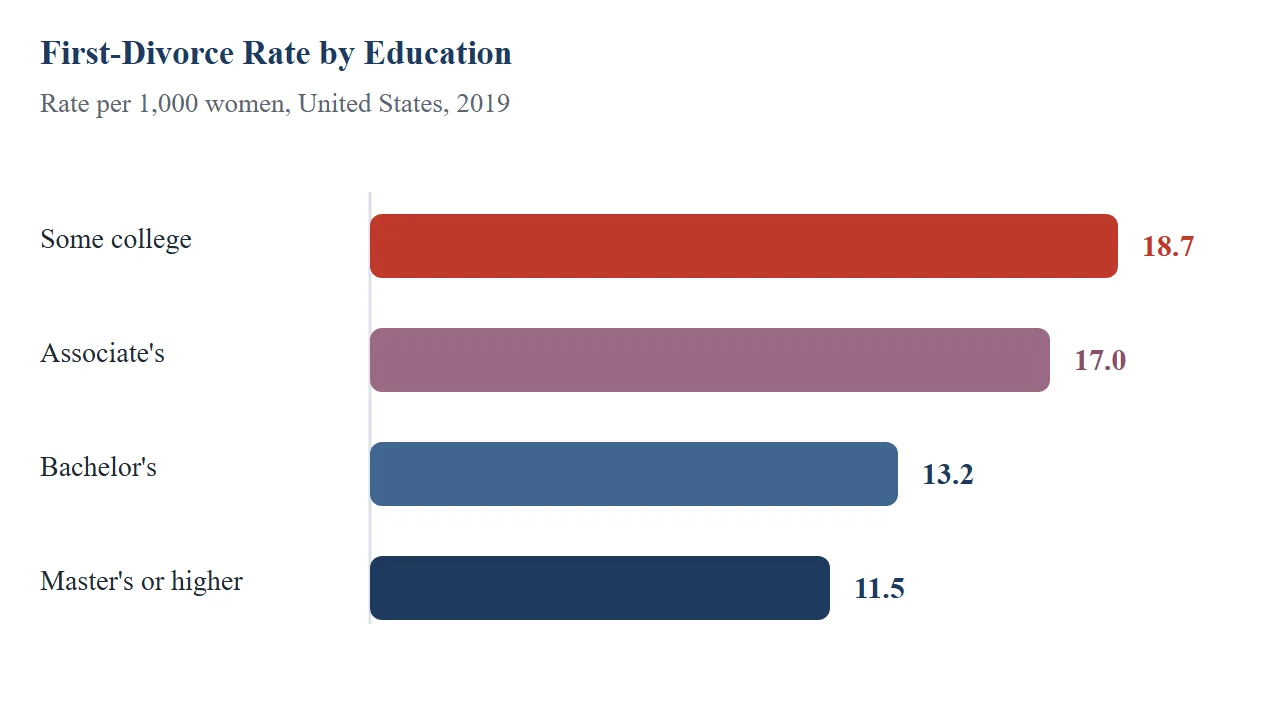
Source: BGSU National Center for Family & Marriage Research, First Divorce Rate in the U.S., 2019 (FP-21-10).
Despite the alarming headlines, young divorce is dropping, not climbing. The refined divorce rate for people aged 15 to 24 fell from 47.2 per 1,000 in 1990 to 19.2 in 2023, the sharpest decline of any age group, according to Bowling Green State University’s family research center.[2] The overall U.S. rate slipped from 19 to 13.7 over the same period.[2]
Why the drop? Fewer teens marry in the first place, and the ones who wait tend to be more stable when they do. The median age at first marriage climbed to 30.2 for men and 28.6 for women in 2024, up from 23.1 and 21.1 back in 1974.[3]
So the pool of teen marriages has shrunk, and later marriage has become the norm. That combination pulls the young-divorce rate down even as public attention on teen divorce stays high.
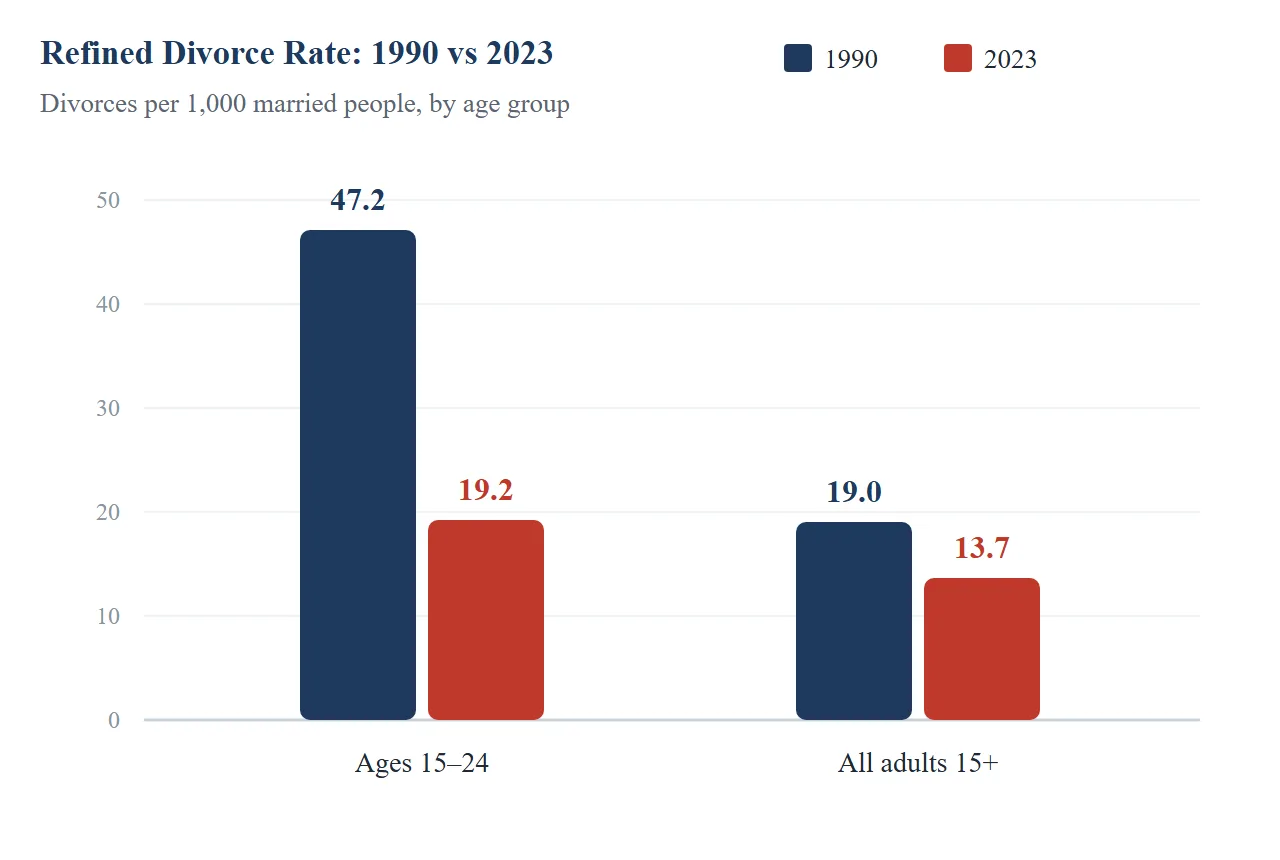
Source: BGSU National Center for Family & Marriage Research, Age Variation in the Refined Divorce Rate, 1990 & 2023 (FP-25-24).
Among young married couples, wives are far more likely to be the ones asking out. Stanford research presented to the American Sociological Association found that women initiated 69% of divorces, versus 31% for men.[4] Notably, that gap vanished for unmarried couples, where breakups split evenly by gender.
Researchers tie the pattern to how young women experience marriage itself. Many report more dissatisfaction with the division of labor and emotional support, and they tend to voice it sooner. Young husbands, by contrast, often delay a decision until they feel more settled financially.
Teen marriage is rarer than most people assume, but it has not disappeared. Advocacy group Unchained At Last documented nearly 315,000 children, some as young as 10, married in the U.S. between 2000 and 2021, most of them girls wed to adult men.[6] Most of those unions happened at ages 16 and 17 with parental consent.
The legal picture is shifting quickly. A growing number of states have banned marriage under 18 with no exceptions, starting with Delaware and New Jersey in 2018. As of 2026, though, some form of minor marriage still remains legal in many states, usually requiring parental or judicial approval.[6]
Because these laws change with nearly every legislative session, the exact count of states allowing it is a moving target. Anyone weighing a marriage involving a minor should confirm the current rule in their own state.
When one of these early marriages needs to end, the route is not always a standard divorce. Annulment and divorce follow separate legal tests, and which one applies depends on the state and the circumstances of the marriage.
A divorce in the teen years lands during a period when identity, finances, and social life are all still forming. Young people who go through it often deal with disrupted schooling, unstable housing, and strained support networks at the exact moment they need stability most.
The good news is that outcomes improve sharply with the right help. Access to counseling, a steady living situation, and legal guidance on custody, support, and keeping conflict from escalating can blunt the long-term fallout.
Where children are involved, a clear parenting plan matters even more than in a typical divorce, because both parents are still building their own adult lives. Understanding how divorce affects children at different ages helps parents choose the right approach.

Whether the marriage started young or not, the legal questions around property, support, and children are the same, and they are easier to handle with guidance.
Call (904) 396-5557 or reach the family-law team at Sacks & Sacks for a free consultation.
CDC data shows that 48% of first marriages of women who married before age 18 had broken up within 10 years, compared with 24% of women who married at 25 or older.[1] Marrying as a teenager roughly doubles the odds of an early divorce.
They are falling. The refined divorce rate for people aged 15 to 24 dropped from 47.2 per 1,000 in 1990 to 19.2 in 2023, the largest decline of any age group, according to Bowling Green State University’s National Center for Family and Marriage Research.[2]
In 2024 the median age at first marriage was 30.2 for men and 28.6 for women, per the U.S. Census Bureau.[3] That is up from 23.1 and 21.1 in 1974, which is a big reason teen marriage has become uncommon.
Women initiate about 69% of divorces, versus 31% for men, according to Stanford research presented to the American Sociological Association.[4] The gender gap disappears for unmarried couples who break up.
It depends on the state. A growing number of states have banned marriage under 18 outright, but as of 2026 some form of minor marriage stays legal in many states, usually with parental or judicial approval, according to advocacy group Unchained At Last.[6]
Statistics reflect the most recent data available from each source at the time of writing.
 ✓
✓Reviewed by
Family Law Attorney & Partner, Sacks & Sacks