

Every parent hopes to protect their child’s well-being during divorce or separation, but legal steps can quickly feel overwhelming in Jacksonville, Florida. Getting custody right means more than just heartfelt intentions—it requires organized documentation and understanding local court procedures.
This guide breaks down each stage, from compiling records that show your parenting involvement to consulting knowledgeable attorneys and securing clear custody orders, so you can feel confident about your family’s next chapter.
Building a strong custody case starts with organized, detailed records that show your involvement in your child’s daily life. The court needs to see concrete evidence of your relationship with your child, not just hear your words about it.
Start by collecting parenting time records. Keep a calendar tracking when your child is with you, what activities you did together, and any significant moments. This doesn’t need to be elaborate—notes about school pickups, weekend outings, or helping with homework are exactly what judges want to see.
Next, gather school and extracurricular records. Collect report cards, progress reports, and documentation of your participation in school events. If you’re involved in coaching, volunteering at the school, or attending conferences, keep records of these activities. Enrollment confirmations for sports, music lessons, or other programs also strengthen your case.
Collect medical and health documentation. You’ll need:
Financial documentation is critical. Gather tax returns, pay stubs, bank statements, and records of child support or alimony payments. Courts use this to understand your ability to support your child and your financial responsibility.
Document the child’s well-being through observations. Keep detailed notes about your child’s emotional state, behavior changes, academic progress, and social relationships. Documentation in child custody cases shows that these personal observations help evaluators and mediators understand the daily parent-child relationship.
Organize everything chronologically in labeled folders or binders. Digital copies are helpful too—email yourself important documents as backup.
Here’s a summary of key documentation types and their significance in a custody case:
| Documentation Type | What It Demonstrates | Recommended Approach |
|---|---|---|
| Parenting Time Records | Consistent involvement in daily life | Keep detailed, dated notes |
| School & Extracurricular | Parental engagement in education | Save official school documents |
| Medical & Health Records | Attention to health and well-being | Organize by date and provider |
| Financial Documentation | Ability to support a child | Maintain chronological order |
| Personal Observations | Child’s emotional and social status | Record significant changes |
Pro tip: Start gathering documentation now, even before you need it for court, so you build a complete record that reflects your genuine involvement over time rather than scrambling to reconstruct activity after a dispute begins.
Hiring an attorney transforms your custody case from a personal battle into a legally sound strategy. A family law lawyer knows Florida’s custody laws, court procedures, and what judges actually look for when making decisions.
Start by scheduling initial consultations. Most family law firms offer free or low-cost first meetings. Use this time to discuss your situation, ask about their experience with custody cases, and understand their fee structure. Prepare a brief summary of your custody situation before you go so the attorney can assess your case efficiently.
When meeting with potential attorneys, look for specific qualities. You want someone with Florida custody experience, preferably in Jacksonville or Northeastern Florida. Ask how many custody cases they’ve handled, what their typical outcomes are, and whether they’ve worked with cases similar to yours. Their local knowledge matters.
Discuss the types of services they offer:
Ask your attorney about mediation versus litigation. Many custody cases resolve through mediation, which is faster and less expensive than court. Your lawyer can advise whether mediation makes sense for your situation or if court representation is necessary.
The following table outlines differences between Mediation and Litigation in Florida custody cases:
| Process | Control Over Outcome | Cost & Time | Atmosphere |
|---|---|---|---|
| Mediation | More parent input | Lower cost, quicker | Cooperative |
| Litigation | Judge decides outcome | Higher cost, longer | Adversarial |
Understand the costs upfront. Ask about hourly rates, retainer fees, and whether you’ll get a payment plan. Some attorneys offer flexible arrangements for clients managing financial stress during divorce.
Once you’ve hired an attorney, be honest and thorough. Share all relevant information, even details that make you uncomfortable. Your lawyer works best when they know the full picture and can prepare accordingly.
Filing your custody petition correctly is a critical turning point. One procedural mistake can delay your case or create legal complications, so accuracy and attention to detail matter here.
Start by obtaining the correct forms. Florida requires specific petition documents for custody cases. Your attorney or the court clerk can provide these forms. The main document is typically the Petition for Parental Responsibility, Custody, and Timesharing. Make sure you have the current version, as court forms change periodically.
Fill out the petition with complete, accurate information. Include your name, address, and contact details, along with the other parent’s information and your child’s details. Be thorough and honest. Courts verify information, and inaccuracies raise red flags.
The petition must include:
Pay the required filing fee or submit a fee waiver request if you cannot afford it. Jacksonville courts accept both, so financial constraints won’t prevent you from filing. Ask the clerk about current fee amounts and payment methods.
Submit your petition to the correct court. In Duval County, this is typically the Family Court division. Your attorney handles this, or you can file in person at the courthouse. Keep copies for your records.
After filing, you must serve the other parent with notice of the petition. This means they receive official notification of your custody action. Service requirements vary, so confirm the proper procedure with the court or your attorney. Filing custody petitions requires following specific procedural requirements to ensure the court can consider your case.
Negotiation is where you shape the actual agreement that will govern your relationship with your child. This step requires a strategic mindset focused on reaching terms that work for your family.
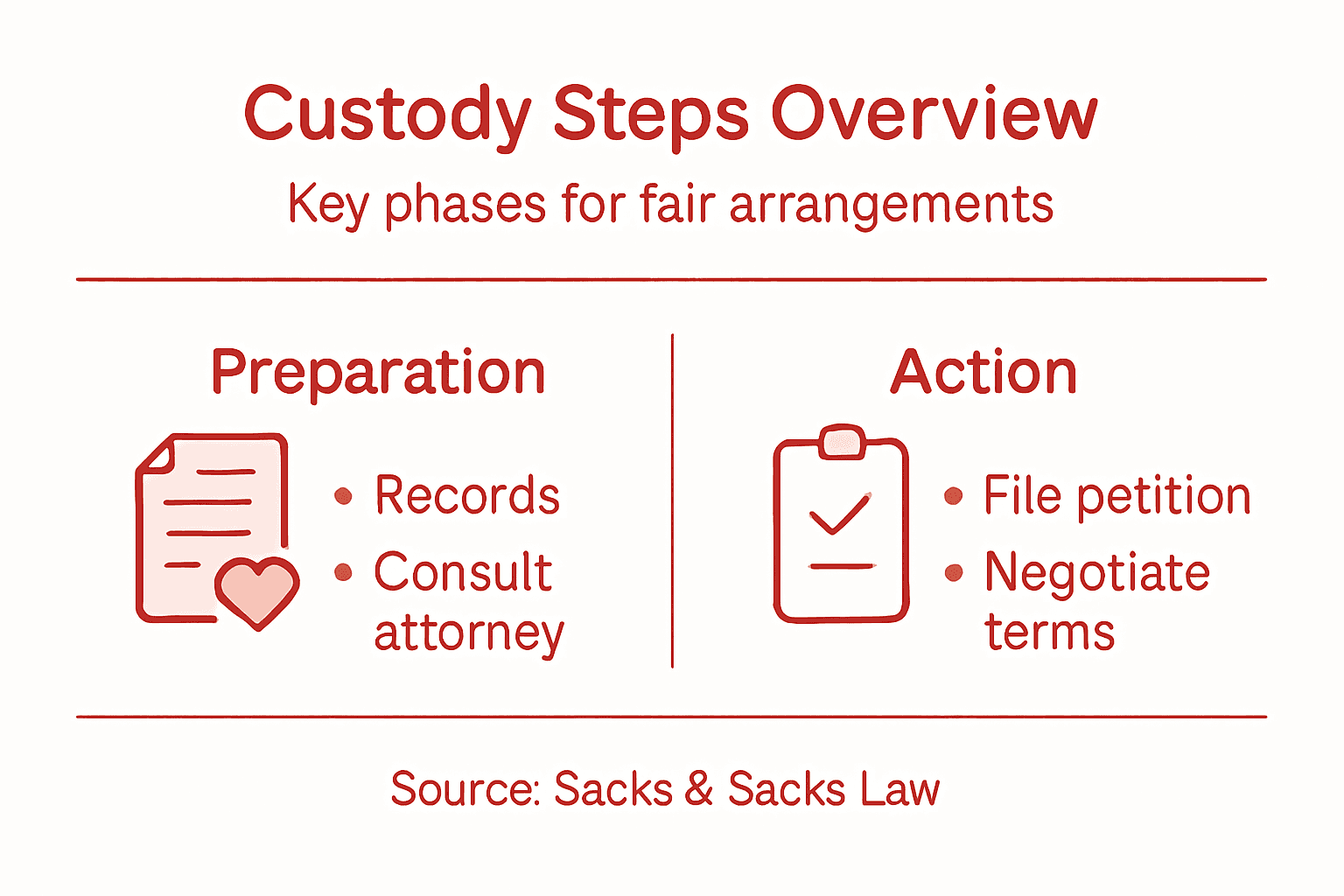
Start by identifying your priorities. What matters most to you? Is it overnight time with your child, flexibility during school breaks, or input on major decisions? Distinguish between non-negotiable needs and areas where you can compromise. Your attorney can help you evaluate what’s realistic given Florida law and your situation.
Understand what a fair parenting plan looks like. Most plans address timesharing schedules, decision-making authority, and how you’ll handle communication about your child. Having clear expectations prevents misunderstandings later.
Approach negotiation with strategic thinking:
Use collaborative problem-solving instead of adversarial tactics. When both parents cooperate toward shared goals, you avoid the time and expense of court litigation. Effective negotiation in custody disputes relies on focusing on mutual interests rather than positions, creating better outcomes for everyone.
Consider working with a mediator if direct negotiation gets stuck. Mediators are neutral third parties who help both sides find common ground. Many custody cases resolve this way without ever seeing a judge.
Document every agreement you reach. Write it down clearly so there’s no confusion later about what you both agreed to. Your attorney can help formalize this into a proper parenting plan.
Pro tip: Come to negotiations prepared with specific proposals and backup options, showing the other parent you’re serious and organized, which often encourages reciprocal professionalism and faster agreement.
You’re nearly done. This final step ensures your custody order is legally sound, clearly written, and ready to guide your family forward for years to come.
Start by carefully reviewing the complete custody order before you sign anything. Read every word. Does it match what you agreed to? Are the timesharing schedules accurate? Does it address decision-making authority, transportation, and communication expectations? Don’t rush this part. Small mistakes now become big headaches later.
Check that the order includes all necessary details:
Make sure the language is clear and unambiguous. Vague terms like “reasonable visitation” cause disputes. Instead, look for specific schedules like “Tuesday and Thursday evenings from 6:00 p.m. to 8:00 p.m.” Ask your attorney to explain anything you don’t fully understand before signing.
Verify the order’s enforceability. A properly finalized custody order should clearly specify all terms so both parents know exactly what’s required and courts can enforce it if needed.
Sign the order only after you’re completely satisfied. Both parents and the judge must sign for it to become official. Once signed, it becomes a legal document binding on both of you.
Keep multiple copies in safe places. Store originals somewhere secure, and keep copies with your important documents and your attorney. You may need to present the order to schools, healthcare providers, or employers.
Pro tip: Request certified copies of the finalized order from the court clerk immediately after it’s signed, as schools and medical providers often require official court copies rather than photocopies.
Navigating child custody can feel overwhelming as you gather crucial documentation and work to present your case clearly. When stakes are this high, having experienced guidance can make all the difference in avoiding costly mistakes and emotional stress.
At Sacks & Sacks Law, our dedicated family law attorneys bring over 50 years of combined experience helping families in Jacksonville and Northeastern Florida achieve fair custody arrangements. From thorough case preparation to expert negotiation and clear custody order finalization, we stand by your side to turn complex legal processes into manageable steps.
Don’t wait until uncertainty clouds your future. Call us at (904) 396-5557 to schedule your free child custody consultation and take decisive action toward the custody outcome your child deserves.
To build a strong custody case, gather essential documents such as parenting time records, school and extracurricular records, medical documentation, financial statements, and personal observations about your child’s well-being. Organize this documentation chronologically in folders or binders to present a clear picture of your involvement.
To negotiate custody terms effectively, identify your priorities and focus on your child’s best interests. Approach the negotiation with a calm and collaborative mindset, listening to the other parent’s needs and proposing creative solutions that benefit both parties.
During the custody petition filing process, obtain the correct court forms and fill them out completely. Ensure you include grounds for requesting custody, your proposed parenting plan, and any existing arrangements. Double-check for accuracy before submitting to avoid delays.
You should consult with an attorney as soon as possible, especially before filing your custody petition. An attorney will guide you through the legal requirements, help you understand your rights, and provide representation for negotiations or court proceedings.
To ensure your custody order is enforceable, carefully review the document for clarity and completeness before signing. Include specific terms regarding timesharing, decision-making authority, and communication expectations, as ambiguous language can lead to future disputes.
Mediation in custody disputes offers a cooperative approach that allows both parents to work together toward a shared solution. This process is generally quicker and less expensive than litigation, helping to reduce stress for everyone involved.
 ✓
✓Reviewed by
Family Law Attorney & Partner, Sacks & Sacks