

Questions about child support with joint custody? Call (904) 396-5557 for a free consultation with an experienced Jacksonville family law attorney.
No. This is one of the most common misconceptions in Florida family law. Florida uses the Income Shares Model under F.S. § 61.30, which calculates child support based on both parents’ combined net income and the number of overnights each parent has. [1]
Child support only reaches $0 when both of these conditions are true:
In reality, this almost never happens. Even a $500/month income difference between parents with perfect 50/50 time-sharing results in a child support obligation. The higher earner pays the lower earner to equalize the child’s standard of living in both homes.
Florida’s Income Shares Model follows a specific formula under F.S. § 61.30 that considers five key inputs: [1]
The guidelines schedule is not a simple percentage. For example, for one child with combined net income of $5,000/month, the combined support obligation is approximately $931/month. For two children, it’s approximately $1,365/month. [1]
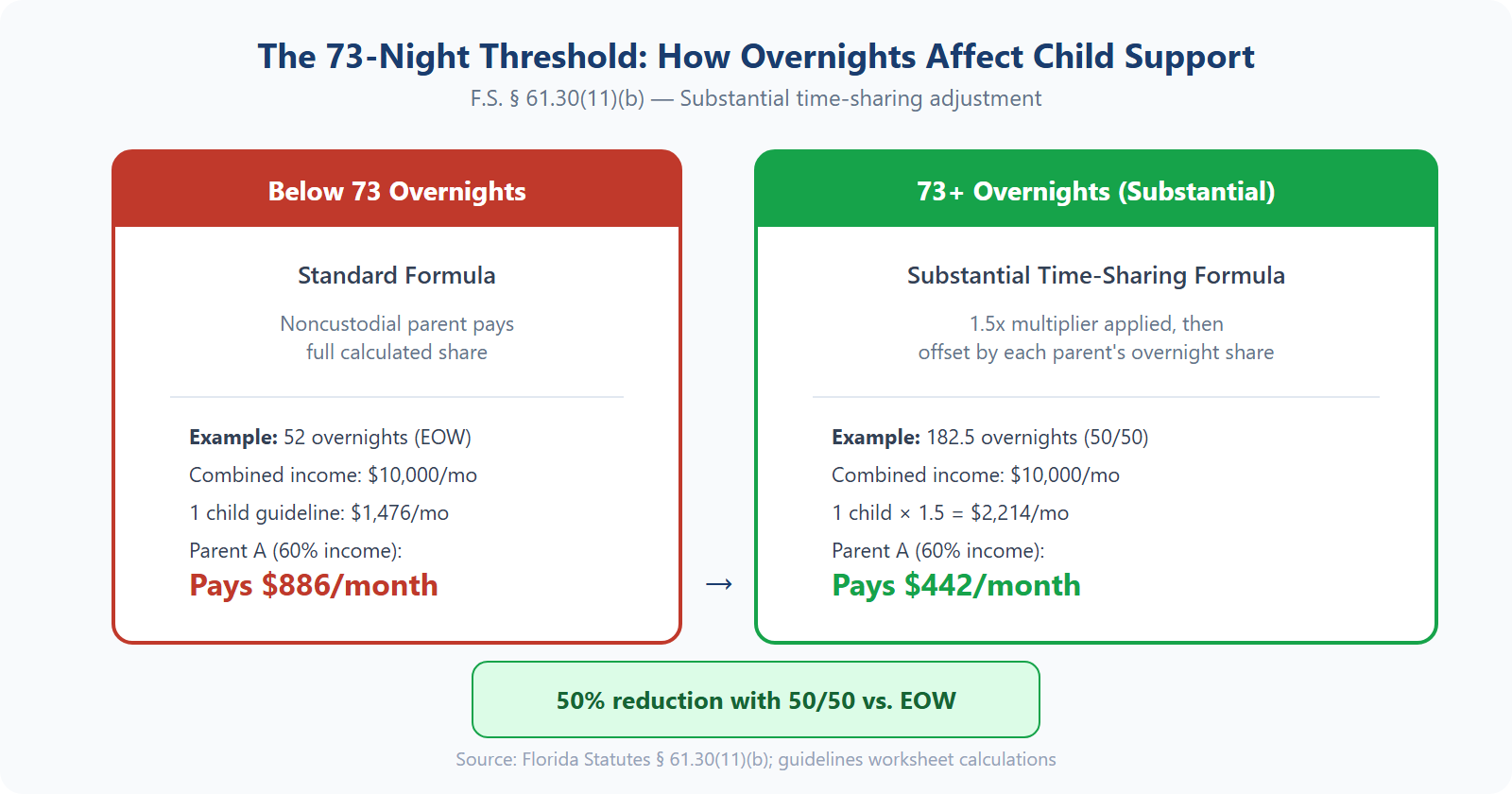
The 73-night threshold is the key number in Florida child support calculations involving shared custody. Under F.S. § 61.30(11)(b), when a parent exercises at least 73 overnights per year (20% of annual overnights), the court applies the “substantial time-sharing” formula, which reduces the support obligation. [1]
Here’s how it works:
The formula doesn’t just reduce support proportionally. It uses a multiplier (1.5) applied to the guidelines amount, then subtracts each parent’s share based on their percentage of overnights. The math is complex, which is why Florida courts use a child support guidelines worksheet rather than rough calculations.
Here’s a simplified example showing how child support works with equal time-sharing in Florida: [1]
Scenario: One child, 50/50 custody (182.5 overnights each)
Substantial time-sharing calculation:
Even with perfectly equal time, the $2,000/month income gap results in $442/month in child support. The higher-earning parent always pays — regardless of which parent is the “father” or “mother.” Florida’s guidelines are gender-neutral.
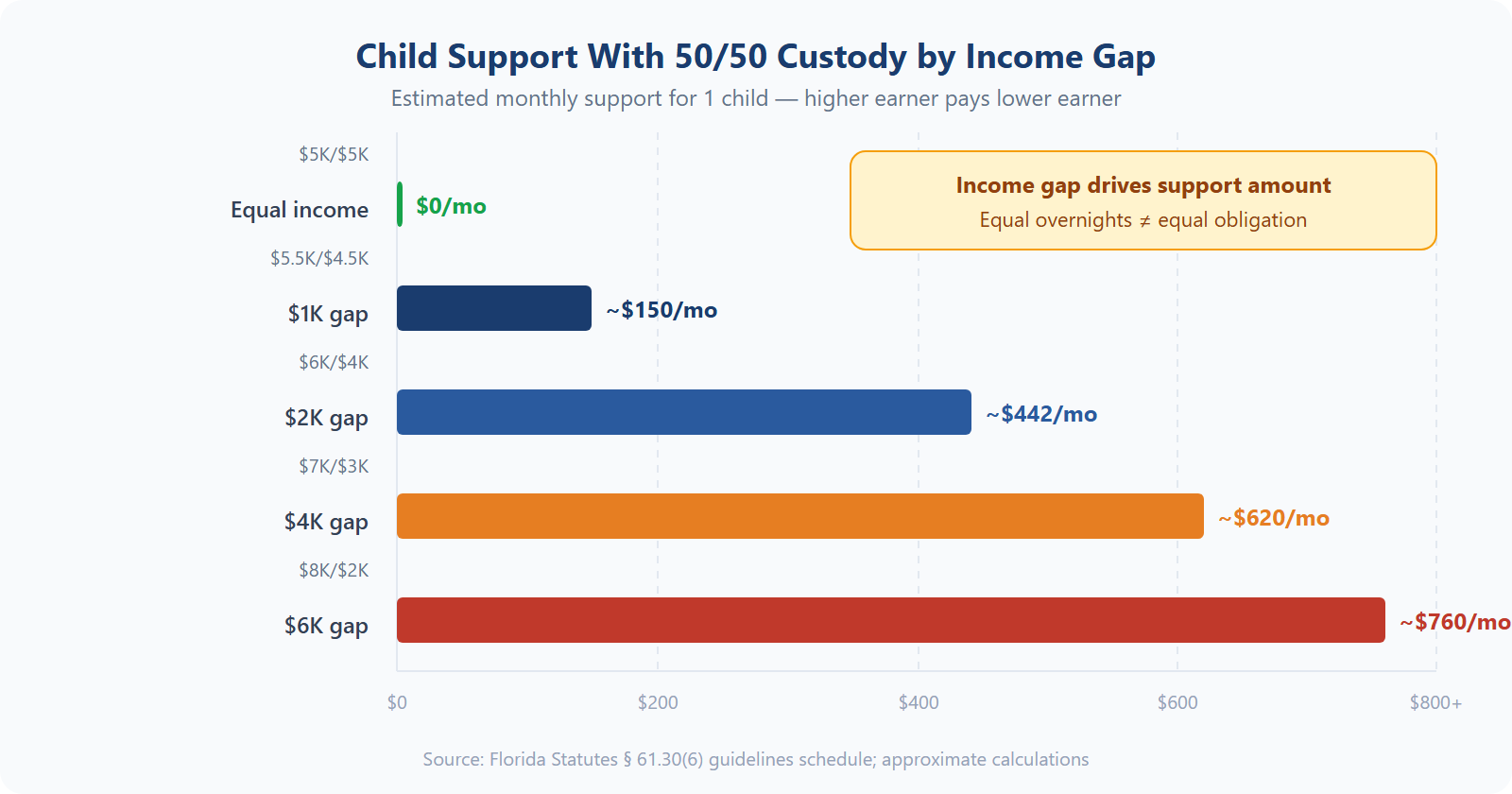
Zero child support with equal time-sharing only occurs in narrow circumstances: [1]
Important: even when parents agree to $0 support, the right to child support belongs to the child, not the parent. A parent cannot permanently waive the child’s right to support. Either parent can petition to establish or modify support at any time if circumstances change.
The monthly child support payment is only one part of the financial picture. Florida law also requires parents to share several additional child-related expenses: [1]
These additional costs can equal or exceed the basic child support amount — and they apply regardless of the custody arrangement. Even parents with zero basic support still share these expenses.
Florida’s 2023 family law reform (Ch. 2023-301, effective July 1, 2023) established a rebuttable presumption of equal time-sharing. [4] This has significant implications for child support:
Before the reform: Most custody arrangements gave one parent majority time (60-70% or more). This meant the other parent almost always paid standard (not substantial time-sharing) child support, resulting in higher payments.
After the reform: With 50/50 as the presumed starting point, more parents qualify for the substantial time-sharing adjustment (73+ overnights). This generally reduces — but does not eliminate — child support obligations.
The practical impact: parents who previously would have had every-other-weekend arrangements (52 overnights — below the 73-night threshold) now start at 182.5 overnights. This shifts them from the standard calculation to the substantial time-sharing calculation, which is more favorable to the higher-time parent. [4]
Yes. Under F.S. § 61.14, child support can be modified when there is a “substantial change in circumstances” that is permanent, involuntary, and material. [1]
Changes that commonly justify modification:
To modify support, you must file a Supplemental Petition for Modification. The new calculation uses the same guidelines formula with updated income and overnight figures.
Child support calculations with joint custody are more complex than most parents realize. The 73-night threshold, the substantial time-sharing multiplier, and the interaction between income and overnights all affect the final number. Getting it wrong — either too high or too low — affects your child’s welfare and your financial stability for years.
I’ve been calculating child support in Jacksonville for over 25 years. Whether you’re negotiating an initial support order or seeking a modification after a custody change, I’ll make sure the math is right and the arrangement is fair.
Call (904) 396-5557 for a free child support consultation — or send us a message online.
No. Equal time-sharing reduces child support through the substantial time-sharing formula, but the higher-earning parent still pays unless both parents have identical incomes. A $2,000/month income gap with one child and 50/50 custody results in approximately $442/month in support. [1]
Under F.S. § 61.30(11)(b), when a parent has 73 or more overnights per year (20% of annual overnights), the court applies the “substantial time-sharing” formula. This reduces — but rarely eliminates — the child support obligation by accounting for direct costs the overnight parent incurs. [1]
Parents can agree to $0 child support, but the court must approve. Judges will only approve if both households can adequately provide for the child. The right to support belongs to the child, not the parent — so either parent can petition to establish support later regardless of any prior agreement. [1]
The 50/50 presumption (Ch. 2023-301) means more parents now qualify for the substantial time-sharing adjustment (73+ overnights). Before the reform, many parents had fewer than 73 overnights and paid higher standard support. The reform generally reduced support amounts in cooperative cases. [4]
Beyond monthly support, parents share health insurance costs, uncovered medical and dental expenses, childcare costs, and extraordinary expenses (special needs, private school, extracurriculars). These are typically split proportionally based on each parent’s income. [1]
Yes. Under F.S. § 61.14, support can be modified when there is a substantial change in circumstances — including income changes (15% or $50/month threshold), changes in overnights (especially crossing the 73-night threshold), or changes in the child’s needs. [1]
Yes. Florida’s child support guidelines are completely gender-neutral. The higher-earning parent pays support to the lower-earning parent regardless of whether they are the mother or father. The calculation is based solely on income and overnights. [1]
Sources:
[1] Florida Statutes, § 61.30 — Child Support Guidelines. flsenate.gov
[2] U.S. Census Bureau, Custodial Mothers and Fathers and Their Child Support: 2019. census.gov
[3] Florida Department of Revenue, Child Support Guidelines Worksheet. floridarevenue.com
[4] Florida Senate, SB 1416 — Dissolution of Marriage (Ch. 2023-301). flsenate.gov
 ✓
✓Written by
Family Law Attorney & Partner, Sacks & Sacks