
Bottom line: Florida is a pure no-fault divorce state: the only ground for divorce is that the marriage is “irretrievably broken” under F.S. § 61.052. You don’t need to prove adultery, abuse, or any wrongdoing.
According to the CDC, Florida recorded approximately 75,783 divorces in 2023, and virtually all of them were filed on no-fault grounds. [1] Call (904) 396-5557 to discuss your divorce options with a Jacksonville family law attorney.
Considering a no-fault divorce in Jacksonville? Call (904) 396-5557 or contact us online to schedule a consultation.
A no-fault divorce means neither spouse has to prove the other did anything wrong to end the marriage. Under F.S. § 61.052, the only ground for dissolution of marriage in Florida is that the marriage is “irretrievably broken.”
All 50 states now allow no-fault divorce, but Florida is one of 19 states that are pure no-fault, meaning fault-based grounds like adultery, cruelty, or abandonment simply don’t exist as legal options. [2]
This is a significant distinction. In states that offer both fault and no-fault options (like New York or Virginia), one spouse can file on fault grounds to gain an advantage in property division or alimony.
In Florida, fault is irrelevant to the grounds for divorce, though certain behaviors like adultery or dissipation of marital assets can still influence equitable distribution and alimony decisions.
The practical impact: either spouse can file for divorce at any time, for any reason, without the other spouse’s consent. If one spouse testifies that the marriage is irretrievably broken, the court must grant the divorce, even if the other spouse disagrees.
Filing a no-fault divorce in Florida requires meeting specific statutory requirements. The Duval County Clerk of Courts processes thousands of divorce petitions annually, and the process follows a predictable path regardless of whether the divorce is contested or uncontested. [3]
Residency requirement: At least one spouse must have been a Florida resident for at least 6 months before filing (F.S. § 61.021). Residency can be proven with a Florida driver’s license, voter registration, or affidavit from a third party.
Filing the petition: The petitioner files a Petition for Dissolution of Marriage (Form 12.901) with the circuit court in the county where either spouse resides. In Duval County, the filing fee is $409.
Serving the other spouse: The respondent must be formally served with the petition. Options include personal service by a process server or sheriff, service by certified mail, or constructive service by publication if the spouse can’t be located.
Mandatory disclosures: Both spouses must exchange full financial affidavits within 45 days of service (Florida Family Law Rule 12.285). This includes income, expenses, assets, and liabilities.
Parenting course: If minor children are involved, both parents must complete a 4-hour Parent Education and Family Stabilization Course under F.S. § 61.21 before the final hearing.
Waiting period: Florida has no mandatory waiting period for divorce. Unlike states that require 30-90 days between filing and finalization, Florida allows an uncontested divorce to be finalized as soon as all requirements are met, sometimes within 30 days.
The distinction between no-fault and fault divorce is one of the most commonly misunderstood aspects of family law. According to the American Bar Association, the shift to no-fault divorce began with California in 1969, and by 2010 all 50 states had adopted some form of no-fault grounds. [4]
No-fault divorce (Florida’s system):
Fault divorce (not available in Florida):
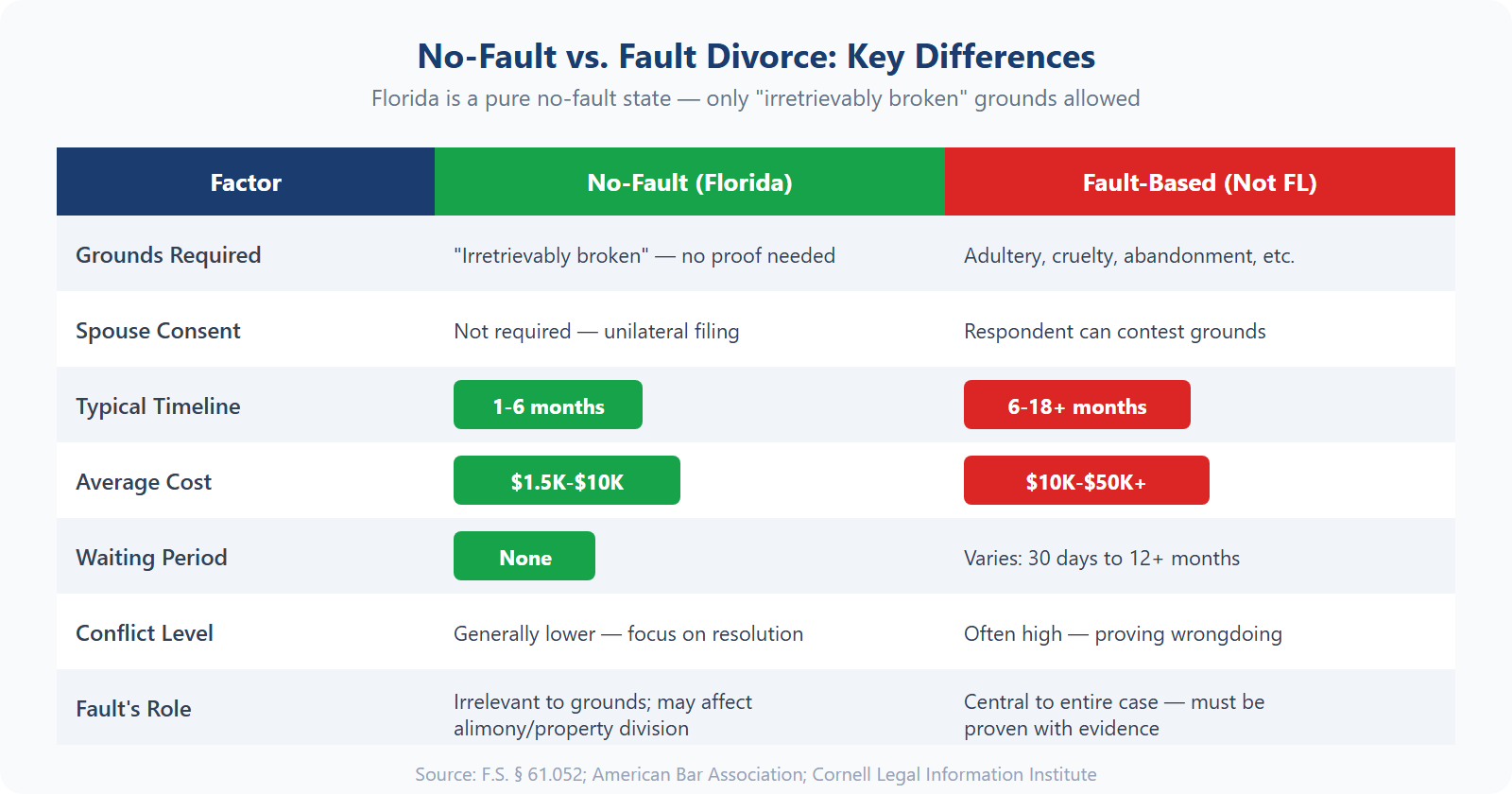
Yes, even though Florida is a pure no-fault state, marital misconduct can still influence several aspects of the divorce outcome. The Florida Supreme Court has consistently held that while fault doesn’t affect the right to divorce, it can be relevant to equitable distribution, alimony, and custody. [2]
Equitable distribution: Under F.S. § 61.075, the court considers “any other factor necessary to do equity and justice between the parties” when dividing marital assets. If one spouse dissipated marital assets (gambling away savings, spending money on an affair, hiding assets), the court can award a larger share to the other spouse.
Alimony: Under F.S. § 61.08(1), the court considers “the adultery of either spouse and the circumstances thereof” as one factor in determining alimony. While adultery alone won’t guarantee or prevent alimony, it can influence the amount and duration, particularly if marital funds were used to support the affair.
Child custody: Under F.S. § 61.13(3), the court evaluates 20 best-interest factors, including “the moral fitness of the parents” and “evidence of domestic violence, sexual violence, child abuse, child abandonment, or child neglect.” Fault that affects the child’s welfare directly impacts custody and time-sharing decisions.
The key distinction: fault doesn’t determine whether you get divorced, but it can affect how the divorce is resolved.
Florida offers several paths to no-fault divorce, each suited to different circumstances. The CDC reports that Florida’s divorce rate was 3.4 per 1,000 population in 2023, slightly below the national average of 3.6 per 1,000. [1]
Regular dissolution of marriage: The standard divorce path under F.S. § 61.052. Available for any married couple meeting the residency requirement. Handles all issues: property division, alimony, child custody, child support. Can be contested or uncontested.
Simplified dissolution of marriage: A streamlined process under F.S. § 61.052(2) for couples who meet ALL of these requirements:
Simplified dissolution is faster and cheaper: both spouses appear together at a single hearing, and the divorce can be finalized that same day. However, the restrictions make it unavailable for most divorces involving children, contested property, or alimony claims.
Uncontested divorce: When both spouses agree on all terms but don’t qualify for simplified dissolution (typically because children are involved). The parties submit a complete Marital Settlement Agreement and Parenting Plan, and the court approves the agreement at a final hearing.
Contested divorce: When the spouses cannot agree on one or more issues. This triggers mandatory mediation under F.S. § 61.183, and if mediation fails, the case proceeds to trial. Contested divorces typically take 4-12 months.
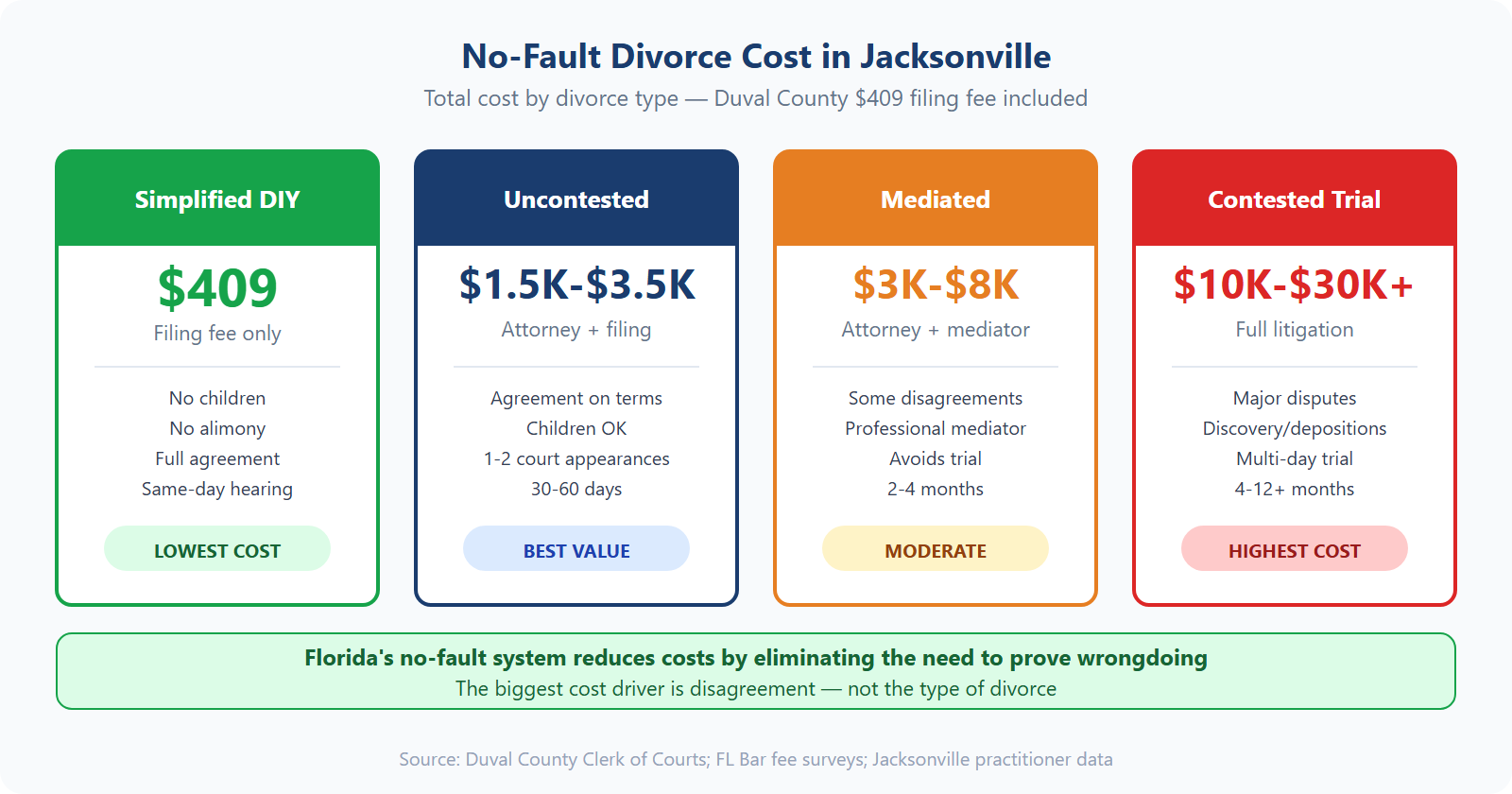
The cost of a no-fault divorce in Jacksonville varies dramatically based on whether the divorce is contested. The Duval County Clerk of Courts filing fee is $409 regardless of divorce type, but total costs range from under $500 for a DIY simplified dissolution to $30,000+ for a contested trial. [3]
Cost breakdown by type:
Florida’s no-fault system generally reduces costs compared to fault-based states. Without the need to prove wrongdoing (which requires hiring investigators, gathering evidence of affairs, and presenting extensive testimony), the discovery process is typically shorter and less expensive.
The biggest cost driver in any Florida divorce is disagreement: the more issues the parties can resolve themselves, the less they spend on attorneys and court time.
Florida’s comprehensive 2023 family law reform (Ch. 2023-301, effective July 1, 2023) made significant changes to alimony, child custody, and support, all of which affect how no-fault divorces are resolved. The reform package was one of the most substantial changes to Florida family law in decades. [5]
Alimony overhaul: The reform eliminated permanent alimony entirely and established three remaining types: bridge-the-gap (up to 2 years, non-modifiable), rehabilitative (up to 5 years, requires plan), and durational (tied to marriage length).
A 35% income cap limits alimony to 35% of the income difference between spouses. This fundamentally changed how no-fault divorces involving spousal support are negotiated.
50/50 custody presumption: The reform established a rebuttable presumption of equal time-sharing for minor children. This has accelerated many divorce settlements because parents now have a clearer starting point for custody negotiations. Before the reform, custody was often the most contested (and most expensive) part of any divorce.
Child support adjustments: With more parents sharing 50/50 time, child support calculations under F.S. § 61.30 increasingly use the substantial time-sharing formula (triggered at 73+ overnights), which generally reduces the support amount. This affects the overall financial negotiation in any no-fault divorce involving children.
The 2023 reform didn’t change the no-fault basis for divorce: F.S. § 61.052 remains unchanged. But it significantly altered how the financial and custody aspects of no-fault divorces are resolved.
You’re not legally required to hire an attorney for a Florida divorce, but in my 25+ years of practice, I’ve seen too many self-represented litigants make costly mistakes that an attorney would have prevented.
The most common: signing away retirement benefits without understanding their value, agreeing to alimony terms that can’t be modified later, or accepting a parenting plan that doesn’t account for future changes.
A no-fault divorce still requires navigating equitable distribution, the new alimony rules under the 2023 reform, child support calculations under the Income Shares Model, and (if children are involved) a parenting plan that addresses the 50/50 presumption. Each of these areas has specific rules and recent changes that significantly affect the outcome.
An experienced Jacksonville divorce attorney ensures you understand your rights, helps you negotiate a fair settlement, and protects you from agreements that look reasonable now but create problems later. Whether you’re filing the petition or responding to one, having counsel makes the process smoother and the outcome more predictable.
Ready to file for divorce in Jacksonville? Call (904) 396-5557 for a consultation. I’ll walk you through the process, explain the 2023 reform’s impact on your situation, and help you understand your options.
Yes. Florida is a pure no-fault divorce state. The only ground for divorce under F.S. § 61.052 is that the marriage is “irretrievably broken.” You cannot file on fault-based grounds like adultery, cruelty, or abandonment.
However, fault-related conduct can still influence alimony, equitable distribution, and child custody decisions even though it doesn’t affect the right to divorce itself. [2]
No. Either spouse can file for a no-fault divorce unilaterally. If one spouse testifies that the marriage is irretrievably broken, the court is required to grant the divorce, even if the other spouse disagrees or refuses to participate. The responding spouse must be properly served but does not need to consent to the divorce proceeding.
An uncontested no-fault divorce can be finalized in as little as 30-60 days. Contested divorces typically take 4-12 months, depending on the complexity of property division, alimony, and custody issues.
Florida has no mandatory waiting period, so the timeline depends primarily on whether both parties can reach an agreement. Learn more about divorce timelines with children. [1]
Yes. Alimony in Florida is determined separately from the grounds for divorce. Under the 2023 reform (Ch. 2023-301), three types remain: bridge-the-gap (up to 2 years), rehabilitative (up to 5 years), and durational (tied to marriage length).
The court considers factors including each spouse’s income, earning capacity, standard of living during the marriage, and the adultery of either spouse. [5]
Simplified dissolution is a streamlined no-fault divorce option under F.S. § 61.052(2) for couples with no minor children, no disputes over assets or debts, and neither spouse seeking alimony.
Both spouses must appear together at a single hearing, and the divorce can be finalized the same day. It’s faster and cheaper than regular dissolution but has strict eligibility requirements. [2]
It can. Under F.S. § 61.075, the court divides marital property equitably, and considers “any other factor necessary to do equity and justice.”
If one spouse dissipated marital assets on an affair (hotel rooms, gifts, travel), the court can award a larger share to the other spouse to compensate. Adultery also factors into alimony under F.S. § 61.08(1). [2]
No. Florida has no legal separation requirement and no mandatory waiting period before filing for divorce. You can file for dissolution of marriage while still living in the same home.
The only requirement is that at least one spouse has been a Florida resident for six months before filing (F.S. § 61.021). Some states require 6-12 months of separation. Florida does not. [2]
Sources:
[1] Centers for Disease Control and Prevention, National Vital Statistics Reports: Marriage and Divorce Data 2023. cdc.gov
[2] Florida Statutes, F.S. § 61.052: Dissolution of Marriage. leg.state.fl.us
[3] Duval County Clerk of Courts, Family Law Filing Fees. duvalclerk.com
[4] American Bar Association, The History of No-Fault Divorce in the United States. americanbar.org
[5] Florida Legislature, Ch. 2023-301: Family Law Reform (SB 1416). flrules.org
[6] Florida Statutes, F.S. § 61.075: Equitable Distribution of Marital Assets and Liabilities. leg.state.fl.us
 ✓
✓Reviewed by
Family Law Attorney & Partner, Sacks & Sacks