

Facing a custody dispute in Jacksonville? Call (904) 396-5557 for a free consultation with an experienced family law attorney.
Florida courts use a structured framework — 20 statutory best-interest factors — to decide time-sharing arrangements. [1] Every mistake on this list maps directly to one or more of those factors. Judges don’t just look at who’s the “better” parent; they look at who demonstrates better judgment, cooperation, and stability.
Since July 1, 2023, Florida law presumes that equal (50/50) time-sharing is in the child’s best interest. [5] To overcome this presumption, a parent must present “clear and convincing evidence” — and that evidence often comes from the other parent’s mistakes. Here are the 11 that cost parents custody most often.
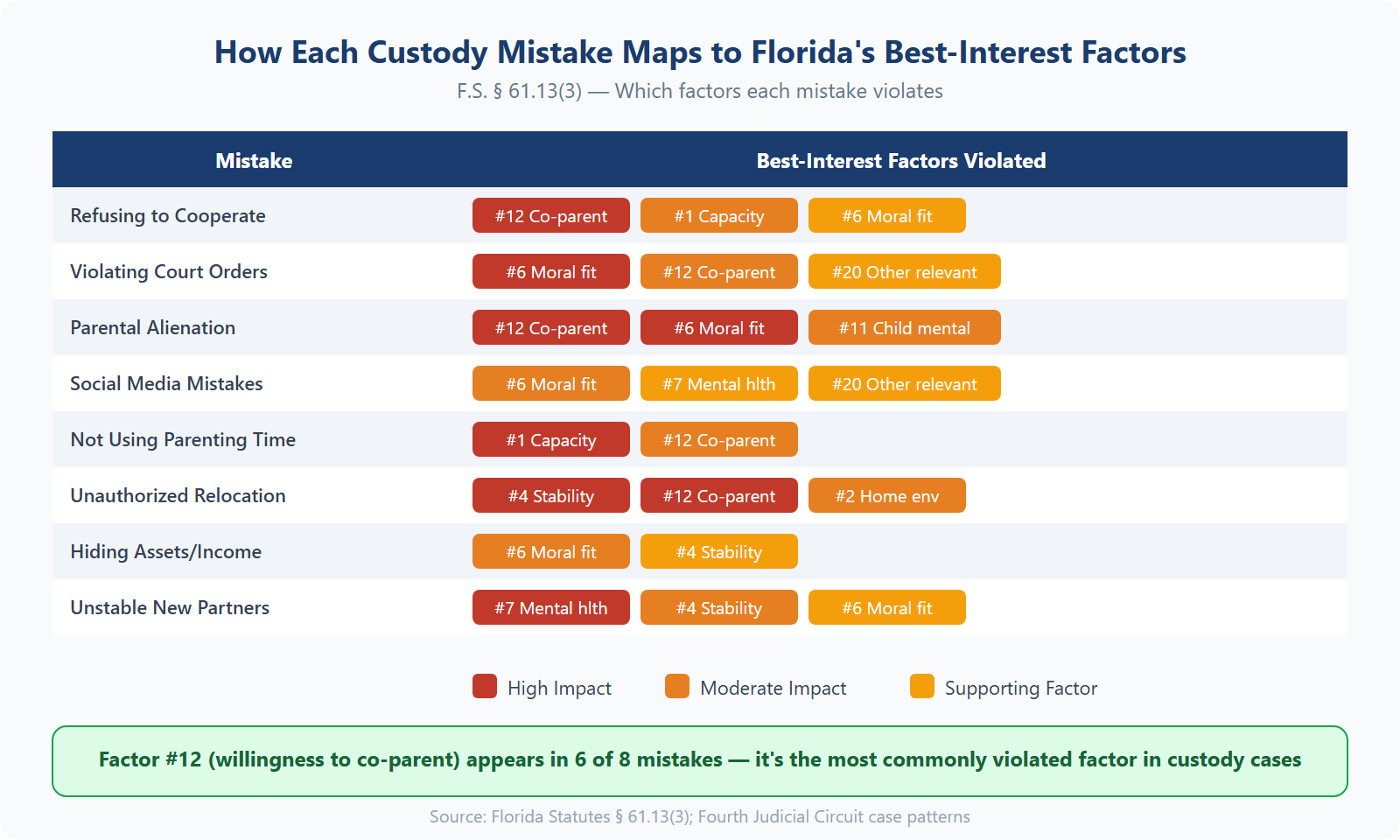
Best-interest factor #12 under F.S. § 61.13(3) evaluates each parent’s willingness to “facilitate and encourage a close and continuing parent-child relationship” with the other parent. [1] Judges take this factor seriously — it’s often the deciding factor in close cases.
What courts look for:
Florida’s mandatory mediation requirement (F.S. § 61.183) means you’ll need to demonstrate good-faith negotiation before the case reaches trial. A pattern of refusal to cooperate shows the judge that you’ll be difficult to co-parent with — and that directly undermines your custody position. [3]
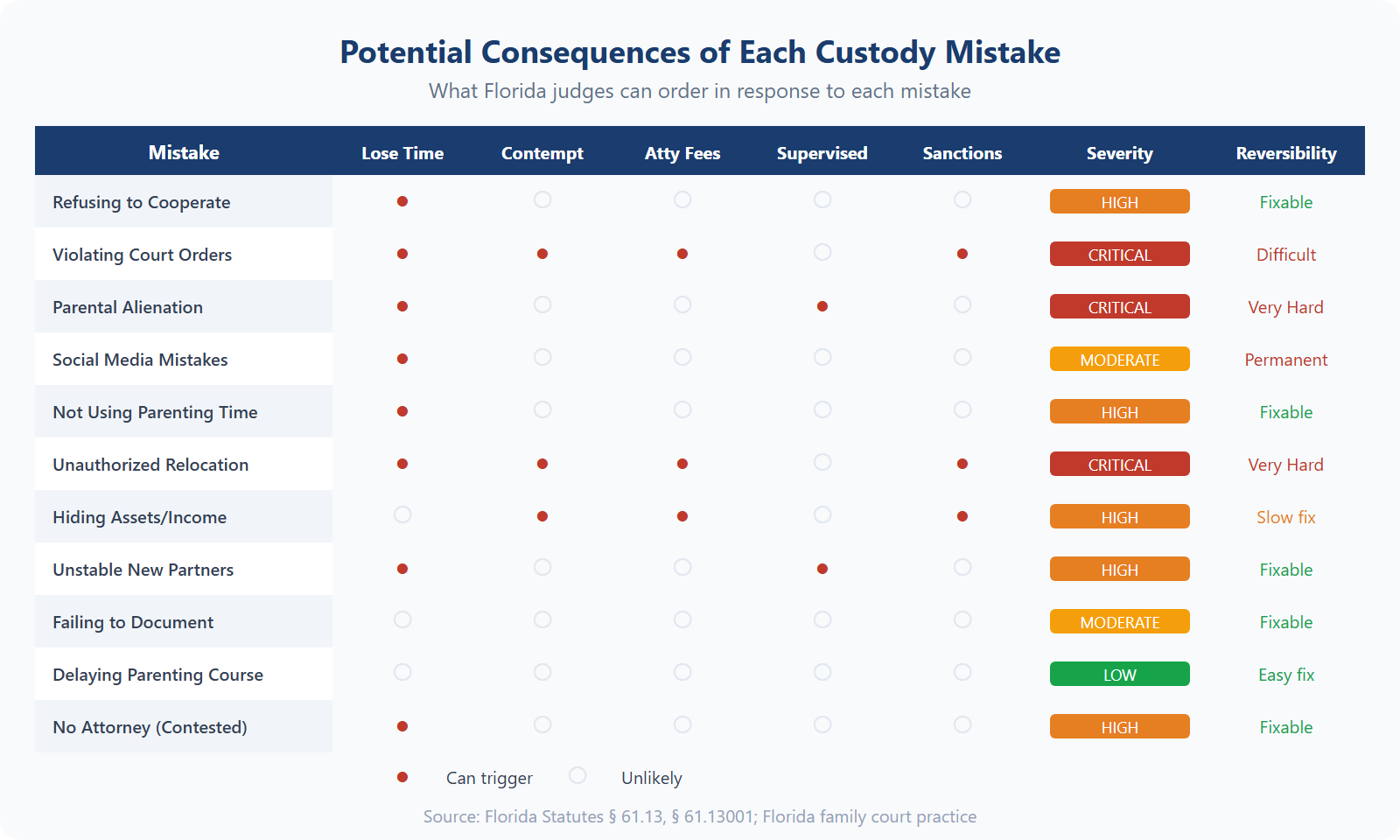
Violating a temporary custody order is one of the fastest ways to lose credibility with a Florida judge. Contempt of court carries penalties including fines, jail time, and — critically — a modification of custody. [1]
Common violations that hurt custody cases:
Even if you disagree with a temporary order, follow it while your attorney works to modify it through proper legal channels. I’ve seen parents lose custody they would have otherwise received because they decided to “correct” what they saw as an unfair temporary arrangement on their own.
Parental alienation — systematically turning a child against the other parent — is one of the most damaging behaviors a Florida judge can observe. Best-interest factor #12 specifically evaluates each parent’s ability to encourage the child’s relationship with the other parent. [1]
What counts as alienation in Florida courts:
Florida courts may appoint a guardian ad litem (GAL) specifically to investigate alienation claims. If the GAL confirms a pattern of alienation, the alienating parent can lose primary time-sharing — or, in extreme cases, be limited to supervised visitation.
Social media posts are admissible evidence in Florida custody proceedings. According to the American Academy of Matrimonial Lawyers, 81% of divorce attorneys have used social media evidence in court. [2] Anything you post, like, comment on, or share can appear in front of the judge.
Posts that regularly damage custody cases:
Don’t delete posts either — that can be construed as spoliation of evidence, which carries its own penalties. The safest approach: assume every post will be read aloud in court. If it wouldn’t help your case, don’t post it.
Best-interest factor #1 evaluates “the demonstrated capacity and disposition of each parent to facilitate and encourage a close and continuing parent-child relationship.” [1] If you’re not showing up for your scheduled time, you’re failing this factor.
Red flags judges look for:
Under the 50/50 presumption, courts start from the position that both parents should have equal time. If you’re voluntarily using less than your allotted time, you’re giving the other parent evidence that you don’t need — or want — equal time-sharing. [5]
Florida has one of the strictest relocation statutes in the country. Under F.S. § 61.13001, a parent cannot move more than 50 miles from their principal residence with a child without either written consent from the other parent or a court order. [1]
The statute applies as soon as a custody case is filed — not just after a final order. Violations can result in:
Even moving 51 miles within Florida triggers the relocation statute. If you need to move for work or family reasons, file a petition to relocate and let the court evaluate whether the move serves the child’s best interests.
Financial dishonesty in a custody case extends beyond child support calculations. Best-interest factor #4 evaluates the “length of time the child has lived in a stable, satisfactory environment” — and financial instability undermines that factor. [1]
Common financial mistakes in custody cases:
Florida judges can order forensic accountants to investigate suspected financial fraud. If you’re caught hiding income or assets, the court can impose sanctions, award attorney’s fees to the other side, and draw negative inferences about your credibility on other custody issues.
Best-interest factor #7 evaluates “the moral fitness of the parents.” [1] While having a new relationship alone doesn’t hurt your custody case, introducing an unstable or unsuitable partner to your children can significantly damage your position.
What raises red flags:
If your new partner has a concerning background, the other parent’s attorney will find it. Background checks are standard in contested custody cases. Focus on demonstrating stability for your children — that’s what the judge cares about.
In custody cases, memory isn’t evidence — documentation is. Florida family courts operate on a “preponderance of evidence” standard, and the parent with better records usually has a significant advantage. [1]
What to document:
Use a co-parenting app like OurFamilyWizard or TalkingParents — they create timestamped, uneditable records that courts accept. Keep a physical journal as backup. The parent who walks into court with organized records is always more credible than the one relying on “I remember that they…”
Florida requires both parents to complete a court-approved Parent Education and Family Stabilization Course before any custody order can be finalized. [1] The course covers the impact of divorce on children, age-appropriate communication, and co-parenting skills.
This seems like a minor requirement, but I’ve watched cases stall for months because one parent simply didn’t complete the 4-hour online course ($25–$50). The court cannot enter a final judgment until both certificates are filed.
Complete the course within the first 30 days of filing. It removes a potential delay, shows the judge you take the process seriously, and gives you useful information about what your children are experiencing during the custody dispute.
Self-represented parents in contested custody cases face the same procedural rules, evidence standards, and courtroom expectations as experienced family law attorneys. Florida’s Rules of Family Law Procedure don’t make exceptions for pro se litigants. [1]
What self-represented parents commonly miss:
An experienced child custody attorney knows which of the 20 best-interest factors matter most in your case, how to present evidence effectively, and how to navigate the 50/50 presumption — whether you’re trying to maintain equal time or seeking a deviation.
Custody mistakes are often irreversible. Once a judge forms an impression of your parenting judgment, it’s extremely difficult to change. The cases I see parents lose are rarely about who loves their children more — they’re about who demonstrated better judgment throughout the process.
I’ve handled custody cases in Jacksonville for over 25 years, as both a litigator and a Florida Supreme Court Certified Family Mediator. Whether your case needs aggressive courtroom advocacy or skilled negotiation, I know how to protect your relationship with your children.
Call (904) 396-5557 for a free custody consultation — or send us a message online.
Refusing to cooperate with the other parent is the most damaging and most common mistake. Best-interest factor #12 under F.S. § 61.13 specifically evaluates each parent’s willingness to encourage the child’s relationship with the other parent. Judges consistently penalize parents who obstruct co-parenting. [1]
Yes. Social media posts are admissible evidence in Florida family court. Photos showing alcohol or drug use, disparaging comments about the other parent, and posts contradicting your sworn statements can all damage your custody case. Don’t delete posts — that can be considered destruction of evidence. [2]
Since July 1, 2023, Florida law presumes equal time-sharing is in the child’s best interest (Ch. 2023-301). To get more than 50/50, a parent must present “clear and convincing evidence” that equal time would be detrimental to the child. Mistakes like violating court orders or parental alienation provide this evidence to the other side. [5]
Under F.S. § 61.13001, relocating more than 50 miles with a child without written consent or a court order can result in court-ordered return of the children, payment of the other parent’s attorney’s fees, loss of time-sharing, and contempt of court. This applies as soon as a custody case is filed. [1]
While not legally required, self-represented parents in contested cases face the same procedural rules as attorneys. Discovery deadlines, evidence authentication, cross-examination, and the 2023 reform’s burden-of-proof rules all require legal knowledge. An experienced family law attorney significantly improves your outcome. [1]
Parental alienation is systematically turning a child against the other parent through negative comments, interference with contact, or forced loyalty conflicts. Florida judges take alienation seriously — confirmed patterns can result in loss of primary time-sharing or supervised visitation for the alienating parent. [1]
Florida judges evaluate 20 best-interest factors under F.S. § 61.13(3), including each parent’s willingness to encourage the child’s relationship with the other parent, moral fitness, mental and physical health, demonstrated parenting capacity, and the child’s preference (if mature enough). The 50/50 presumption is the starting point. [1]
Sources:
[1] Florida Statutes, Chapter 61 — Dissolution of Marriage; Support; Time-Sharing. flsenate.gov
[2] American Academy of Matrimonial Lawyers, Social Media Evidence in Family Law Cases. aaml.org
[3] Florida Courts, Alternative Dispute Resolution Report, FY 2024-2025. flcourts.gov
[4] Centers for Disease Control and Prevention, Stats of the States — Divorce Rates (2023 Data). cdc.gov
[5] Florida Senate, SB 1416 — Dissolution of Marriage (Ch. 2023-301). flsenate.gov
 ✓
✓Written by
Family Law Attorney & Partner, Sacks & Sacks