

Need help with a time-sharing schedule in Jacksonville? Call (904) 396-5557 for a free consultation.
Florida eliminated the term “visitation” from its family law statutes in 2008 (SB 2532), replacing it with “time-sharing.” The change was deliberate — “visitation” implies one parent is a visitor in their own child’s life, while “time-sharing” reflects the legal principle that both parents have equal standing (F.S. § 61.13) [1].
This isn’t just a label change. The shift in terminology reflects a fundamental change in how Florida law treats both parents:
Despite the legal change, most people (and even some lawyers) still say “visitation.” For this guide, we’ll use both terms interchangeably, but understand that all Florida court orders use “time-sharing.”
Effective July 1, 2023, Florida’s family law reform (Ch. 2023-301) created a rebuttable presumption that equal time-sharing is in the child’s best interest [2]. This is the most significant change to Florida custody law in decades.
What “rebuttable presumption” means in practice:
Before this reform, there was no presumption — one parent often received “primary” custody with the other getting every-other-weekend. The 2023 law levels the playing field.
Florida courts must evaluate 20 specific factors listed in F.S. § 61.13(3) when determining a time-sharing schedule [1]. No single factor is dispositive. Key categories include:
Parent-child relationship factors:
Stability and continuity factors:
Safety factors:
Practical factors:
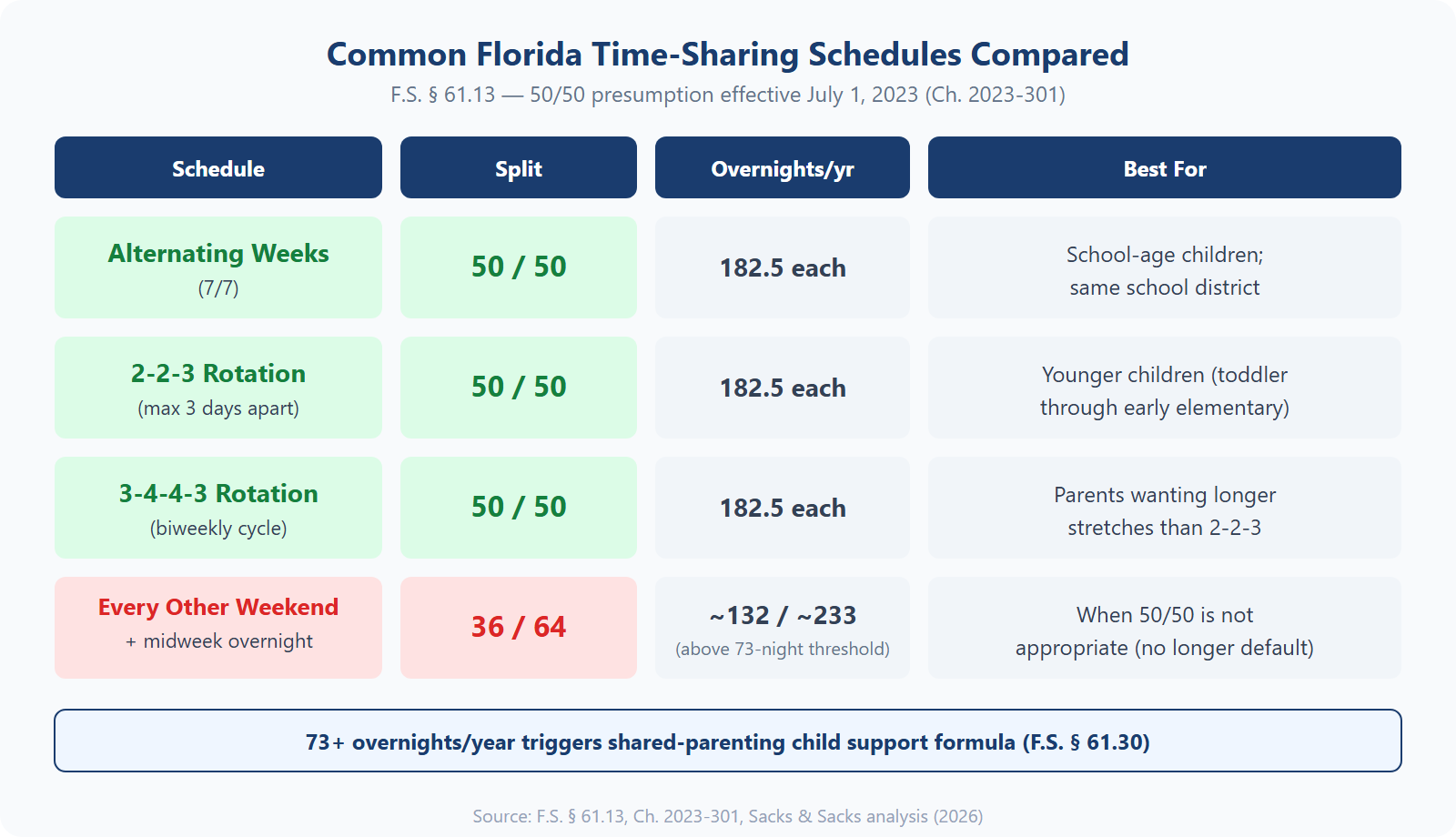
Since the 2023 reform, courts increasingly favor schedules that approximate equal time. The four most common arrangements are [1]:
Each parent has the child for one full week, then switches. This is the simplest 50/50 schedule. Best for: school-age children who can handle a full week away from either parent, parents who live in the same school district.
Overnights per year: 182.5 each (exactly 50/50)
Parent A has Monday-Tuesday, Parent B has Wednesday-Thursday, and they alternate Friday-Sunday. The following week reverses. Neither parent goes more than 3 days without seeing the child.
Overnights per year: 182.5 each (50/50). Best for: younger children (toddlers through early elementary) who need more frequent contact with both parents.
Parent A has 3 days, Parent B has 4 days, then Parent B has 3 days, Parent A has 4 days. Repeats every two weeks.
Overnights per year: 182.5 each (50/50). Best for: parents who want slightly longer stretches than 2-2-3 but shorter than full alternating weeks.
One parent has primary time, the other gets every other weekend (Friday-Sunday) plus a midweek overnight (typically Wednesday). This is no longer the default since the 2023 reform, but courts still order it when 50/50 isn’t appropriate.
Overnights per year: Approximately 132 for the non-majority parent (36/64 split). The 73-night threshold is critical for child support calculations under F.S. § 61.30 [3].
Every Florida custody case requires a written parenting plan approved by the court (F.S. § 61.13(2)(b)) [1]. A valid parenting plan must address:
If parents cannot agree on a parenting plan, the court will impose one based on the 20 best interest factors.
Florida courts can order supervised time-sharing under F.S. Chapter 753 when there are concerns about the child’s safety [4]. Common reasons include:
Supervised visits occur at approved supervised visitation centers or with a court-approved supervisor (often a family member). The cost typically ranges from $50-$150 per visit and is usually paid by the supervised parent.
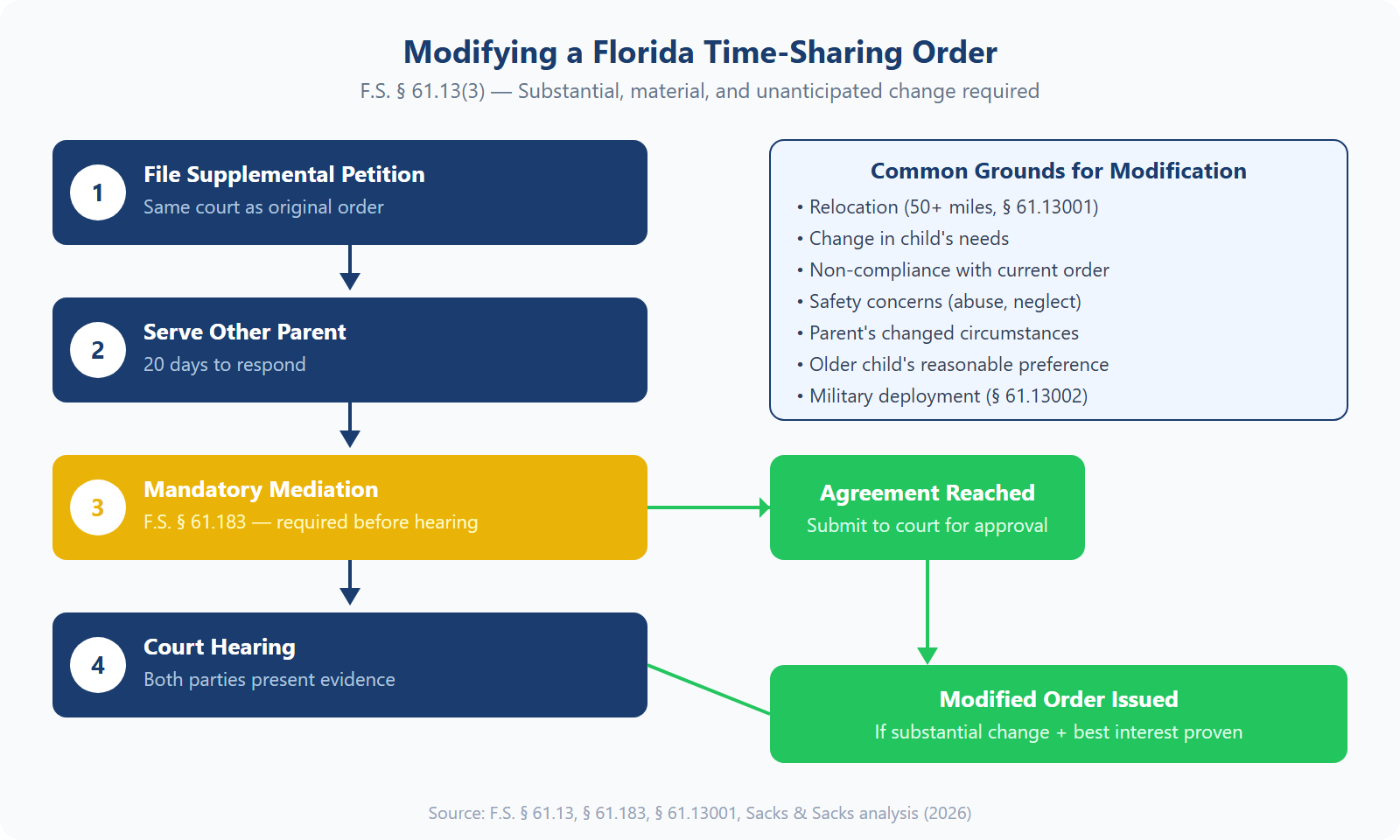
To modify an existing time-sharing order, you must prove a substantial, material, and unanticipated change in circumstances since the last order (F.S. § 61.13(3)) AND that the modification is in the child’s best interest [1].
Common grounds for modification:
The modification process:
Violating a court-ordered time-sharing schedule is enforceable through contempt of court. The non-violating parent can file a Motion for Contempt and Enforcement. Available remedies include [1]:
Important: You cannot withhold child support because the other parent denies time-sharing, and you cannot deny time-sharing because the other parent doesn’t pay child support. These are separate legal obligations.
Under F.S. § 61.13001, if a parent wants to move more than 50 miles from their current residence, they must either get the other parent’s written agreement or court approval [5].
The relocating parent must file a petition including:
The non-relocating parent has 20 days to object. If they object, the court holds a hearing and considers 11 factors including the child’s relationship with both parents, the economic benefit of the move, and the feasibility of preserving the relationship with the non-relocating parent.
Relocating without court approval or written agreement is a violation that can result in contempt, attorney’s fees, and even a shift of majority time-sharing to the non-relocating parent.
Florida provides very limited grandparent visitation rights. Under F.S. § 752.011, a grandparent can petition for visitation only if [6]:
Florida courts give great deference to parents’ decisions about who has access to their children. The U.S. Supreme Court’s decision in Troxel v. Granville (2000) established that fit parents have a fundamental right to make decisions about their children’s care, and Florida law reflects this principle.
Florida law does not set a specific age. The child’s “reasonable preference” is one of the 20 best interest factors under F.S. § 61.13(3), but it is only considered if the child has “sufficient intelligence, understanding, and experience.” Courts generally give more weight to preferences of children 14 and older, but even a teenager’s preference is just one factor — not determinative.
Under F.S. § 61.30, when a parent has the child for 73 or more overnights per year (20%), the child support calculation shifts to a shared-parenting formula that reduces the obligation. This makes the exact number of overnights in a time-sharing schedule financially significant.
No. Time-sharing and child support are separate legal obligations in Florida. A parent cannot withhold time-sharing because the other parent is behind on support, and a parent cannot withhold support because time-sharing is being denied. Either violation can result in contempt of court.
Under F.S. § 61.13002, a deploying military parent can designate a family member to exercise time-sharing during deployment. The existing time-sharing order is automatically reinstated upon return. Deployment cannot be used as the sole basis to permanently modify time-sharing.
Shared parental responsibility (the default) means both parents must agree on major decisions about education, healthcare, religion, and extracurricular activities. Sole parental responsibility means one parent makes all major decisions alone. Courts only grant sole responsibility when shared responsibility would be detrimental to the child — typically in cases involving domestic violence, substance abuse, or severe parental conflict.
Sources:
[1] Florida Legislature, F.S. § 61.13 — Parental Responsibility; Time-Sharing; Parenting Plans (2025). leg.state.fl.us
[2] Florida Legislature, Ch. 2023-301 — Family Law Reform (50/50 Time-Sharing Presumption). laws.flrules.org
[3] Florida Legislature, F.S. § 61.30 — Child Support Guidelines (2025). leg.state.fl.us
[4] Florida Legislature, F.S. Chapter 753 — Supervised Visitation (2025). leg.state.fl.us
[5] Florida Legislature, F.S. § 61.13001 — Parental Relocation with a Child (2025). leg.state.fl.us
[6] Florida Legislature, F.S. § 752.011 — Grandparent Visitation Rights (2025). leg.state.fl.us
 ✓
✓Written by
Family Law Attorney & Partner, Sacks & Sacks