TL;DR: Adoption costs in Florida range from
$0 for foster care adoption to
$60,000-$65,000 for private newborn adoption in 2026. The federal adoption tax credit of
$17,280 (2025) / $17,670 (2026) — now partially refundable — can offset a significant portion of expenses (
IRS)
[1]. Florida law under
Chapter 63 governs all adoption types, and the process typically takes
6-18 months.
Considering adoption in Jacksonville? Call (904) 396-5557 for a free consultation with an experienced Florida adoption attorney.
How Much Does Adoption Cost in Florida in 2026?
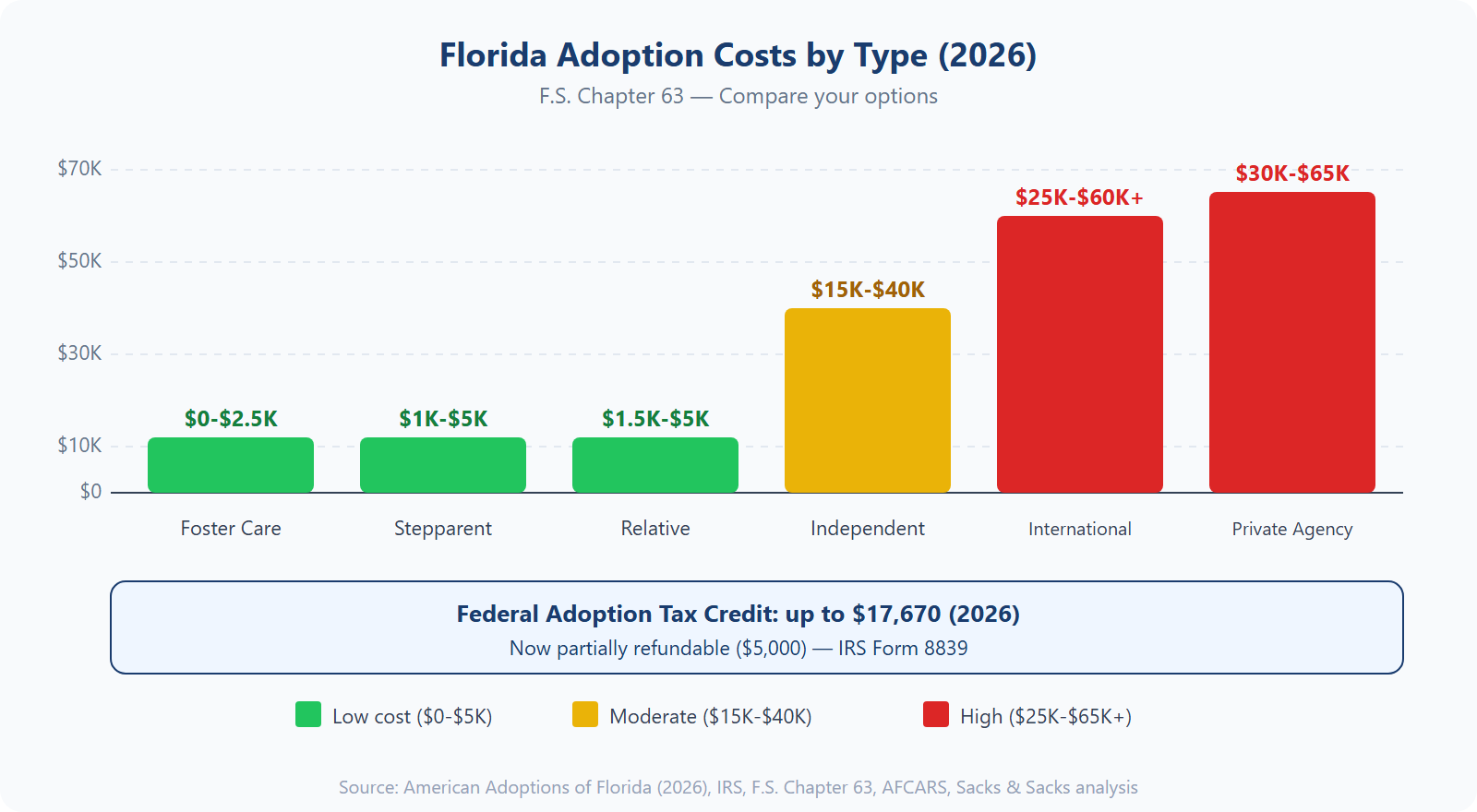
The cost to adopt in Florida varies dramatically by type — from $0 for foster care adoption to $60,000-$65,000 for private newborn placement through a licensed agency (American Adoptions of Florida) [2]. The type of adoption you pursue is the single biggest factor in total cost.
Here’s a realistic breakdown by adoption type in 2026:
- Foster care adoption: $0-$2,500 — state covers most or all costs
- Stepparent adoption: $1,000-$5,000 (mostly legal fees)
- Relative/kinship adoption: $1,500-$5,000
- Private agency (newborn): $30,000-$65,000
- Independent/attorney adoption: $15,000-$40,000
- International adoption: $25,000-$60,000+
All adoptions in Florida are governed by Florida Statutes Chapter 63, which sets requirements for consent, home studies, placement, and finalization [3].
What Are the Costs by Adoption Type?
Foster Care Adoption ($0-$2,500)
Foster care adoption is the most affordable path. Florida’s Department of Children and Families (DCF) covers most adoption-related costs for children in the foster care system. There are approximately 4,500 children waiting for adoption in Florida’s foster care system at any given time (HHS/AFCARS) [4].
What the state typically covers:
- Home study fees
- Court filing fees
- Legal representation through DCF
- Training and preparation classes
- Monthly subsidy payments for children with special needs (may continue until age 18 or 21)
- Medicaid coverage for the adopted child
Stepparent Adoption ($1,000-$5,000)
Stepparent adoption is one of the most common types in Florida. Under F.S. § 63.042, a stepparent married to the child’s legal parent can adopt without a home study if certain conditions are met [3]. Costs include:
- Attorney fees: $1,000-$3,500
- Court filing fees: $300-$400
- Background check: $50-$100
- Home study (if required): $900-$3,000
The biggest variable is whether the biological parent consents. If consent is contested, legal fees can increase significantly.
Private Agency Adoption ($30,000-$65,000)
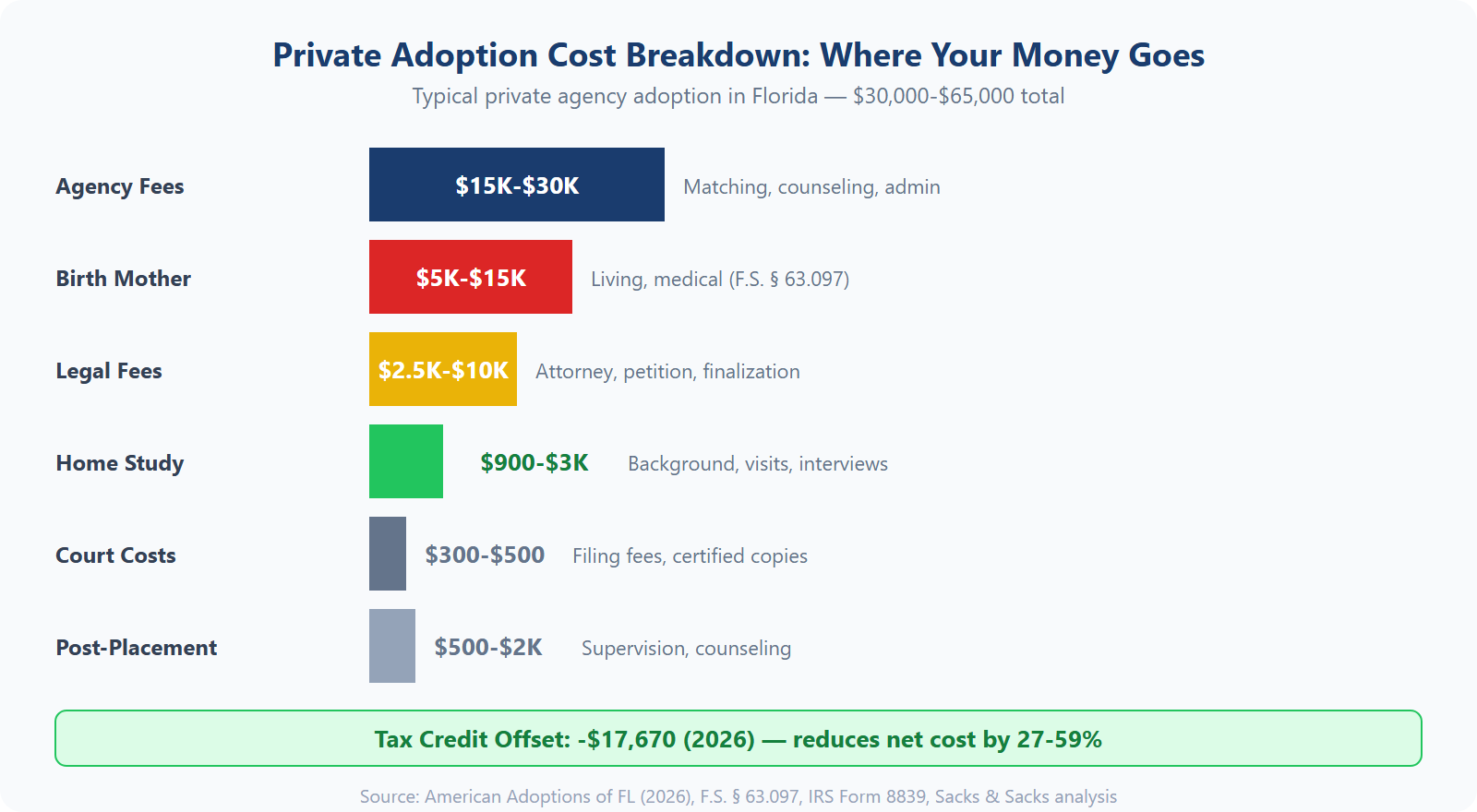
Private agency adoption — typically for newborn placement — is the most expensive option. In 2026, the average cost through a licensed Florida agency is $60,000-$65,000 [2]. This covers:
- Agency fees: $15,000-$30,000 (matching, counseling, administrative)
- Birth mother expenses: $5,000-$15,000 (living expenses, medical bills — allowed under F.S. § 63.097)
- Home study: $900-$3,000
- Legal fees: $2,500-$10,000
- Court costs: $300-$500
- Post-placement supervision: $500-$2,000
Independent/Attorney Adoption ($15,000-$40,000)
Independent adoption occurs when the birth parent and adoptive parent connect directly, with an attorney facilitating the legal process. Under F.S. § 63.085, an adoption entity (attorney or agency) must still be involved to ensure legal compliance [3]. Costs are lower because there are no agency fees.
International Adoption ($25,000-$60,000+)
International adoption involves both U.S. immigration law (Hague Convention) and the laws of the child’s birth country. Costs include agency fees, immigration/USCIS fees ($800+), travel (often 2-3 trips to the birth country), translation/authentication of documents, and legal fees in both countries.
What Does a Home Study Cost in Florida?
A home study is required for every adoption in Florida (with limited exceptions for stepparent adoptions). The cost ranges from $900 to $3,000 for a private home study, though some agencies charge up to $4,500 depending on location and complexity (American Adoptions) [5].
A Florida home study includes:
- Background checks — criminal history (FDLE, FBI fingerprinting), child abuse registry (FL Abuse Hotline), sex offender registry
- Home visits — at least one visit to assess safety, sleeping arrangements, and environment
- Interviews — individual and joint interviews with all household members
- References — personal and professional references (typically 3-5)
- Financial review — income verification, tax returns, insurance
- Medical clearance — physical exam for each adoptive parent
- Autobiographical statements — personal history, parenting philosophy
For foster care adoption, the state pays for the home study. The study is valid for 1 year from completion.
What Legal Fees Should You Expect?
Florida law requires an adoption entity (licensed agency or attorney) to facilitate every adoption under F.S. § 63.039 [3]. Attorney fees typically include:
- Petition filing and court representation: $2,500-$5,000 (uncontested)
- Contested adoption / TPR hearing: $5,000-$15,000+
- Interstate adoption (ICPC compliance): $3,000-$8,000 additional
- Birth parent consent / relinquishment: $500-$2,000
Florida requires a mandatory 48-hour waiting period after birth before a birth mother can sign consent to adoption (F.S. § 63.082). Consent is irrevocable once signed, except in cases of fraud or duress [3].
How Can You Adopt for Free or Low Cost in Florida?
If cost is a barrier, these options can reduce or eliminate adoption expenses:
- Foster care adoption through DCF — $0 or near-zero cost. The state covers home study, legal fees, and court costs. Children may come with ongoing monthly subsidies and Medicaid.
- Stepparent adoption — as low as $1,000 if the biological parent consents and no home study is required.
- Adoption through a non-profit organization — organizations like the Dave Thomas Foundation for Adoption provide grants and support for families adopting from foster care.
- Military families — the Military Adoption Reimbursement Program reimburses up to $2,000 per child (up to $5,000 in a calendar year) for qualified adoption expenses.
- Federal adoption tax credit — up to $17,280 (2025) or $17,670 (2026) can be claimed to offset adoption expenses, now partially refundable [1].
What Financial Assistance Is Available for Adoption?
Multiple financial assistance programs exist to help families afford adoption:
Government Programs:
- Federal Adoption Tax Credit: Up to $17,670 (2026) — see next section for details
- FL Adoption Subsidy: Monthly payments for children with special needs adopted from foster care
- Medicaid: Continues for foster care adoptees until age 18 (or 21 in some cases)
- Title IV-E funding: Federal support for foster care adoptions
Grants (non-repayable):
- Dave Thomas Foundation for Adoption — Wendy’s Wonderful Kids program
- Gift of Adoption Fund — grants up to $15,000
- National Adoption Foundation — grants + interest-free loans
- Help Us Adopt — grants up to $15,000
- A Child Waits Foundation — grants for international adoption
Employer Benefits:
Many large employers offer adoption assistance. Companies like Wendy’s ($25,600), Microsoft ($10,000), Goldman Sachs ($20,000), and Bank of America ($8,000) provide adoption reimbursement programs. Check your employer’s HR benefits before assuming you’ll pay full price.
Loans:
- Adoption-specific loans from lenders like AAFC (American Adoptions Financial Center)
- Home equity loans or lines of credit (interest may be tax-deductible)
- 0% interest credit cards with promotional periods for managing short-term expenses
What Is the Federal Adoption Tax Credit for 2025-2026?
The federal adoption tax credit is one of the most valuable tools for managing adoption costs. For tax year 2025, the maximum credit is $17,280. For 2026, it increases to $17,670 (IRS) [1].
Key changes for 2025 and beyond:
- Partially refundable — up to $5,000 is now refundable (you get money back even if you owe no tax)
- The remaining portion is non-refundable but can be carried forward for up to 5 years
- Special needs adoption: You can claim the full credit amount even if your actual expenses were less
- Income limits apply: The credit phases out for modified AGI above certain thresholds
Qualified adoption expenses include:
- Agency fees, attorney fees, court costs
- Home study fees and travel expenses
- Re-adoption expenses for international adoptions
- Not included: Expenses reimbursed by an employer or paid by a government program
File IRS Form 8839 with your tax return to claim the credit. Consult a tax professional for personalized guidance.
What Are the Hidden Costs of Adoption?
Beyond the obvious fees, adoptive parents should budget for these often-overlooked expenses:
- Failed placements — if a birth mother changes her mind (before the 48-hour waiting period in Florida), you may lose non-refundable expenses. Some agencies offer “risk-sharing” programs.
- Travel costs — multiple trips to the birth mother’s location, the courthouse, or (for international adoption) the birth country. Budget $2,000-$10,000+ for international travel.
- Birth mother living expenses — Florida allows adoptive parents to pay reasonable living expenses during pregnancy under F.S. § 63.097, but these must be court-approved and can add $5,000-$15,000.
- Post-adoption counseling — therapy for the child and/or family ($100-$200/session). Many foster care adoptions include subsidized counseling.
- Second parent adoption — for unmarried couples or same-sex couples, a second-parent adoption may be needed ($1,500-$3,500).
- Document authentication — for international adoptions, apostille and authentication fees can add $500-$2,000.
How to Create a Realistic Adoption Budget
A well-planned budget prevents financial surprises and helps you identify the right adoption path. Follow these steps:
- Determine your adoption type — this sets the cost range (see breakdown above)
- Get detailed fee schedules from at least 2-3 agencies or attorneys before committing
- Factor in the tax credit — $17,280-$17,670 will be returned to you (partially refundable in 2025+)
- Apply for grants early — grant cycles fill up, and processing takes 3-6 months
- Check employer benefits — many families don’t realize their employer offers adoption reimbursement
- Build a contingency fund — add 15-20% to your budget for unexpected expenses
- Keep all receipts — every qualified expense is eligible for the tax credit
Ready to start the adoption process? Call (904) 396-5557 for a free consultation. We’ll walk you through costs, timelines, and your best options under Florida law.
Frequently Asked Questions
Is the federal adoption tax credit refundable?
Beginning in tax year 2025, up to $5,000 of the adoption tax credit is refundable — meaning you’ll receive that amount even if you owe zero in taxes (IRS) [1]. The remaining amount (up to $12,280 for 2025 or $12,670 for 2026) is non-refundable but can be carried forward for up to 5 years. For special needs adoptions, you can claim the full credit even if your expenses were lower.
How much does a Florida home study cost?
A private home study in Florida costs between $900 and $3,000, with some providers charging up to $4,500 depending on location and complexity (American Adoptions) [5]. For foster care adoption, the state pays for the home study. The study is valid for 1 year from completion and includes background checks, home visits, interviews, and financial review.
Can I adopt a child for free in Florida?
Yes. Foster care adoption through Florida DCF costs $0 or near-zero. The state covers home study fees, legal representation, and court costs. Many foster care adoptions also include monthly subsidy payments and Medicaid coverage for the child. Approximately 4,500 children are waiting for adoption in Florida’s foster care system at any given time (AFCARS) [4].
Do I need an attorney to adopt in Florida?
Florida requires an adoption entity — either a licensed adoption agency or attorney — to handle every adoption under F.S. § 63.039. While you could technically use only a licensed agency, most families benefit from having their own attorney to review the adoption agreement, attend the finalization hearing, and protect their legal interests. Attorney fees range from $2,500-$10,000 depending on complexity.
How long does the adoption process take in Florida?
Timelines vary by type: stepparent adoption takes 2-4 months, foster care adoption takes 6-18 months (including the mandatory fostering period), private agency adoption takes 1-3 years (wait time for matching), and international adoption takes 2-4 years. The finalization hearing itself is typically scheduled 30-90 days after the placement is complete under F.S. § 63.122.
Sources:
[1] Internal Revenue Service, Adoption Credit — Tax Years 2025-2026. irs.gov
[2] American Adoptions of Florida, Why Is Adoption So Expensive? (2026). americanadoptionsofflorida.com
[3] Florida Legislature, F.S. Chapter 63 — Adoption (2025). leg.state.fl.us
[4] U.S. Department of Health and Human Services, Adoption and Foster Care Analysis and Reporting System (AFCARS). acf.hhs.gov
[5] American Adoptions, How Much Does a Home Study in Florida Cost?. americanadoptions.com
Related Posts


 ✓
✓