
Nearly half of all Florida births, 45.1%, are to unmarried mothers, according to the CDC 2024 final natality data (CDC, 2024) [1]. That is roughly 100,000 children a year born to parents who are not married. Until paternity is established, the father has no legal standing: no custody, no say in major decisions, and no guaranteed time with his child.
Florida law treats married and unmarried fathers very differently. When a child is born to married parents, the husband is automatically presumed to be the legal father under Florida’s longstanding presumption of legitimacy. An unmarried father, though, is a legal stranger to his own child until paternity is formally established [2].
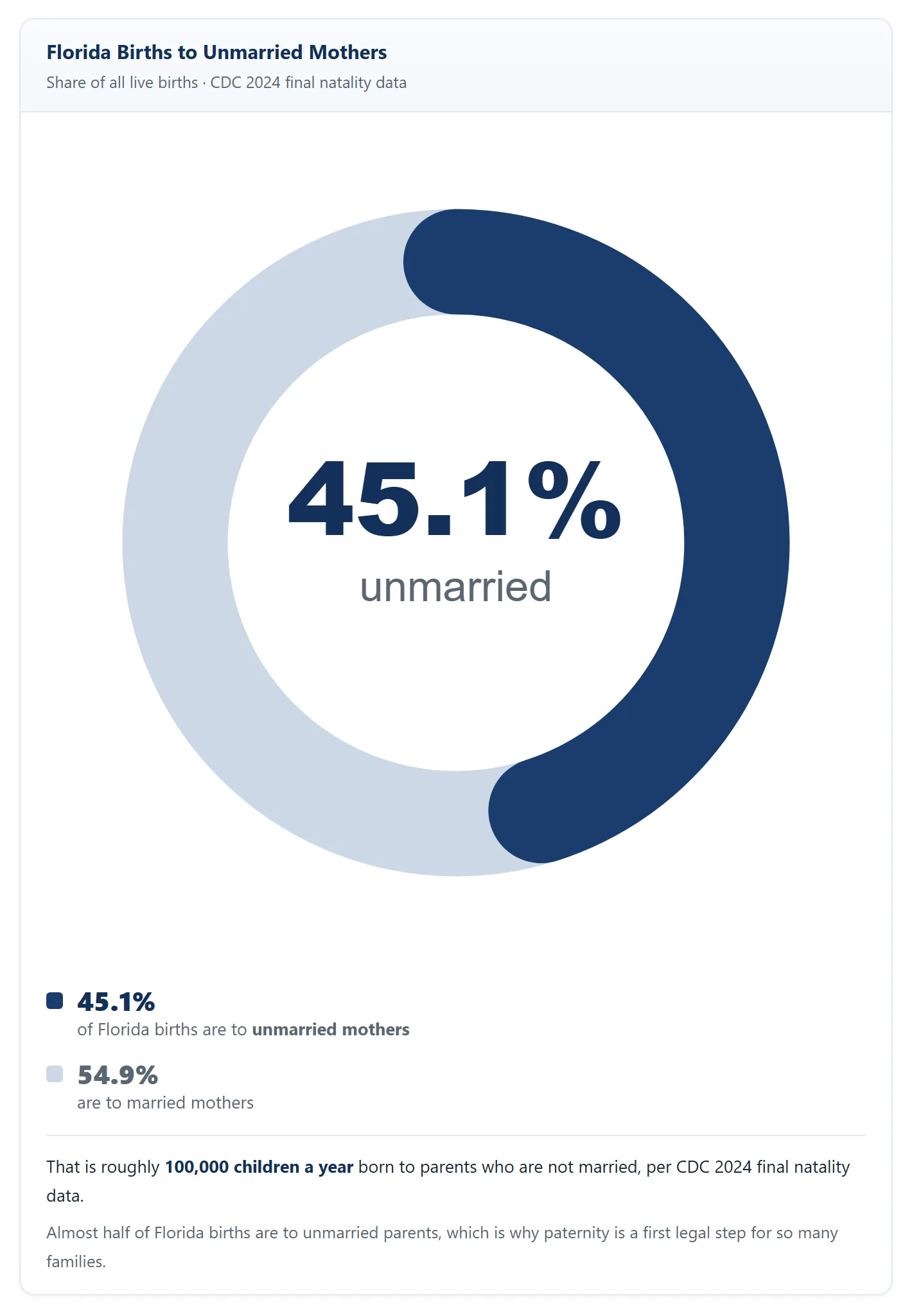
Almost half of Florida births are to unmarried parents, which is why paternity is a first legal step for so many families. Source: CDC 2024 final natality data.
The gap is not small. Establishing paternity is what converts a biological father into a legal parent with enforceable rights. The table below shows exactly what changes.
| Right or Benefit | Before Paternity | After Paternity |
|---|---|---|
| Custody & time-sharing | None | Yes (50/50 presumption) |
| Decision-making (school, medical) | None | Yes |
| Child’s inheritance from father | No | Yes |
| Benefits (Social Security, VA, insurance) | No | Yes |
| Access to paternal medical history | No | Yes |
| Child support | Not enforceable | Either parent can seek it |
Florida law under F.S. Chapter 742 gives you three main paths, and they differ sharply on price [2]. The hospital form is free, the post-birth form runs about $30, and a contested court petition can reach $5,000 or more. The chart and table below compare all three at a glance.
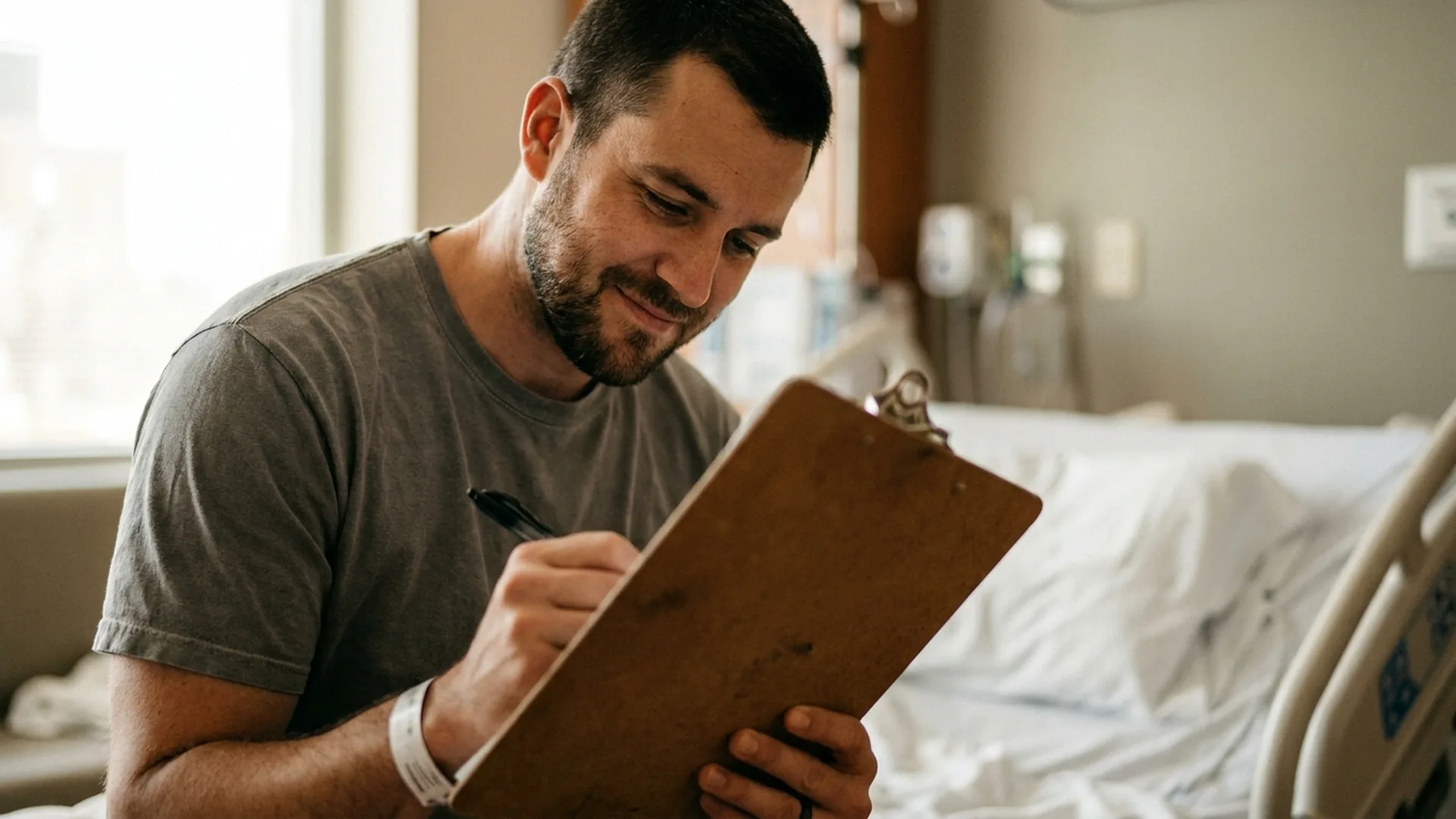
Signing the Voluntary Acknowledgment of Paternity (DH-511) at the hospital is the fastest and cheapest of the three paths.
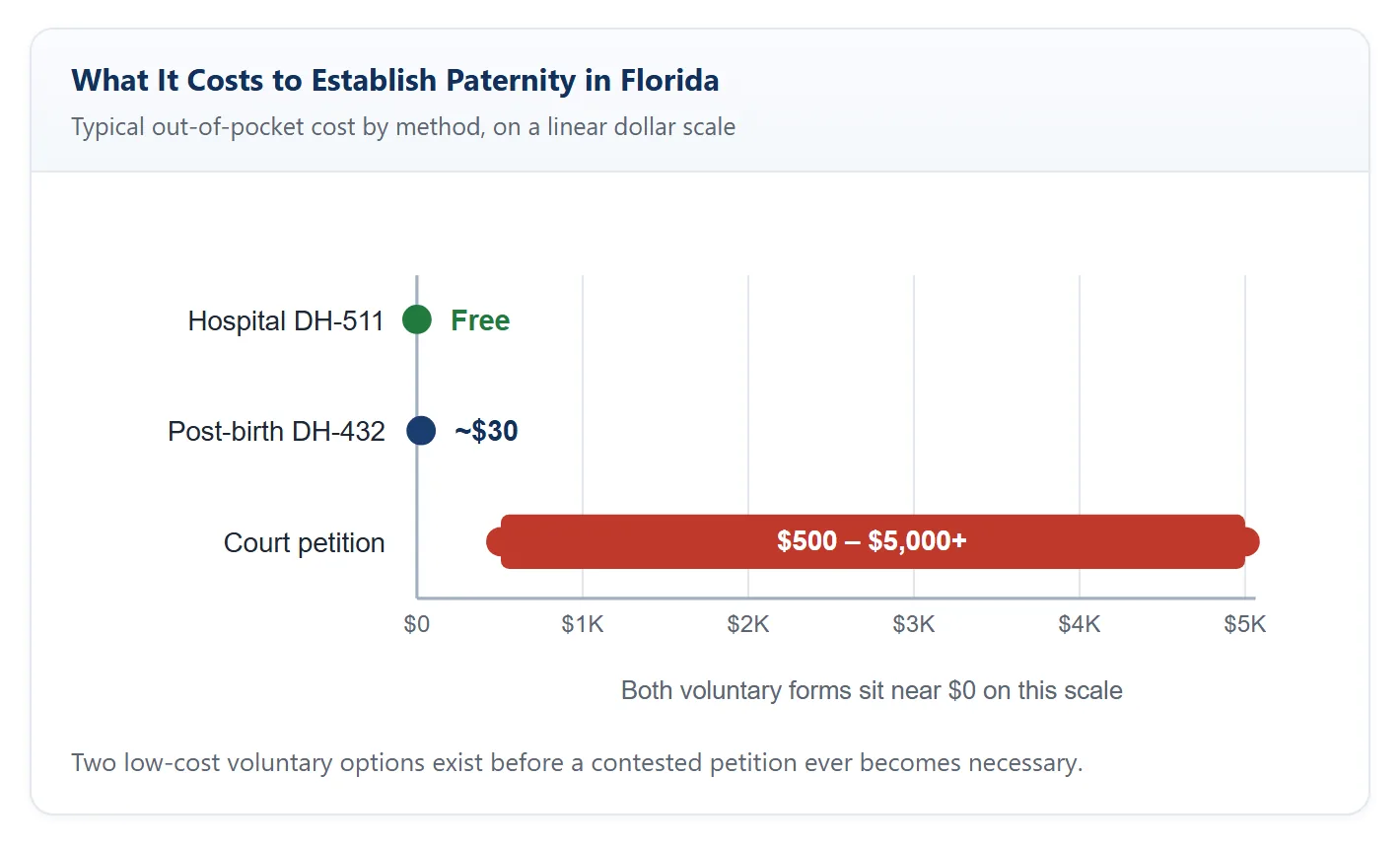
Two low-cost voluntary options exist before a contested petition ever becomes necessary.
| Method | Cost | Timeline | Can It Be Undone? |
|---|---|---|---|
| Hospital acknowledgment (DH-511) | Free | Same day | Within 60 days |
| Post-birth acknowledgment (DH-432) | $30+ (notary) | 1–2 weeks | Within 60 days |
| Court petition (F.S. Ch. 742) | $500–$5,000+ | 3–12 months | No (binding order) |
This is the simplest and most common route. When a child is born to unmarried parents, the hospital provides a Voluntary Acknowledgment of Paternity form (DH-511). Both parents sign in front of two witnesses or a notary.
Since the Good Dad Act (HB 775, effective July 1, 2023), signing this form automatically grants parental rights to the father [3]. That includes the right to file for custody and time-sharing without a separate court petition. Before this law, signing only established biological paternity, and the father still needed a court order for custody.
If the parents miss the hospital window, they can file a Notarized Voluntary Acknowledgment (DH-432) at any point after birth.
You can get the form from the Florida Department of Health. Once it is processed, the father’s name is added to the child’s birth certificate.
When either parent disputes paternity, or when the father wants rights and the mother will not cooperate, someone must file a Petition to Determine Paternity with the circuit court.
DNA testing uses a simple cheek swab from the alleged father, the mother, and the child. Home DNA tests ($130–$300) are not admissible in court. Court-admissible legal tests ($300–$500) must be run by an AABB-accredited lab with a documented chain of custody [4].
Who can file a paternity petition in Florida?
The Good Dad Act (HB 775, effective July 1, 2023) was the biggest change to Florida paternity law in decades [3]. Before it, signing a voluntary acknowledgment at the hospital established biological paternity but gave the father no custodial rights. He still had to file a separate court petition to get time-sharing, a process that could take months and cost thousands.
After the Good Dad Act, the signed acknowledgment does far more:
This is a real shift. Before 2023, a father who signed the hospital form could still be shut out of his child’s life until a judge granted a custody order. Now that signature is a gateway to immediate legal standing.
DNA paternity testing compares genetic markers between the alleged father and the child. Modern tests analyze 20 or more genetic loci and reach 99.99% accuracy for confirming paternity, or 100% for excluding it, per the standards of the AABB [4]. Not every test counts in court, though, and that distinction matters a lot.
The type of test you choose decides whether a judge can rely on it. The table below breaks down the three you will run into.
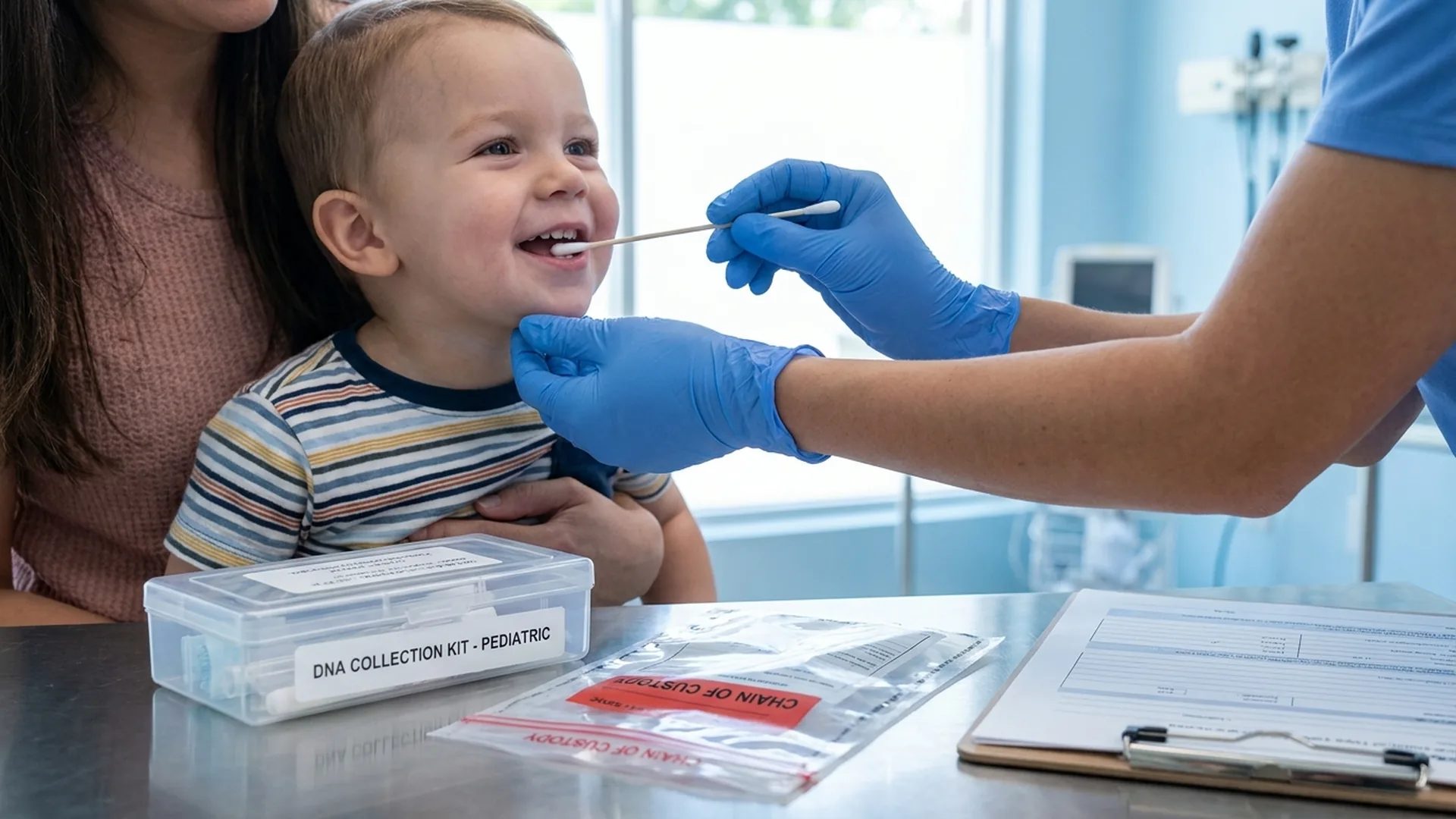
A court-admissible legal DNA test is collected under a documented chain of custody, which is what a home test lacks.
| Test Type | Price | Turnaround | Court-Admissible? |
|---|---|---|---|
| Home (informational) | $130–$300 | 3–5 business days | No |
| Legal (chain of custody) | $300–$500 | 5–7 business days | Yes |
| Prenatal (NIPP) | $1,500–$2,000 | After 7 weeks gestation | For confirmation only |
A home test lets you self-collect cheek swabs and mail them to a lab, but it carries no verified chain of custody, so a court will not accept it. A legal test is collected at a certified site with photo ID and a witnessed sample, which is what makes it admissible. A prenatal NIPP test uses a blood draw from the mother compared with the father’s swab, is 99.9% accurate, and poses no risk to the baby.
In a court-ordered case, the judge decides who pays for testing. Often the party proven wrong bears the cost. If the Department of Revenue starts the case, the state may cover testing up front.
Yes, but it is hard. Florida’s disestablishment statute (F.S. § 742.18) lets a man challenge an existing paternity determination, but only if he clears strict requirements [2]. This is not a quick undo button.
The court must deny relief if, after learning he might not be the biological father, the man did any of six things: married the mother and assumed the parental role, acknowledged paternity in a sworn statement, consented to be named on the birth certificate, promised in writing to support the child, ignored a court or agency order to submit to testing, or signed a voluntary acknowledgment of paternity under § 742.10(4). Any one of them can defeat the petition.
Even when disestablishment is granted, the court may still order the man to pay child support if no other father is identified and the child would otherwise be left without support. This is complex territory. Talk to an attorney before you pursue it.
Florida keeps a Putative Father Registry under F.S. § 63.054, which protects men who believe they may be the father of a child being placed for adoption. The filing fee is just $9, and missing the deadline can cost you everything.
If you think you may be the father but the mother has not told you about the pregnancy or birth, take these steps:
Failing to register can let your parental rights be terminated without your knowledge. That risk is highest when the mother may be considering adoption without telling the father.
Once paternity is established, either parent can petition for child support under Florida’s Income Shares Model (F.S. § 61.30) [6]. Support can be ordered retroactively for up to 24 months before the petition is filed under F.S. § 61.30(17), which can still mean a substantial lump sum. That single fact reshapes many cases.
A few things to know once paternity is settled:
If that court-ordered amount later becomes hard to pay, learn the proper steps to take when you cannot afford child support. Missing payments risks wage garnishment and license suspension, so a formal modification is the safer route.
It depends on the method. A voluntary acknowledgment at the hospital takes effect immediately, the same day. A post-birth acknowledgment takes 1 to 2 weeks to process. A court petition takes 3 to 12 months, depending on whether the other party cooperates and whether DNA testing is required [2].
The hospital acknowledgment (DH-511) is free. A post-birth acknowledgment runs about $30 for notary fees. A court petition costs $500 to $5,000 or more, including filing fees ($300+ in Duval County), attorney fees, and court-admissible DNA testing ($300 to $500) [2].
A mother can refuse to sign a voluntary acknowledgment, but she cannot stop the father from filing a court petition under F.S. Chapter 742. The court can order DNA testing over her objection. If the test confirms paternity, the court will enter an order establishing the father’s legal rights [2].
He can petition for custody and time-sharing (starting with the 50/50 presumption created by HB 1301 in 2023, now in F.S. § 61.13), decision-making authority over education and healthcare, and a voice in every major decision about the child. The child also gains inheritance rights and access to the father’s benefits, including Social Security, health insurance, and veterans’ benefits [3] [5].
Yes. A non-invasive prenatal paternity test (NIPP) can be done as early as 7 weeks of gestation, using a blood draw from the mother and a cheek swab from the alleged father. These tests are 99.9% accurate with no risk to the baby, and cost about $1,500 to $2,000. Legal paternity, meaning the court order or acknowledgment, still cannot be finalized until after the child is born [4].
[1] CDC, National Center for Health Statistics, Stats of the States: Florida (Births to Unmarried Mothers, 2024 final data). Reports 45.1% of Florida live births to unmarried mothers. cdc.gov
[2] Florida Legislature, F.S. Chapter 742: Determination of Parentage (including § 742.10 voluntary acknowledgment and § 742.18 disestablishment). flsenate.gov
[3] Florida Senate, HB 775: Good Dad Act (2023). flsenate.gov
[4] American Association of Blood Banks (AABB), Accredited Relationship (DNA) Testing Facilities and Standards. aabb.org
[5] Florida Legislature, CS/HB 1301 (2023), Chapter 2023-301, Laws of Florida. Created the rebuttable presumption of equal (50/50) time-sharing, codified at F.S. § 61.13(2)(c)1. flsenate.gov
[6] Florida Legislature, F.S. § 61.30: Child Support Guidelines. flsenate.gov
 ✓
✓Reviewed by
Family Law Attorney & Partner, Sacks & Sacks