
Need help with a child custody case in Jacksonville? Call (904) 396-5557 or contact us online to schedule a consultation.
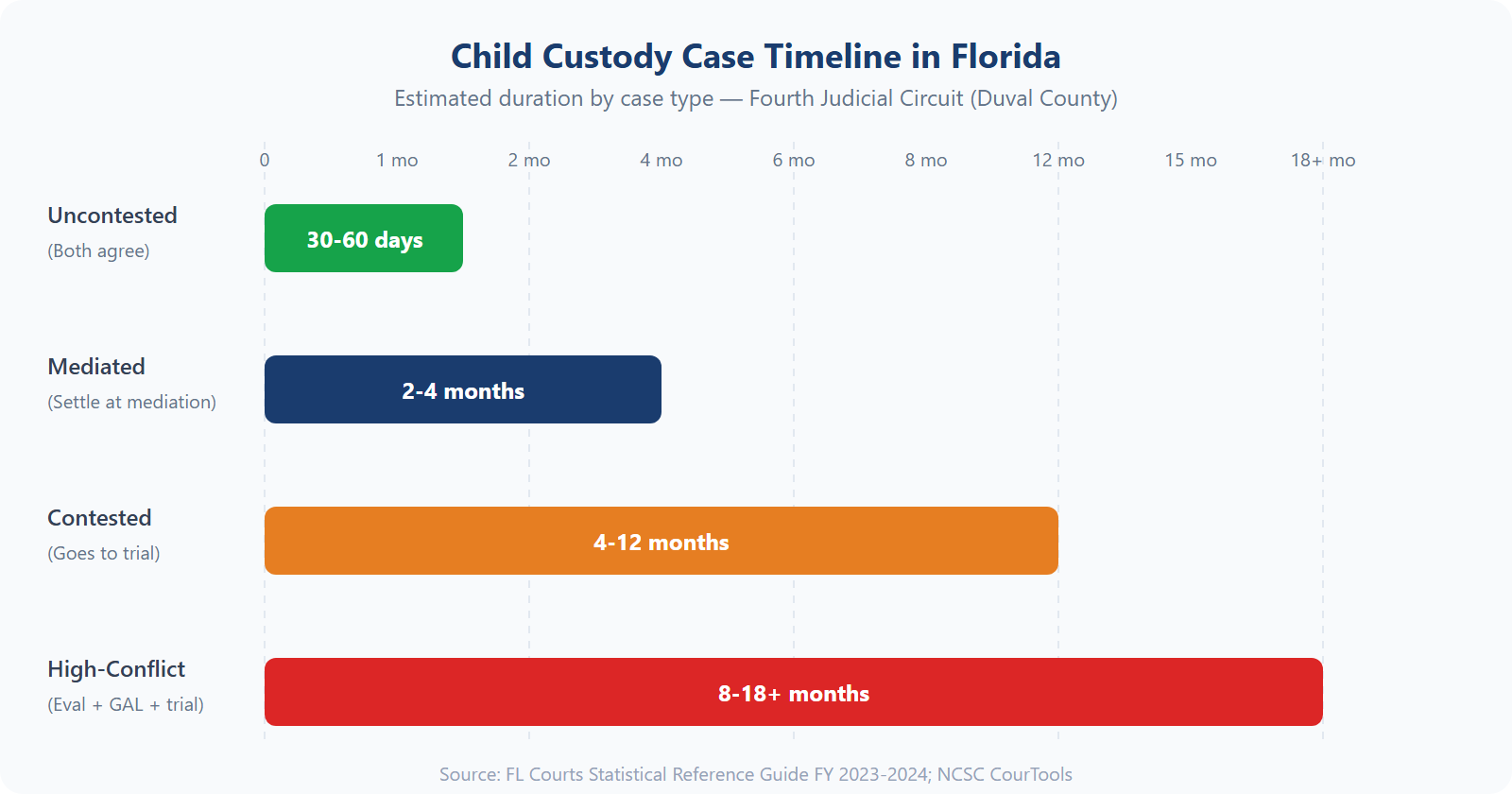
Most child custody cases in Florida resolve within 3-12 months, though the range is wide. According to the Florida Courts’ FY 2023-2024 data, the Fourth Judicial Circuit (Duval, Clay, Nassau counties) handled over 12,000 family law filings, with custody-related cases averaging 4-8 months from petition to final order. [1] Uncontested cases where both parents agree on a parenting plan can be finalized in as little as 30 days.
The timeline depends almost entirely on whether the parents can agree. Florida law requires mediation before trial for contested custody issues (F.S. § 61.183), and roughly 65% of mediated family cases reach full or partial settlement — which shortens the process significantly. Cases that go to trial typically take 8-18 months and sometimes longer when custody evaluations, guardian ad litem appointments, or complex discovery are involved.
Here’s a realistic breakdown of what to expect at each stage of the process in Duval County.
An uncontested custody case — where both parents agree on time-sharing, parental responsibility, and the parenting plan — can be resolved in as little as 30-60 days in Duval County. The Florida Courts’ Biennial Report shows that uncontested family law matters have the shortest processing times, often completing within one court appearance. [1]
The timeline for an uncontested case typically looks like this:
If your ex-spouse agrees to waive formal service and files a consent agreement, the process can be even faster. Some uncontested cases are resolved at the first hearing without any return trips to court.
Contested custody cases — where parents disagree on time-sharing, parental responsibility, or key provisions of the parenting plan — typically take 4-12 months in the Fourth Judicial Circuit, with complex cases extending to 18 months or longer. The National Center for State Courts reports that the median disposition time for contested family law cases nationally is 8.3 months. [2]
The contested case timeline follows these stages:
Months 1-2: Filing and initial hearings. The petitioning parent files the custody petition, the other parent is served and responds within 20 days, and the court may set a case management conference. If either parent needs immediate protection, the court can enter temporary custody orders at an emergency hearing.
Months 2-4: Discovery and disclosure. Both parents exchange financial affidavits, parenting plans, and relevant documents. Discovery can include interrogatories, requests for production, and depositions. Complex cases involving hidden assets or business income take longer.
Months 3-5: Mandatory mediation. Under F.S. § 61.183, all contested family law issues must be mediated before trial. Mediation sessions typically last 3-8 hours and resolve approximately 65% of cases (full settlement) with another 10% reaching partial agreements. [3]
Months 4-8: Pre-trial preparation. If mediation fails, both sides prepare for trial — filing witness lists, exhibit lists, and pre-trial memoranda. The court schedules a pre-trial conference 30-60 days before the trial date.
Months 6-12+: Trial. Custody trials in Duval County typically last 1-3 days for standard cases and up to a week for complex high-conflict matters. The judge evaluates the 20 best-interest factors under F.S. § 61.13(3) and issues a final order, usually within 30 days of the trial’s conclusion.
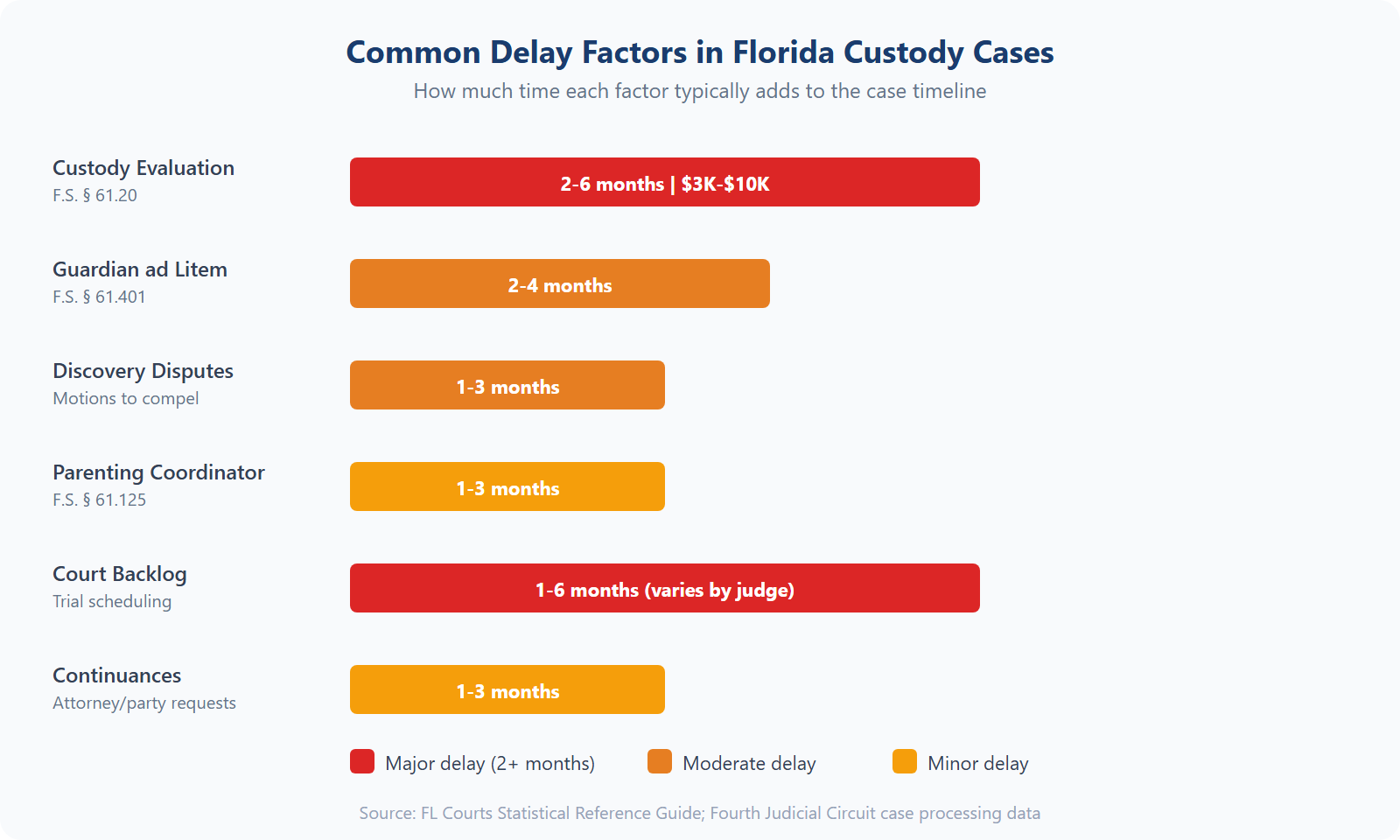
Several factors can extend a custody case well beyond the typical timeline. The Florida Courts’ Statistical Reference Guide identifies judicial vacancies, complex evaluations, and attorney scheduling conflicts as the top three causes of delay in family law cases. [1]
Custody evaluation (adds 2-6 months): When the court orders a social investigation under F.S. § 61.20, a qualified evaluator interviews both parents, observes parent-child interactions, and reviews records. Full custody evaluations in Jacksonville typically cost $3,000-$10,000 and take 2-6 months to complete.
Guardian ad litem appointment (adds 2-4 months): The court may appoint a guardian ad litem (GAL) to represent the child’s interests under F.S. § 61.401. The GAL conducts their own independent investigation and files a report with recommendations. This adds time but can be extremely influential — judges frequently adopt GAL recommendations.
Parenting coordinator involvement (adds 1-3 months): For high-conflict cases, the court may appoint a parenting coordinator under F.S. § 61.125 to help resolve ongoing disputes about the parenting plan. While this can delay the final order, it often prevents future modifications.
Discovery disputes (adds 1-3 months): When one parent refuses to disclose financial information, produces incomplete records, or fails to cooperate with discovery, the other parent must file motions to compel — each of which requires a hearing and adds weeks to the timeline.
Continuances and scheduling conflicts (adds 1-3 months): Attorney scheduling, judicial calendars, and party requests for continuances are common causes of delay. Duval County judges generally limit continuances but grant them for good cause (medical emergencies, newly discovered evidence, attorney withdrawal).
Court backlog (adds 1-6 months): The Fourth Judicial Circuit’s family law division handles a high volume of cases. Trial dates are typically set 2-4 months out from the pre-trial conference, and complex cases may wait longer for multi-day trial slots.
Yes — and this is one of the most important tools available to parents in contested custody cases. Under Florida Rule of Family Law Procedure 12.610, either parent can request temporary relief while the case is pending. Temporary custody orders typically take 2-4 weeks to obtain, depending on the urgency. [4]
Emergency temporary custody (24-72 hours): If the child is in immediate danger — abuse, neglect, substance abuse in the home — the court can enter an emergency temporary order within 24-72 hours without the other parent being present (ex parte). A full hearing must follow within 15 days.
Standard temporary custody (2-4 weeks): For non-emergency situations, the parent files a motion for temporary time-sharing and the court schedules a hearing. Both parents present evidence, and the judge enters a temporary order that remains in effect until the final order is issued.
Temporary orders matter because they establish the status quo. Judges consider the existing arrangement when making final custody decisions, so the temporary order often shapes the outcome. If one parent has been exercising majority time-sharing under a temporary order for 6-8 months, courts are reluctant to disrupt that stability.
Mediation is the single most effective way to shorten a custody case. The Florida Courts’ ADR data shows that 102,106 cases were mediated statewide in FY 2024-2025, with 20,808 of those being family law cases. Mediated custody cases typically resolve 3-6 months faster than cases that go to trial. [3]
Under F.S. § 61.183, mediation is mandatory for all contested family law issues in Florida (with exceptions for domestic violence). The mediator is a neutral third party — often a Florida Supreme Court Certified Family Mediator — who helps parents negotiate a parenting plan.
If mediation succeeds, the agreed-upon parenting plan is submitted to the court for approval. The judge reviews it to ensure it meets the child’s best interests under F.S. § 61.13, and if approved, enters it as a final order. This can wrap up a case in 2-4 months — compared to 8-12 months for a full trial.
Even when mediation doesn’t produce a full agreement, partial settlements narrow the issues for trial. If parents agree on parental responsibility and the school district but disagree on the overnight schedule, the trial is shorter and the judge focuses only on the disputed issue.
Florida’s 2023 custody reform (Ch. 2023-301), which established a rebuttable presumption of equal (50/50) time-sharing effective July 1, 2023, has had a measurable impact on custody case timelines. Early data from family law practitioners suggests that more cases are settling at mediation because the 50/50 presumption gives both parents a clearer starting point for negotiation. [5]
Before the reform, one parent often had to prove why they deserved majority time-sharing — which required more evidence, more expert testimony, and longer trials. Now, 50/50 is the presumed starting point, and the parent seeking a different arrangement bears the burden of proving why equal time-sharing isn’t in the child’s best interests.
This shift has shortened some cases but lengthened others. Cases where one parent has legitimate safety concerns (domestic violence, substance abuse, untreated mental health issues) may take longer because that parent must now present more evidence to overcome the 50/50 presumption. But for the majority of custody disputes, the reform has accelerated resolution by reducing the range of contested issues.
The 20 best-interest factors under F.S. § 61.13(3) still control every custody decision. The presumption doesn’t change what the court considers — it changes who has to prove their case.
Custody hearings in Duval County follow a structured format, and knowing what to expect reduces anxiety and helps you prepare effectively. The Florida Courts Self-Help Center reports that parents who prepare thoroughly for hearings achieve better outcomes and experience shorter case timelines. [6]
Temporary custody hearings (30-60 minutes): These are shorter proceedings where the judge considers immediate needs — who the child lives with, the temporary time-sharing schedule, and any emergency protections. Both parents may testify, but lengthy witness testimony is usually not permitted.
Final custody hearings / trials (1-3 days): Both parents present evidence through testimony, documents, and expert witnesses. The judge evaluates the 20 best-interest factors under F.S. § 61.13(3), including each parent’s capacity to provide for the child, the stability of each home, the child’s preference (if mature enough), and each parent’s willingness to co-parent.
What to bring:
What to avoid: Don’t speak negatively about the other parent in court. Judges evaluate willingness to co-parent (Factor #12) — parents who demonstrate cooperation and respect for the other parent’s relationship with the child tend to receive more favorable outcomes.
I’ve handled custody cases in Jacksonville that resolved in 45 days and others that took over a year. The difference almost always comes down to preparation and strategy. Parents who walk into court without an attorney frequently make procedural mistakes — missing filing deadlines, submitting incomplete financial affidavits, failing to preserve evidence — that add months to their case.
An experienced family law attorney knows which battles are worth fighting and which ones to concede. In the Fourth Judicial Circuit, I know which judges prefer detailed parenting plans, which mediators are most effective for high-conflict cases, and how to structure discovery requests that produce results quickly without unnecessary motions.
The 2023 reform makes legal representation even more important. Understanding how the 50/50 presumption interacts with the 20 best-interest factors — and knowing which evidence effectively rebuts the presumption when necessary — requires both legal knowledge and courtroom experience.
Don’t wait to get your custody case started. Call (904) 396-5557 today. I’ll evaluate your situation, explain your realistic timeline, and build a strategy to resolve your case as efficiently as possible.
An uncontested custody case where both parents agree on a parenting plan typically takes 30-60 days in Duval County. The process involves filing the petition, serving the other parent (or obtaining a waiver), waiting the 20-day response period, and attending a single hearing where the judge approves the agreed plan. If both parents cooperate fully, some cases are finalized at the first appearance. [1]
Contested custody cases typically take 4-12 months from filing to final order, with complex cases extending to 18 months. The timeline includes discovery (2-4 months), mandatory mediation (1-2 months), pre-trial preparation (1-3 months), and the trial itself (1-3 days). Cases involving custody evaluations, guardian ad litem appointments, or high-conflict disputes take longer. [2]
Yes. Under F.S. § 61.183, mediation is mandatory for all contested family law issues in Florida. The only exceptions are cases involving domestic violence or where the court finds mediation would be inappropriate. Mediation resolves approximately 65% of family cases with full agreement, and cases that settle at mediation finish 3-6 months faster than those proceeding to trial. [3]
Yes. Either parent can request temporary custody orders under Florida Rule of Family Law Procedure 12.610. Standard temporary orders take 2-4 weeks to obtain. In emergencies involving child safety, the court can enter an ex parte temporary order within 24-72 hours, with a full hearing required within 15 days. Temporary orders establish the status quo and often influence the final custody decision. [4]
In many cases, yes. Florida’s 2023 custody reform (Ch. 2023-301) established a rebuttable presumption of equal time-sharing, giving parents a clearer starting point for negotiation. More cases are settling at mediation because neither parent needs to “win” majority time-sharing — 50/50 is already presumed. However, cases where one parent must rebut the presumption with evidence of safety concerns may take longer. [5]
The fastest path is agreeing on a parenting plan before or during mediation. Parents who settle at mediation typically finalize their custody case in 2-4 months. To speed the process: complete your parenting course early (F.S. § 61.21), prepare your financial affidavit immediately, agree on non-controversial issues before mediation, and hire an experienced local attorney who can navigate the Fourth Judicial Circuit efficiently.
A full custody evaluation ordered under F.S. § 61.20 typically takes 2-6 months to complete and adds that time to the overall case duration. The evaluator interviews both parents, observes parent-child interactions, reviews records, and may administer psychological testing. Evaluations in Jacksonville cost $3,000-$10,000. Judges frequently rely heavily on evaluation findings when making final custody decisions.
Sources:
[1] Florida Courts, Statistical Reference Guide & Biennial Report FY 2023-2024. flcourts.gov
[2] National Center for State Courts, CourTools: Time to Disposition. ncsc.org
[3] Florida Courts, Dispute Resolution Center Annual Report FY 2024-2025. flcourts.gov
[4] Florida Rules of Family Law Procedure, Rule 12.610 — Injunctions for Protection. floridabar.org
[5] Florida Legislature, Ch. 2023-301 — Parenting and Time-Sharing. flrules.org
[6] Florida Courts Self-Help Center, Family Law — Time-Sharing and Parenting Plans. help.flcourts.gov
 ✓
✓Reviewed by
Family Law Attorney & Partner, Sacks & Sacks