How to File For a Restraining Order in Florida

restraining order
TL;DR: Florida courts processed 79,483 injunction-for-protection filings in FY 2023-24, with domestic violence accounting for 54.8% of all petitions (FL Courts Statistical Reference Guide). There is no filing fee for any type of restraining order in Florida (F.S. § 741.30(2)(a)). A judge can grant a temporary ex parte injunction the same day you file if there is immediate danger, and the sheriff serves it at no cost.

Need a restraining order in Jacksonville? Call (904) 396-5557 for a free consultation with a family law attorney who handles injunction cases in Duval County.

What Is a Restraining Order (Injunction for Protection) in Florida?

Florida processed 79,483 injunction petitions in FY 2023-24, averaging 218 filings per day statewide (FL Courts) [1]. In Florida, what most people call a “restraining order” is legally known as an injunction for protection.

An injunction is a court order that prohibits the respondent (the person you need protection from) from contacting you, coming near you, your home, your workplace, or your children. It carries the force of law — violating an injunction is a first-degree misdemeanor punishable by up to one year in jail under F.S. § 741.31 [2].

Key facts about Florida injunctions:

  • No filing fee — the petition is free to file (F.S. § 741.30(2)(a))
  • No attorney required — you can file pro se, though legal representation significantly strengthens your case
  • Free service — the sheriff serves the injunction on the respondent at no charge
  • Immediate relief available — a judge can issue a temporary ex parte order the same day
  • Statewide enforcement — valid and enforceable in all 67 Florida counties

What Are the 5 Types of Restraining Orders in Florida?

Florida law provides five distinct types of injunctions for protection, each governed by different statutes and eligibility requirements. In FY 2023-24, domestic violence injunctions accounted for 43,536 filings (54.8%), followed by stalking at 24,021 (30.2%) [1].

  1. Domestic Violence Injunction (F.S. § 741.30)

    The most common type. Available to family or household members who are victims of domestic violence or have reasonable cause to believe they are in imminent danger. “Family or household member” includes:

    • Spouses and former spouses
    • People related by blood or marriage
    • People who currently live together or previously lived together as a family
    • People who have a child in common (regardless of whether they ever lived together)

    Filings FY 2023-24: 43,536 statewide [1]

  2. Stalking Injunction (F.S. § 784.0485)

    Available when someone willfully, maliciously, and repeatedly follows, harasses, or cyberstalks you. No prior relationship with the stalker is required. This includes online harassment, repeated unwanted contact, and surveillance.

    Filings FY 2023-24: 24,021 statewide [1]

  3. Repeat Violence Injunction (F.S. § 784.046)

    Available when someone who is not a family or household member has committed two or more acts of violence against you, with at least one incident within the past 6 months. This covers neighbors, coworkers, acquaintances, or strangers.

    Filings FY 2023-24: 7,375 statewide [1]

  4. Dating Violence Injunction (F.S. § 784.046)

    Applies to people in a continuing and significant romantic or intimate relationship. The court considers the duration, nature, and frequency of interaction. This covers boyfriends, girlfriends, and dating partners who are not household members.

    Filings FY 2023-24: 3,602 statewide [1]

  5. Sexual Violence Injunction (F.S. § 784.046)

    Available to victims of sexual battery, lewd acts, or luring/enticing a child. No prior relationship is required. If the respondent was convicted or adjudicated delinquent, a single incident is sufficient. Without a conviction, the victim must have reported the incident to law enforcement and must be cooperating with prosecution.

    Filings FY 2023-24: 949 statewide [1]
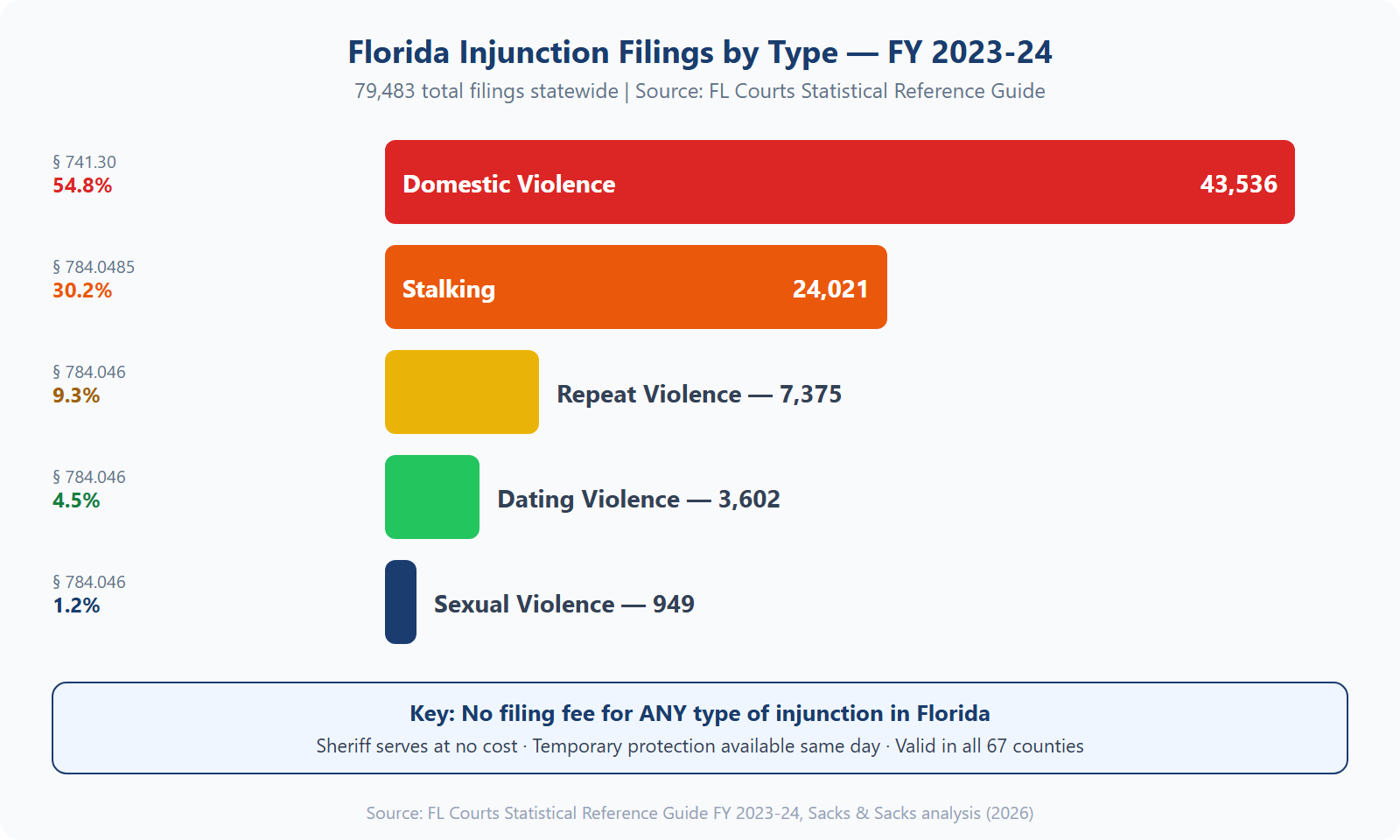
    Chart comparing 5 types of Florida injunctions for protection showing domestic violence as most common at 43,536 filings followed by stalking at 24,021

How Do You File for a Restraining Order in Florida? (Step-by-Step)

The process takes as little as one day for emergency protection. Florida courts are required to schedule the full hearing at the earliest possible time after a petition is filed (F.S. § 741.30(4)) [2].

Step 1: Go to the Courthouse Clerk’s Office

In Duval County, go to the Duval County Courthouse, 501 W. Adams Street, Jacksonville, FL 32202. You can also file in the county where the respondent resides or where the violence occurred — there is no residency requirement (F.S. § 741.30(1)(j)).

The clerk’s office will:

  • Help you select the correct petition form
  • Provide simplified forms and instructions
  • Ensure your privacy while completing forms
  • Provide domestic violence center brochures and referrals

Step 2: Complete the Petition Form

You’ll fill out the appropriate Florida Supreme Court Approved Form:

  • Domestic violence: Form 12.980(a) — Petition for Injunction for Protection Against Domestic Violence
  • Repeat/dating/sexual violence: Form 12.980(b), (f), or (g) depending on the type
  • Stalking: Form 12.980(g) — Petition for Injunction for Protection Against Stalking

The petition requires specific facts and circumstances — dates, locations, descriptions of incidents, witnesses, and why you believe you are in danger. Be as detailed as possible. The more specific your petition, the stronger your case.

Step 3: File the Petition (Same Day)

Submit the completed petition to the clerk. There is no filing fee and no bond required. The clerk will assign a case number and forward your petition to a judge, typically within hours.

Step 4: Judge Reviews for Temporary Injunction

A judge will review your petition — usually the same day — to determine if there is “immediate and present danger.” If so, the judge issues a temporary ex parte injunction that lasts up to 15 days (F.S. § 741.30(5)(c)) [2].

“Ex parte” means the respondent does not need to be present for this initial order. The temporary injunction typically orders:

  • No contact with the petitioner (in person, by phone, text, email, or through third parties)
  • Stay away from petitioner’s home, work, school, and children’s locations
  • Temporary exclusive use of shared dwelling (if applicable)
  • Temporary parenting plan and time-sharing (up to 100% to petitioner)
  • Surrender of firearms and ammunition (F.S. § 790.233)

If the judge does not find immediate danger, the petition is not dismissed — instead, the court must schedule a full hearing with notice to both parties.

Step 5: Sheriff Serves the Respondent

Within 24 hours of the court issuing the injunction, the clerk electronically transmits it to the sheriff, who serves it on the respondent at no cost, any day of the week, any time of day or night (F.S. § 741.30(8)(a)) [2].

The injunction is entered into the Domestic and Repeat Violence Injunction Statewide Verification System maintained by FDLE, making it immediately available to all law enforcement agencies statewide.

Step 6: Attend the Full Hearing (Within 15 Days)

The court schedules a full hearing before the temporary injunction expires. Both parties can present evidence and testimony. Bring:

  • Police reports and incident reports
  • Medical records and photographs of injuries
  • Screenshots of threatening texts, emails, or social media messages
  • Witness statements or witnesses willing to testify
  • Records of prior incidents (even if not reported to police)

Step 7: Judge Issues Final Injunction

If the judge finds sufficient evidence, a final injunction for protection is issued. Unlike the temporary order, a final DV injunction has no expiration date — it remains in effect until modified or dissolved by the court (F.S. § 741.30(6)(c)) [2].

The final injunction can include all temporary provisions plus:
  • Temporary child support for the petitioner or children
  • Batterer’s intervention program requirement for the respondent
  • Referral to a certified domestic violence center
  • Pet protection — exclusive care, possession, or control of animals
  • Hope Card — a wallet-sized card confirming the active injunction (F.S. § 741.311)

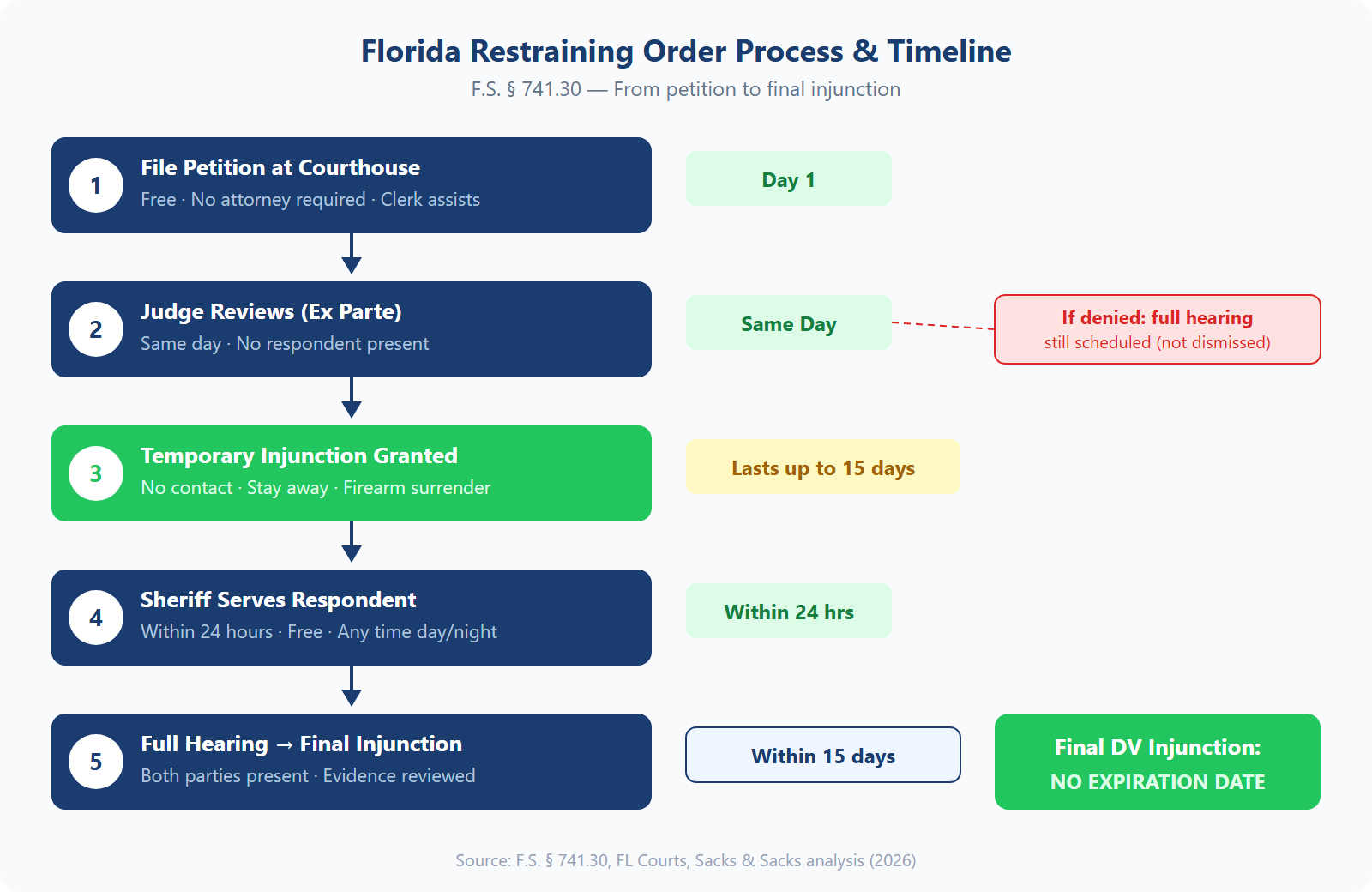
Chart showing the step-by-step process and timeline for filing a restraining order in Florida from petition to final injunction

How Common Is Domestic Violence in Florida?

Florida reported 103,915 domestic violence incidents in FY 2024-25, resulting in 220 homicides — approximately 20% of all homicides in the state (FL DCF Domestic Violence Annual Report 2025) [3].

Additional statewide data from FY 2024-25:

  • 63,464 arrests for domestic violence-related crimes
  • 74,381 crisis hotline calls received by certified DV centers
  • 12,425 individuals received emergency shelter
  • 624,269 shelter nights provided statewide
  • 229,076 safety plans completed with survivors

These numbers underscore why Florida’s injunction system exists — it provides immediate legal protection without requiring victims to wait for criminal charges or convictions.

What Can a Florida Restraining Order Actually Do?

A Florida injunction for protection is one of the most powerful civil remedies available. Under F.S. § 741.30(6), a court can order [2]:

  1. No contact — prohibit all communication (in person, phone, text, email, social media, or through third parties)
  2. Stay-away distance — require the respondent to remain a specified distance from your home, work, school, and children’s locations
  3. Exclusive dwelling use — grant you possession of the shared home and exclude the respondent
  4. Temporary parenting plan — award up to 100% of time-sharing to the petitioner during the injunction
  5. Temporary child support — establish financial support for children and/or the petitioner
  6. Firearm surrender — respondent must relinquish all firearms and ammunition (first-degree misdemeanor to possess under F.S. § 790.233)
  7. Batterer’s intervention — require participation in a certified batterer’s intervention program
  8. Pet protection — grant exclusive care and custody of household animals

What Happens If Someone Violates a Restraining Order?

Violating an injunction for protection is a first-degree misdemeanor under F.S. § 741.31, carrying up to 1 year in jail and a $1,000 fine [2]. Law enforcement officers can arrest the respondent without a warrant if they have probable cause to believe a violation occurred (F.S. § 901.15(6)).

After arrest, the respondent is held in custody until brought before the court. The court can enforce the injunction through:

  • Criminal contempt — additional jail time for willful violation
  • Civil contempt — monetary fines and assessments
  • Criminal prosecution by the State Attorney’s office
  • Enhanced charges if the violation involves new acts of violence (battery, stalking, etc.)

If you believe someone has violated your injunction, call 911 immediately. Do not confront the person yourself.

Where Do You File for a Restraining Order in Jacksonville?

In the Jacksonville area, injunctions for protection are filed in Circuit 4, which covers Duval, Nassau, and Clay counties. Circuit 4 processed 18,393 family court filings in FY 2023-24 [1].

Duval County filing locations:

  • Duval County Courthouse — 501 W. Adams Street, Jacksonville, FL 32202 (main courthouse)
  • The clerk’s office provides forms, instructions, and privacy during the filing process

Important jurisdictional rules (F.S. § 741.30(1)(j)):

  • You can file where you currently or temporarily reside
  • You can file where the respondent resides
  • You can file where the violence occurred
  • There is no minimum residency requirement — even if you just moved to Jacksonville

What Are the 6 Most Common Mistakes When Filing for a Restraining Order?

  1. Being too vague in the petition — general statements like “he threatened me” are weak. Include specific dates, times, locations, exact words spoken, and any witnesses present. The judge needs concrete facts.
  2. Filing the wrong type of injunction — if you file a domestic violence injunction against someone you never lived with or had a child with, the petition will be denied. Make sure you qualify under the correct statute.
  3. Not bringing evidence to the hearing — text messages, voicemails, photos of injuries, police reports, and medical records strengthen your case. The court relies on evidence, not just verbal testimony.
  4. Missing the full hearing — if you don’t appear at the hearing, the temporary injunction expires and the case is dismissed. Mark the date and arrive early.
  5. Contacting the respondent after filing — initiating contact with the respondent can undermine your case. The respondent’s attorney may argue you don’t actually fear for your safety.
  6. Not seeking legal help — while no attorney is required, an experienced family law attorney understands how to present evidence, cross-examine the respondent, and address custody, support, and housing issues within the injunction proceedings.

How Does a Restraining Order Affect Child Custody?

A domestic violence injunction has significant implications for custody and time-sharing. Under F.S. § 741.30(5)(a)(3), the court can award the petitioner up to 100% of time-sharing in a temporary parenting plan [2].

This is particularly important in light of Florida’s 50/50 time-sharing presumption under Ch. 2023-301 [4]. The 2023 reform creates a rebuttable presumption of equal time-sharing, but domestic violence is one of the strongest factors courts use to deviate from the 50/50 default under the 20 best interest factors in F.S. § 61.13(3).

Key custody provisions in an injunction:

  • Temporary parenting plan remains in effect until a family court order replaces it
  • Child exchanges must occur at a neutral safe exchange location if any time-sharing is granted to the respondent
  • The court considers supervised visitation programs for the respondent’s contact
  • Temporary child support can be established within the injunction

How Long Does a Florida Restraining Order Last?

The duration depends on the type of injunction and whether it’s temporary or final:

  • Temporary ex parte injunction: Up to 15 days, but automatically extended if the full hearing is continued
  • Final domestic violence injunction: No expiration date — remains in effect until modified or dissolved by the court (F.S. § 741.30(6)(c))
  • Final repeat/dating/sexual violence injunction: Set period determined by the court, or permanent if the court deems it necessary
  • Final stalking injunction: Set period or permanent

Either party can move to modify or dissolve the injunction at any time (F.S. § 741.30(10)). However, the court will only dissolve an injunction if it finds the circumstances have changed sufficiently.

Can a Restraining Order Be Denied?

Yes. A judge can deny a petition for an injunction, but must provide a written order stating the legal grounds for denial (F.S. § 741.30(5)(b)) [2]. Common reasons for denial include:

  • Insufficient evidence of domestic violence or imminent danger
  • Wrong type of injunction — the parties don’t meet the relationship definition for the selected type
  • Vague allegations — the petition lacks specific facts, dates, and circumstances
  • Stale incidents — the violent acts occurred too long ago without ongoing threat

If your temporary injunction is denied on the grounds of no “immediate and present danger,” the court must still schedule a full hearing — your petition is not dismissed. You can also amend and refile the petition with additional details.

Frequently Asked Questions

How much does it cost to file for a restraining order in Florida?

There is no fee to file a petition for any type of injunction for protection in Florida (F.S. § 741.30(2)(a)). The sheriff also serves the injunction on the respondent at no charge. If you hire an attorney to assist with your petition and represent you at the hearing, attorney fees typically range from $1,500 to $5,000 depending on complexity.

How quickly can I get a restraining order in Florida?

A temporary ex parte injunction can be issued the same day you file if the judge finds immediate and present danger. The full hearing must be scheduled within 15 days. In Duval County, judges typically review petitions within hours of filing.

Can I get a restraining order without the other person knowing?

The initial temporary ex parte injunction is issued without the respondent being present or notified. However, the respondent must be served before the full hearing, and has the right to appear, present evidence, and be heard at the hearing. The respondent will know about the injunction when served by the sheriff.

What is a Hope Card in Florida?

A Hope Card is a wallet-sized card that confirms you have an active final injunction for protection (F.S. § 741.311). It contains the respondent’s information and the terms of the order. You can show it to law enforcement if the respondent violates the injunction, making verification faster than looking up the court order.

Can a restraining order be used against me in a custody case?

Yes. A domestic violence injunction is a significant factor in custody proceedings. Under F.S. § 61.13(3), domestic violence is one of 20 best interest factors courts must consider. An active or past injunction can be used to rebut the 50/50 time-sharing presumption. Filing a false petition is punishable under F.S. § 92.525 (perjury).

Sources:

[1] Florida Courts, Statistical Reference Guide FY 2023-24, Chapter 5: Circuit Family Court Statistics. flcourts.gov

[2] Florida Legislature, F.S. § 741.30 — Domestic Violence; Injunction; Powers and Duties of Court (2025). leg.state.fl.us

[3] Florida Department of Children and Families, Domestic Violence Annual Report 2025 (FY 2024-25). myflfamilies.com

[4] Florida Legislature, Ch. 2023-301 — Family Law Reform (50/50 Time-Sharing Presumption). laws.flrules.org

[5] Florida Courts, Overview for Petitioners — Domestic Violence Injunctions. flcourts.gov

Related Posts

Adam Sacks

Written by

Adam Sacks

Family Law Attorney & Partner, Sacks & Sacks
FL Supreme CourtCertified Family Mediator
Avvo Rating4.8 / 5.0
Share This Article