
If you or someone you know is in danger, call 911. For legal protection in Jacksonville, call (904) 396-5557 — we help victims file injunctions and protect their families.
Florida law defines domestic violence broadly under F.S. § 741.28 as any assault, battery, sexual assault, stalking, kidnapping, false imprisonment, or any criminal offense resulting in physical injury or death committed by one family or household member against another [2]. This is much broader than most people realize.
“Family or household member” includes spouses, ex-spouses, people related by blood or marriage, people who live together as a family, and people who have a child in common — regardless of whether they ever lived together. Dating relationships are covered under a separate statute, F.S. § 784.046 [2].
Key legal points every Floridian should know:
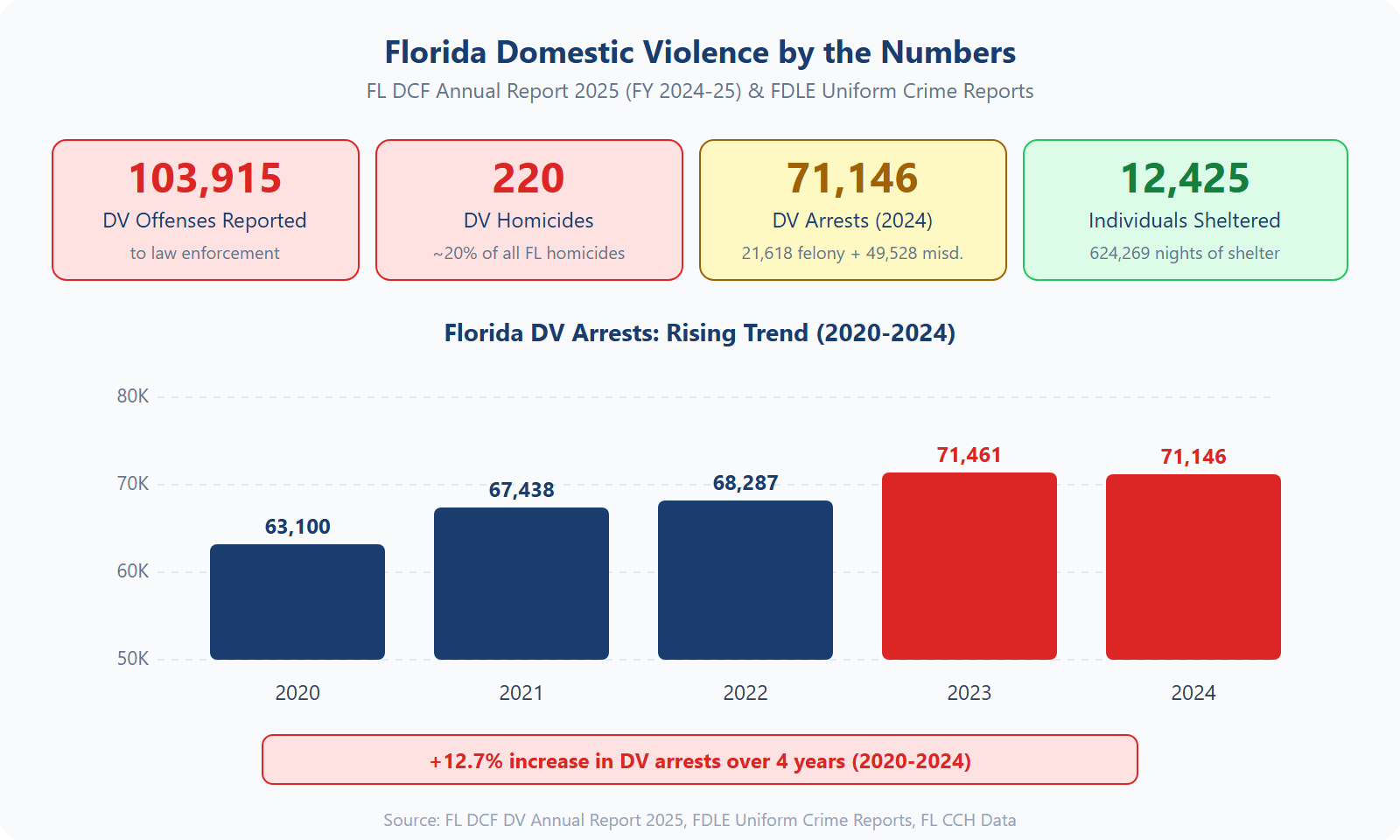
Florida reported 103,915 domestic violence offenses to law enforcement, 220 DV homicides (roughly 20% of all homicides in the state), and 63,464 DV arrests (FL DCF Annual Report 2025) [1]. These numbers are staggering — but experts agree they significantly undercount the true scope, since many incidents go unreported.
The trend is worsening. DV arrests in Florida have risen steadily from 63,100 in 2020 to 71,146 in 2024 — a 12.7% increase in 4 years [1]:
Nationally, the CDC reports that 1 in 3 women (43.5 million) and 1 in 6 men (20.7 million) experience intimate partner violence in their lifetime. The lifetime economic cost of IPV in the U.S. is $3.6 trillion (CDC NISVS) [3].
Florida’s 74,381 crisis hotline calls and 12,425 individuals sheltered in certified DV centers during FY 2024-25 show the scale of the crisis at the community level [1].
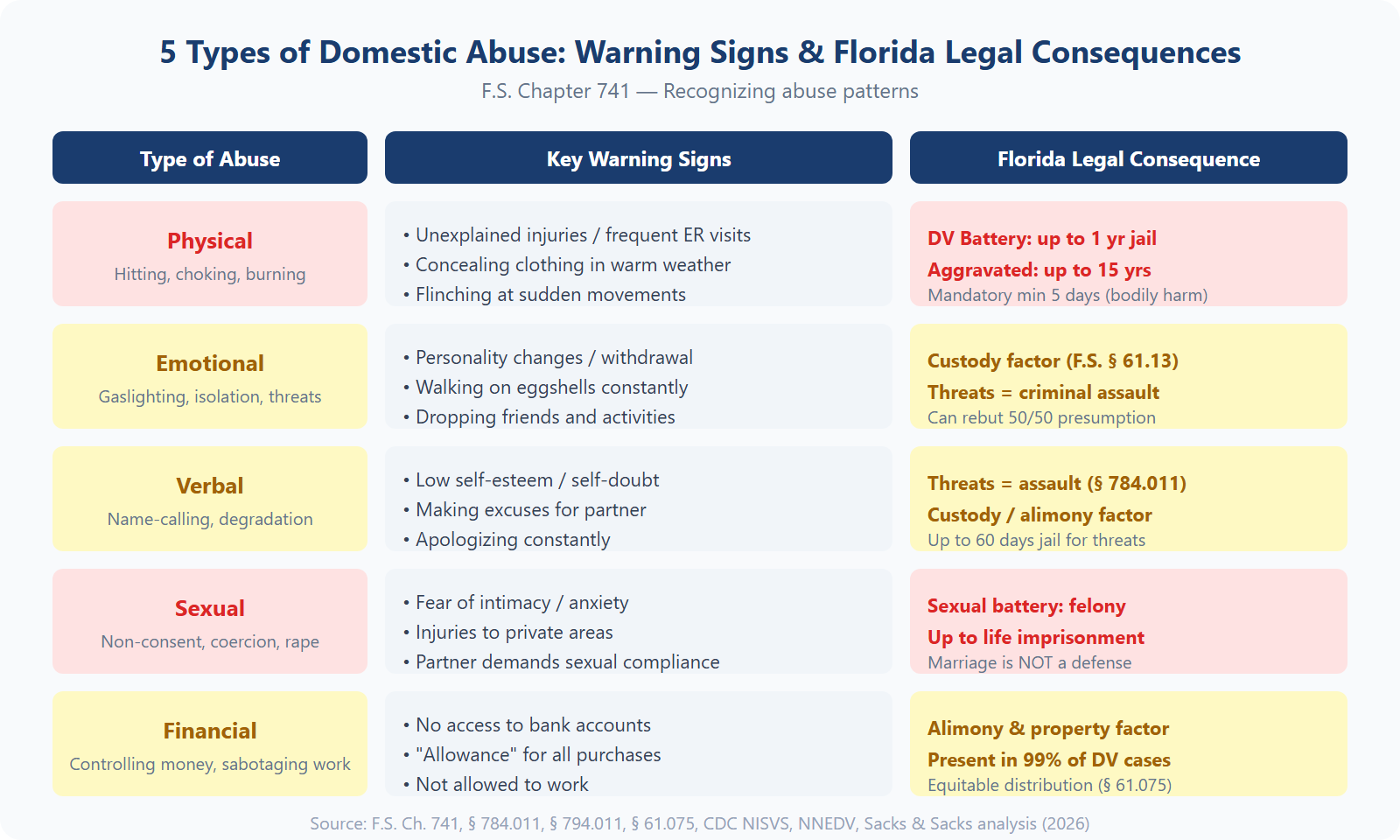
Domestic abuse extends far beyond physical violence. Understanding all five types helps victims and their loved ones recognize patterns that may not leave visible marks but are equally devastating — and equally illegal under Florida law.
Physical abuse is the most recognized form: hitting, punching, kicking, slapping, choking, burning, or using weapons. It also includes restraining someone physically, throwing objects, or threatening physical harm to loved ones or pets. In Florida, DV battery is a first-degree misdemeanor punishable by up to 1 year in jail, with aggravated battery (great bodily harm or use of a deadly weapon) rising to a second-degree felony with up to 15 years [2].
Emotional abuse involves manipulation tactics designed to undermine a victim’s reality, self-worth, and independence. Common forms include:
While emotional abuse alone may not constitute a criminal offense, it is a strong factor in custody decisions. Florida courts consider the impact of emotional abuse when evaluating the 20 best interest factors under F.S. § 61.13(3).
Verbal abuse includes name-calling, degradation, constant put-downs, and humiliation — often in front of others, including children. Abusers use words to strip their victims of self-esteem and identity. When verbal abuse includes threats of violence, it crosses into criminal assault under Florida law (F.S. § 784.011) [2].
Sexual abuse includes any non-consensual sexual contact, including marital rape, coerced sexual activity, and sexual degradation. Florida fully recognizes marital rape as a crime — marriage is not a defense to sexual battery under F.S. § 794.011. Sexual battery is a felony carrying sentences up to life imprisonment [2].
Financial abuse — controlling access to money, preventing employment, running up debt in the victim’s name, or hiding assets — is one of the most effective tools abusers use to trap victims in relationships. According to the National Network to End Domestic Violence, 99% of DV cases involve some form of financial abuse.
In Florida, financial abuse is relevant to both divorce proceedings (as a factor in alimony and equitable distribution) and custody decisions (as evidence of controlling behavior).
Physical abuse often follows a cycle of tension, explosion, and reconciliation (“honeymoon phase”). Recognizing the warning signs in yourself or someone you know can save lives. The CDC reports that over half of female homicide victims are killed by a current or former male intimate partner [3].
Warning signs include:
Emotional abuse is harder to spot because there are no visible injuries, but the damage can be just as severe. The CDC found that nearly 1 in 4 women and about 1 in 7 men experience severe physical violence by an intimate partner, but the rates for psychological aggression are even higher [3].
Signs someone may be experiencing emotional abuse:
Financial abuse is the least-recognized form of domestic violence, yet it’s present in the vast majority of abusive relationships. Signs include:
If you’re experiencing financial abuse in a marriage, Florida’s equitable distribution laws (F.S. § 61.075) protect your right to marital assets — and the court can consider financial abuse when dividing property and awarding alimony [2].
In FY 2024-25, Florida’s Child Protection Investigation (CPI) Project enabled 20,815 children involved in the child welfare system to safely remain with a non-offending caregiver — underscoring how many children are caught in DV situations [1]. Domestic violence-related maltreatments account for 22.69% of all reports to the Florida Abuse Hotline [1].
Children exposed to domestic violence may display:
Florida courts must consider the impact of DV on children when making custody decisions. Under F.S. § 61.13(3), domestic violence is a specific factor in the 20 best interest criteria, and a finding of DV can rebut the 50/50 time-sharing presumption (Ch. 2023-301) [4].
Florida provides 5 types of injunctions for protection, and you don’t need an attorney to file one — though having one significantly increases your chances of getting the order and making it enforceable [2]:
The process for filing in Duval County (Jacksonville):
For more detail on the filing process, read our complete guide: How to File a Restraining Order in Florida.
If you or someone you know is experiencing domestic violence, take these steps:
If you’re in immediate danger:
If you’re planning to leave:
If you suspect someone else is being abused:
Domestic violence has significant legal consequences in family law proceedings. Under Florida’s 2023 family law reform (Ch. 2023-301), the 50/50 time-sharing presumption can be rebutted by evidence of domestic violence [4]. Specifically:
Jacksonville has multiple resources for DV survivors:
Need legal protection from domestic violence? Call (904) 396-5557 for a free consultation. We help victims file injunctions, protect custody rights, and navigate the legal system safely.
Under F.S. § 741.28, domestic violence includes any assault, battery, sexual assault, stalking, kidnapping, false imprisonment, or criminal offense resulting in physical injury or death committed by a family or household member. This includes spouses, ex-spouses, people related by blood or marriage, cohabitants, and people who share a child in common.
Yes. Florida does not require an attorney to file a petition for an injunction for protection. There is no filing fee, and courts provide standardized forms. However, having an attorney significantly improves the strength of your petition, especially regarding evidence presentation and long-term enforceability. In FY 2023-24, Florida courts processed 43,536 DV injunction petitions (FL Courts) [5].
Absolutely. Domestic violence is one of the 20 best interest factors courts evaluate under F.S. § 61.13(3). A documented history of DV can rebut the 50/50 time-sharing presumption, result in supervised visitation, or lead to sole parental responsibility for the non-abusive parent. The court prioritizes the child’s safety above all other factors.
Financial abuse — controlling access to money, preventing employment, or hiding assets — is present in an estimated 99% of DV cases. Start by secretly gathering financial documents (bank statements, tax returns, pay stubs). Contact a family law attorney who can help you access marital funds through emergency court motions. Florida’s equitable distribution law (F.S. § 61.075) protects your right to marital assets regardless of whose name they’re in.
A temporary injunction lasts up to 15 days until the full hearing. If the court grants a final injunction, it has no automatic expiration date — it remains in effect until the court modifies or dissolves it. The respondent can petition to dissolve the injunction, but the burden is on them to show changed circumstances. Violating an injunction is a first-degree misdemeanor punishable by up to 1 year in jail.
Sources:
[1] Florida Department of Children and Families, Domestic Violence Annual Report 2025 (FY 2024-25). myflfamilies.com
[2] Florida Legislature, F.S. § 741.28, § 741.29, § 741.30, § 741.283, § 784.046, § 794.011 (2025). leg.state.fl.us
[3] Centers for Disease Control and Prevention, National Intimate Partner and Sexual Violence Survey (NISVS) — About Intimate Partner Violence. cdc.gov
[4] Florida Legislature, Ch. 2023-301 — Family Law Reform (50/50 Time-Sharing Presumption). laws.flrules.org
[5] Florida Courts, Statistical Reference Guide FY 2023-24, Chapter 5: Family Court. flcourts.gov
 ✓
✓Reviewed by
Family Law Attorney & Partner, Sacks & Sacks