

Need help with fathers’ rights? Call (904) 396-5557 for a consultation with Sacks & Sacks.
Yes — Florida law explicitly prohibits any presumption favoring the mother or father in custody determinations. Under F.S. § 61.13(2)(c), courts must evaluate 20 best-interest factors without gender bias. Since July 1, 2023, Florida goes further: there is now a rebuttable presumption that equal 50/50 time-sharing is in the child’s best interests (Ch. 2023-301).
This means the court starts from the assumption that both parents should share equal custody. To deviate from 50/50, a parent must prove by a preponderance of the evidence that equal time-sharing is not in the child’s best interests. This presumption applies to all new cases — though a January 2026 Florida Bar Journal analysis concluded it is not retroactive to parenting plans established before July 1, 2023 (FL Bar Journal, Vol. 100).
Fathers’ rights in Florida include:

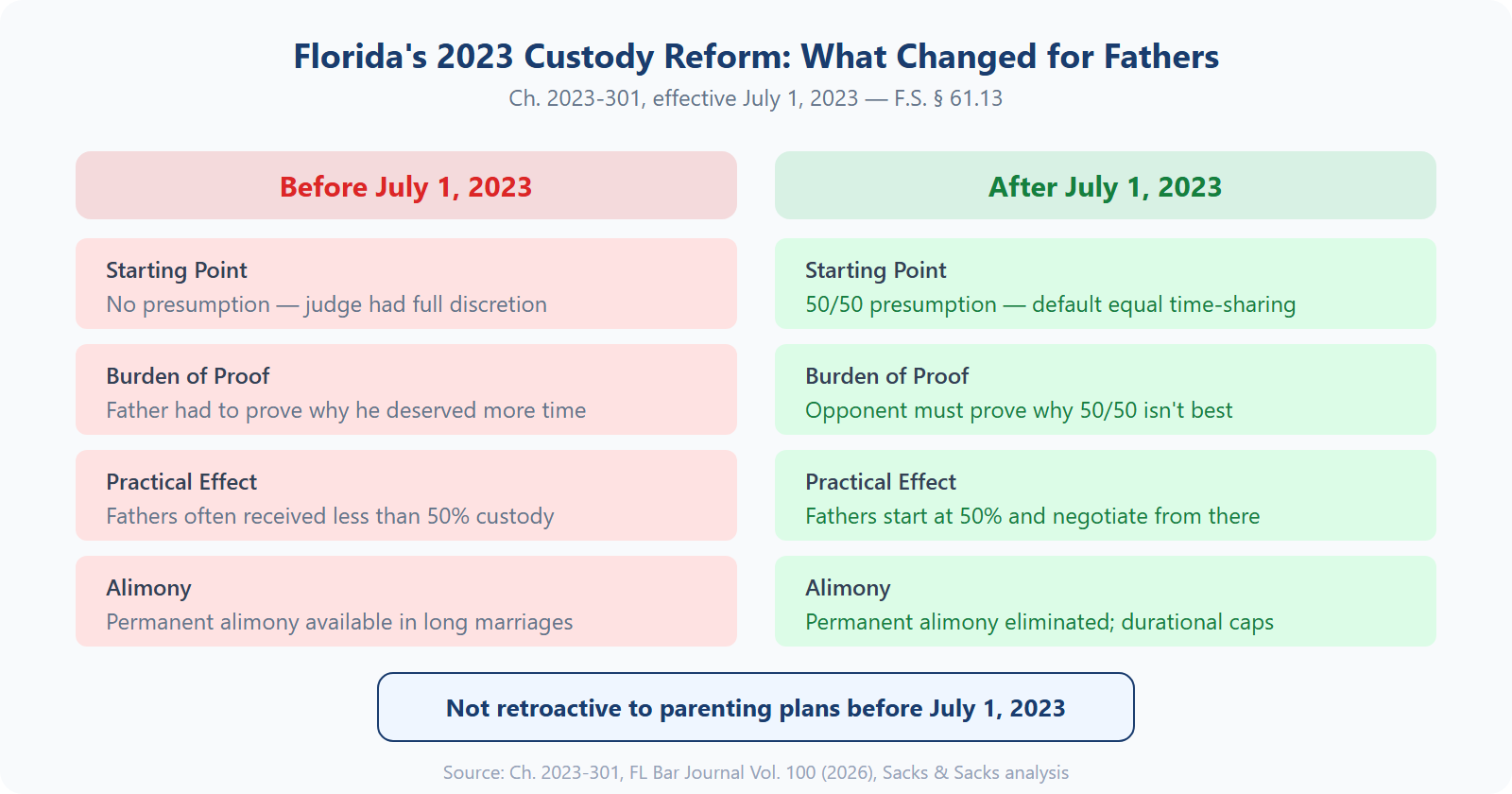
Ch. 2023-301, signed into law on June 28, 2023 and effective July 1, 2023, was the most significant family law reform in Florida in decades. The Florida Bar Journal noted that F.S. § 61.13 has been amended 67 times since 1828, with 30 amendments in the last 24 years alone (FL Bar Journal, 2026). Here’s what changed for fathers:
Before July 1, 2023:
After July 1, 2023:
The practical impact: fathers entering custody disputes now start at 50/50 rather than fighting upward from a lower baseline. The burden shifts to the parent seeking unequal time-sharing to justify the deviation.
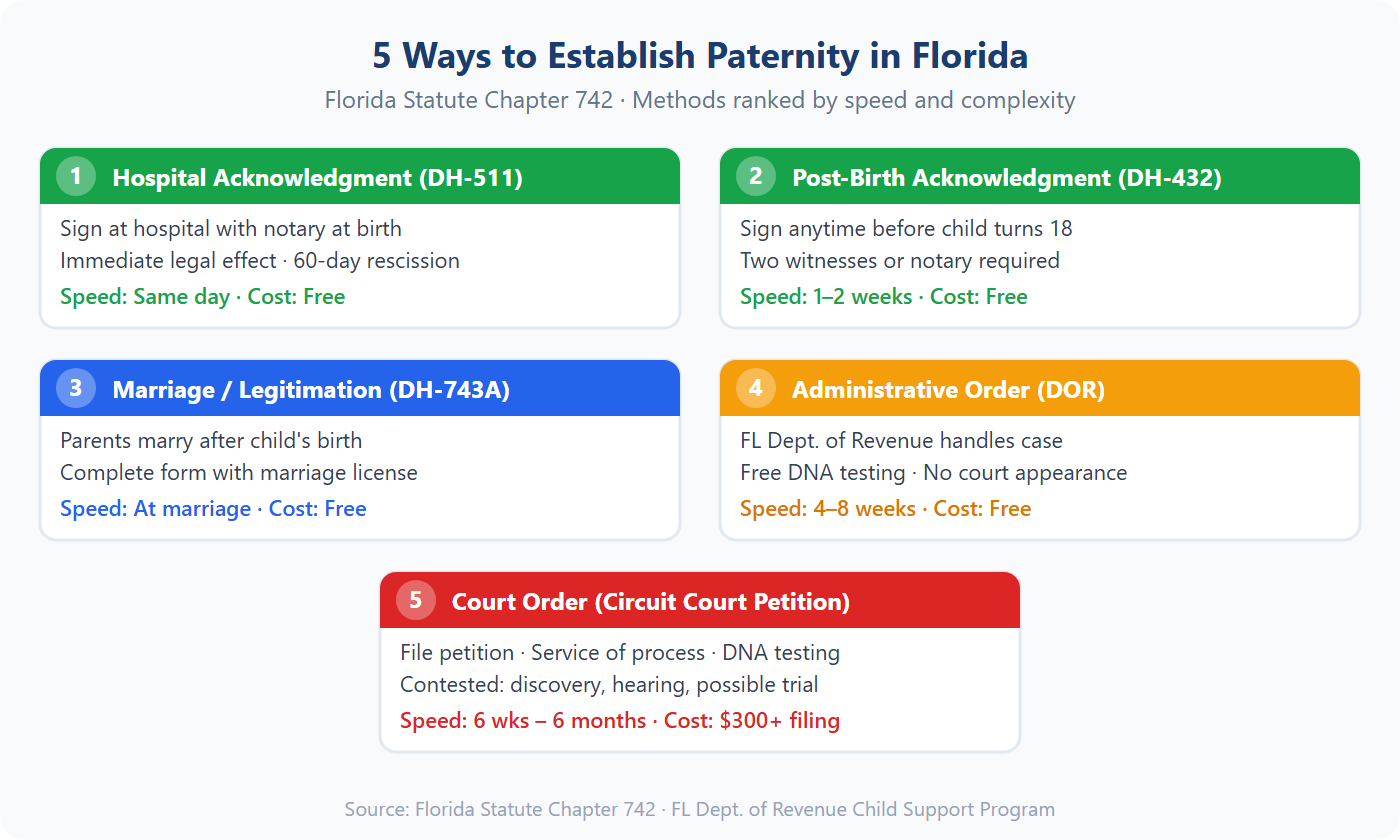
With 45.8% of Florida births to unmarried mothers (CDC, 2023), paternity establishment is essential for nearly half of new fathers. Without legal paternity, an unmarried father has no custody rights, no time-sharing rights, and no decision-making authority — even if his name is on the birth certificate (F.S. § 742.10).
Florida offers three main paths to establish paternity:
House Bill 775 (the “Good Dad Act,” effective July 1, 2023) streamlined the process: unmarried fathers who sign the birth certificate and paternity acknowledgment now automatically gain parental rights without filing a separate court case (FL Senate, HB 775).
Critical timeline: A signed acknowledgment becomes irrevocable after 60 days. After that, it can only be challenged by proving fraud, duress, or material mistake of fact.

Florida courts evaluate 20 factors under F.S. § 61.13(3) when determining the parenting plan. No single factor is dispositive — courts weigh the totality of circumstances. Key factors that often favor involved fathers include:
The 20 factors carry no automatic preference for either parent’s gender. Fathers who maintain active, documented involvement in their child’s daily life are in the strongest position to achieve their desired time-sharing arrangement.
Yes. While “sole custody” no longer exists as a legal term in Florida (replaced by “majority time-sharing” and “sole parental responsibility”), fathers can and do receive primary custody. The 50/50 presumption under Ch. 2023-301 is rebuttable — a father can seek more than 50% if it serves the child’s best interests.
Common situations where fathers receive majority time-sharing:
Courts can also award sole parental responsibility (full decision-making authority) to a father when shared responsibility would be detrimental to the child. This is an exception — shared parental responsibility is the default under F.S. § 61.13(2)(c).

Child support in Florida is gender-neutral — either parent can be ordered to pay based on the Income Shares Model under F.S. § 61.30. At $5,000 combined monthly income, the base obligation is $1,000 for one child and $1,551 for two children. The higher-earning parent pays the larger share regardless of gender.
Key points for fathers:
For a detailed breakdown of calculations and guidelines, see our complete guide to child support in Florida.
Jacksonville’s large military community — with six installations and over 68,000 military jobs generating $9.1 billion in economic impact (City of Jacksonville) — makes deployment custody a common issue for local fathers.
Florida law specifically protects military parents through F.S. § 61.13002:
The federal Servicemembers Civil Relief Act (SCRA) provides additional protections, including the right to stay court proceedings for the duration of military service plus 60 days (50 USC §§ 3931–3938).
For more on military divorce and custody, see our military divorce guide.
Protecting your rights as a father? Call (904) 396-5557 to speak with Sacks & Sacks.
Yes. Since July 1, 2023, Florida law includes a rebuttable presumption that 50/50 time-sharing is in the child’s best interests under Ch. 2023-301 [1]. Courts evaluate 20 gender-neutral factors under F.S. § 61.13 and cannot favor either parent based on gender. The parent seeking less than 50/50 must prove it’s justified by a preponderance of the evidence.
Unmarried fathers must first establish legal paternity under F.S. Chapter 742 [2]. This can be done by signing a Voluntary Acknowledgment of Paternity at the hospital (DH-511), signing post-birth (DH-432), or filing a court petition with DNA testing. The Good Dad Act (HB 775, eff. 2023) allows fathers who sign the birth certificate and paternity acknowledgment to gain rights without a separate court case [3].
No. A January 2026 Florida Bar Journal analysis concluded the equal time-sharing presumption does not apply retroactively to parenting plans established before July 1, 2023 [4]. Fathers with pre-existing orders must show a substantial change in circumstances to modify their parenting plan, and the 50/50 presumption does not apply in that modification proceeding.
Yes. If the mother has substance abuse issues, domestic violence history, inability to provide adequate supervision, or other factors that make 50/50 contrary to the child’s best interests, the father can receive majority time-sharing [1]. Courts can also award sole parental responsibility when shared decision-making would be detrimental.
File a motion for contempt in the circuit court that issued the parenting plan. Document every violation with dates, times, and evidence (texts, emails, witness statements). Courts can enforce through makeup time-sharing, modification of the plan, attorney’s fee awards, or contempt sanctions including fines and jail [1]. For immediate safety concerns, contact law enforcement.
Sources:
[1] Florida Legislature, F.S. § 61.13 — Support of Children; Parenting and Time-Sharing. flsenate.gov
[2] Florida Legislature, F.S. Chapter 742 — Determination of Parentage. flsenate.gov
[3] Florida Senate, HB 775 — Establishment of Paternity. flsenate.gov
[4] Florida Bar Journal, Retroactivity (or Not) of the Equal Timesharing Presumption, Vol. 100, No. 1 (Jan/Feb 2026). floridabar.org
[5] CDC National Center for Health Statistics, Births to Unmarried Mothers by State (2023). cdc.gov
[6] City of Jacksonville, Military Affairs and Veterans. jacksonville.gov
 ✓
✓Written by
Family Law Attorney & Partner, Sacks & Sacks