Going through a divorce in Jacksonville? Call (904) 396-5557 for a free consultation with Sacks & Sacks.
Florida’s crude divorce rate fell to 3.0 divorces per 1,000 residents in 2023, according to the CDC’s National Vital Statistics System [1]. That’s a significant drop from 3.4 per 1,000 in 2021 and 3.6 per 1,000 in 2019.
To put that number in perspective: with Florida’s population of roughly 23 million, a rate of 3.0 per 1,000 translates to approximately 69,000 divorces per year. Florida consistently ranks among the top 10 states for total divorce volume due to its large population.
The declining rate does not mean fewer people are divorcing. It reflects broader trends: fewer Americans are marrying in the first place, couples are marrying later (median age 30 for men, 28 for women nationally), and cohabitation without marriage has increased. The denominator — total population — keeps growing while divorce counts hold relatively steady.
Florida’s 3.0 per 1,000 rate places it in the middle-to-upper tier nationally, according to CDC data for 2023 [1]. The national refined divorce rate was 14.2 per 1,000 married women in 2024, down slightly from 14.4 in 2023 (BGSU National Center for Family & Marriage Research [2]).
States with the highest refined divorce rates (2024):
States with the lowest refined divorce rates (2024):
Southeastern states generally have higher divorce rates than the national average. Florida’s neighboring states — Georgia (2.2/1,000 crude), Alabama (3.0), and South Carolina (2.2) — show a similar regional pattern [1].
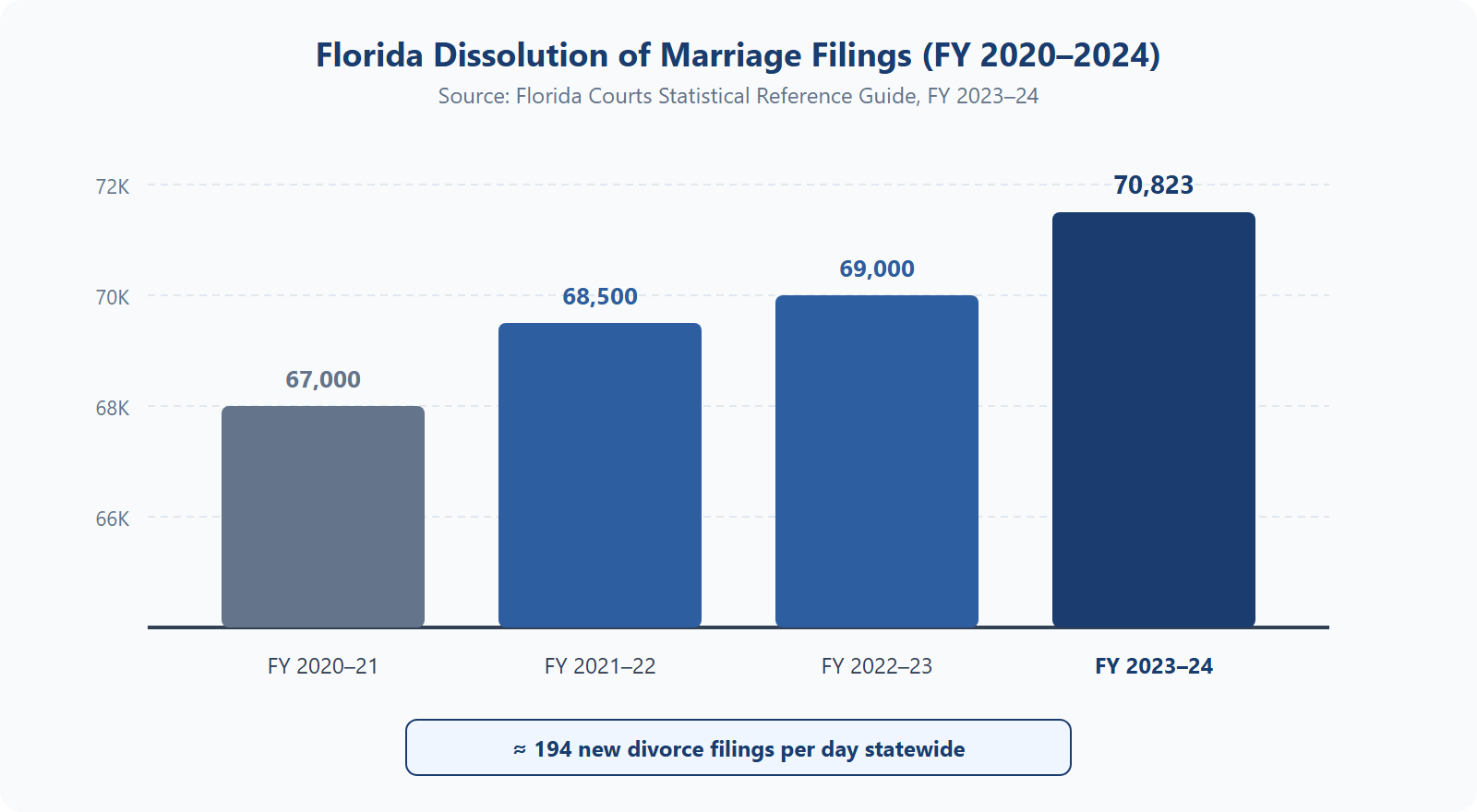
Florida’s circuit courts processed 70,823 dissolution of marriage filings in fiscal year 2023–24, according to the Florida Courts Statistical Reference Guide [3]. Total family court filings statewide reached 241,880 — meaning dissolutions accounted for roughly 29% of all family court cases.
The filing trend has been gradually increasing:
That’s roughly 194 divorces filed per day across Florida, or about 8 per hour during business hours. The post-pandemic years saw steady increases as courts cleared pandemic-era backlogs and couples who delayed divorce during lockdowns moved forward.
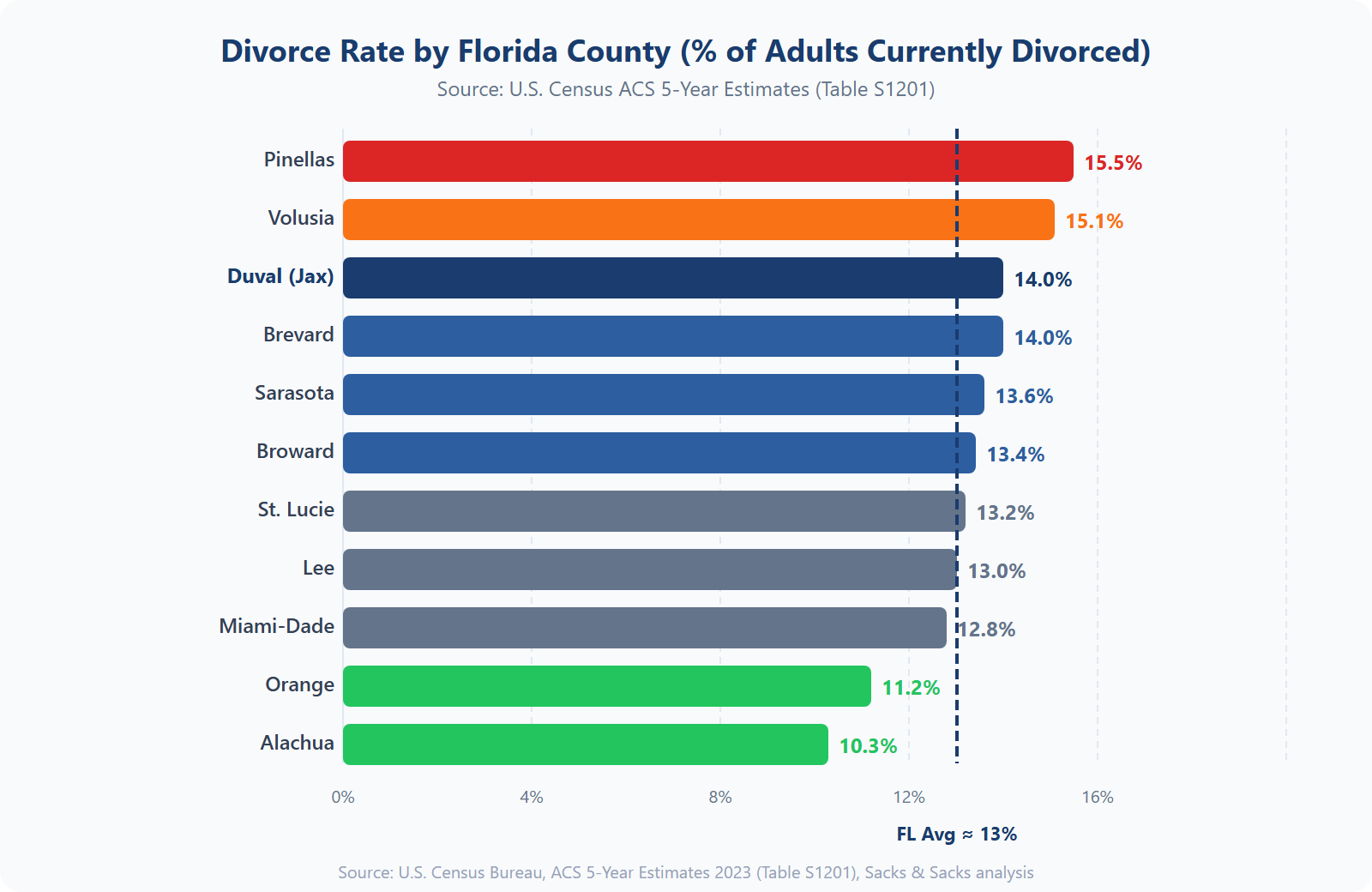
Duval County has a 14.0% divorced population, meaning 14 out of every 100 adults in the county are currently divorced, according to U.S. Census ACS data [4]. That’s above the statewide average of approximately 13%.
In terms of court filings, Circuit 4 (which covers Duval, Nassau, and Clay counties) processed 4,096 dissolution filings in FY 2023–24 [3]. That’s roughly 11 new divorce cases filed every day in the Jacksonville area.
Jacksonville’s divorce rate reflects several local factors:
Divorce rates vary significantly across Florida’s 67 counties. The percentage of the adult population that is currently divorced (ACS data) ranges from under 10% in college towns to over 15% in retirement and coastal counties [4].
Highest divorce rates by county:
Lowest divorce rates by county:
The pattern is consistent: counties with older populations and more retirees (Pinellas, Volusia, Sarasota) tend to have higher percentages of divorced residents. College towns (Alachua) and younger suburban counties (St. Johns) tend to be lower. Note that these percentages reflect currently divorced residents — not annual divorce filings — so they accumulate over time.
Divorce rates in Florida differ significantly by race, gender, and age group. According to ACS data [4]:
By race/ethnicity:
By gender: Women in Florida have a higher currently-divorced rate (14.3%) compared to men (11.7%). This gap exists partly because divorced women are less likely to remarry than divorced men and do so more slowly.
By age: Divorce rates peak among adults aged 50–64. This “gray divorce” trend has been growing nationally — the divorce rate for adults 50+ has roughly doubled since 1990, according to the BGSU National Center for Family & Marriage Research [2]. In Florida, with its large retiree population, gray divorce is particularly significant.
Florida is a pure no-fault divorce state under F.S. § 61.052, meaning the only legal ground required is that the marriage is “irretrievably broken” [5]. Courts don’t track specific reasons. However, research from multiple sources identifies consistent patterns:
While Florida courts don’t require fault, certain behaviors do matter in divorce proceedings. Adultery can affect alimony awards under F.S. § 61.08. Dissipation of marital assets (gambling, excessive spending during separation) can affect property division.
Florida’s landmark family law reform (Ch. 2023-301, effective July 1, 2023) made two changes that directly affect divorce statistics and trends [6]:
1. 50/50 custody presumption. Florida now presumes equal time-sharing is in the child’s best interest under F.S. § 61.13. This has reduced the number of contested custody disputes — when both parents start at 50/50, there’s less to fight about. More cases settle through mediation rather than going to trial.
2. Permanent alimony eliminated. The same bill eliminated permanent alimony and capped durational alimony at percentages of the marriage length (50% for short marriages, 60% for moderate, 75% for long). This simplified negotiations and reduced one of the biggest drivers of contested divorce in Florida. See our alimony guide for details.
The early data suggests the reforms are working as intended. The 2023–24 filing numbers (70,823) show a modest increase, but the clearance rate — the percentage of cases resolved within the fiscal year — has improved as more cases settle without trial. The 50/50 presumption is not retroactive to parenting plans entered before July 1, 2023 (FL Bar Journal Vol. 100, Jan 2026).
Florida’s divorce rate has been declining for over two decades, mirroring a national trend. The crude rate has dropped from 5.3 per 1,000 in 2000 to 3.0 per 1,000 in 2023 — a 43% decrease [1].
Key trend factors in Florida:
Despite the rate decline, total filings have stayed relatively flat because Florida’s population growth offsets the per-capita decrease. The state adds roughly 300,000–400,000 new residents per year, many of them retirees entering the “gray divorce” demographic.
Understanding divorce statistics helps, but if you’re considering divorce, the practical question is cost. In Duval County, the filing fee is $409 plus $10 for service of process (Duval County Clerk). Total costs vary by type:
For a complete breakdown, see our guide to divorce costs in Jacksonville. If you need help navigating the process, read our step-by-step filing guide.
Need help with a Jacksonville divorce? Call (904) 396-5557 for a free consultation with Sacks & Sacks.
Florida’s divorce rate was 3.0 per 1,000 residents in 2023, according to CDC National Vital Statistics data [1]. This is down from 3.4 per 1,000 in 2021. In terms of population percentage, approximately 13% of Florida adults are currently divorced according to ACS estimates.
Florida courts processed 70,823 dissolution of marriage filings in fiscal year 2023–24 [3]. That’s approximately 194 new divorce cases filed per day statewide. In the Jacksonville area (Circuit 4), there were 4,096 dissolution filings in the same period.
Duval County has a 14.0% divorced population according to ACS data, above the state average of approximately 13% [4]. Circuit 4 courts (Duval, Nassau, Clay counties) processed 4,096 dissolution filings in FY 2023–24, averaging about 11 new divorce cases per day.
Pinellas County has the highest percentage of divorced residents at 15.5%, followed by Volusia County at 15.1% [4]. Counties with older populations and more retirees tend to have higher percentages of divorced residents. Alachua County (Gainesville) has the lowest among major counties at 10.3%.
The per-capita rate is going down — from 5.3 per 1,000 in 2000 to 3.0 per 1,000 in 2023, a 43% decrease [1]. However, total annual filings remain relatively stable (around 70,000) because Florida’s population continues growing. People are marrying later, cohabiting more, and divorcing less frequently when they do marry.
Sources:
[1] CDC National Center for Health Statistics, Stats of the States: Florida. cdc.gov
[2] BGSU National Center for Family & Marriage Research, Refined Divorce Rate in the U.S.: Geographic Variation, 2024. bgsu.edu
[3] Florida Courts, FY 2023–24 Statistical Reference Guide, Chapter 5: Circuit Family Court Statistics. flcourts.gov
[4] U.S. Census Bureau, American Community Survey, Table S1201: Marital Status (5-Year Estimates, 2023). data.census.gov
[5] Florida Legislature, F.S. § 61.052 — Dissolution of Marriage. flsenate.gov
[6] Florida Legislature, Ch. 2023-301 — Family Law Reform. flrules.org
 ✓
✓Written by
Family Law Attorney & Partner, Sacks & Sacks