
Have questions about divorce in Florida? Call (904) 396-5557 for a free consultation with a Jacksonville family law attorney.
Yes — Florida is one of the purest no-fault divorce states in the country. Under F.S. § 61.052, the only ground for dissolution of marriage is that the marriage is “irretrievably broken.” [1] Neither spouse needs to prove fault, adultery, abandonment, or any other wrongdoing to obtain a divorce.
The only alternative ground is mental incapacity of one spouse for at least three years prior to filing — which is extremely rare. This means Florida courts do not consider who was “at fault” when deciding whether to grant the divorce itself.
However, certain conduct — such as adultery or domestic violence — can still influence related issues like alimony awards and parenting time allocation, even though it doesn’t affect the divorce decree itself.
At least one spouse must have been a resident of Florida for a minimum of six months (180 days) before filing a petition for dissolution of marriage (F.S. § 61.021). [1] This is a jurisdictional requirement — if it’s not met, the court will dismiss the case.
Residency can be proven with a Florida driver’s license, voter registration, state tax returns, utility bills, or a corroborating witness affidavit. You can file in the county where either spouse lives; you don’t have to file where the marriage took place.
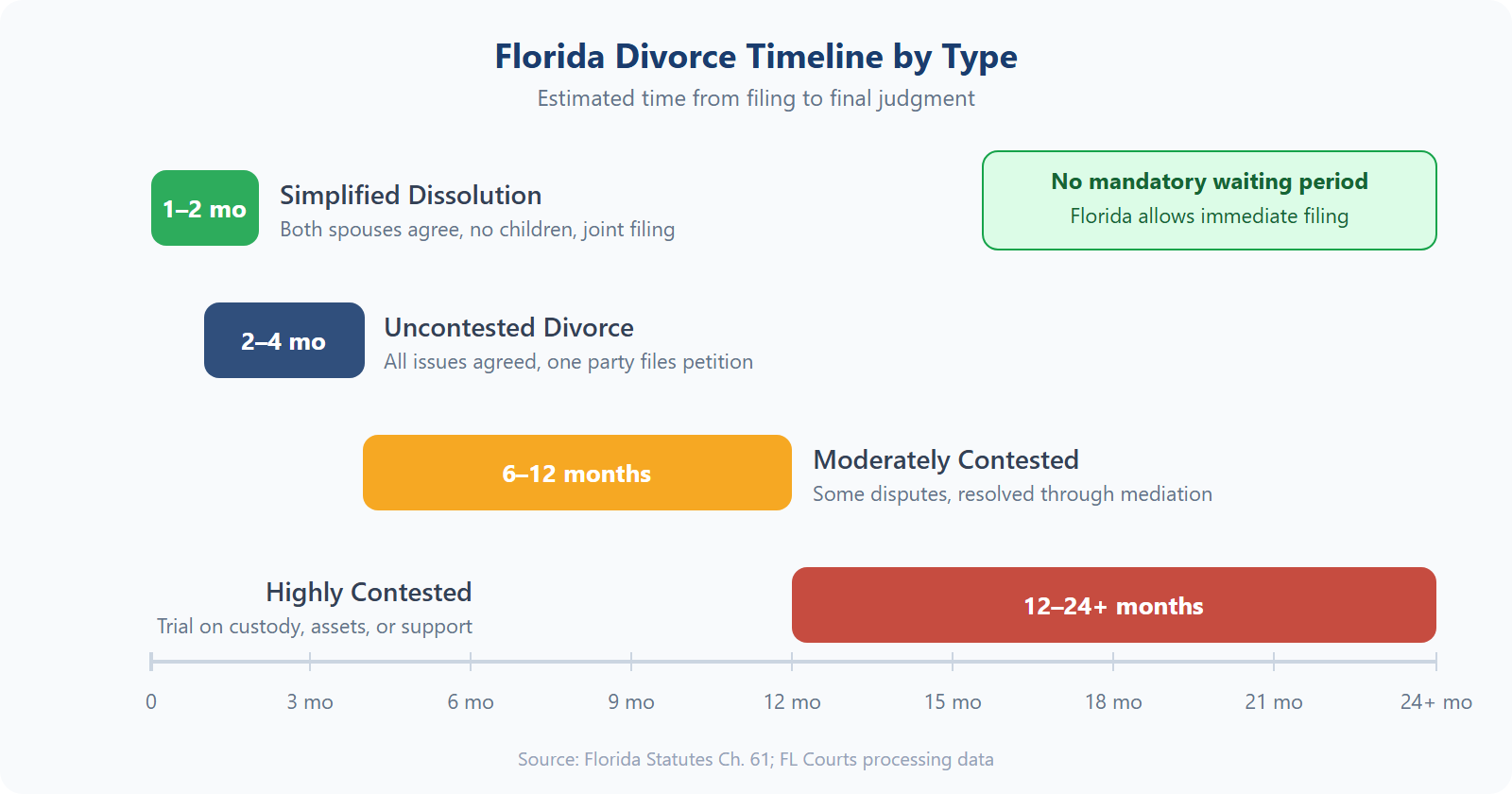
Unlike some states, Florida has no mandatory separation period and no mandatory waiting period before a divorce can be finalized. Once you meet the residency requirement, you can file immediately.
Florida offers two primary paths to divorce, plus a simplified option for qualifying couples. The right choice depends on whether you and your spouse agree on the major issues — property, support, and children. [1]
An uncontested divorce means both spouses agree on all issues: property division, debt allocation, alimony, child custody, and child support. This is the fastest and least expensive option, typically costing $450–$5,000 with attorney fees and taking 2–4 months to finalize. [3]
A contested divorce occurs when spouses cannot agree on one or more issues. The court must resolve disputed matters through mediation, hearings, and potentially trial. Contested divorces in Florida typically cost $5,000–$30,000+ and take 12–24 months or longer. [3]
Florida offers a streamlined process called simplified dissolution under F.S. § 61.052(2). To qualify, you must meet all of these requirements:
Simplified dissolution eliminates the formal service of process requirement and can be completed in as few as 30 days in some counties.
Florida processed over 80,000 dissolution of marriage cases in fiscal year 2023–2024 through its 20 judicial circuits (FL Courts). [2] Whether your case is simple or complex, the filing process follows the same basic steps.
File a Petition for Dissolution of Marriage with the clerk of the circuit court in the county where either spouse resides. The standard filing fee is $400–$410 in most Florida counties (Duval County: $401 + $10 summons). [4] If you cannot afford the fee, you may petition the court for a fee waiver using an Application for Determination of Civil Indigent Status.
Under F.S. § 61.043, the non-filing spouse must be formally served with the divorce papers. Service can be made by the county sheriff, a private process server, or certified mail with return receipt. The responding spouse has 20 days to file an answer after being served.
Both parties must complete and exchange mandatory financial affidavits within 45 days of service (Rule 12.285, Florida Family Law Rules of Procedure). This includes income, assets, debts, and monthly expenses. Full financial disclosure is required regardless of whether the divorce is contested or uncontested.
If the couple has minor children, both parents must complete a court-approved Parent Education and Family Stabilization Course (commonly called a “parenting course”) within the timeframe set by the court.
For contested issues, Florida requires mediation before trial under F.S. § 61.183. A neutral mediator helps both parties negotiate a settlement. Mediation resolves 70–80% of family law disputes in Florida and costs significantly less than trial. [5]
Once all issues are resolved — either by agreement or after trial — the judge enters a Final Judgment of Dissolution of Marriage. This document is the official court order that ends the marriage and addresses property, support, custody, and all other issues.

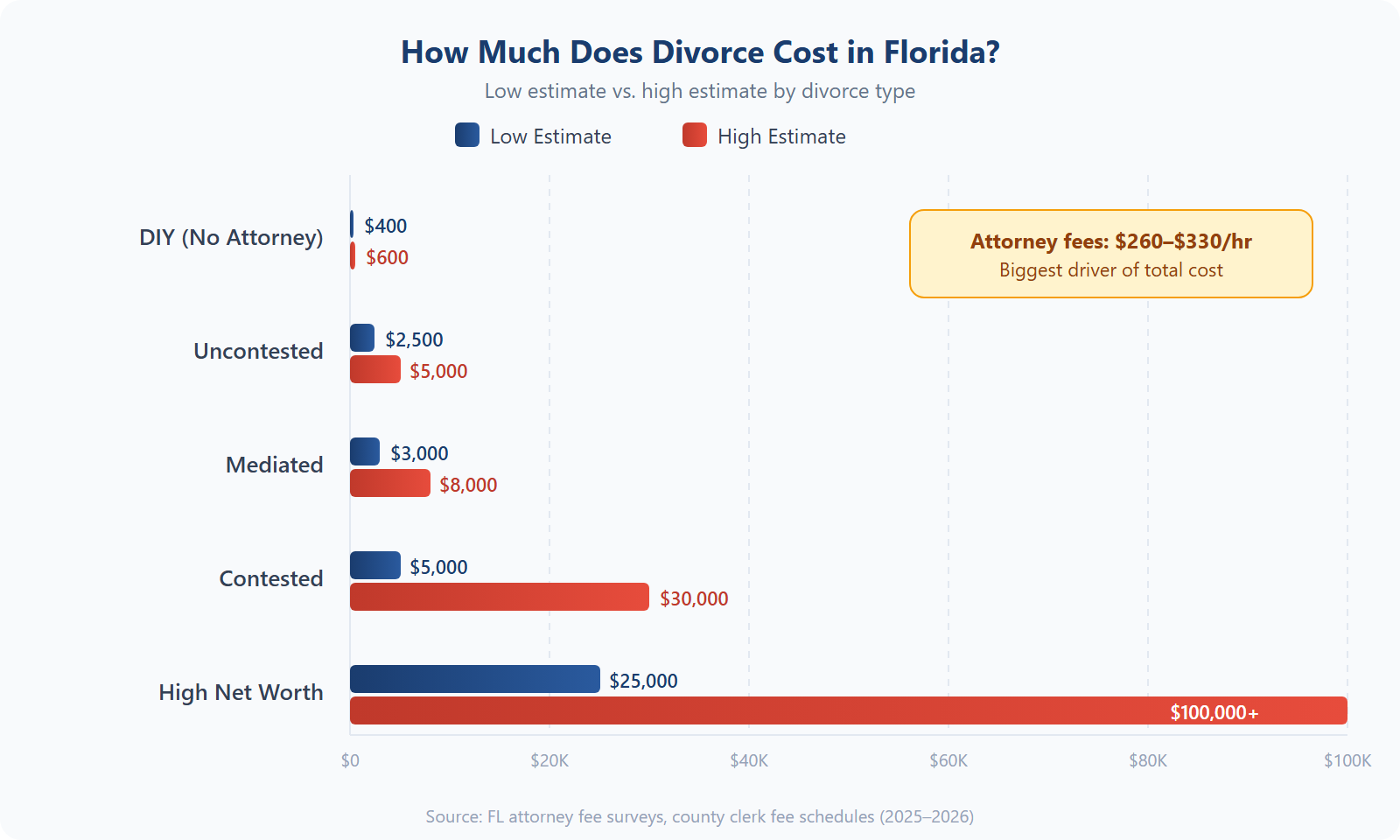
The total cost of divorce in Florida varies dramatically based on whether the case is contested or uncontested. Filing fees alone run $400–$410 in most counties, but attorney fees and litigation costs can push the total much higher. [3]
Here’s a realistic breakdown of divorce costs across Florida:
Florida family law attorneys typically charge $260–$330 per hour. The biggest cost drivers in contested cases are discovery disputes, custody evaluations, expert witnesses, and trial preparation.
Florida is an equitable distribution state — not a community property state. Under F.S. § 61.075, the court divides marital assets and liabilities in a manner that is fair and equitable, which does not necessarily mean 50/50. [1]
The court starts with the presumption that distribution should be equal, then considers 10 statutory factors that may justify an unequal split:
Important: Only marital property is subject to division. Non-marital (separate) property — such as assets owned before the marriage, inheritances, and gifts to one spouse — is generally not divided, provided it was not commingled with marital assets.
Effective July 1, 2023, Florida enacted sweeping alimony reform through SB 1416 (Ch. 2023-301), eliminating permanent alimony entirely and restructuring how courts calculate support. [6] This is the most significant change to Florida alimony law in decades.
Under the new law, Florida now has three types of alimony:
The reform also imposed a 35% income cap: alimony cannot exceed 35% of the difference between the spouses’ net incomes or the recipient’s reasonable need, whichever is less. Additionally, the court must consider the payor’s ability to meet their own basic needs after paying support.
Florida’s 2023 family law reform (Ch. 2023-301, effective July 1, 2023) established a rebuttable presumption that equal time-sharing (50/50) is in the best interest of the child. [6] This was a fundamental shift — previously, Florida courts had no default starting point and evaluated each case entirely on its facts.
Under the new presumption, a court must start with equal time-sharing and can deviate only if clear and convincing evidence shows that 50/50 would be detrimental to the child. The court still evaluates the 20 best-interest factors under F.S. § 61.13, but the burden has shifted to the parent opposing equal time.
Key exceptions where 50/50 may not apply include:
Yes. Under F.S. § 61.183, Florida courts require mediation of all contested family law issues before trial. [5] Florida’s court-connected mediation program handled 102,106 cases in fiscal year 2024–2025, with 20,808 of those being family cases.
Mediation is confidential under F.S. § 44.405, meaning statements made during mediation cannot be used as evidence in court. If mediation succeeds, the agreement is put in writing and submitted to the judge for approval. If it fails, the case proceeds to trial.
Exceptions to mandatory mediation include cases involving documented domestic violence or situations where one party’s safety would be at risk.
Florida has no mandatory waiting period, making it one of the faster states for divorce processing. However, the actual timeline depends heavily on whether the case is contested and the county’s court calendar. [1]
The biggest delays come from discovery disputes, custody evaluations (which can take 3–6 months alone), and crowded court dockets. Some Florida circuits have faster processing times than others — rural circuits tend to move faster than urban ones like Miami-Dade or Broward.
After 25 years of handling Florida divorce cases, these are the mistakes I see most often: [1]

Legally, no — Florida allows self-representation (pro se) in divorce cases. But the complexity of Florida’s family law statutes, mandatory financial disclosure rules, and the 2023 custody and alimony reforms make attorney representation strongly advisable for most cases.
Consider hiring a family law attorney if:
An uncontested divorce with no children and minimal assets may be appropriate for self-representation. But for anything involving custody, significant property, or alimony, the cost of an attorney is typically far less than the cost of a mistake.
Divorce affects every part of your life — your finances, your home, your children, and your future. Whether you’re considering divorce or have already been served, getting the right legal guidance early makes a real difference in the outcome.
I’ve been helping Florida families through divorce for over 25 years. I’ll give you a straight answer about where you stand — no pressure, no obligation.
Call (904) 396-5557 for a free consultation — or send us a message online.
At least one spouse must have been a Florida resident for a minimum of six months (180 days) before filing, as required by F.S. § 61.021. You can prove residency with a Florida driver’s license, voter registration, employment records, or a corroborating witness affidavit. You may file in any county where either spouse resides. [1]
No. Florida has no mandatory separation period and no mandatory waiting period. You can file for divorce as soon as you meet the six-month residency requirement. This makes Florida one of the faster states for processing divorces. [1]
Under the 2023 reform (SB 1416), alimony is generally not awarded for marriages under 3 years. For short marriages (3–10 years), durational alimony is capped at 50% of the marriage length. The 35% income differential cap also applies — alimony cannot exceed 35% of the difference between the spouses’ net incomes. [6]
The marital home is subject to equitable distribution under F.S. § 61.075. If the home was purchased during the marriage, it’s a marital asset. Common outcomes include one spouse buying out the other’s equity, selling the home and splitting proceeds, or one spouse retaining the home in exchange for other assets. The court considers whether minor children need stability in the family home. [1]
Since July 1, 2023, Florida has a rebuttable presumption of equal (50/50) time-sharing under Ch. 2023-301. The court starts with equal time and can deviate only if clear and convincing evidence shows 50/50 would harm the child. The 20 best-interest factors under F.S. § 61.13 still apply. [6]
The standard filing fee for dissolution of marriage is $400–$410 in most Florida counties. A summons costs an additional $10. If you cannot afford the fee, you can apply for indigent status. Total divorce costs range from $450 (DIY uncontested) to $30,000+ (contested with attorney), depending on the complexity of your case. [4]
Many Florida counties now offer electronic filing (e-filing) through the Florida Courts E-Filing Portal. You can submit your petition, financial affidavits, and other documents online. However, you still need to arrange formal service of process on your spouse, and both parties must attend court hearings (in person or via video, depending on the county). [2]
Sources:
[1] Florida Statutes, Chapter 61 — Dissolution of Marriage; Support; Time-Sharing. flsenate.gov
[2] Florida Courts, Annual Report on the Workload of Florida’s Courts, FY 2023-2024. flcourts.gov
[3] Centers for Disease Control and Prevention, Stats of the States — Divorce Rates (2023 Data). cdc.gov
[4] Duval County Clerk of Courts, Fee Schedules. duvalclerk.com
[5] Florida Courts, Alternative Dispute Resolution Report, FY 2024-2025. flcourts.gov
[6] Florida Senate, SB 1416 — Dissolution of Marriage (Ch. 2023-301). flsenate.gov
 ✓
✓Reviewed by
Family Law Attorney & Partner, Sacks & Sacks