
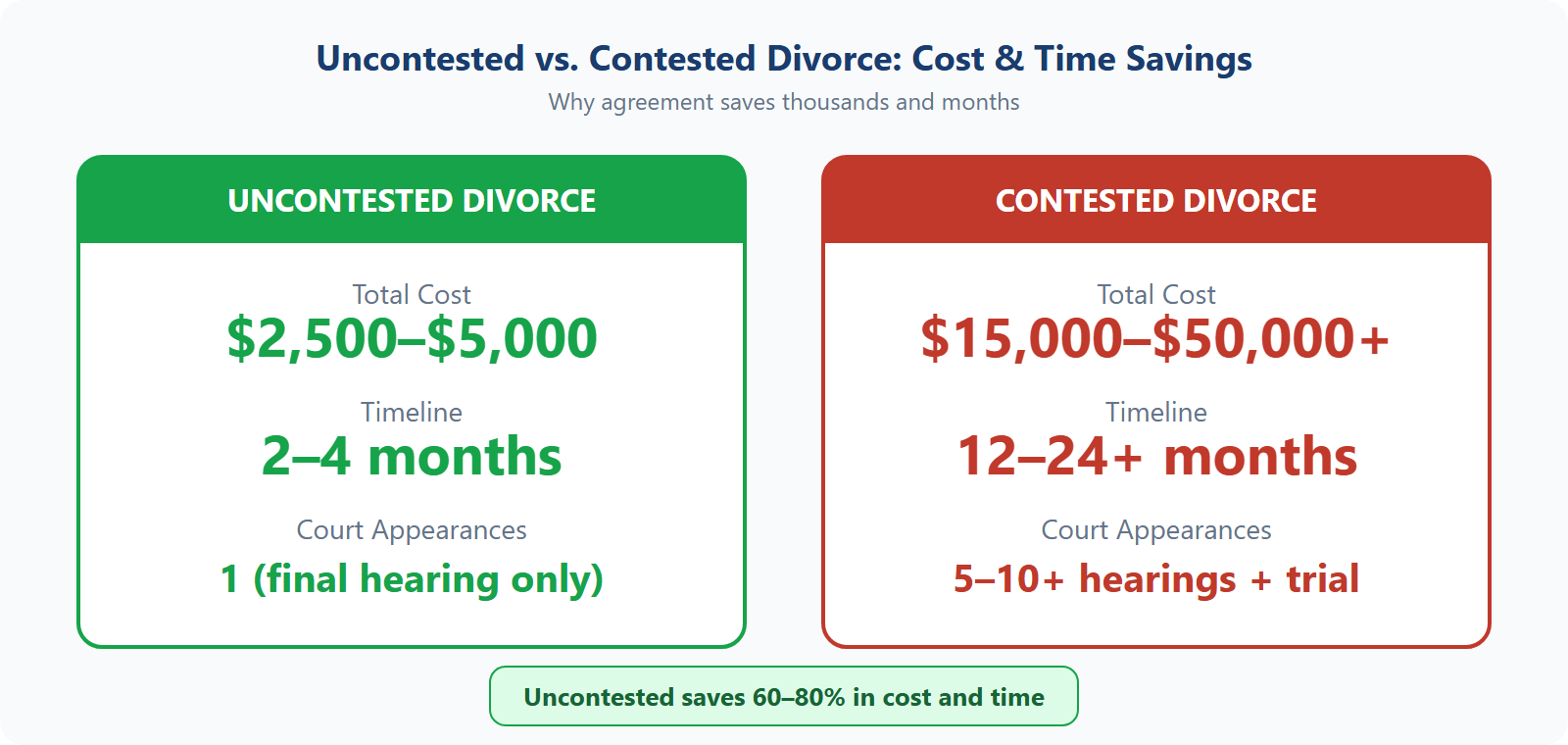
Bottom line: An uncontested divorce in Florida typically costs $2,500–$5,000 with an attorney and can be finalized in 2–4 months, compared to $15,000–$50,000+ and 12–24 months for contested cases. [3]
To qualify, both spouses must agree on all issues: property division, support, and child custody. Florida also offers a simplified dissolution option for couples with no children and no alimony disputes under F.S. § 61.052(2).
Considering an uncontested divorce? Call (904) 396-5557 for a free consultation to find out if you qualify.
An uncontested divorce means both spouses agree on every issue in the case: property division, debt allocation, spousal support, child custody, and child support. When there are no disputes for the court to resolve, the process moves significantly faster and costs far less than a contested divorce. [1]
Florida’s divorce rate is 3.0 per 1,000 residents, 25% above the national average (CDC, 2023). [2] Of the tens of thousands of Florida divorces filed each year, a substantial portion begin as uncontested, though some become contested when disagreements emerge during the process.
An uncontested divorce is not the same as a simplified dissolution. Both are faster than contested proceedings, but they have different eligibility requirements and procedures.
To file an uncontested divorce in Florida, you must meet the following requirements under Florida Statutes Chapter 61: [1]
Key distinction: There is no income limit, asset limit, or marriage-length restriction for an uncontested divorce. Couples with children, significant property, or long marriages can all file uncontested, as long as they agree on everything.
Florida offers two streamlined divorce paths, and they’re often confused. The key differences are eligibility and procedure. [1]
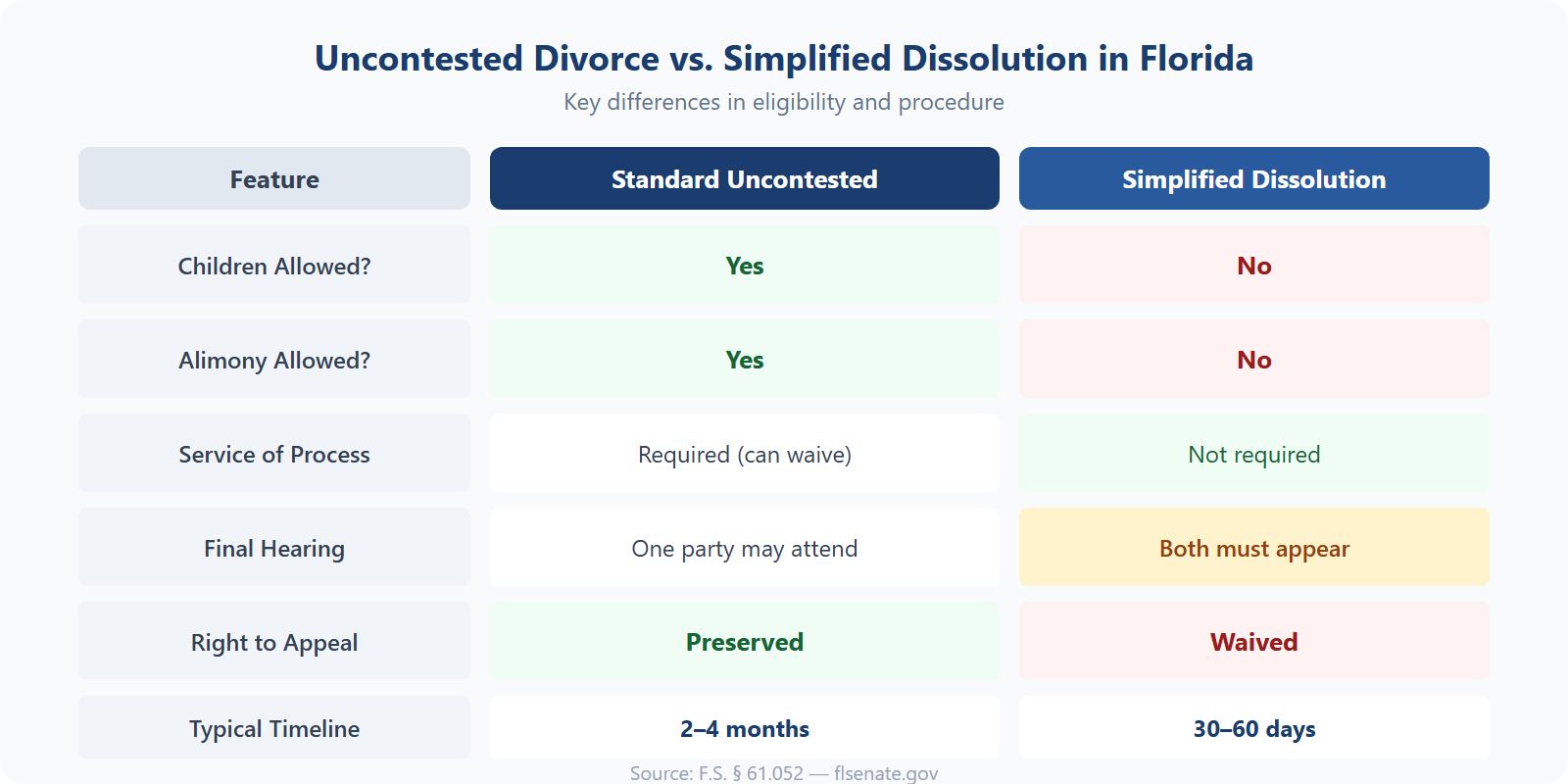
Simplified dissolution under F.S. § 61.052(2) has stricter eligibility requirements:
If you have children or either spouse wants alimony, simplified dissolution is not available. You’ll need to file a standard uncontested divorce (also called a regular dissolution by agreement).
A standard uncontested divorce has no restrictions on children, alimony, or property complexity. The only requirement is that both spouses agree on all terms before filing. One spouse files the petition, the other is served and files a response (or waives service), and both submit a signed marital settlement agreement to the court.
The uncontested divorce process in Florida follows a structured sequence that typically takes 2–4 months from filing to final judgment. [1] Here’s the step-by-step process:
Before filing, both spouses should negotiate and sign a Marital Settlement Agreement (MSA) covering all issues: property division, debt allocation, alimony, and (if applicable) a parenting plan and child support. This is the most important document in an uncontested divorce. Having it ready before filing accelerates the entire process.
File the Petition for Dissolution of Marriage with the clerk of the circuit court in the county where either spouse resides. The filing fee is $400–$410 in most Florida counties (Duval County: $401 + $10 summons). [4] File the MSA along with the petition.
The non-filing spouse must be formally served under F.S. § 61.043. In an uncontested case, the responding spouse can sign a Waiver of Service, which eliminates the need for formal service by the sheriff or process server. This saves time and money.
Both parties must exchange mandatory financial affidavits within 45 days (Rule 12.285). Even in uncontested cases, full financial disclosure is required. In simplified dissolution cases, both parties file a single financial affidavit.
If the couple has minor children, both parents must complete a court-approved Parent Education and Family Stabilization Course before the final hearing.
A judge reviews the MSA, confirms both parties entered into it voluntarily, and ensures the terms are fair, particularly regarding children. The judge then enters the Final Judgment of Dissolution of Marriage. In simplified dissolution, both spouses must appear together; in standard uncontested cases, often only one party needs to attend.
The cost difference between uncontested and contested divorce in Florida is substantial. An uncontested divorce saves an average of 60–80% compared to a contested case. [3]
Florida family law attorneys typically charge $260–$330 per hour. In an uncontested case, the total attorney time is usually 5–15 hours (drafting the MSA, filing documents, attending the final hearing). In a contested case, 50–100+ hours is common.
Even if you agree on most issues, hiring an attorney to review or draft the marital settlement agreement is strongly recommended. A poorly drafted MSA can lead to enforcement problems, modification disputes, and thousands in future legal fees.
Uncontested divorces involving children require additional documentation and court scrutiny. Under Florida’s 2023 family law reform (Ch. 2023-301), the 50/50 time-sharing presumption applies even in uncontested cases. [5]
When minor children are involved, the MSA must include a comprehensive parenting plan that addresses:
The judge has an independent obligation to ensure the parenting plan is in the best interests of the child. Even if both parents agree, the court can reject a parenting plan that it finds inadequate or harmful to the children.
Even divorces that start as uncontested can become contested. Based on 25 years of practice, these are the most common issues that derail uncontested cases: [1]
If an uncontested divorce becomes contested, the court will order mediation under F.S. § 61.183. Florida’s mediation program resolves 70–80% of disputed cases. [3]
An uncontested divorce is the fastest, most affordable path to ending a marriage in Florida. But “uncontested” doesn’t mean “simple”: the marital settlement agreement needs to be drafted correctly, financial disclosure must be complete, and the parenting plan must meet the court’s standards.
I’ve handled thousands of divorces in Jacksonville over 25 years. If you and your spouse can agree on the terms, I’ll make the process as smooth and affordable as possible. If disputes come up, I’ll help you work through them.
Call (904) 396-5557 for a free consultation, or send us a message online.
An uncontested divorce in Florida typically takes 2–4 months from filing to final judgment. A simplified dissolution can be completed in as few as 30–60 days. The timeline depends on how quickly both parties complete financial disclosure, the parenting course (if children are involved), and the court’s scheduling. [1]
Yes. Having children does not disqualify you from an uncontested divorce. However, you must agree on a complete parenting plan covering time-sharing, child support, parental responsibility, and communication arrangements. The plan must comply with the 50/50 presumption under Ch. 2023-301. [5]
Simplified dissolution (F.S. § 61.052(2)) requires no children, no alimony, and both spouses must appear together at the final hearing. Standard uncontested divorce has no such restrictions: couples with children, alimony, and complex property can file uncontested as long as they agree on all terms. [1]
Not legally: Florida allows self-representation. However, the marital settlement agreement is a binding legal contract that governs property division, support, and child custody. A poorly drafted MSA can lead to enforcement problems and costly modification proceedings. Most family law attorneys charge $2,500–$5,000 for an uncontested divorce. [3]
If you cannot agree on all issues, the divorce becomes contested. The court will require mediation under F.S. § 61.183. Florida’s mediation program resolves 70–80% of family disputes. If mediation fails, the remaining issues go to trial. A partially uncontested case, where you agree on most issues, still saves significant time and money. [3]
The Duval County filing fee is $401 plus $10 for a summons. With an attorney, total costs are typically $2,500–$5,000. Without an attorney (DIY), costs are $400–$600 for filing fees and court costs only. Compared to $15,000–$50,000+ for a contested divorce, uncontested saves 60–80%. [4]
Yes. Common causes include discovery of hidden assets, disagreements over the parenting plan, alimony disputes under the 2023 reform, and real estate complications. If this happens, the court orders mediation before trial. Having an attorney draft a thorough MSA from the start reduces this risk significantly. [1]
Sources:
[1] Florida Statutes, Chapter 61: Dissolution of Marriage; Support; Time-Sharing. flsenate.gov
[2] Centers for Disease Control and Prevention, Stats of the States: Divorce Rates (2023 Data). cdc.gov
[3] Florida Courts, Alternative Dispute Resolution Report, FY 2024-2025. flcourts.gov
[4] Duval County Clerk of Courts, Fee Schedules. duvalclerk.com
[5] Florida Senate, SB 1416: Dissolution of Marriage (Ch. 2023-301). flsenate.gov
 ✓
✓Reviewed by
Family Law Attorney & Partner, Sacks & Sacks