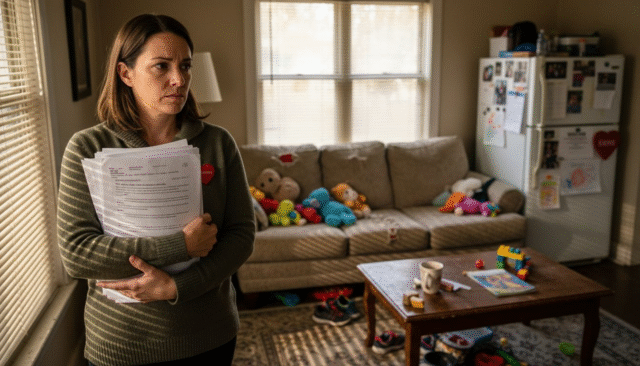

Bottom line: Florida uses the Income Shares Model under F.S. § 61.30 to calculate child support based on both parents’ combined net income and number of children. At $5,000 combined monthly income, one child costs $1,000/month; two children cost $1,551.
The 73-overnight threshold triggers adjustments, and even 50/50 custody doesn’t eliminate support if incomes differ. Jacksonville family law attorney Adam Sacks helps parents get accurate calculations that protect their children’s financial future.
Need help with child support? Call (904) 396-5557 for a consultation with Sacks & Sacks.
Florida’s Income Shares Model, used by 41 states, combines both parents’ net monthly income to determine child support obligations (F.S. § 61.30). The model estimates what parents would spend on their children if the family lived together, then divides that amount proportionally based on each parent’s income share.
Here’s how the five-step calculation works in Duval County and across Florida:
Each parent’s share is proportional to their income. If Parent A earns $4,000/month and Parent B earns $2,000/month, Parent A pays 67% of the total obligation and Parent B pays 33%.

Florida defines income broadly under F.S. § 61.30(2), counting virtually every source of money a parent receives. Courts look beyond W-2 wages to capture the full financial picture.
Income sources that count toward child support:
Courts can also impute income to a parent who is voluntarily unemployed or underemployed. If a parent quits a $60,000 job to avoid support, the court calculates payments based on their earning capacity, not their actual income (F.S. § 61.30(2)(b)).
For self-employed parents, courts typically require 3–5 years of tax returns and business records. Deductions that look like personal expenses disguised as business costs get added back to income.
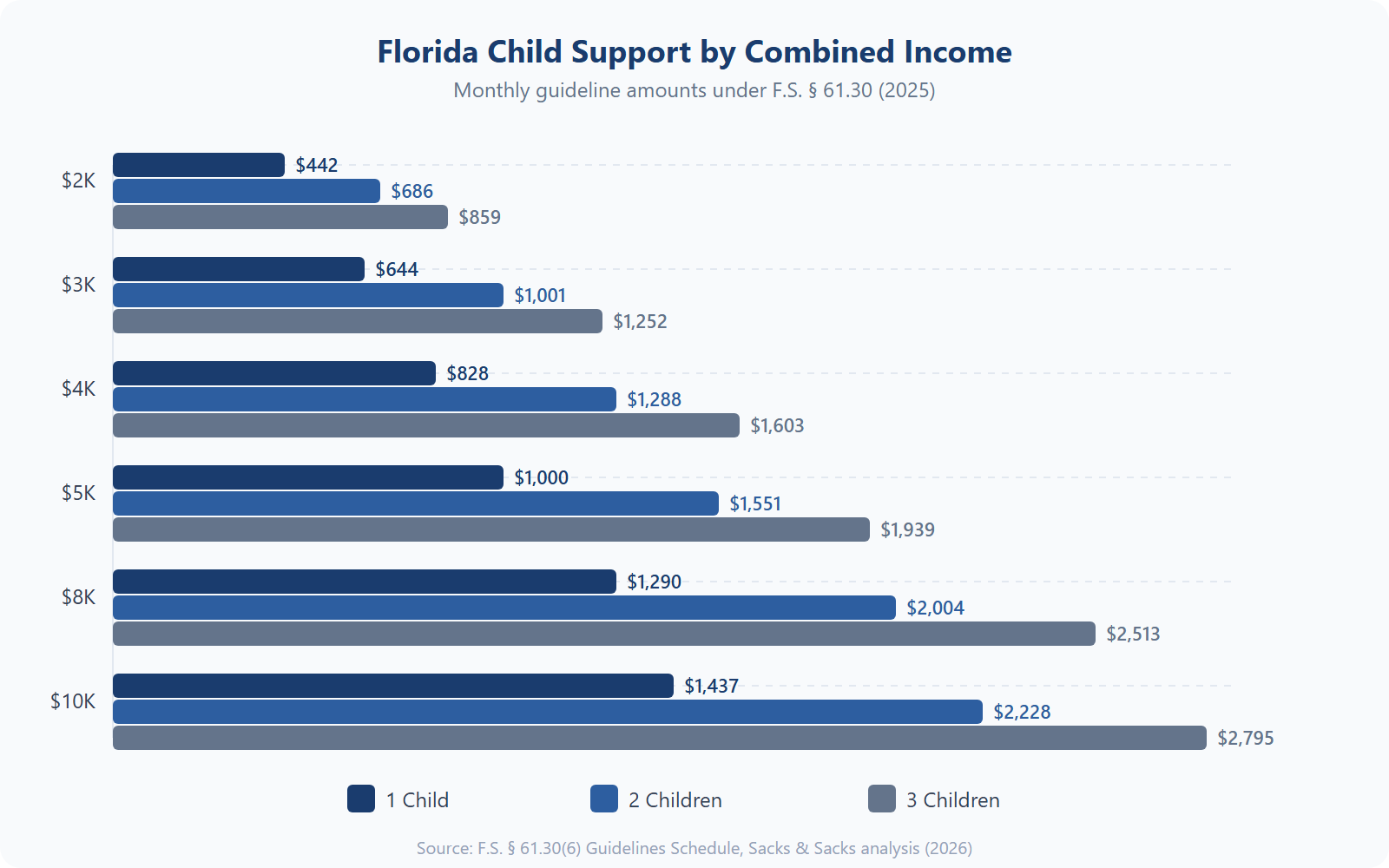
Florida’s statutory guidelines chart under F.S. § 61.30(6) sets presumptive support amounts based on combined net income and number of children. These amounts represent the total obligation. Each parent pays their proportional share.
Here are key amounts from the 2025 guidelines schedule:
| Combined Net Income | 1 Child | 2 Children | 3 Children |
|---|---|---|---|
| $2,000/mo | $442 | $686 | $859 |
| $3,000/mo | $644 | $1,001 | $1,252 |
| $4,000/mo | $828 | $1,288 | $1,603 |
| $5,000/mo | $1,000 | $1,551 | $1,939 |
| $6,000/mo | $1,121 | $1,737 | $2,175 |
| $8,000/mo | $1,290 | $2,004 | $2,513 |
| $10,000/mo | $1,437 | $2,228 | $2,795 |
For combined incomes above $10,000/month, Florida uses a percentage-based formula: 5% per child for one child, 7.5% for two, 9.5% for three, 11% for four, 12% for five, and 12.5% for six children (F.S. § 61.30(6)).
Courts can deviate up to 5% from guideline amounts without written justification. Larger deviations require specific findings on the record.
Florida’s child support formula adjusts when either parent has the child for at least 73 overnights per year (20% of the year) under F.S. § 61.30(11). This threshold recognizes that both parents incur direct costs (food, utilities, supplies) when maintaining a second household for the child.
When the 73-overnight threshold is met, the calculation changes:
Courts count only overnights, not daytime hours. Where the child sleeps is what matters for calculation purposes. A parent who spends every day with the child but returns them each evening has zero overnights.

No. This is the most common misconception in Florida family law. Even with a perfectly equal 50/50 time-sharing schedule, child support usually still applies when parents have different income levels (F.S. § 61.30).
Florida’s system aims to equalize the child’s standard of living across both households. If one parent earns $6,000/month and the other earns $3,000/month, the higher-earning parent still pays support, even with equal overnights, so the child doesn’t experience drastically different living standards.
The only scenario where 50/50 eliminates support payments requires three conditions to align simultaneously:
In practice, this combination is extraordinarily rare. Most 50/50 arrangements still result in a transfer payment from the higher-earning parent to the lower-earning parent.
Florida child support covers a child’s basic needs as outlined in F.S. § 61.30: housing, food, clothing, education, and transportation. The guidelines amount is a floor, not a ceiling. Courts can order additional support for specific expenses.
Beyond the base obligation, support calculations include:
Child support is not taxable income for the receiving parent and not tax-deductible for the paying parent. This tax-neutral status has applied to all child support since the Tax Cuts and Jobs Act of 2017 (IRS Topic 452).

Child support in Florida typically ends when the child turns 18 or graduates from high school, whichever comes later, but no later than age 19 (F.S. § 743.07). The Florida Department of Revenue recommends contacting them six months before the child turns 18 if the child is still in high school (FL DOR).
Specific rules:
Support may also end early if the child marries, joins the military, or is legally emancipated. For families with multiple children, the support order typically reduces (but doesn’t end) as each child ages out.
Either parent can petition to modify child support in Duval County when there is a “substantial change in circumstances” under F.S. § 61.30(1)(a). The legal threshold is clear: the change must result in at least a 15% or $50 difference (whichever is greater) from the current support amount.
Common grounds for modification include:
The Florida Department of Revenue also reviews child support orders every three years upon request to determine if modification is appropriate. Either parent can request this review through the FL DOR Child Support Program.
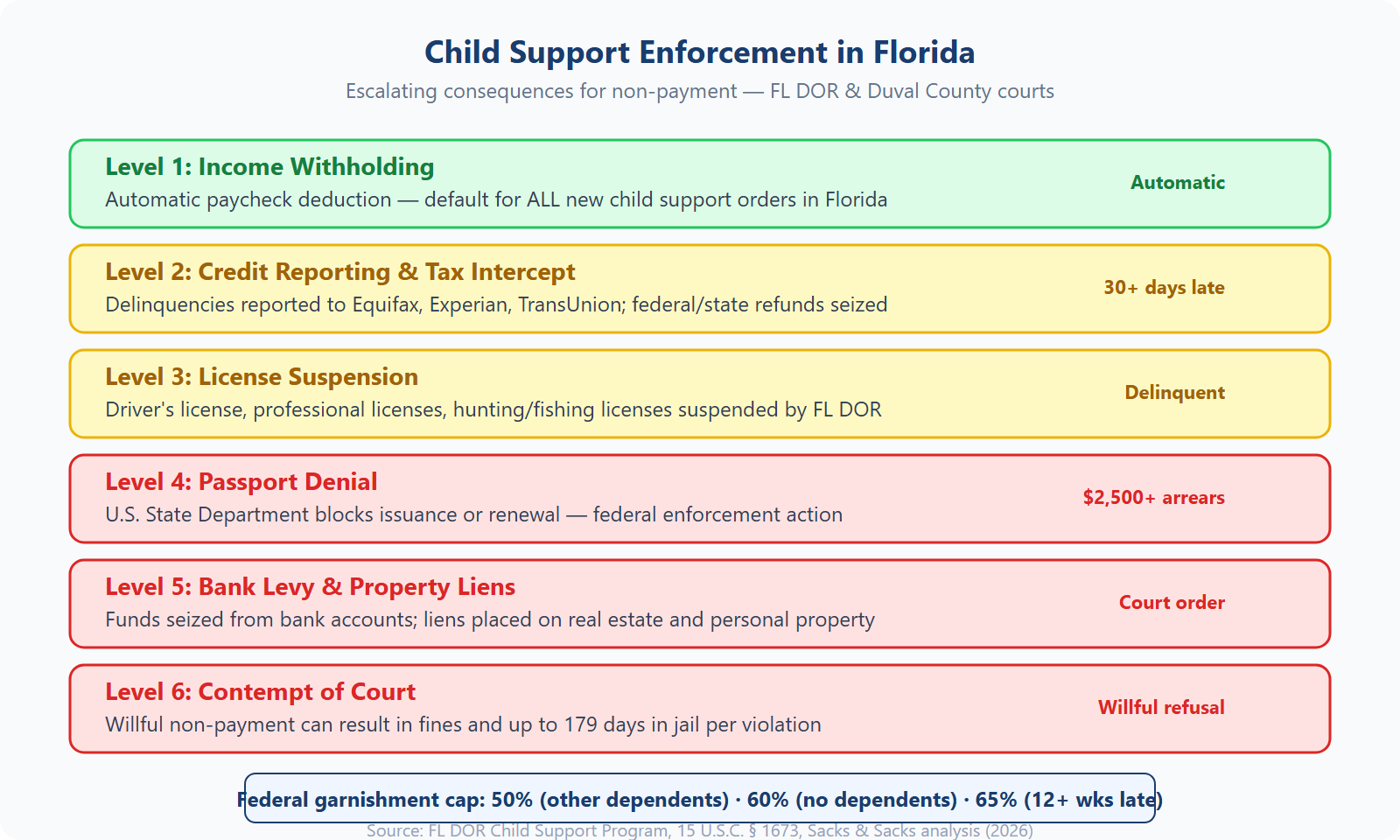
Florida provides aggressive enforcement tools when a parent falls behind on child support. The Florida Department of Revenue, which manages over 1 million child support cases and disburses more than $1 billion annually, can pursue enforcement without the custodial parent hiring an attorney (FL DOR).
Enforcement actions include:
Federal garnishment limits cap withholding at 50% of disposable income if the parent supports another family, 60% if they don’t, and 65% if payments are 12+ weeks overdue.

Questions about child support in Jacksonville? Call (904) 396-5557 to speak with Sacks & Sacks about your case.
Florida uses the Income Shares Model under [1] F.S. § 61.30, which combines both parents’ net monthly income and matches it to a statutory guidelines chart. At $5,000 combined monthly income, the base obligation is $1,000 for one child and $1,551 for two children.
Each parent pays their proportional share based on income percentage, with adjustments for health insurance, childcare, and time-sharing.
No. Even with equal 50/50 time-sharing, child support applies when parents have different incomes [1]. Florida’s formula adjusts for shared overnights but still requires the higher-earning parent to pay so the child maintains a consistent standard of living in both homes.
Support only reaches zero when incomes are nearly identical and all expenses are split equally.
When either parent has the child for at least 73 overnights per year (20% of the year), the support calculation triggers a time-sharing adjustment under F.S. § 61.30(11) [1].
The base obligation is multiplied by 1.5, and each parent’s share is adjusted based on their actual overnight percentage. This reduces the transfer payment to account for both parents directly housing the child.
Yes. Either parent can petition for modification when a substantial change in circumstances would alter the support amount by at least 15% or $50 per month, whichever is greater [1].
Common triggers include job loss, significant income changes, changes in overnight schedules, or new medical needs. The FL Department of Revenue also reviews orders every three years upon request [2].
Florida enforces child support through income withholding, contempt of court (including jail), driver’s and professional license suspension, passport denial for arrears over $2,500, tax refund interception, bank levies, and credit reporting [2].
Federal law caps garnishment at 50–65% of disposable income. The FL Department of Revenue manages enforcement for over 1 million cases statewide.
Sources:
[1] Florida Legislature, F.S. § 61.30: Child Support Guidelines. flsenate.gov
[2] Florida Department of Revenue, Child Support Program. floridarevenue.com
[3] IRS, Topic No. 452: Alimony and Separate Maintenance. irs.gov
[4] National Conference of State Legislatures, Child Support Guideline Models. ncsl.org
[5] Florida Legislature, F.S. § 743.07: Removal of Disabilities of Nonage. flsenate.gov
[6] Florida Legislature, Ch. 2023-301: Family Law Reform (50/50 Presumption). flrules.org
 ✓
✓Reviewed by
Family Law Attorney & Partner, Sacks & Sacks