TL;DR: Florida is an
equitable distribution state — not equal, but
fair — governed by
10 statutory factors under
F.S. § 61.075 [1]. The biggest asset protection mistakes happen
before filing: commingling separate property, hiding assets (which can result in
forfeiture and perjury charges), and failing to document pre-marital ownership. With the median Florida home value at
$404,100 (
Zillow, Feb 2026)
[2], the stakes in property division have never been higher.
Going through a divorce in Jacksonville? Call (904) 396-5557 for a free consultation on protecting your assets under Florida law.
What Is Equitable Distribution in Florida?
Florida follows the equitable distribution model for dividing marital property in divorce, codified in F.S. § 61.075 [1]. “Equitable” does not mean 50/50 — it means the court divides assets and debts in a way that is fair to both parties based on the specific circumstances of the marriage.
The court’s process follows three steps:
- Identify and categorize all assets and debts as marital or non-marital
- Value each marital asset and debt
- Distribute equitably using the 10 statutory factors
The starting presumption is equal distribution — the court begins with a 50/50 split and adjusts only if one party demonstrates that an unequal division is justified [1]. This means protecting your assets requires understanding what’s subject to division and what isn’t.
What’s the Difference Between Marital and Non-Marital Property?
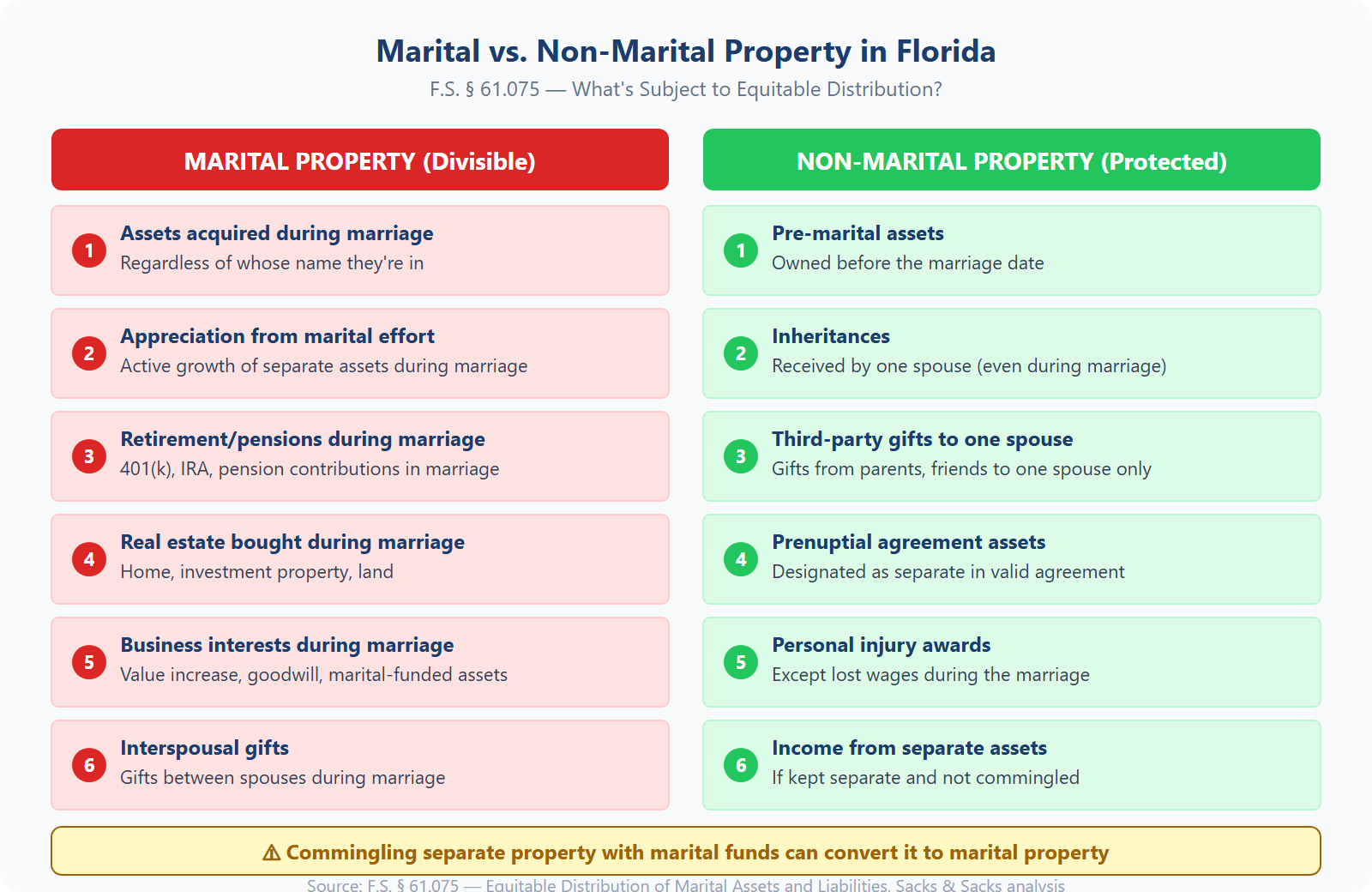
The most important distinction in Florida asset division is between marital and non-marital property. Only marital property is subject to equitable distribution [1].
Marital property includes:
- All assets and debts acquired by either spouse during the marriage (regardless of whose name they’re in)
- Appreciation in value of non-marital assets caused by marital effort or funds
- Retirement benefits, pensions, and 401(k)s earned during the marriage
- Real estate purchased during the marriage
- Business interests developed during the marriage
- Gifts between spouses during the marriage
Non-marital (separate) property includes:
- Assets owned by either spouse before the marriage
- Inheritances received by one spouse (even during the marriage)
- Gifts from third parties to one spouse only
- Income from non-marital assets (if kept separate)
- Assets designated as separate in a prenuptial or postnuptial agreement
- Personal injury awards (except for lost wages during the marriage)
What Are the 10 Factors Courts Use to Divide Assets?
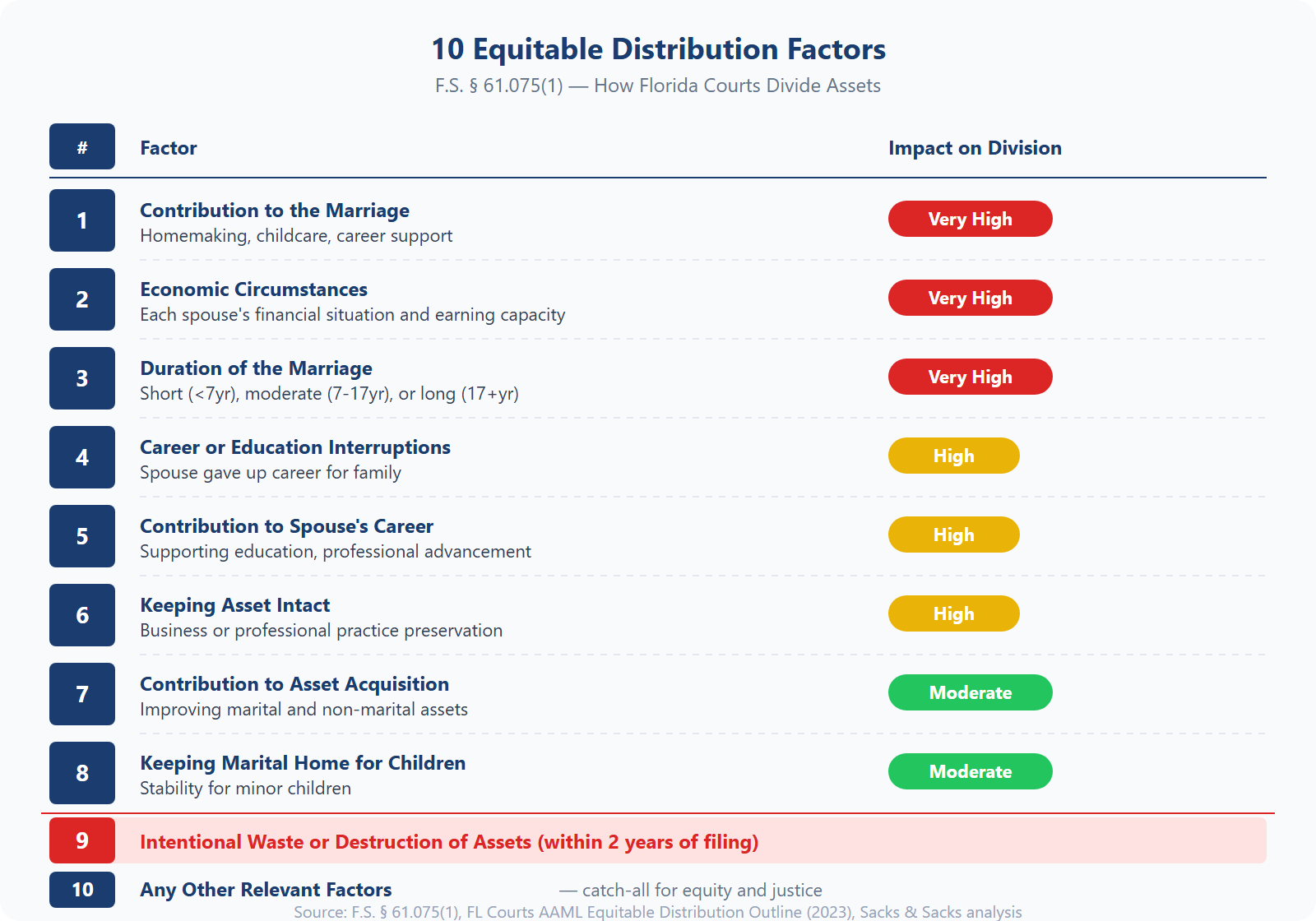
Under F.S. § 61.075(1), the court considers 10 specific factors when determining equitable distribution [1]:
- Contribution to the marriage — including homemaking, childcare, and career-building for the other spouse
- Economic circumstances of each spouse
- Duration of the marriage
- Career or education interruptions by either spouse
- Contribution to the other spouse’s career or education
- Desirability of keeping an asset intact (e.g., a business or professional practice)
- Contribution to acquiring or improving marital and non-marital assets
- Desirability of keeping the marital home for minor children
- Intentional waste or destruction of marital assets within 2 years of filing or after filing
- Any other relevant factors necessary for equity and justice
Factor #9 — asset dissipation — is particularly important for asset protection. If your spouse spent marital funds on extramarital affairs, gambling, or reckless investments, the court can credit you for those wasted amounts in the distribution.
How to Protect Assets Before Filing for Divorce
The most effective asset protection happens before you file for divorce. Once the petition is filed, Florida’s automatic temporary injunction (F.S. § 61.071) prevents both parties from selling, concealing, or disposing of marital assets [1].
Before you file, take these steps:
- Document everything. Gather bank statements, tax returns, retirement account statements, property deeds, vehicle titles, and business records. Make copies and store them securely outside the home.
- Inventory all assets and debts. Create a comprehensive list of every asset (real estate, vehicles, investments, retirement accounts, valuables) and every debt (mortgages, credit cards, loans).
- Preserve your separate property trail. If you brought assets into the marriage, have documentation proving ownership before the marriage date. Bank statements, purchase records, and appraisals from that time are critical.
- Stop commingling. If you haven’t already, stop depositing non-marital funds (inheritances, gifts, pre-marital savings) into joint accounts. Once separate property is mixed with marital property, it becomes extremely difficult to “untrace.”
- Monitor joint accounts. Check for unusual withdrawals, transfers, or spending that could indicate your spouse is hiding or wasting assets.
- Freeze joint credit. Contact credit card companies to prevent new charges on joint accounts. You can request a freeze without your spouse’s consent on accounts in both names.
- Get professional valuations. For real estate, businesses, or valuable collections, get appraisals from qualified professionals. In Jacksonville, the median home value is $288,500 (Zillow) [2] — accurate valuation is essential.
Do Prenuptial and Postnuptial Agreements Work in Florida?
Yes — when properly executed. Florida’s Uniform Premarital Agreement Act (F.S. § 61.079) governs prenuptial agreements, and F.S. § 61.079 also covers postnuptial agreements [1].
For a prenuptial or postnuptial agreement to be enforceable in Florida, it must:
- Be in writing and signed by both parties
- Be executed voluntarily (no coercion or duress)
- Include full financial disclosure by both parties
- Not be unconscionable at the time of enforcement
A prenuptial agreement is the single most effective asset protection tool for people entering a marriage with significant assets, business interests, or expected inheritances. Without one, those assets may become subject to equitable distribution if they appreciate during the marriage or are commingled with marital funds.
What Happens to the Marital Home in a Florida Divorce?
The marital home is often the largest asset in a Florida divorce. The court has several options:
- Award the home to one spouse (with an offset of equity to the other)
- Order the home sold and proceeds divided
- Allow one spouse to remain temporarily (common when minor children are involved — Factor #8 under F.S. § 61.075)
If you want to keep the home, you’ll need to:
- Refinance the mortgage in your name only (removing your spouse from the note)
- Buy out your spouse’s equity share
- Demonstrate you can afford the ongoing costs (mortgage, taxes, insurance, maintenance)
Florida’s homestead exemption protects the marital home from forced sale by creditors, but it does not protect it from equitable distribution in divorce [1].
How Are Retirement Accounts and Pensions Divided?
Retirement accounts earned during the marriage are marital property subject to equitable distribution, even if only one spouse contributed. This includes:
- 401(k) and 403(b) accounts
- IRA accounts (Traditional and Roth)
- Pension plans (state, federal, military, and private)
- Deferred compensation
- Stock options and RSUs
To divide a qualified retirement plan (401(k), pension), the court issues a Qualified Domestic Relations Order (QDRO). A QDRO allows the retirement plan to pay a portion directly to the non-employee spouse without triggering early withdrawal penalties or taxes.
Only the marital portion (contributions and growth during the marriage) is divisible. Pre-marital balances and post-separation contributions remain separate property [1].
What About Business Ownership in Divorce?
If you or your spouse own a business, the marital portion of that business is subject to equitable distribution. This includes:
- Increase in value during the marriage (even for a pre-marital business)
- Business assets purchased with marital funds
- Goodwill (both personal and enterprise goodwill)
Business valuation typically requires a forensic accountant or business appraiser. Common valuation methods include the income approach, market approach, and asset-based approach.
Factor #6 under F.S. § 61.075 — the desirability of keeping an asset intact — often allows the business-owning spouse to retain the business while compensating the other spouse with other assets of equivalent value [1].
7 Common Asset Protection Mistakes in Florida Divorce
- Hiding assets. Florida requires full financial disclosure via mandatory financial affidavits (F.S. § 61.052). Hiding assets can result in the court awarding the hidden asset entirely to your spouse, plus sanctions, attorney fee awards, and potential perjury charges [1].
- Commingling separate property. Depositing an inheritance into a joint checking account, using marital funds to pay the mortgage on pre-marital property, or adding your spouse to a pre-marital asset’s title can convert separate property into marital property.
- Emptying joint accounts. After filing, the automatic temporary injunction (F.S. § 61.071) prohibits both parties from disposing of marital assets. Draining accounts can result in contempt of court.
- Dissipating marital assets. Spending marital funds on extramarital relationships, gambling, or reckless investments within 2 years of filing (or after filing) can cause the court to credit the other spouse for those amounts.
- Ignoring debt. Marital debts are divided alongside assets. Ignoring joint debts can destroy your credit — creditors aren’t bound by divorce decrees.
- Failing to update beneficiary designations. Life insurance, retirement accounts, and bank accounts with payable-on-death designations often bypass the divorce decree. Update these immediately after the divorce is final.
- Undervaluing assets. Failing to get professional appraisals for real estate, businesses, and retirement accounts can cost you tens of thousands in lost equity.
Do Asset Protection Trusts Work in Florida Divorce?
A Domestic Asset Protection Trust (DAPT) can protect assets from creditors, but Florida does not have a DAPT statute. Residents must establish DAPTs in states that allow them (Nevada, South Dakota, Delaware, etc.).
Important limitations in divorce:
- The court can invalidate a trust created in anticipation of divorce
- Transfers made with intent to defraud a spouse may be treated as fraudulent transfers
- Trusts work best when established well before any marriage issues arise
- A properly drafted prenuptial agreement is generally more effective and less expensive than a DAPT for asset protection in divorce
Need to protect your assets in a Jacksonville divorce? Call (904) 396-5557 for a free consultation. We’ll review your situation and develop a strategy to protect what’s yours.
Frequently Asked Questions
Is Florida a 50/50 divorce state for property?
Not exactly. Florida follows equitable distribution, which starts with a presumption of equal (50/50) division but allows the court to adjust based on 10 factors under F.S. § 61.075. Factors include marriage length, each spouse’s economic circumstances, contributions to the marriage, and whether either spouse wasted marital assets. The final split can be 60/40, 70/30, or any other ratio the court finds equitable.
Can my spouse take my inheritance in a Florida divorce?
Generally no — inheritances received by one spouse are classified as non-marital property under F.S. § 61.075(7)(b). However, if you commingled the inheritance with marital funds (deposited it in a joint account, used it to pay joint debts, or added your spouse’s name to the account), all or part of it may become marital property subject to division.
What happens if my spouse hides assets during divorce?
Florida law requires full financial disclosure through mandatory financial affidavits. If a spouse hides assets and is caught (through discovery, forensic accounting, or subpoenas), the court can award the hidden asset entirely to the other spouse, impose sanctions, order attorney fees paid, and in extreme cases, refer the matter for perjury prosecution. The court may also draw negative inferences about the hiding spouse’s credibility on other issues.
Do I need a QDRO to divide retirement accounts?
Yes, for employer-sponsored plans like 401(k)s, pensions, and 403(b) plans. A Qualified Domestic Relations Order (QDRO) is a separate court order that directs the retirement plan to pay a portion to the non-employee spouse. Without a QDRO, the plan administrator won’t divide the account. IRAs don’t require a QDRO — they can be divided by a transfer incident to divorce (Form 1099-R, rollover).
Can I protect my business from divorce in Florida?
The most effective protection is a prenuptial agreement that designates the business as separate property. Without one, the marital portion of the business (increase in value during the marriage, plus any marital funds invested) is subject to equitable distribution. Under Factor #6 of F.S. § 61.075, courts often allow the business-owning spouse to keep the business while compensating the other spouse with other marital assets.
Sources:
[1] Florida Legislature, F.S. § 61.075 — Equitable Distribution of Marital Assets and Liabilities (2025). leg.state.fl.us
[2] Zillow, Florida Home Values (February 2026). zillow.com
[3] Florida Legislature, F.S. § 61.079 — Premarital Agreements (Uniform Premarital Agreement Act). leg.state.fl.us
[4] Florida Legislature, F.S. § 61.052 — Dissolution of Marriage, § 61.071 — Alimony and Temporary Injunction. leg.state.fl.us
[5] Florida Courts, Equitable Distribution Outline (AAML 2023). flcourts.gov
Related Posts


 ✓
✓