
Since 1990, divorce among adults 50 and older has roughly doubled, and the rise tracks the same years more women move through menopause. Behind many of these splits sits a health change almost no one names in a courtroom. The hot flashes and mood swings rarely end a marriage on their own, but they can pull the cover off cracks that were already there.
Menopause reshapes far more than sleep and body temperature. For many women it lands at the same moment as career shifts, aging parents, and an empty nest. That pile-up can test even a long marriage. Some couples grow closer through it. Others reach a breaking point and decide to start over.
This guide looks at how menopause and midlife pressures feed the rise in “gray divorce.” It covers what the research shows, and how Florida’s 2023 divorce laws change the picture for anyone over 50.
The menopausal transition usually begins between ages 45 and 55. Menopause itself is confirmed once a woman has gone a full year without a period (National Institute on Aging).[1] The shift is driven by two hormones, estrogen and progesterone, that fall sharply during this stage.
That drop shows up in the body first. Hot flashes, night sweats, fatigue, and joint pain are common, and they can wreck sleep for months at a time.
The same hormones also reach the brain. As estrogen falls, so do neurotransmitters like serotonin and dopamine that help steady mood. The result can be heightened anxiety, irritability, or sadness that has nothing to do with a woman’s partner but still spills into the marriage.

The mental-health load is real and measurable. Perimenopausal women face about 40% higher odds of depression than women who have not started the transition (OR 1.40; Badawy et al., 2024).[2] Johns Hopkins Medicine explains why: as estrogen and progesterone fall, serotonin function drops with them, which can feed irritability, anxiety, and sadness.[3]
Physical symptoms add friction too. Hot flashes, joint pain, and vaginal dryness can make intimacy uncomfortable, and libido often drops. When couples don’t talk about it, distance grows fast.
Many women feel isolated in this stretch. Their partner may not grasp how intense the symptoms are, so support that should be automatic never shows up. Partners, in turn, can feel shut out or unwanted. Is it any wonder some marriages buckle?
Couples who come through it tend to share two habits: honest communication and a willingness to meet each other’s needs. Therapy helps here. It gives both people room to say what they’re feeling and to hear the other side without a fight.

Menopause often forces a reckoning with identity, not just biology. Society pushes women to look young and energetic, and when that image slips, it can chip away at confidence. Many women feel quietly ashamed of a process that is completely natural.
There’s another side to it, though. After years spent centered on family and careers, midlife can open space for self-discovery. Women set new goals, pick up old interests, and build new friendships.
That new independence is healthy. It can also clash with a marriage built on an older routine. For some women, menopause becomes the moment they ask a hard question: does this relationship still fit the life I want next?
“Gray divorce” means divorce among adults age 50 and older, and it has climbed steadily for a generation. The rate roughly doubled between 1990 and 2010, from 4.87 to 10.05 divorces per 1,000 married adults 50+ (Brown & Lin, 2022).[4]
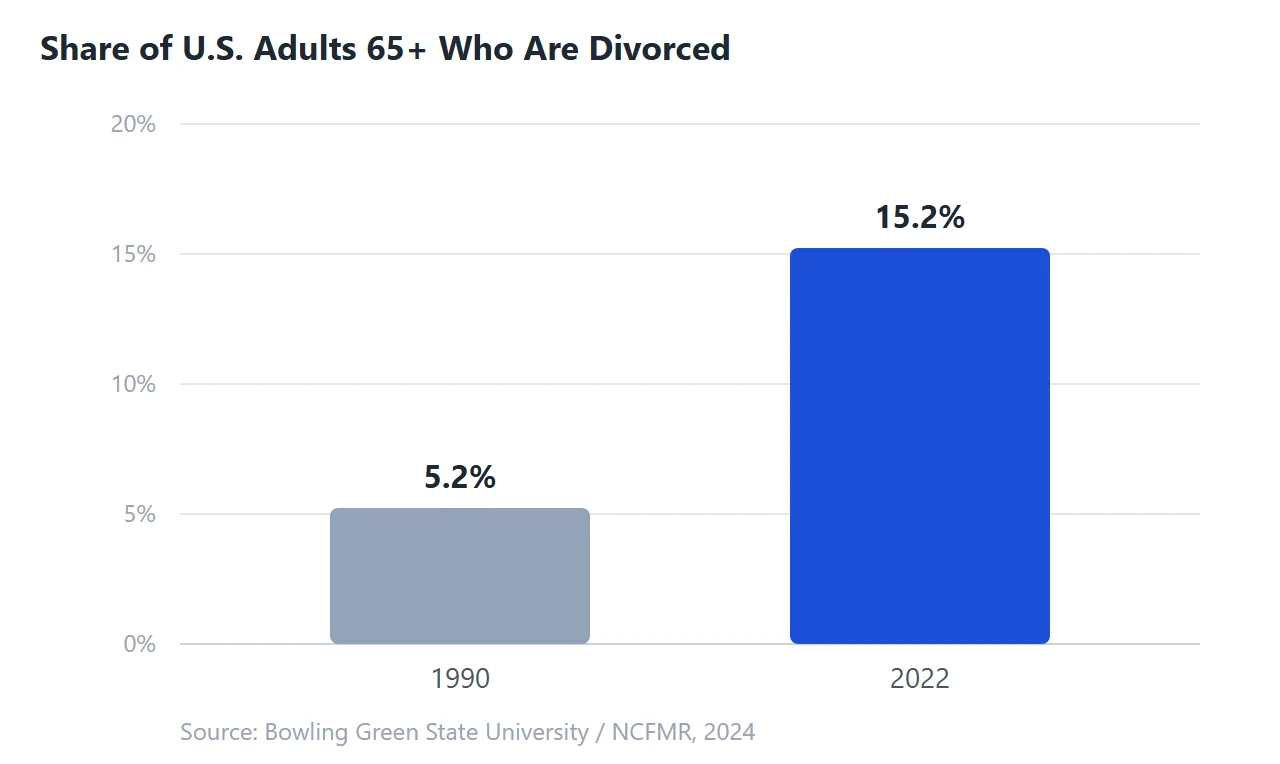
The newer numbers are starker. Among adults 65 and older, the share who are divorced rose from 5.2% in 1990 to 15.2% in 2022 (Bowling Green State University, 2024).[5] By the APA’s count, about 1 in 10 people getting divorced today is 65 or older.[6]
What drives the trend? Hormonal change is only one thread. Longer lifespans, financial independence, and less stigma around divorce all play a part. Menopause can be the catalyst that makes a woman act on doubts she has carried for years, especially if she feels unsupported at home.
A gray divorce also lands harder on the wallet than one at 30. Splitting one household into two shrinks the savings each person keeps, and there are fewer working years left to rebuild. Retirement accounts, a paid-off home, and Social Security timing all come into play at once.
For many couples over 50, the money questions end up tougher than the emotional ones. That is why sound legal and financial advice early on makes a real difference.
“In our Jacksonville family-law practice, the hardest part of a divorce after 50 is rarely who did what. It comes down to dividing retirement accounts, the house, and Social Security timing. The couples who come out steadiest sort the money out early, often before either spouse files.”

Two Florida laws that took effect July 1, 2023 reshaped later-life divorce. CS/CS/SB 1416 (Chapter 2023-315, Laws of Florida) ended permanent alimony statewide.[7] A separate law, CS/HB 1301 (Chapter 2023-301), created a rebuttable presumption that equal, 50/50 time-sharing serves a child’s best interest.[8]
The alimony change matters most for people over 50. Courts can no longer award lifetime alimony. Instead they use bridge-the-gap, rehabilitative, or durational support, and durational awards are capped based on how long the marriage lasted.
For a spouse who left the workforce decades ago, that’s a major shift. Planning around retirement accounts, pensions, and Social Security now carries even more weight in a gray divorce. Our Florida spousal support and alimony page walks through the current award types.
The time-sharing presumption affects a smaller slice of this group, since many couples over 50 have grown children. It still matters for later-in-life parents and for grandparents raising kids. You can read more on our child custody and time-sharing page.
A gray divorce usually unwinds decades of shared money, not just a shared address. That makes preparation the single biggest factor in how the process goes. A few steps matter more than the rest.
List every account, property, retirement plan, and debt in both names. Pensions and 401(k)s are often the largest marital assets in a late-life divorce, and dividing them correctly takes specific paperwork.
Joint cards and loans can turn one spouse’s spending into both spouses’ problem. Review our guide on protecting your credit during separation before you make any big moves.
Because permanent alimony is gone, the type and length of support you can expect changed in 2023. Our overview of how alimony is defined in a Florida divorce explains the current categories.
Mediation often costs less than a courtroom fight and keeps decisions in your hands. For couples with substantial assets, it can also protect privacy. Learn what to expect from Florida divorce mediation.
Divorce after menopause is hard, but it can also be a fresh start. Women who do well through it tend to lean on the same tools: a strong support network, honest counseling, and clear financial footing.
Set concrete goals for the first year. Rebuild your own credit and savings. Reconnect with friends and interests that a long marriage may have crowded out. The point isn’t to erase the past. It’s to build a next chapter that actually fits who you are now.
Ending a marriage at this stage should be a deliberate choice, not a reaction to a rough few months. If you and your spouse have decided to part ways, our Jacksonville divorce attorneys can walk you through your options under current Florida law.
Thinking about a divorce over 50? The Law Offices of Sacks & Sacks, P.A. has guided Jacksonville families through divorce and family law for years. We’ll help you weigh your options with a clear head.
Menopause triggers a sharp drop in estrogen and progesterone that can raise anxiety, low mood, and conflict. When those changes collide with midlife stress, some couples grow apart. Perimenopausal women face about 40% higher odds of depression than premenopausal women (Badawy et al., 2024).
Gray divorce is divorce among adults age 50 and older. The rate roughly doubled between 1990 and 2010 (Brown & Lin, 2022). Among adults 65 and older, the share who are divorced climbed from 5.2% in 1990 to 15.2% in 2022 (BGSU, 2024).
Yes. Effective July 1, 2023, CS/CS/SB 1416 (Chapter 2023-315, Laws of Florida) removed permanent alimony as an option. Courts now award bridge-the-gap, rehabilitative, or durational alimony instead. A separate law, CS/HB 1301 (Chapter 2023-301), created a rebuttable presumption of equal time-sharing for minor children.
Falling estrogen and progesterone pull down serotonin, which helps steady mood, so many women feel more irritability, nervousness, and anxiety (Johns Hopkins Medicine). A history of depression makes a new episode near menopause more likely, and perimenopausal women face about 40% higher odds of depression (Badawy et al., 2024).
Mediation is often worth trying first, especially after a long marriage with shared retirement accounts, a home, and decades of assets. It tends to cost less than litigation and keeps decisions in your hands. A Florida family law attorney can tell you whether your situation is a good fit.
 ✓
✓Reviewed by
Family Law Attorney & Partner, Sacks & Sacks